

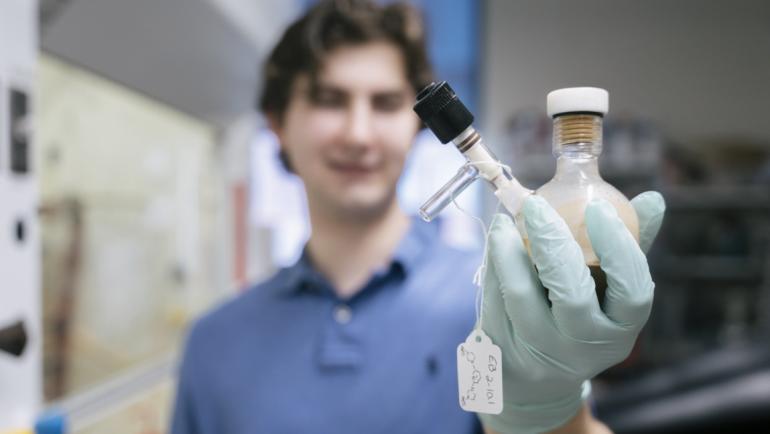
Evan Beretta (above) holds out a sample of an organic ligand for iron. Once fully synthesized, this iron compound will be tested as a catalyst to facilitate phosphinidene transfer. This test is one of many Beretta has done in support of Professor Rory Waterman’s lab research to find the optimal catalyst that will conduct these reactions that use phosphorus efficiently as possible. The success of this research has the potential for far reaching impacts when applied to a mass production scale by reducing economic and environmental impacts. (Photo: Bailey Beltramo)
Vermont Business Magazine A new initiative by a private foundation will allow a University of Vermont Chemistry student to work with his faculty mentor on a phosphorus research project for a year after graduation.
Rory Waterman, professor of Chemistry and associate dean in UVM’s College of Arts and Sciences, is one of nine scholars in the country to receive a Cottrell Postbac Award from the Research Corporation for Science Advancement (RCSA).
The $50,000 award will make it possible for undergraduate senior student Evan Beretta ‘22 to participate in a one-year post-baccalaureate fellowship to perform research in close collaboration with Waterman.
“This experience will give strong undergraduate researchers more time and experience to see themselves as scientists,” said RCSA President & CEO Daniel Linzer. “Whether they go on to graduate school or find jobs in STEM-related fields, they will be able to strengthen their research portfolios, contribute to projects, and help train the next undergraduates in their research groups.”
Beretta will focus his research on new ways to investigate the unique reactions of phosphorus compounds in a low state of oxidation. Such new reactions may provide more efficient ways to use phosphorus, a finite resource, in applications from medicine to consumer goods.
“This award not only allows me to continue working on research I’m passionate about, but with full focus too,” said Beretta. “I plan to move forward with my education and career experience in research, and through this opportunity, I will be more than well prepared to do so. I have nothing but gratitude for Dr. Rory Waterman, the University of Vermont, and Research Corporation for providing me the means to achieve this accomplishment, and many more to come!”
The work will involve an international component, since next year Waterman will be at Kyoto University working with Professor Norihiro Tokitoh, an internationally renowned expert in low oxidation state chemistry, primarily with elements like silicon.
“My aim there is to garner some of Professor Tokitoh’s expertise to help with our long-term efforts in phosphorus chemistry,” said Waterman. “The challenge for us is that these low oxidation state phosphorus fragments, so called phosphinidenes, have an electronic configuration that doesn’t do the chemistry we want. From this side of the Pacific, Evan will be pushing on one aspect of the problem, which generally involves “cheating” by enlisting the help of transition metals, and I will be pushing from the other side of the Pacific by trying to make phosphorus behave like silicon.”
“Evan has tremendous potential as a researcher and in chemistry,” Waterman added. “It is exciting to think about Evan having the dedicated time to make progress on this project related to phosphorus and its unique chemistry.”
RCSA Senior Program Director Silvia Ronco, said: “These outstanding undergraduate mentors are developing a diverse new generation of scientists. As their labs emerge from the pandemic and all its disruptions, we hope this support will offer some continuity and help strengthen their important contributions to the larger scientific enterprise.”
About Research Corporation for Science Advancement
Founded in 1912, RCSA is a private foundation that funds early stage, high-potential basic research in the physical sciences (astronomy, chemistry, physics, and related fields) at colleges and universities in the United States and Canada.
About the University of Vermont
Since 1791, the University of Vermont has worked to move humankind forward. UVM’s strengths align with the most pressing needs of our time: the health of our societies and the health of our environment. Our size—large enough to offer a breadth of ideas, resources, and opportunities, yet intimate enough to enable close faculty-student mentorship across all levels of study—allows us to pursue these interconnected issues through cross-disciplinary research and collaboration. Providing an unparalleled educational experience for our students, and ensuring their success, are at the core of what we do. As one of the nation’s first land grant universities, UVM advances Vermont and the broader society through the discovery and application of new knowledge.
UVM is derived from the Latin Universitas Viridis Montis (in English, University of the Green Mountains).
