


CHT CEO Michael Monte, CHT Board Member Antoinette Bennett-Jones and NEFCU CEO John Dwyer. NEFCU photo.
Vermont Business Magazine New England Federal Credit Union (NEFCU) announced today the launch of a three-year, $6 million campaign to address the affordable housing crisis in Vermont.
“The housing shortage in Vermont, already a crisis, has been made even worse by recent events,” noted NEFCU President and CEO John J. Dwyer, Jr. “Major, immediate action is needed. In line with our ongoing mission of community support, we are beginning a comprehensive campaign that will provide multiple solutions to this complex challenge.”
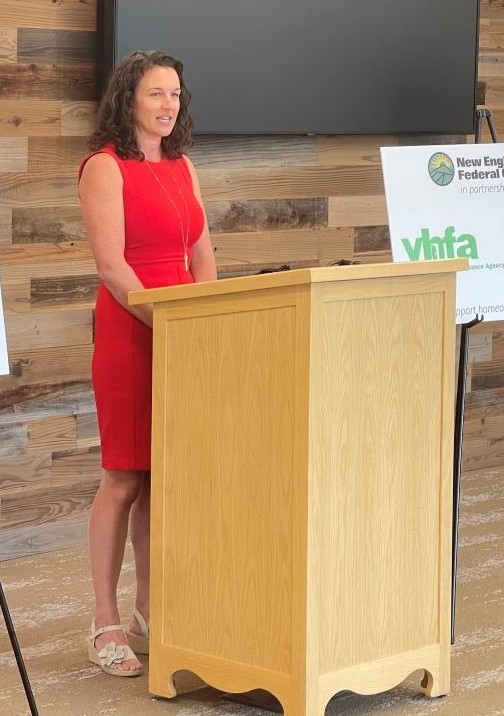 VHFA Executive Director Maura Collins. VBM Photo
The NEFCU initiative will include three separate programs. One, in partnership with the Vermont Housing Finance Agency (VHFA), will devote $3 million to affordable homeownership and multi-family rental projects.
The second, with Champlain Housing Trust (CHT), will commit $3 million to advance BIPOC homeownership. The third will be NEFCU’s own Home Ownership Made Easier (HOME) program to help first-time homebuyers struggling with affordability.
"NEFCU’s cornerstone investment will be matched by public resources to support the development of hundreds of affordable homes statewide,” noted VHFA’s Executive Director, Maura Collins. “As Vermont continues its economic recovery, it is inspiring to see the leadership role NEFCU is playing to ensure we build more vibrant and affordable communities.”
“Vermont’s affordable housing crisis impacts historically disadvantaged populations even more grievously,” said CHT’s Chief Executive Officer, Michael Monte. “NEFCU’s contribution will support Vermont’s most significant effort to date targeting the BIPOC community.”
SEE FULL COMMENTS BY COLLINS AND MONTE AND DWYER BELOW.
New England Federal Credit Union (NEFCU), headquartered in Williston, Vermont is a member-owned financial institution serving communities in twelve counties of Vermont: Addison, Bennington, Caledonia, Chittenden, Franklin, Grand Isle, Lamoille, Orange, Rutland, Washington, Windham, and Windsor; and four counties in New Hampshire: Cheshire, Grafton, Merrimack, and Sullivan.
Maura Collins’s remarks
- Thank you to all NEFCU members, leadership and board for this incredible $3 million contribution to VHFA’s Housing Investment fund.
- This donation will help move Vermont forward and advance the priorities shared by both NEFCU and VHFA. With this money we plan to launch a pilot program to build affordable single-family homes for moderate income families. We hope this will further NEFCU and VHFA’s shared goal of expanding homeownership opportunities for communities who have been historically underserved, especially Black and Brown households.
- The investment will also support permanent homes for Vermonters at risk of or experiencing homelessness, paired with supportive services to help them succeed.
- It will provide key financing for economically integrated rental housing across the state in transit-friendly areas. Building homes in Vermont’s downtowns near schools, jobs and other economic opportunities will help our cities and towns stay strong and vibrant.
- By pairing these private funds with VHFA’s public resources, NEFCU’s impact will extend far. The funds provided by NEFCU will be used to fill critical project gaps in housing developments, providing the “but for” funding needed to make key affordable housing developments a reality. On average each dollar of this investment will be paired with 25 state, federal and private dollars, helping more Vermonters than any of us could do alone.
- And never has the time been more critical.
- Right now Vermont stands at a crossroads. The post-war, post-interstate building boom of the 1950s through 1970s saw tremendous investment in our state’s housing. That slowed down but even in the 1980s Vermont was adding roughly 3,200 year-round homes each year, but since 2010 that’s dropped off to only about 400 per year.
- The pandemic has only worsened this shortage.
- But what has been laid bare is that the impacts of this have not affected all of us equally.
- A lack of affordable homes deepens the existing wealth and opportunity gaps in our cities and towns. Just 24% of Black Vermont households own their own homes, compared to 72% of white households.
- Access to homeownership creates home equity which is the largest asset of the middle class. If we hope to emerge from this pandemic with stronger, more equitable communities, we must make affordable housing a priority.
- I am especially grateful because this is not the first time NEFCU has partnered with VHFA in this way. Before the pandemic NEFCU provided $1.5 million in funding that helped build 114 affordable homes across the state. This new investment will allow VHFA to help even more Vermont homebuyers and renters access safe, decent, and affordable housing opportunities.
- This public-private partnership is exactly what we need to begin to overcome the challenges we face in providing safe, decent, and affordable homes for all Vermonters.
- VHFA's long-standing role as a key coordinator of housing investment in the state as well as our 47 years of underwriting experience will allow us to make smart, impactful investments on behalf of NEFCU. I applaud NEFCU’s vision, leadership, and dedication to serving their communities, and look forward to the work ahead.
- Thank you, John, Greg, your board and especially to NEFCU’s members. Today is a great day.
John J. Dwyer, Jr., NEFCU President and CEO
Good morning, my name is John Dwyer, and I am the President & CEO of the New England Federal Credit Union. Thanks for joining us this morning for a very exciting announcement regarding a three-year, six-million-dollar initiative we are launching with the goal of impacting affordable housing and BIPOC homeownership here in Vermont.
The specific initiatives are as follows:
- We have committed to an annual contribution of $1M for each of the next three years to Vermont Housing Finance Agency’s Housing Investment Fund. This statewide program is a direct investment into a fund for homeownership and multi-family projects. VHFA leverages NEFCU funds with other private and public investment resources to make homeownership possible and to develop affordable rental units. They also underwrite housing subsidies to unique affordability standards and to targeted communities in need, including BIPOC. NEFCU previously donated $1.5M to similar efforts between 2017-2018.
- We have also committed to an annual contribution of $1M for each of the next three years to Champlain Housing Trust. These funds will be used to advance BIPOC homeownership.
- We will re-introduce our NEFCU H.O.M.E. (Home Ownership Made Easier) program. This program provides down payment and mortgage insurance help to first time home ownership members. This program is available to all members. Between 2017 and 2019 NEFCU provided such assistance to over 160 members and the program will be offered through 2022.
You may ask why NEFCU is making such commitments.
First, NEFCU has been part of this community and meeting the financial service needs of Vermonters for 60 years. Starting as the local IBM credit union, our mutual organization has grown from a few dozen members to over 95,000. We believe strongly that organizations that rely on the strength of the community should, when able, give back to the community and help improve it.
Second, based on federal housing data NEFCU has been the largest originator of first mortgages in Vermont for the last decade. We work with thousands of Vermonters each year to meet their mortgage goals and remain successful in working locally to do so. In fact, since the beginning of 2020, we have originated over $1.6B in first mortgages. The credit union has benefited from this level of activity and our leadership believes that these commitments are appropriate given our role in housing.
And finally, it is a widely shared position that there is a housing crisis in Vermont. In our experience, and it is confirmed by many organizations, including the state legislature, there is simply not enough affordable housing to meet the needs of our community. We know that the issues are complex, the solutions never simple, and the scale of need is significant. In CHT and VHFA we have committed to supporting organizations that work on these issues every day. We believe that the best way to impact housing is to support existing organizations with the skills, talent, systems, and leverage needed to use these resources in the most impactful way possible.
CHT Remarks
Michael Monte
I offer Champlain Housing Trust’s heartfelt appreciation to the New England Federal Credit Union for this very generous gift to help us address the lack of homeownership opportunity in BIPOC households. The credit union’s commitment to CHT and to this initiative inspires us immensely.
If you are white in Vermont, you are nearly three-times more likely to be a homeowner than if you are Black. This is no accident. It stems from this country’s legacy of housing policies that covertly and overtly discriminated against black people. With these funds, we will work to address this inequity.
Our program has five pieces:
- Marketing and Outreach
- Homebuyer Education and Counseling
- Down Payment Assistance and Housing Production
- Credit and Lending
- Housing Sustainability
We are looking forward to getting these programs set up and getting to work. I now have the pleasure to introduce Antoinette Bennett-Jones, one of CHT’s board members.
Antoinette Bennett-Jones
Good morning, I very much appreciate not only the opportunity to speak but the very occasion why we’re here this morning: on behalf of the board of directors, residents and members of the Champlain Housing Trust, I want to thank you NEFCU for your investment in programs that not just promote affordable housing, but racial equity.
My kids and I rent an affordable apartment from the Champlain Housing Trust, and like many families we, too, dream of owning our own home someday. But people who aren’t white have a harder time because of the history Michael mentioned. My parents and grandparents had less opportunity to build wealth, to buy a home, and that legacy still affects me and my family today. Thank you NEFCU for realizing that now is the time to invest in equity to help people like me reach for the American dream of homeownership.
I am thrilled to know that these opportunities will be available to BIPOC families, and it’s my hope that the next generation – my kids – will thank us for giving them a better, more stable future.
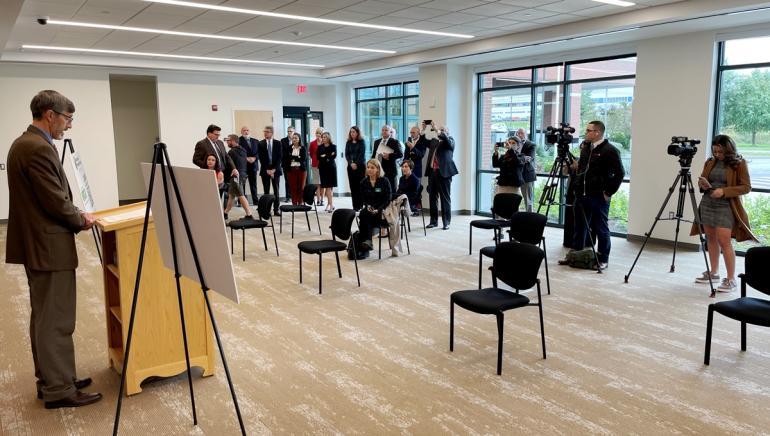
Source: Williston 9.30.2021. NEFCU nefcu.com.