

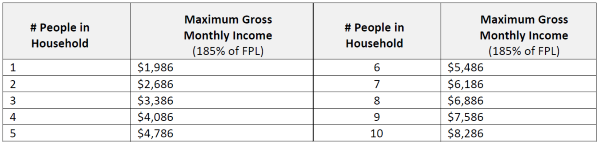
Vermont Business Magazine The Department for Children and Families announced today that, to enhance predictability and stability for program participants, the Adverse Weather Conditions policy for the General Assistance Emergency Housing Program will be applied for a 100-day period from November 22, 2021, through March 1, 2022. A family of four, for instance, will qualify if their income is no more than $4,086 a month. See the income eligibility table below.
The Adverse Weather Conditions policy has historically been applied on a day-by-day basis, based on weather forecasts and conditions. To reduce the need for beneficiaries of the program to reapply on a daily basis, the state will open eligibility during this time period, which is historically when it sees the most use.
During this period:
Vermonters will have to meet eligibility criteria, which include:
- an urgent need for housing,
- income guidelines, and
- a lack of adequate financial resources available to secure housing on their own.
However, enhanced predictability through the Adverse Weather Conditions policy will be achieved through the following flexibilities
- Qualifying for temporary shelter will not depend on the day-to-day weather conditions.
- People will not have to fit into one of the categories below to get assistance:
- individual over 60 or with a disability,
- person fleeing domestic violence,
- family with children or pregnant, or
- lost housing due to a natural disaster (e.g., flood, fire, or hurricane).
Shelter space will be utilized as a first option for individuals – unless there are safety concerns related to domestic violence.
FEMA has extended its funding for the program. The General Assistance program, commonly called the hotel/motel program served about 250 people at a time before the pandemic. Those numbers swelled to over 2,000 and now stand at about 1,500 (1,200 adults and 300 children). The state has also offered those who meet the guidelines $2,500 to help them find housing.
Human Services Secretary Mike Smith said Tuesday that the state is having trouble finding temporary shelter and is scouring the state in search of suitable housing. He said they would even consider vacant college dorm rooms. The number of available motel rooms is in very short supply as the winter tourism season ramps up and because the Holiday Inn on Williston Road in South Burlington is closed for renovations. That hotel was a significant source of available GA rooms early in the pandemic.
Governor Scott and Smith have maintained that the cost to the state of continuing the motel program is unsustainable without the federal funding from FEMA. They want to use some of the $250 million in ARPA money to build long-term housing, while trying to find short-term solutions.
General Assistance Housing Adverse Weather Conditions (AWC) for the 2021-22 Season
Commencing November 22, eligibility for temporary shelter through Vermont’s General Assistance Emergency Housing programs will be relaxed to encourage Vermonters experiencing homelessness who are without adequate financial resources to seek safe shelter.
A. Eligibility for temporary housing will be relaxed beginning November 22th, 2021, continuing through March 1, 2022, independent of weather forecasts.
B. Temporary housing may be authorized in increments up to 30 days.
C. The income limit applies to AWC housing, pursuant to rule EH-735.
D. The resource limit of $2,250 in available resources applies to AWC housing, pursuant to rule EH-745.
E. Households are not required to contribute their own income towards the cost of Emergency Housing.
F. If a household applying for or granted temporary housing under AWC loses their temporary housing at a shelter, hotel or similar establishment, the household will be ineligible for AWC housing pursuant to rule EH-765. **Please note the Period of Ineligibility does not apply to families with children.**
If a household applying for temporary housing under AWC refused available shelter space and has not requested and received a reasonable accommodation (form 218M), the household will be ineligible for further temporary housing for a period of 30 days beginning with the date the applicant refused available shelter space, absent good cause.
If a household does not check in at an ESD District Office the following business day after being housed by 211, the household will be ineligible for further temporary housing until they contact ESD to apply for temporary housing.
G. Although there is no cap on the number of nights temporary housing can be authorized under AWC, nights received under AWC will count toward the maximum number of nights that can be received pursuant to rule EH-700.
H. District Offices should refer each applicant requesting housing under AWC to the local Coordinated Entry Lead Agency.
Beginning on March 2, 2022, Adverse Weather Conditions will remain in effect but will revert to the traditional weather conditions for shelter criteria.
Before the pandemic, the General Assistance Emergency Housing Program typically served about 250 individuals on any given night. Current eligibility is significantly expanded from pre-pandemic standards, and the program currently serves over 1,500 people. The Adverse Weather Condition policy allows people who do not meet current categorical eligibility to use the program, provided they meet the other eligibility requirements.
The General Assistance Emergency housing program is not an ideal setting for people experiencing homelessness. The State and DCF continue to work to help transition people who are in the program into stable, long-term housing, which is better for the health and safety of Vermonters.
To learn more:
- Call 1-800-479-6151.
- Go to https://dcf.vermont.gov/benefits/EA-GA.
- Visit your local ESD District Office. https://dcf.vermont.gov/esd/contact-us/districts
Source: Montpelier, Vt. - The Department for Children and Families 11.10.2021