


Dr Mark Levine, Health Commissioner, with Governor Phil Scott, at one of the first COVID-19 press conferences, March 16, 2020. VBM photo.
by Joyce Marcel, Vermont Business Magazine It would have been a bigger surprise if Vermont had failed.
Think of Tropical Storm Irene in 2011, and how Vermont and Vermonters rose to meet the challenge. Why would we expect anything less when COVID-19 came along?
We wouldn't, of course, which is why Vermont has been a leader in dealing with the COVID-19 pandemic since it first reared its ugly head at the beginning of the year 2020. Governor Phil Scott proclaimed a State of Emergency on March 13, 2020.
The state's leadership was recognized when, in September of 2020, Dr Anthony Fauci, head of the National Institute of Allergy and Infectious Disease, video-visited a Vermont press conference with Governor Scott and Commissioner of Public Health Dr Mark Levine.
He called Vermont “a model for the rest of the nation” and said he wished he “could bottle (the state's response) and take it with me when I go around talking to other parts of the country."
Dr Fauci saved his most enthusiastic praise for the people of Vermont when he approvingly observed that, for the most part, we wear masks, stay physically distant, sanitize our hands and exercise outdoors.
“Wasn't that validating?” Dr Levine said, laughing, when we talked digitally last month.
He was proud at how quickly Vermont had formulated a plan to respond to the virus back in December of 2019.
“It was across all sectors of state government, just as if we were planning for Hurricane Irene,” Levine said. “This is just a different kind of disaster drill; it happens to be very health focused, while most of the others have health as a secondary issue.”
From the beginning, Vermont was navigating dark and muddy waters.
 Photo: Dr. Levine, Health Commissioner, wears a mask as a role model for Vermonters. Photo by Katie Kittell, VBM.
So far, more than 500,000 Americans — as many as 4,000 a day during the worst weeks of the pandemic in mid-January — have died of the virus. New and potentially more dangerous strains are being discovered all over the world.
While the breathtakingly rapid development of vaccines has given people some hope, getting the vaccine into people's arms has proven to be a slow, complex, controversial and ever-challenging problem.
And through it all, Vermont has performed at the highest standard.
As of mid-February of this year, North Dakota had the most confirmed COVID-19 cases per 100,000 population of all US states, while Hawaii had the fewest, according to an analysis by The New York Times. Right after Hawaii comes Vermont.
Citing his leadership in the pandemic, Vermonters overwhelmingly elected Scott to a third term as governor in November.
And even more people believe that Dr Levine — a very tall man at 6' 5”, sort of wonky, smart, accessible, calm, earnest and a surprisingly witty man —has been the right man in the right place at the right time.
Scott certainly believes it. He calls Dr Levine, whom he appointed to be health commissioner in 2017, “Vermont's own Dr Fauci.”
“Dr Levine’s expertise and talent were clear from the start, that’s why we wanted him on our team,” Scott said. “But I think what makes him so well suited to help us navigate this once-in-a-century health crisis is his even-keeled style and his ability to explain and offer solutions to complex problems in a way that the everyday Vermonter understands. His counsel has had a huge impact on Vermont’s nation-leading response. We’re fortunate to have him and I know I definitely made the right decision when I appointed him. And I think Vermonters have been able to see for themselves, in the nearly 240 hours’ worth of media briefings we’ve had since March, why his thoughtful and compassionate demeanor makes him the right person for the job.”
When I asked Mike Smith, Scott's secretary of the Agency of Human Services, about Dr Levine, he said, “So I'm just gonna sit here and gush for 15 minutes.”
Smith met Dr Levine when he came to head the Health Department.
“And immediately, he impressed,” Smith said. “This is pre-pandemic, and I was impressed by him at that point. He's very knowledgeable about public health. We became very close working together once the pandemic hit. He's risen to the occasion. He's providing solid, analytical data advice to me and the governor.”
With apologies to Wayne Gretzky, Smith said, it's all about the hockey puck.
“Dr Levine says, 'We need to look at the data and figure out where the hockey puck is going to be,'” Smith said. “He means we need to anticipate where the hockey puck is going to be. And that's something that he's been very good at. It's funny how it happens, but he is the right man at the right time. He has the right demeanor. He has the trust of Vermonters. And he has an analytical mind that just puts all of this together in a very understandable way. And he has great communication skills. Mark is at the head of the parade, along with the governor and myself and (commissioner of the Department of Financial Regulation) Mike Pieciak in terms of this pandemic response. He's done a marvelous job.”
I asked Smith how the Scott team resisted the many pressures they faced —everything from high school athletic directors to the ski resort and restaurant industries — over the orders to stay at home and social distance.
“Well, we were fairly confident in our data early on,” Smith said. “And I'll give you a Mark story. Early on, we didn't have a lot of the analytical tools that we have now. The forecasting was very rudimentary. We needed a little bit more data to see where this trajectory was going and catch it in time before it started to get out of control. This was in March or April of last year. And we also didn't have a lot of testing supplies at that point in time.
“And it was Mark — and this was a critical decision — it was Mark who said, 'Let's keep testing. We'll worry about the supplies, but let's keep testing. Let's get the data in so that we can make a rational judgment.' And we did, and we weren't late like some states were. I mean, the numbers still went up, but it didn't get out of hand. And as you know, Vermont has proved to be one of the best in the nation. That was a gutsy decision that we made. We were down to two days of supplies and testing, and we kept testing.
“Now, luckily, the governor and Mark and others were able to obtain some further testing equipment after those two days, but we were down to two days at that point. And that was the right call. It was a gutsy call, and I attribute it to Mark. I want to get back to the hockey puck, because Mark keeps saying that about Wayne Gretzky. He wasn't great because of how he could handle the puck, but because he knew where the puck was going to be. And that's been the whole thing here with our response, just trying to figure out where the puck is going to be, where the virus is going to be and reacting that way. And Dr Levine's contribution has been immense in that area.”
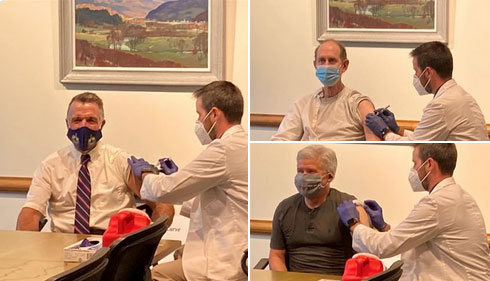 Photo: Governor Phil Scott left; Dr. Levine, Health Commissioner top right and Mike Smith, Secretary of the Agency of Human Services getting the flu shot in October. Courtesy photo.
Before the pandemic, public health was almost invisible, said Jan Carney, associate dean for public health at the Robert Larner MD College of Medicine at The University of Vermont.
“When everything is done well, you don't think about it,” Dr Carney said. “This pandemic has been a public health marathon. People see what epidemiologists and nurses are doing. And our public health systems across the country are so important in making sure the public stays healthy, in addition to preventing epidemics and pandemics. We think very highly of Dr Levine. He's an outstanding teacher.
He speaks clearly about complex problems, in a way that's understandable to everyone. He's honest, he is credible, he can be very funny, and he's sincere and caring. You can see the caring that physicians have for individual people coming across when he talks to the public.”
In the future, academics will be doing case studies about what a coordinated response meant to Vermont's success in dealing with a pandemic. Every agency of state government pitched in on this one.
“The Agency of Commerce was thrust into an unusual role when the pandemic struck – asked to issue guidance on how businesses and organizations could operate safely,” said Ted Brady, the deputy secretary of the Vermont Agency of Commerce and Community Development. “Dr Levine has helped us respond to the most complex questions to the mundane – always working to balance the penultimate goal of public health while working to understand the economic impacts our decisions would have. Dr Levine’s greatest accomplishment to date came long before the pandemic struck. Over the past several years he built a team of experts at the Department of Health that was ready to respond – from those on the front lines in district offices to the deputies and doctors in leadership posts. What Vermonters see at the news conferences is who Dr Levine is – a caring, brilliant and compassionate leader.”
Vermont's government was handicapped by the fact that for most of the pandemic, there was no national leadership.
“It's really been such a challenge,” Dr Levine said. “To have every state operating independently, and to have the phenomenon of states on your borders where you don't often have consistent political thinking? Everyone's doing something different. And the inability of us to be like Alaska or Hawaii? We're not an island here in Northern New England. We like to behave like one, and I think we've come as close to being an island in this country as any state, based on our statistics. We've done so remarkably well compared to every other state. But the reality is, you can't be an island.”
The distortion of the national dialogue remains a large problem.
“It's been so incorrect, so loaded with dangers sometimes, with a lack of a uniform message or lack of a cogent and cohesive set of policies, and program for dealing with the virus,” Dr Levine said. “We've had all of that to contend with. It's a huge challenge, especially when you're trying to get just the population of your own state believing what you believe and adhere to the guidance you provide, because you firmly think it's the correct thing to do.”
The governor and the commissioner, along with Pieciak, have become rock stars on television. At twice weekly press conferences (down from three) filled with data, dashboards and charts, they explain what's happening and answer every question that's put to them.
“I think it's helped us that the governor and myself have become the trusted messengers that we are,” Dr Levine said. “We rarely hear that people think we're pulling something over on them or giving them some misguided information. They're almost always commenting on the stark contrast between our messages and what they heard coming out of Washington — at least until January 20. Vermonters really have embraced what we've been telling them. They've embraced the way we embrace science and data when we make our decisions.”
Dr Levine has been working nonstop, said Kelly Dougherty, deputy health commissioner for alcohol and drug abuse programs
“It's been amazing that we're a year into this and I don't think the man has had a day off,” Dougherty said. “I recall when we had our first case in Vermont – early last March – he was actually on vacation. He had recently had a new granddaughter and was visiting his daughter and her new baby, but he immediately had to fly back home.”
Levine is “an extraordinarily kind man” whose leadership provides “a very steady force,” Dougherty said.
“He manages not only to have the twice-weekly press conferences, plus internal meetings, press briefings and meetings with the governor, he's also able to keep up with all the science. He's up on all the research and the data. I think the Health Department staff has really appreciated his calm and steady leadership. Another thing he has done – we instituted it over the summer – are regular Q&A sessions with the staff. We do it virtually, but all Health Department staff are invited to meet with him once a month to ask questions. He takes the time to spend with the staff.”
As the first news of COVID-19 started coming out of Wuhan in China in December 2019, Dr Levine went on the alert.
“We opened up our Health Operations Center in early February last year, full scale, and it pretty quickly became the primary work of the Health Department,” Dougherty said. “Most of the staff in there are involved in some COVID-19 work in some shape or form.”
Her colleague, Deputy Health Commissioner Tracy Dolan, said that Dr Levine has elevated the role of public health in governmental policy.
“Dr Levine is shoulder to shoulder with the governor twice a week talking about the role of public health in the pandemic,” Dolan said. “Whereas our role in that past was to inform the governor on public health issues, now Dr Levine and senior staff regularly recommend policy up to the governor and provide data to help the governor make decisions.”
The key strength Dr Levine brings to his job, Dolan said, is his ability to “listen to all sides and to the experts.”
“For example,” Dolan said, “he's not someone who shoots from the hip. He wants his opinions to be informed by the data and best practices of public health science. In addition to listening and data-driven decision making, he likes to build consensus. His preference is to bring people along so we work in cooperation and are more effective working in the same direction. He's also calm, measured and a quick study.”
Vermonter's respect for Dr Levine pays off in many ways.
For example, if someone asks him about drinking bleach or exposure to X-rays or “some other cockamamie therapy that they've heard might be good for COVID,” Dr Levine said, “We can say, 'No, there's no data. This is what the data shows.' And we get listened to, which is refreshing.”
Dr Levine admitted that he would not want to be doing public health in some states.
“I have colleagues whose population has been a bit brainwashed,” Dr Levine said. “Many of them have governors who you know have been — is the word 'acolytes'? — acolytes of the former president, and their population is not actually being given the full truth on anything. It makes it very hard for their state health officials to actually get things to move in the direction they want to move them. It's very frustrating.”
It can be more than frustrating for his colleagues; it can be dangerous. In some states, according to The Associated Press, public health officials have been “vilified and threatened with violence.”
“Many health commissioners are no longer working at their job,” Dr Levine said. “They either quit, or they were released because there were differences in their thinking, or they were used as scapegoats for poor performance by their state, or their population camped out on their front lawn because they were against what they were saying. All kinds of those things have happened. It's been reported in the news. The numbers are astounding for state and local health officials who are no longer working as a result of the pandemic. They're a casualty of the pandemic.”
Vermont's success has been internationally recognized.
For example, a news story in, of all places, the Sydney (Australia) Morning Herald, is headlined “Picturesque and unpolarised: How Vermont Crushed the Coronavirus.”
“Over the past year Vermont has gained national recognition as the US state that has done better than anywhere else at keeping the coronavirus pandemic under control,” the newspaper said.
When Vermont is celebrated in Australia, you know the world has taken notice.
Early Years
So who is Dr Mark Levine and why was Vermont lucky enough to find him at the helm when an unknown virus changed the world?
Dr Levine, 67, has a BA in biology from the University of Connecticut, and an MD from the University of Rochester.
He did his residency in internal medicine at the University of Vermont.
He was born in Sharon, MA, but not into a medical family. His father was in higher management for the Internal Revenue Service; his mother was a housewife.
“Back in those days, that's pretty common,” Dr Levine said. “She had sort of an administrative assistant kind of career, but she was mostly a mother when we were growing up.”
Dr Levine has one sibling, a younger brother.
Dr Levine has always loved science.
“And I liked research,” he said. “I was very curious. And biology was sort of a passion and an interest. Then I realized I could combine my love of science with my desire to do some good for people as well. Not be at a laboratory bench, necessarily, but still be pursuing science while doing it with human beings.”
For the same reason, he chose the specialty of internal medicine.
“Internal medicine is a sort of one of those things we call a cognitive specialty,” Dr Levine said. “It really takes advantage of your ability to do creative thinking, critical thinking. I enjoyed the kind of organ system approach, taking care of a variety of ailments. And in addition —to me, at least — it provided a lot of opportunity. You can be a generalist, you can become a specialist in one of the organ systems, you can do ambulatory outpatient work, you can do hospital work.”
His medical career didn't always have the smoothest of sailings.
“Once upon a time, I wanted to apply for a Robert Wood Johnson Foundation fellowship in health policy,” Dr Levine said. “And I thought I was a pretty good candidate for it. I thought I'd done a pretty successful job of trying to navigate it, but I didn't get it in the end. It was very competitive, and a very small number of people could get it per year. But it really made me go even further in pursuit of my vision and dream for what I wanted to do in prevention, public health, population health and health policy. And it's culminated now in this position, which has given me great opportunity to do a lot of that stuff. But I don't know if I would have been as well prepared to encounter all the things I've encountered here if I hadn't had that setback.”
He chose to do his fellowship in internal medicine at the University of North Carolina.
“And so I got to do more in the way of developing research skills, epidemiology skills, teaching skills, and eventually administering educational programs and medicine,” Dr Levine said.
The pull of the north brought him to UVM the first time.
“I wanted to come back to New England,” Dr Levine said. “I had that few years in Rochester, New York, which obviously, climate-wise, isn't all that different than here. But at the same time, I've always considered myself a New Englander. So when I had a chance to do residency in New England, in a place that I actually hadn't spent much time in, that was still beautiful, I took it.”
Dr Levine was just getting married at that point.
“And my wife came from Ithaca, which, of course, is on one of the Finger Lakes, and has several colleges,” Dr Levine said. “So Burlington was a perfect kind of environment for both of us. We liked the lake and mountains. She could be reminded of where she grew up, and I could do high quality training in a place I really liked, without being in a huge city. This was perfect. It gave me sort of the best of all worlds.”
At UVM, Dr Levine did a three-year residency in internal medicine. From there he went to the Geisinger Medical Center in Danville, PA, for almost a decade, running training programs for doctors in ambulatory care, pediatrics and internal medicine.
“At Geisinger, I had wonderful years that helped develop me better as a clinician and as an educator, and as a residency program director and administrator,” Dr Levine said. “It was very formative for me.”
Settling in Vermont
After nine years, the Levines decided to return to Vermont.
“We realized Central Pennsylvania was very different than New England,” Dr Levine said. “And we had a couple of kids by then. We really wanted to get back to New England. And fortunately, I still had good connections here. A position opened up for me that was perfect.”
He began teaching while at the same time building a private practice in Essex Junction and the UVM Medical Center; he loved seeing patients.
“Early on, a high percent of my career was practice, but then it became about 50 percent,” Levine said. “Then it became about a third. But I would never compromise with less than a third, because then it's like, 'Why did you go to medical school?' I really valued the patient interaction above all. So I wouldn't let any administrative or teaching or academic responsibilities take away too much of the time I could still spend in the actual practice of medicine.”
Health Commissioner
When Dr Harry Chen resigned as Vermont's health commissioner in 2017, Dr Levine knew he was interested in the job, but painfully aware that it would be the end of his clinical practice.
“It was challenging, because I had so many years of direct patient contact,” Dr Levine said. “And that defines you in many ways. Not only do you value those interactions, you feel good about what you can bring to them. You also worry about what will happen if you leave the practice — all these patients still have to be taken care of.”
The government job was enticing because it represented the nexus of several interests that Dr Levine had been developing over the years.
“I was developing an interest in that place where health care, individual health, public health, population health and health policy all meet together,” Levine said. “I'd been getting more active in my professional organizations, like the American College of Physicians, the Alliance for Academic Internal Medicine, and the Vermont Medical Society. They were giving me a little different view on the world, bringing policy into the equation.”
Dr Levine discovered in himself a desire to move to a “more population-based” constituency.
“After you've spent decades counseling people about their behaviors in terms of lifestyle behaviors, re-examining them, working to improve them, you have successes, but they happen very incrementally,” Dr Levine said. “They don't happen overnight. They can happen after weeks, years or decades, depending on the person. I really felt that I could bring a lot to the population in the public health arena, because there, when you make an impact, it's on a very large population-wide basis.
“You can really move metrics, if you will. You can move mountains in some ways by just a simple partnership with an organization or a policy change at the state level that has a huge impact and will produce in a preventive way, good health for people for years on end. It would have taken you a long time to do one-on-one and one-by-one.”
Once Dr Levine took the job, he began trying to reduce cigarette use.
The state joined a national crusade called Tobacco 21 which raised the age that young people can buy tobacco products from 18 to 21. It became federal law in December of 2019.
“I always like to say that I convinced a lot of people to quit smoking,” Dr Levine said. “Not all were successes, but many were. They don't happen overnight. They take a long time. And the impact of smoking on our healthcare expenditures and on our population's health is just incredible.”
Vaping also came under attack. There was a moment when vape shops popped up all over Vermont — and then they quietly vaporized.
“We had a number of policy initiatives that the Legislature followed through on that interfered with the ability of our youth to vape,” Dr Levine said. “You know, we put taxes on their supplies. We prevented some internet purchases. We really had an impact there that will go on and on for a long time. Not that it's better or worse than talking to one person at a time and getting them to be enlightened and helping them along their path to improvement, but the impact is just incredible to have been able to do that.”
It Hits the Fan
Dr Levine was beginning to have an impact on people's lives. And then stories started surfacing — a new and terrible virus, contagious, attacking the lungs, virulent, deadly, coming out of China. Life was about to change.
“People ask me all the time, 'Is this what you thought you were buying into?'” Dr Levine said. “And I'm like, 'There's no chance I would ever think about this.' But at the same time, someone's got to do it. And it's almost an honor and a privilege to be the one who's thrown in the middle of it all.”
Levine knew about the new virus before it even had a name.
“We heard about these coronavirus and pneumonia cases in China,” he said. “The bottom line is that they were starting to spread in a region. And this was a novel virus. We thought, 'We ought to be worried about this. Let's start planning now.' So that was probably right around the turn of the year, 2019 to 2020. I briefed the cabinet sometime in January, saying, 'There's something going on that you ought to know about. It's not here, but you've got to know about this. I'm afraid you might hear about it again.' And it was soon thereafter, probably the beginning of February, that we were having regular meetings of our Health Operation Center and our State Emergency Operation Center. Then in March, we had our first case. So we were all kind of poised. But again, you never know how things are going to go until things happen.”
The whole Health Department became one anti-COVID-19 team.
“Everybody's doing this as job one, even though they're still trying to do some of their real jobs,” Dr Levine said. “The bottom line is, the team was within the department, but it was also across other sectors of state government, just as if we were planning for Hurricane Irene.”
The first priority — one that Dr Levine and Scott agreed on early — was to protect the state's most vulnerable population.
“I think we had the right sets of priorities from the start,” Dr Levine said. “And those priorities resonated with people. One of the priorities was to, frankly, protect the most vulnerable. People have been hearing that from Governor Scott long before the pandemic. So we had strict visitation policies in our nursing homes. We had lots of issues with regards to testing in those sites, to protecting those vulnerable citizens. And then we tried, very early on, to highlight those behaviors that people could use that would protect them and their communities and their families.”
Dr Levine used growing data to illustrate the state's plans and show how well they were working.
 Photo: Dr. Levine, Health Commissioner at a press conference earlier this year. VBM photo.
“The data was looking good,” he said. “It was a little bit of a self-fulfilling prophecy that if you could show the people that their behaviors were paying off, well, of course they're going to buy into that more. They can see the results of their labors. And then they heard us not act insane.”
Many states got fed up with lockdown and opened everything up. Vermont was not one of those states.
“We basically said, 'we're not doing that,'” Dr Levine said. “We said, 'We're going to be very, very gradual. We're going to do it in a phased and sequential way.'”
The plan was to wait two weeks after each change in the plan.
“That way we got to watch and make sure that we didn't do anything harmful before we moved on to the next reopening,” Dr Levine said. “We have a governor who basically says public health and safety are priorities for him. As much as he wants to help the business community at every moment — and he tries his hardest — he's not going to reopen everything so fast that it's going to end up hurting public health. That will just hurt the community again. So he was very careful with that. And I think people have understood that our approach allows economic recovery, but not at the expense of public health.”
Needing Supplies
Handling the virus was difficult, given the number of unknowns.
“It was hard because we didn't have great coordination at the federal level,” Dr Levine said. “Need I say more? We didn't have any coordination at the travel level. Things could keep coming into the country without anybody even thinking about them. And we didn't have any state-by-state coordination. It was sort of every state for themselves, whether it be diagnosing their first case, whether it be how to deal with the public health emergency, whether it be the absence of PPE (personal protective equipment), whether it be the absence of ability to test and understand if we were actually seeing this condition or not. So all that had to be put together really fast, and a lot of it needed federal support that just wasn't there.”
Take PPEs, for example. All over the country, newspapers were reporting severe shortages. Vermont was no exception. Some people think the state had to do private fundraising to get enough PPEs.
“No, we ended up not doing any private fundraising,” Levine said. “But we ended up interacting with the private sector quite a bit. We had to work across all of our hospitals, all of our practices throughout the state. When it came to testing, we were totally dependent on the federal Centers for Disease Control and Prevention. But once a test was released, we did start talking with the private sector a little about where we could go with that. But again, most of that stuff needed the Food and Drug Administration emergency use authorization. So a state by itself couldn't really just set up a testing enterprise.”
When a wave of panic hit the country over a ventilator shortage, Dr Levine went to Vermont manufacturers.
“We actually talked to industries in Vermont who could adapt their own technology into the ventilator arena,” he said. “We wanted to see who wanted to help us work on that. And we got a great response. That's the kind of stuff you can actually do when people can't suddenly do what they were doing but still have all the technological expertise to help in a different direction. That's what happened.”
In the end, extra ventilators were not needed.
“We don't need them even now, with this real surge of cases in the hospital and everything,” Dr Levine said. “We're doing a lot better with how to take care of patients. Ventilators are not actually the answer. We have medications, we have protocols for helping with breathing and oxygenation that don't require people to be put on a ventilator quite as often.”
Although no one wants to catch COVID-19, the disease doesn't seem to be as fatal as it once was.
“We still say 80 percent will do fine,” Levine said. “But the other 20 percent could have a more serious course. It could include being in the hospital.”
Many people who recover have continuing health problems, including coughing, fatigue, debilitating joint pain, inability to walk, tightness in the chest, and a host of other problems. There's a name for them now, Levine said. They are called “long haulers.”
“There might be up to 10 percent of people who recover that we end up calling long haulers,” Levine said. “It's a syndrome poorly defined and poorly understood. People can have chronic fatigue, they can have chronic shortness of breath. They can have chest pain and other cardiac symptoms. They can have memory loss. They can have cognitive issues. I mean, the list is endless. It's kind of frightening. And we're seeing it on a large scale because so many people in the country have come down with COVID-19. But certainly, people do not have normal lives for months after having been through the illness. We expect everyone to be back to normal, and these people aren't, and they can't shake a lot of very serious symptoms.”
Not Insane
There are still many, many Americans who deny that a pandemic exists.
In November 2020, The Washington Post featured an incredible story from South Dakota — a state where the governor denies the existence of the disease.
The Post described nurses' experiences with patients dying of COVID-19, while denying that they had the disease.
The headline read: “South Dakota nurse says many patients deny the coronavirus exists — right up until death.”
“It's hard enough to deal with people who deny there's a pandemic,” Dr Levine said. “And then there's people who've accepted there's a pandemic, but say, 'But what are you worried about? This is not going to hurt anybody.' And I have to point out that even the people that don't have a serious initial illness can have their whole life changed. We need to learn more about it.”
Vermonters, however, trusted Scott and Dr Levine and the message they were sending.
“That's really helped our cause,” Dr Levine said. “Vermonters really have embraced what we've been telling them. They've embraced the way we embrace science and data when we make our decisions.”
In general, Vermont is one of the healthiest states in the country, Dr Levine said. Vermonters seem to prioritize health.
“So when you confront them with a pandemic, you can enlist their collaboration and cooperation and compliance,” Levine said. “It's a little easier to do because they've started from a good place already. But I do firmly believe, though, that we have disbelievers in Vermont, no question, just like any state. Not as many, thank God. And we have so many who actually do listen, and are compliant. And without that I don't think we could ever have gotten anywhere.”
Economic Health
The state can have health, safety and economic recovery, Dr Levine said.
“You can do it,” he said. “But you have to do it in a very graduated way. We wanted to make sure that the level of suppression of the virus, after we closed everything down, was sufficient to allow us to start up in this way. But there's science in the data behind everything we've tried to do.”
Take the retail sector, for example. Stores have remained open.
“You can buy anything you want,” Dr Levine said. “It's pretty rare that you go to a store and you have to wait outside because of some public health reason. But occasionally, if it's a small store, they'll say, 'We've reached our capacity. You can't come in till the next person leaves.' Which is fine. But most of the time, if you're going to go to a big box store, or you're going to go to a supermarket, you just go like you always did. But you respect the distancing and the masking and all of that.”
The fact that this worked out successfully is a sign that you can have retail business and public health simultaneously, Dr Levine said.
“We started outdoors, then we moved indoors,” Dr Levine said. “But it's all worked.”
Construction has not been hard hit by restrictions.
“Major developers have been able to do well,” Dr Levine said. “People are actually hiring them more because they're home and they want to get things done around their house or their property or what have you. All of that works.”
The hospitality sector has been much more difficult.
“Especially restaurants, just because of the association of bars and restaurants with people indoors in a crowded way, interacting in a multi-household fashion,” Dr Levine said. “And they're not wearing masks because they're eating and drinking. It makes it very challenging. But again, we've tried to go as far as we could, and we've not demonstrated a lot of case transmission with the guidance we provided. But of course, a lot of those places aren't open to capacity. And now you can't even have a second household at your own table. It has to be one per table. So there have been rules that have been rigorous there.”
The ski industry is a good example of how to engineer public health into a business.
“There's so many factors,” Dr Levine said. “It's like, can you use the lodge? If you're going to use the lodge, how do you make it work so that only a certain number of people can be there at a time? How do you still serve food? And still obey the rules we have about restaurants? How do you line up outside to get on the ski lift? And how do you do that in a way where everybody's respecting everybody else? And then, when you finally sitting on the chair, how do you actually make that happen so that you're not going to get exposed to somebody who could be potentially infectious in the same settings?”
Ski resorts spent most of last spring and summer trying to figure out the answers to these questions.
“They've done a great job of complying with all the stuff that we sent down,” Dr Levine said. “In fact, they helped develop it. That's one example of what we've done, which is bringing those to the table who are affected. They often have good ideas, and rather than shove something down their throat that you've packaged up as a state, it's always best to get their input.”
The Opioid Crisis
While public health is obsessed with the COVID-19 virus — as it should be — the opioid crisis that was destroying large swaths of Vermont has not gone away.
“In fact, the virus has exposed it even more,” Dr Levine said. “At least, from the point of view of someone who has to look at the public health data all the time, we had six years of no action in terms of severe numbers of people dying of opioid overdoses. Then in 2019, we had the first year that we showed a decrement in those overdose deaths. And then the pandemic came, and now the statistics are higher than they've ever been.”
The drug problem is hidden from sight as people quarantine in place.
“People don't see it all the time,” Dr Levine said. “And we don't have it on our city streets as much as other major cities do. But at the same time, it's out there, and we were just devastated by the impact that the virus has had. One reason people are dying is because they often are now using drugs alone. It's hard to be in a group of people. If you're alone, people won't notice that you're not rousable. They will not rescue you with Narcan. They won't call 911.”
Another reason people are dying is that their drugs have changed.
“Often, people are using different drugs than they were used to, because their usual sellers aren't there.”
Dr Levine said. “So they have to use a different supply route. And they don't know what they are getting.”
Recovery centers are still working, but like everything else, they are more remote. Treatment centers are still operating, but again, getting connected with them is more challenging because people are obeying the 'stay home stay safe' order.
In response, the state has worked to increase access to medication-assisted treatment.
“And that system is going really, really well,” Dr Levine said. “It's just got a real uphill battle to fight, because of what the pandemic has done to this group of people.”
Much of the homeless population has been quarantined in hotels around the state, making the hotels virtual one-stop drug malls for dealers.
“That was a concern,” Dr Levine said. “But at the same time, having people in those hotels really has done wonders to their lives in many other ways. And most of all, and not everybody in those hotels is a drug addicted person. There are many, many people who have nothing to do with that.”
The Vaccine Age
Several varieties of vaccine against COVID-19 — maybe also against newer variations, maybe not — are now rolling out. The vaccine is free, paid for by the federal government. As of this writing, President Joseph Biden has bought 200 million new doses, enough to vaccinate most Americans, although not right away.
How different states will get the new doses and how they will give them out is still a matter of some controversy.
The first doses went to front-line health workers and residents and staff of long-term care facilities, the so-called 1A phase.
In Vermont, people over 75 were the first age-band population to sign up for the virus. Next came people over 70. Those over 65 will come next.
This was part of Dr Levine and Scott's desire to save vulnerable populations first.
What populations come next is unknown — and controversial — as of this writing.
It will include those with chronic conditions and others whose medical condition make them more vulnerable to getting a severe illness. But all told that is a large number of Vermonters.
As Governor Scott said in February, they are getting lobbied by many groups to be next on the list.
But the ultimate idea is to get close to “herd immunity,” where enough people have the antibodies so that the virus cannot get a foothold in the communities.
What if unvaccinated people — say, a motorcycle gang from the Dakotas who fervently believes the virus is a scam — roll through Vermont. Will they be able to infect even people who have already been vaccinated?
“Hopefully not,” Dr Levine said. “You shouldn't get a severe illness. You might get sick, but you won't die, because you have the vaccine. That's the goal. The ultimate goal is that enough of us in Vermont who've had the vaccine, plus the small percentage of Vermonters who got sick before the vaccine and now have the antibodies, can suppress the illness. Even if we don't get to herd immunity, we won't get to devastating illness. But it's going to take time to get enough people vaccinated so that you won't run that risk.”
The Future
At least until spring, and possibly into summer, Vermonters, whether they're vaccinated or not, will still have to wear a mask, sanitize and socially distance themselves.
“We're saying probably towards the summer,” Dr Levine said. “But two weeks after your second dose, you will definitely be safer. It's not light years away.”
Is Dr Levine concerned about people who are already vaccinated relaxing and becoming bad role models for everyone else?
My question made him laugh.
“There's so many things I'm worried about,” Dr Levine said. “That one hasn't crossed my desk.
“I'm not so worried about that, especially not in Vermont. I guess I would worry about it elsewhere, because there's so many people that aren't doing those right behaviors, even now. But in Vermont, I'm a lot less concerned about that.”
 Photo: Dr. Levine, Health Commissioner at the Pavillion Building on State Street in Montpelier. Photo by Katie Kittell, VBM.
When Vermonters finally come out of quarantine, they will find a different world — one that they will have a hand in making.
One thing the US must do is use the COVID-19 experience to build a better public health system, Dr Levine said.
“Public health has suffered for so long,” Dr Levine said. “And it needs to be respected more than ever before. We need to have more prevention. We need to have more pandemic preparedness, because there will be another one. Hopefully not too close in time, but we need to have more disaster preparedness. All those funds were taken away for years and years and years on end. So we need to approach the future by learning from this experience.”
There is a strong probability that more viruses like COVID-19 will be coming down the pike.
“I'm hoping it's another 100 years, but everybody predicts it's going to be way less than that,” Dr Levine said. “Just look at what we've been through. We have COVID, we had H1N1. We had Zika, Ebola, SARS, COVID-1, MRSA. I mean, these have all occurred within our lifetime. The fact is, they keep occurring.”
There's a common thread here, and it's a scary one: humans are crowding out animals.
“Humans are living in more and more parts of the planet, and coming in closer contact with the animal world and the illnesses that that world has,” Dr Levine said. “And it often leads to what we call a zooanthroponosis illness. It's an illness that should have stayed in the animal population but jumped to the human — and look what it did! Those things are happening with increasing frequency. Just like the flu viruses we see every year, most of the time we deal with them and we move on to the next flu season. But occasionally we have a different flu that came from a pig or came from a bird. And we're watching those things like a hawk now, we have to, because they can easily jump to the humans and cause devastating illness.”
Humans must recognize the impact they have on others.
“We need to approach the future, I think, with a little more deliberateness about how we live our day to day lives and impact each other,” Dr Levine said. “For example, a lot of people have talked about the handshake maybe disappearing. Certainly, it's going to be gone for a while. I don't know if it's going to be gone forever. To be honest. I think hugs will actually occur more commonly, because people perceive the handshake as, 'Oh, then I could contaminate myself if I touch my face,' or whatever. The reality is, that is true, but nowhere near as powerful as breathing on another person. And coughing on them. And that's how most of the infection is transmitted.”
Another thing humans need to do is have a new respect for travel; it's a global world now.
“This global society has the ability to spread COVID-19 to every corner of the planet,” Dr Levine said. “And that's the way it is. So we have to be much more surveillant and much more understanding about ways to prevent that from happening.”
As for Dr Levine's future, he plans to stick with Scott and see Vermont through the pandemic.
“I'd like to see us exit the pandemic, and provide a helping hand in that pursuit,” Dr Levine said. “As you know, Governor Scott's been re-elected. He hasn't told me he wants to keep me on for the next two years, but he hasn't told me he doesn't. He keeps making me come to these press conferences, so I assume job security. So I would like to get us out of this and return to those sorts of dreams and visions we had for moving on as a Department of Health in Vermont. I mean, trying to do some more of those really good things that would benefit the lives of Vermonters and make Vermont even a healthier state. It would be great to see that happen.”
Dr Levine hasn't thought much further out than that.
“I have no idea what else I'd like to do,” he said. “I mean, I've certainly got another job or two or whatever in me, so I don't want to close any doors for my future. People always ask me, 'Are you going to go back into practice?' I terribly miss practice, to the point where I actually still teach every week. I meet with residents a couple times a month, and do what's called 'resident report,' which is hearing a case and facilitating a discussion of that case. And I meet with students once a week, and professors, and we talk about cases.
“Before the pandemic, we would actually visit the patient as well because they're usually a hospitalized patient. And that keeps that part of my brain exercised that I really always need to exercise — the clinical side of me. But I don't think I could probably go back into practice at this point. Not because I wouldn't love it, or because I wouldn't be good at it — because I think about it all the time — but more because I think my horizons have been broadened and opened by the job I'm in. I think I could do the most good in a position that similarly allowed me to bring that nexus of health and healthcare and population health and policy together, whatever that would be.”
Joyce Marcel is a journalist in southern Vermont. In 2017 she was named the best business magazine profile writer in the country by the Alliance of Area Business Publications. She is married to Randy Holhut, the news editor/acting operations manager of The Commons, a weekly newspaper in Brattleboro.