

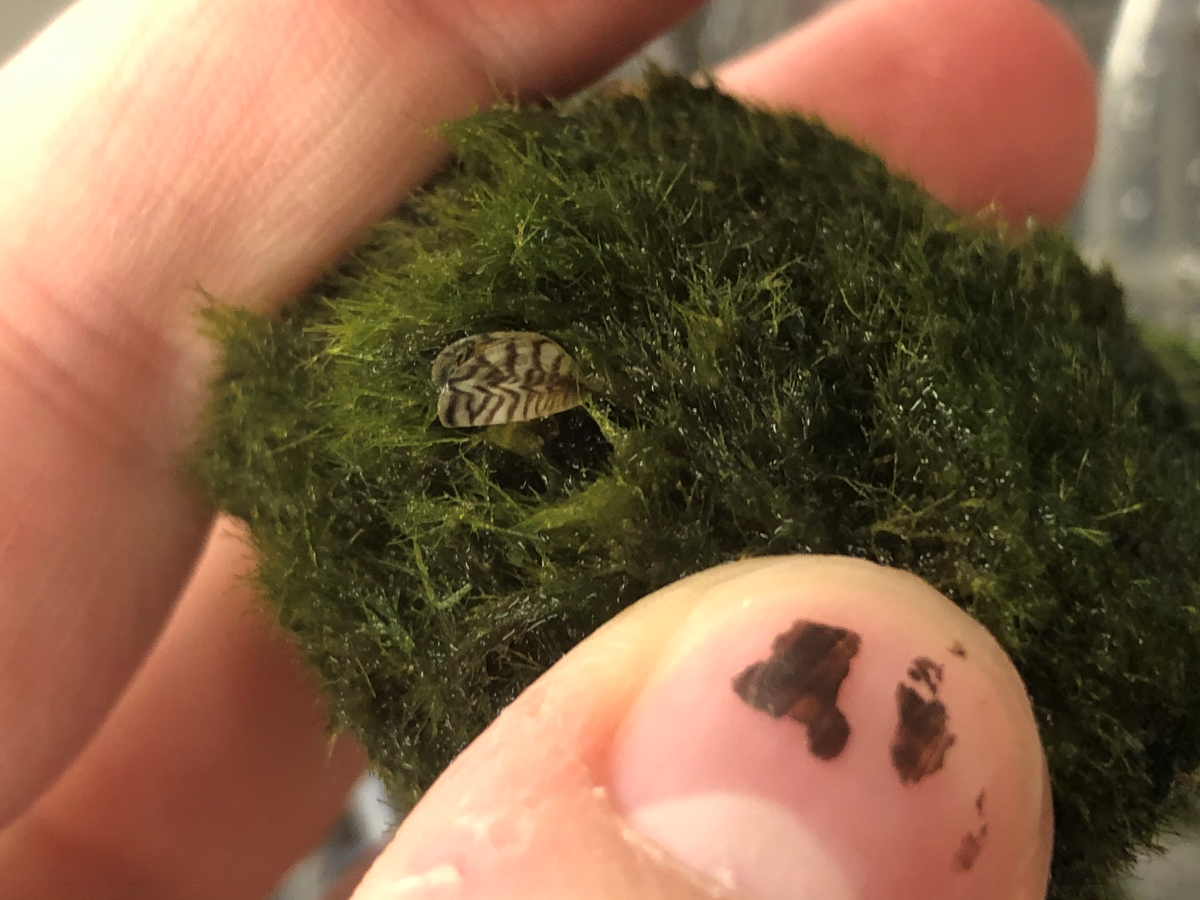
Zebra mussel found within a moss ball. USGS Photo.
Vermont Business Magazine Vermont Agency of Natural Resources staff scientists were alerted last week that an aquarium plant sold within Vermont and throughout the country may contain an invasive aquatic animal species, zebra mussels (Dreissena polymorpha). The aquarium plant commonly known as moss balls, may be sold under names including “Beta Buddy Marimo Balls,” “Mini Marimo Moss Balls,” and “Marimo Moss Ball Plant” and were available to purchase in large department stores or through online sales. While the plant is benign, the plants may harbor zebra mussels within the plant, or within the packaging.
Zebra mussels are a small freshwater mollusk aquatic invasive species that can reproduce rapidly and cause detrimental harm to the ecological balance within a water system. They can also cause an economic burden, clogging pipes and other underwater infrastructure. As filter-feeders, they prolifically consume microscopic aquatic life, which causes a potential impact to native mollusk species.
Zebra mussels first arrived in the Great Lakes in the 1980s via ballast water that was discharged by large ships from Europe. Zebra mussel adult specimens were first discovered in Vermont in Lake Champlain in 1993. They have also been discovered in Lake Bomoseen, Lake Dunmore, and in the Quebec portion of Lake Memphremagog.
Consumers who have recently purchased or acquired these items are encouraged to inspect the product or the aquarium for the presence of zebra mussels. If zebra mussels are discovered, it is recommended to remove, freeze or boil the plants and mussels, prior to disposal. If mussels were found, they may have reproduced and the aquarium should be decontaminated by dumping the aquarium water outside and away from a waterbody, and disinfecting the tank and materials with water diluted with a bleach solution.
This discovery of zebra mussels throughout the county has caused a widespread national quarantine on the product and enforcement checks by state agencies to ensure the quarantine measures are taken. Fortunately, the small number of stores that sell these products in Vermont have agreed to remove the products from shelves, and only one contaminated specimen was found and removed.
The discovery of a contaminated aquarium product available for sale in Vermont highlights the critical importance for all aquarium enthusiasts to be informed about and prevent the spread of aquatic invasive species. The aquarium trade is one of the major vectors for the introduction of aquatic invasive species caused by the illegal dumping of aquariums in waterbodies, or flushing aquarium water down drains, which can eventually lead to waterbodies.
To alert ANR of a contaminated product, please contact Kimberly Jensen, ANR Environmental Scientist, (802) 490-6120, or [email protected].
For more information, visit https://dec.vermont.gov/watershed/lakes-ponds/aquatic-invasives and the USFWS page on zebra mussel disposal.
Quarantine Event on Moss Balls Contaminated with Zebra Mussels
On March 1, 2021, U.S. Geological Survey (USGS) scientists were alerted that zebra mussels were found attached and inside moss balls sold as aquarium plants. Zebra mussels are an invasive species that can devastate local ecosystems and infrastructure. Zebra mussels are currently invasive in several states, and we need the public’s help to ensure this dangerous invasive species does not spread further.
What is an Aquarium Moss Ball?
Aquarium moss balls are not moss but a green filamentous algae (Aegagropila linnaei) that looks like moss. They are soft and spongy when filled with water in aquariums, and provide habitat for fish, shrimp, and other species. Moss balls are hearty and easy to maintain and are an active commodity in the aquarium trade. Moss balls can be purchased in every state through national retail chains, small independent retailers, and online market places.
The species is mainly found in the areas of Northern Europe and in several places in Japan. It has been found in North America, but it is rare, as well as in Australia. We have not found any reports that this species of moss ball demonstrates a history of invasiveness.
Where are contaminated moss balls coming from? Zebra mussels are native to Eastern Europe in the Black, Caspian, and Azov Seas. It is unknown whether contamination is occurring within the supply, distribution, or retail chains. Additional assessments will be needed to understand the origins and magnitude of the problem.
What are zebra mussels and why are they a problem?
Zebra mussels are one of the most devastating invasive species in North America. When they become established in an environment they alter food webs and change water chemistry, harming native fish, plants, and other aquatic life. They clog pipelines used for water filtration, render beaches unusable, and damage boats. These filter feeders outcompete other native species in infested rivers and lakes. The waste they produce accumulates and degrades the environment, using up oxygen, making the water acidic and producing toxic byproducts. >
Where have zebra mussels on moss balls been found?
As of March 4, 2021, zebra mussels found on moss balls have been reported in Alaska, Arizona, Arkansas, Colorado, California, Florida, Georgia, Idaho, Indiana, Iowa, Louisiana, Maryland, Montana, Nevada, Nebraska, New York, North Dakota, Oklahoma, Oregon, South Dakota, Texas, Virginia, Vermont, Wisconsin, Wyoming, and Washington.
What needs to be done immediately to manage the invasive risks of zebra mussel contaminated moss balls?
Properly dispose of contaminated moss ball products already in the United States supply chain, retail stores, on-line commerce, and home tanks of aquarists.
What stores or products were contaminated?
At this time, we do not know the full extent of stores or products containing zebra mussels. If you have recently purchased moss balls from any retailer, we recommend they be destroyed following our Destroy, Dispose, Drain instructions.
What should I do if I recently purchased a moss ball?
Until we know the extent of the moss ball contamination problem in the United States, we are recommending that recently purchased moss balls be destroyed, the water decontaminated, and tanks cleaned according to the instructions on our website.
Can I just quarantine my moss ball for a few months rather than destroy it? Zebra mussels can damage your tank's filtration system. Zebra mussel larva can live in the water, in the aquarium substrate, on decorative elements, and in the filter systems. Until we know the extent of the moss ball contamination problem in the United States, we are recommending that recently purchased moss balls be destroyed, the water decontaminated, and your tank cleaned according to the instructions on our website.
I found a zebra mussel in my moss balls, do I need to report it? Additional reports of zebra mussels attached to moss balls should be submitted to the USGS Nonindigenous Aquatic Species database. https://nas.er.usgs.gov/SightingReport.aspx and reported to your state agency.
Upon submission, the information you provide is sent to USGS staff experts for verification. And follow the Destroy, Dispose, Drain procedures outlined on our website.
For questions or concerns specific to your state, reach out to your local state agency that oversees aquatic invasive species. https://dec.vermont.gov/watershed/lakes-ponds/aquatic-invasives
What is USFWS doing to fight aquatic invasive species? The U.S. Fish and Wildlife Service’s Branch of Aquatic Invasive Species funds and coordinates aquatic invasive species activities across the country. Our regional coordinators work closely with the public and private sector partners, and our Fish and Wildlife Conservation Offices provide research and technical support. The Service also develops regulations to prohibit the importation and some transport of high-risk species known as injurious wildlife.
Is there a summary or news release available?
The U.S. Fish and Wildlife Service Fish and Aquatic Conservation program’s Destroy, Dispose, Drain guidelines and protocols can be found at the top of this webpage.
State news releases, as of March 7, 2021:
• Oregon Department of Fish and Wildlife: https://www.dfw.state.or.us/news/2021/03_mar/030321.asp
• Montana Fish, Wildlife and Parks: https://fwp.mt.gov/homepage/news/2021/march/0304-invasive-mussels-moss-b...
• Washington Department of Fish and Wildlife: https://wdfw.wa.gov/news/state-asks-public-inspect-aquarium-moss-and-pre...
• Colorado Parks and Wildlife: https://cpw.state.co.us/aboutus/Pages/News-Release-Details.aspx?NewsID=7717
• Nebraska Game and Parks : http://magazine.outdoornebraska.gov/2021/03/game-and-parks-urges-public-...
• Idaho State Department of Agriculture: https://idfg.idaho.gov/press/idaho-discovers-invasive-mussels-aquarium-p...
• Alaska Department of Fish and Game: https://www.adfg.alaska.gov/sf/EONR/index.cfm?ADFG=region.NR&NRID=3100&u...
• North Carolina Wildlife Resources Commission: - https://www.ncwildlife.org/News-Archives/UPDATE-to-Consumer-Alert-Aquari...'s%20actually%20illegal%20to%20possess%20zebra%20mussels%20in%20North%20Carolina.%E2%80%9D
• South Carolina Department of Natural Resources: – https://www.live5news.com/2021/03/05/invasive-mussels-found-products-sol...
• Florida Fish and Wildlife Conservation Commission: https://www.tampafp.com/florida-fwc-asks-public-to-help-stop-the-spread-...
• Virginia Department of Wildlife Resources: https://www.cbs19news.com/story/43455293/dwr-issues-alert-about-moss-bal...
Vermont Agency of Natural Resources