Governor Scott budget proposal
January 26, 2021
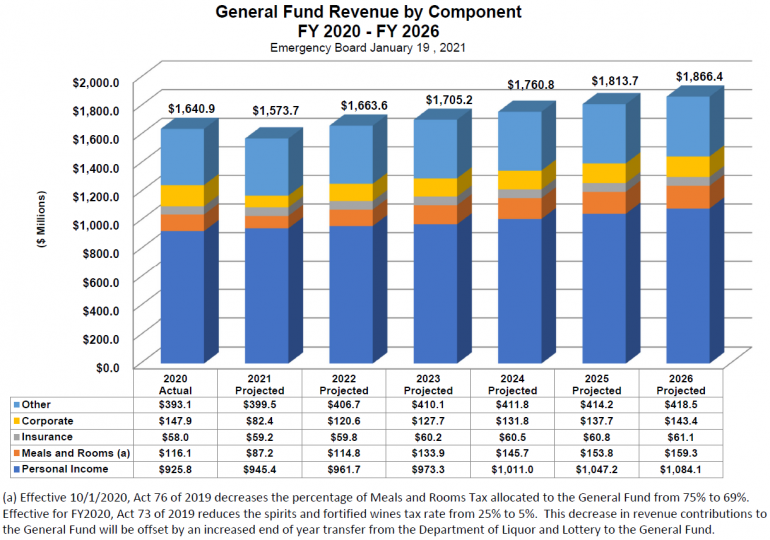
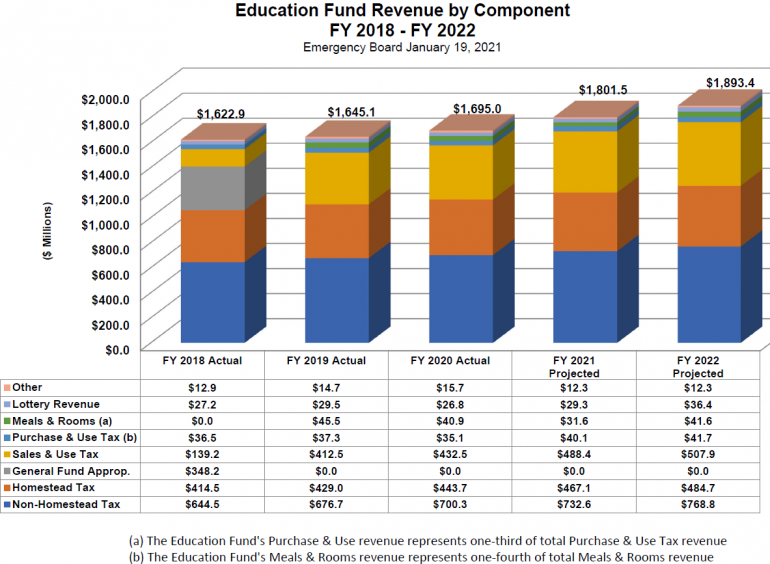
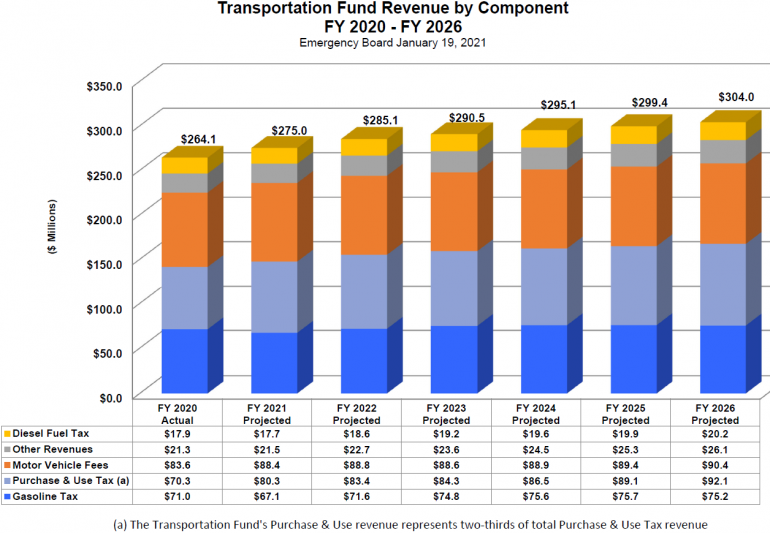
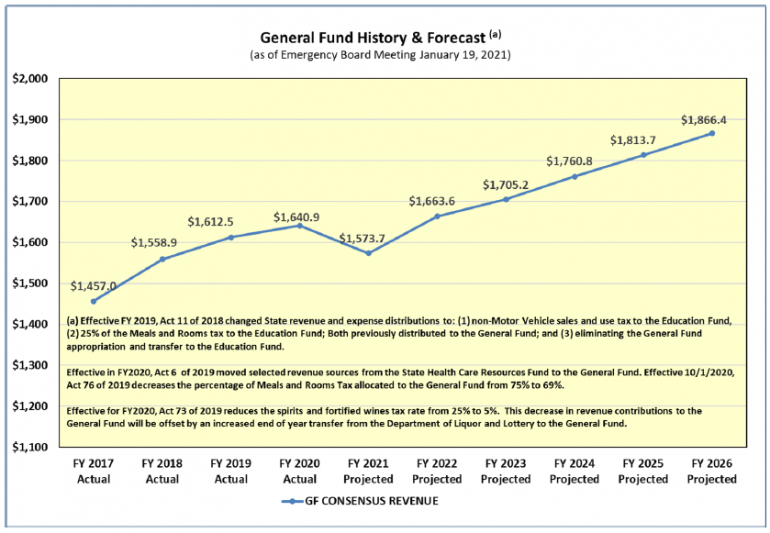
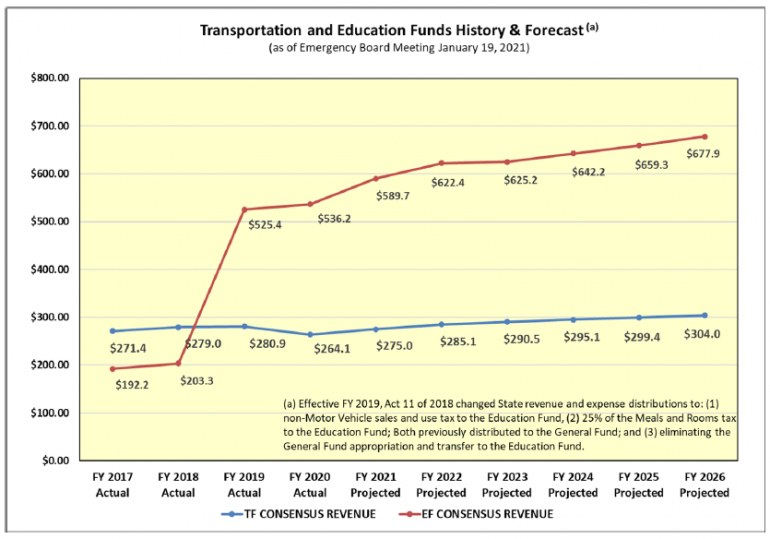
On January 19, 2021, the Vermont Emergency Board adopted revised General, Transportation and Education Fund Consensus Revenue Forecasts for the remainder of FY2021, FY2022 and FY2023 as compared to the adopted January 2020 forecast.
The General Fund (GF) for FY2021 was projected to be $1,573.7 million (-$23 million, -1.4%) while the FY2022 GF was projected at $1,663.6 million (+$52 million, +3.2%).
The Transportation Fund forecast for the remainder of FY2021 was projected at $275.0 million (-$12.9 million, -4.5%) and for FY2022 was projected at $285.1 million (-$6.1 million, -2.1%).
The Education Fund (portion subject to consensus revenue forecast) was projected at $589.7 million for FY2021 (+$15.4 million, +2.7%) and $622.4 million for FY2022 (+$31.5 million, +5.3%).
RELATED STORIES
Governor Scott delivers $6.8 billion FY22 budget address
Advocates weigh-in on Scott's budget proposals
Videoconference Public Hearings on the Governor’s Recommended FY 2022 State Budget
The Vermont House and Senate Committees on Appropriations are seeking public input on the Governor’s Recommended FY 2022 State Budget and will hold two public hearings on Monday, February 8, 2021. The first from 1 pm to 2 pm (2:30 pm) and a second from 6 pm to 7 pm (7:30 pm) via videoconference.
The Committees will take testimony on the Governor’s recommended State budget at the above date and times. Anyone interested in testifying should sign up in advance of the hearing through the following online form: https://legislature.vermont.
There may be time limits on testimony, depending on the volume of participants—expect a time range of 2–3 minutes. To view the Governor’s FY 2022 recommended State budget, go to the Department of Finance and Management’s website or click the following link: https://finance.vermont.gov/
The public hearings will be available to watch live on YouTube at the following link: https://legislature.vermont.
- Supports FY2022 total General Fund appropriations of $1.99 billion.
- Supports base spending with base funding.
- Fully funds state retirement and debt obligations.
- Maintains all statutory reserve levels.
As part of the Governor’s ongoing pandemic response, he proposes using $210 million in one-time funding for economic recovery through investments in housing, infrastructure, broadband buildout, environmental stewardship, carbon reducing initiatives, and government modernization, among others.
- As part of the one-time investments, makes a down payment on state government modernization by creating a Technology Modernization Fund to propel costly, and much needed, IT upgrades.
Economic Recovery and Downtown and Village Center Revitalization:
The favorable revenue picture supporting this budget is not a reflection of a strong Vermont economy – instead, it is a result of fleeting federal funding. We must focus on economic recovery to rebuild the foundational blocks of the state budget, which are predominantly personal and corporate income taxes as well as consumption-based taxes such as rooms and meals and sales and use taxes. We must fortify these revenue streams while responding and recovering from this pandemic. The following investments of surplus revenue are strategically aimed at economic recovery:
- $3 million to the Working Lands Enterprise Fund – the increase to this program recognizes Vermont’s distinction for good, locallysourced food. This investment will support Vermont’s farmers, producers, and local markets and co-ops where goods are exchanged, which make up a critical portion of our food system.
- $10 million in addition to $14 million in the Capital Bill to buffer Vermont’s outdoor recreation assets and economic sector:
o $5 million for the Vermont Outdoor Recreation Economic Collaborative (VOREC) grant program – we launched this initiative three years ago as a pilot with only $200,000 in funding. But it has helped develop projects such as Newport’s Waterfront Recreation Trail and Randolph’s Outdoor hub. Communities in every corner of the state have a lot to offer in outdoor recreation opportunities, which support local business and drive tourism. These grants will spread the love to more communities who need help developing some of the infrastructure.
o $5 million to improve access at state parks and improve public/private trail networks that have seen increased use since the pandemic – Vermont’s state parks are part of what makes Vermont such a nice place to live. But not all Vermonters can enjoy them equally. These one-time grants will improve accessibility for all Vermonters at our state parks as well as mitigate the higher use of our many recreational trail networks since the beginning of the pandemic.
$1 million in seed funding for a tourism and marketing fund that is tied to rooms and meals tax performance – While tourism is one of Vermont’s biggest economic sectors, our tourism marketing budget is the smallest in the northeast and half that of our next closest competitor. Our tourism and hospitality industry is arguably the best in the region – and they perform at a disadvantage. When this pandemic is over, people will start to travel again, and we should be ready to remind them what Vermont has to offer. While this proposal is supported with one time money, this fund would be replenished in future years by the difference between actual and forecasted rooms and meals taxes, rewarding the sector responsible for bringing in the revenue.
$1.75 million for the downtown and village center tax credits – This increase lifts the existing program cap to $4.75 million which will help meet demand. The downtown and village center tax credit helps to stimulate private investment, create jobs, restore buildings, and jump start revitalization in Vermont communities. Successful projects range from small inns and rental apartments to multimillion-dollar downtown redevelopments.
$1 million for the consumer stimulus program created by the Agency of Commerce and Community Development (ACCD) – Last year, using federal Coronavirus Relief Funds (CRF), ACCD stood up a consumer stimulus program to fund discounts for Vermonters at participating local businesses. The $500,000 pilot helped 975 businesses and offered discounts to 15,864 Vermonters. The average business received $436 from the program. In addition, the program stimulated a 73 percent increase in spending from consumers when they redeemed their offer which generated about $1.5 million in additional consumer spending at businesses.
$5.5 million for the Better Connections program – This proposal, combining General Fund and Transportation Fund monies, will expand the Downtown Transportation Fund to include approximately 38 municipalities and broaden opportunities for transportation investments to smaller rural villages. The program helps fund sidewalk renovations, bike lanes and other infrastructure projects which help Vermonters move about their communities. The Better Connections program is a multi-agency partnership (VTrans, ACCD, ANR, and Department of Health) that supports local transportation planning and community revitalization efforts.
$5 million for the Better Places Initiative – This initiative will establish a community grant program that strategically coordinates the efforts of funders supporting place-based economic development projects to improve and revitalize public spaces. These can include a new walking or cycling path, turning vacant buildings into pop-up markets, improving community gathering spaces, increasing outdoor dining opportunities, expanding cultural programming, or testing a street closure to make more room for pedestrians and retailers or for farmers markets to operate safely.
Housing:
Vermont’s low-income and rental housing markets have been a critical issue for the Governor and General Assembly, helping to pass the “Housing for All” bond in 2017, which generated more than $100 million in public and private funding for affordable housing for working Vermonters. While this was the single biggest investment in affordable housing ever, more can be done to make living in the Green Mountain State affordable. The following initiatives are directed at affordable housing as part of the Governor’s bigger economic recovery strategy:
$20 million to fully fund the Vermont Housing and Conservation Board – The Vermont Housing & Conservation Board (VHCB) makes grants and loans for the acquisition, rehabilitation, and construction of affordable housing by nonprofit housing organizations. Since 1987, VHCB has contributed to the development of more than 12,500 permanently affordable homes around the state. In addition to addressing the shortage of affordable housing, housing construction and rehabilitation stimulate our economy and provide jobs. Housing developments eligible for funding include rental housing, mobile home parks, single-family home ownership opportunities, and service-supported housing for seniors, victims of domestic violence, or persons with physical, developmental, or mental disabilities.
- $3 million into the Vermont Homeowner Investment Program (VHIP) –
o Rental Housing Investment Program: $2 million – The Department of Housing and Community Development’s Rental Housing Program will incentivize private apartment owners to re-invest in rental units that have been closed due to housing quality concerns. By providing more available grants, to be matched with private investments, VHIP will continue to allow owners of blighted, vacant and non-code compliant units to make the necessary safety and weatherization improvements to increase the availability of affordable housing. o Homeowner Purchase & Rehabilitation Investment: $1 million – This program will assist middle-income families to purchase and rehabilitate affordable homes currently available in “Opportunity Neighborhoods” throughout Vermont’s slower growing regions. Incentives will encourage the purchase and rehabilitation of dilapidated and deteriorated housing. This will provide families new options to create safe, energy efficient, and more affordable housing while also reinvigorating housing stock in our communities. By targeting incentives and rewarding employer participation, regional demographic challenges will also be addressed. Minority Ownership Set-aside: 25% - Vermont is fortunate to have a high homeownership rate, over 70%. However, taking a closer look, the homeownership rate for Black, Indigenous and People of Color (BIPOC) is far lower than the rate for white Vermonters. Systemic racism, lack of access to capital and federal housing policies have contributed to these inequities. We must acknowledge and correct these wrongs and we must provide opportunity for people of color to live the American dream and become homeowners here in Vermont. One quarter of all newly invested VHIP Homeowner funds will be reserved for minority and marginalized households.
Broadband Build Out:
The COVID-19 pandemic has underscored the importance of broadband to the state’s economic well-being. While the long-term impact of the pandemic is speculative, it is reasonable to surmise that remote work arrangements between employees and employers will become more prevalent in Vermont and across the country, which provides a good basis for making big investments in Vermont’s broadband infrastructure.
- $19.9 million for broadband build out –
o $2.5 million for the Line Extension Consumer Assistance Program – The Department of Public Service created this program using Coronavirus Relief Funds to help fill internet gaps during the pandemic. This program partners with cable and internet service providers to pay the consumer’s portion of a line extension. These are typical arrangements between a consumer and an internet service provider who lacks an economic incentive to extend a line. The consumer pays some upfront cost for the extension and then has a service agreement with the internet service provider. This program would help offset that upfront cost, extending broadband to the more remote parts of the state. o $1.5 million for a State-wide pole data harvesting study – Pole data is helpful to Communications Union Districts (CUDs) in designing a network. Contractors would review poles in CUD territories and estimate make-ready costs and other features that could help CUDs plan and configure fiber builds. The pole data harvesting study funding would be issued to CUDs in the form of grants. o $15.9 million to create a Broadband Facilities Deployment program – The program would make grants and administer a revolving loan fund to make loans to facilities-based providers, such as CUDs. The program could be time limited and would fund a variety of different projects, such as last-mile fiber construction and cell towers, as well as initiatives designed to increase broadband adoption.
Environmental Stewardship:
Vermont has strong environmental standards and regulations – and we are proud of it. However, this commitment does not stop all environmental contamination. Sites across the state that could otherwise serve an economic purpose sit empty because of chemical contamination that exceeds appropriate and healthy levels. Brownfields are sites that, with some one-time funding, can go from community eyesores to opportunities. Some examples of brownfield sites include Springfield’s Jones & Lamson building, the Bellows Falls Garage, and the Lynnwood Crown Farm in Derby.
$25 million for brownfield remediation – The program will be jointly administered and funded through the Department of Environmental Conservation and the Agency of Commerce and Community Development to identify sites and allocate money that has the greatest environmental and economic impact for all 251 communities in Vermont. $10 million to backfill the Environmental Contingency Fund – this fund, administered by the Secretary of the Agency of Natural Resources is financed through financial settlements with violators of environmental laws. The Fund finances emergency clean-ups of contamination and chemical discharges. However, liabilities against the fund regularly outpace environmental settlement payments into it. This large infusion of money will help the fund remain solvent in the coming years. It will also be used to fund testing for all potentially at-risk schools for polychlorinated biphenyl (PCBs) contamination, the airborne contaminant recently found in Burlington High School.
Reducing Vermont’s Reliance on Fossil Fuels, Doing our Part to Address Climate Change:
Vermont has set aggressive goals in reducing our reliance on fossil fuels. These initiatives will help us meet those obligations and infuse local economies with project funding right away:
$25 million for weatherization, ‘VT Warms’ – Estimates put the need at more than 100,000 low-to-moderate income weatherization projects before the end of the decade to meet our greenhouse gas reduction requirements. We must scale up our investment, but we also must use proven programs from other jurisdictions to stretch our dollars. Specifically, these dollars will be invested in the following ways:
o $4 million to the Department of Children and Families to increase by 20 percent low-income weatherization conducted by regional weatherization partner agencies;
o $16 million to the Vermont Housing Finance Agency (VHFA) to develop programs that leverage private capital to expand the reach of Vermont’s low-to-moderate income weatherization efforts and support the delivery of those programs and projects; and
o $5 million to enable the expansion of the highly successful State Energy Management Program (SEMP) to municipal buildings.
$10 million for Affordable Community Solar Energy – This program will help low- and moderate-income Vermonters invest in community solar developments. Participating households maintain a virtual ownership share by sponsoring the community scale solar project. Customers may also combine storage with solar. One-time funds would be used to help buy down the cost of sponsoring solar panels for participating customers through lower rates. Participation in the program would be available to all, but the subsidy would be limited to income qualifying customers.
Cradle-to-Career:
Prior to the pandemic, the institutions comprising Vermont’s cradle-to-career system faced significant challenges, either from increasing property tax rates to pay for school budgets; structural deficits across most of the Vermont State College System; or access and affordability challenges in our child care and early learning system for families with young children. To come out of this pandemic stronger than before, we must continue to think of these issues and institutions as a single system and develop greater coherency in the way they serve Vermonters. That might not entail more funding in the aggregate, because these investments constitute the biggest expenditure in the state budget by a very wide margin. The following initiatives continue the evolution of a single, cradle-to-career education system with investments in the areas of need and greatest return.
$20 million to the Vermont State College System – Since the beginning of the pandemic, the Vermont State Colleges have received $89 million through the state’s base appropriation, direct federal payments, state Coronavirus Relief Funds, and General Funds in the Budget Adjustment Act. The Governor is proposing to appropriate another $20 million in one-time General Funds as bridge funding for the VSC System to support them during their structural reorganization. This level of funding cannot be sustained, and the Governor is proposing this investment with the caveat that this is unlikely to be repeated. The Governor appreciates the role the legislature has taken in addressing the fiscal challenges within the system and for their work to create the Select Committee on the Future of Public Higher Education in Vermont in Act 120 of 2020.
- $600,000 additional funding to the Vermont Student Assistance Corporation –
o $500,000 in supplemental funding for VSAC advancement grants – These grants assist adult learners with their education and training. The grants provide up to $2,500 for non-degree technical education.
o $100,000 addition to the VSAC Aspirations Program – This program boosts postsecondary matriculation and is run by VSAC in collaboration with Vermont high schools. Currently VSAC pays for it out of their own budget.
Funds ‘Year 3’ of the Child Development Division’s Redesign of the Child Care Financial Assistance Program with existing resources – In continuation of the five-year plan, year 3 is planned as the “flip year”: implementation for the redesign of the program to set copayment amount by family rather than by child, which should result in an increase in the number of children and eventually the number of families utilizing the program. With the completion of upgrading the first module of CDD Information System (previously known as BFIS) by the target date of October 1, 2021, CDD will be able to implement this change in calculating subsidy payments. This redesigned system will result in increased childcare affordability for Vermont families and allow Vermont to come into compliance with federal CCDF requirements. Based on current Covid-19 utilization patterns, no FY2022 investment is needed to implement the policy change. Once utilization returns to Pre-COVID levels, a $5.5 million ongoing investment will be needed.
Protecting the Most Vulnerable:
Most of state government’s programs aimed at protecting the most vulnerable require base funding because, despite our best efforts, the need for these programs does not expire at the end of a one-time investment. The Governor is sensitive to these pressures and used nearly all available base revenue attributable to the January 19, 2021 revenue upgrade to cover base expenses so that one-time money for base programs does not burden the budget process next year.
- $42 million to the Agency of Human Services (AHS) Base Budget to mitigate reliance on one-time bump to the Federal Medicaid
Assistance Percentage (FMAP) – The federal relief bills have boosted states FMAP for the first two quarters of FY2022, which impacts the federal matching funds for programs run through Vermont’s Global Commitment to Health waiver. When the revenue forecast was more dire, the Governor’s budget balanced on these virtual, one-time funds. However, with the revenue upgrade, the Governor’s budget restores the base funding amount in the AHS budget, better positioning the Agency and state government to meet the needs of Vermonters in the years to come.
- $900,000 for to fund policy recommendations from the Governor’s Justice Reinvestment Working Group:
o $400,000 for community behavioral health intervention – funding split between the Department of Mental Health and the division of Alcohol and Drug Abuse Prevention at the Department of Health
o $200,000 for domestic violence intervention programming
o $300,000 for transitional housing administered by the Department of Corrections.
Government Modernization:
The Governor and General Assembly both recognize state government must improve the way it manages and funds Information Technology (IT) projects. The Governor’s Executive Order and the General Assembly’s affirmation to create an Agency of Digital Services achieved half the battle by establishing better oversight and prioritization of IT. However, IT projects, which are typically complicated, expensive, and critical to the work of state government, are paid for via piece meal appropriations from various sources – sometimes out of an agency or department’s base budget, other times with one-time funds or through bonding. The Governor proposes to use a considerable portion of the FY2021 surplus to establish an IT fund, which will jump start a dozen IT projects, prioritized in the Administration’s budget development process.
$53 million to establish the Technology Modernization Fund to be overseen by the Agency of Digital Services. The fund will be used to purchase and upgrade technology platforms, systems, and cybersecurity services, and grant management platforms used by agencies and departments statewide.
Retirement Systems Financial Integrity Report
As specified in 32 V.S.A. §311, the following is a report on the financial integrity of the State Employees’ and State Teachers’ Retirement Systems.
Contribution Levels
VSERS
As a result of the June 30, 2020 actuarial valuation, the actuary for the Vermont State Employees’ Retirement System (VSERS) recommended a FY 2022 contribution of $119,967,770 to the pension plan (VSERS pension) and $109,708,031 to the Vermont State Employees’ Other Post-Employment Benefits (VSERS OPEB) plan.
The State’s VSERS pension contribution is offset by $1,350,000, based on the Treasurer’s estimate of FY 2022 contributions to VSERS by town participants, slightly reducing the state contribution to $118,617,770.
The State’s contribution to the VSERS OPEB during FY 2022 will be $37,206,521, consisting of $37,086,521 which is the Treasurer’s December estimate of VSERS retiree benefit costs on a pay-asyou- go basis, plus $120,000 for the State Employee retiree life insurance premiums, as estimated by the State Treasurer’s Office. The Governor’s recommended FY 2022 budget has set aside funds with the intent of funding the needed VSERS pension and VSERS OPEB pay-go contributions in full.
VSTRS
As a result of the June 30, 2020 actuarial valuation, the actuary for the Vermont State Teachers’ Retirement System (VSTRS) recommended a FY 2022 contribution of $196,206,504 to the pension fund (VSTRS pension) and $102,153,408 to the Retired Teachers’ Health and Medical Benefits (VSTRS OPEB) fund. The FY 2022 VSTRS contribution of $196,206,504 will be funded by $152,045,711 of State general funds, $37,600,918 of State education funds and $6,559,875 from local education agencies for teacher salaries supported by federal grants. Of the $6,559,875, $1,300,615 will be applied to the normal cost, and $5,259,260 will be applied to the unfunded liability.
The Treasurer’s December 2020 estimate for VSTRS OPEB costs on a pay-as-you-go basis is $42,569,048. That amount will be contributed to VSTRS OPEB during FY 2022, using $35,093,844 of State general funds and $7,475,204 from other sources projected by the Treasurer, including $4,108,428 from the employer annual charge for new teacher health care and $2,951,944 from subsidies under the Employee Group Waiver Plan (EGWP), which was implemented in 2014.
Funding Levels
State statutes define the method of funding the retirement systems, which is assessed and reported by an independent actuary. Based on the actuarial valuation, the funded ratios (and resulting unfunded liability) for the VSERS and VSTRS pension systems for the period ended June 30, 2020 are 63.81% ($1,111,186,438 unfunded liability) and 50% ($1,951,128,430 unfunded liability) respectively. The funded ratios (and resulting unfunded liability) for the VSERS OPEB and VSTRS OPEB plans for the period ended June 30, 2020 are 3.88% ($1,425,377,649 unfunded liability) and 0.69% ($1,259,400,309 unfunded liability), respectively. The pension system (VSERS and VSTRS) values are derived using the GASB 67 accounting standard actuarial valuations, and the OPEB system values are derived from the GASB 74 actuarial valuations, all of which are produced by the State’s actuary.