

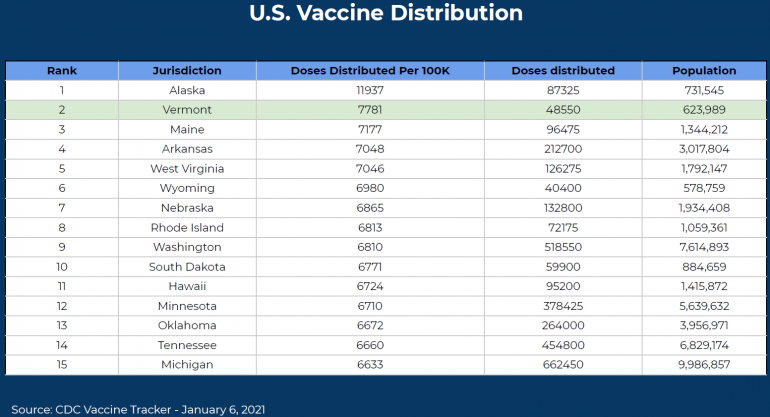
Vermont Business Magazine The Vermont Association of Hospitals and Health Systems (VAHHS), which represents all of Vermont’s 14 non-profit hospitals, has been working in partnership with the Vermont Department of Health (VDH) and community providers to administer COVID-19 vaccinations to Vermonters identified in the State’s plan as qualifying for the first phase of Vermont’s vaccination effort. More than 17 million doses have been distributed across the country, with nearly 50,000 coming to Vermont so far and over 21,000 administered.
As of January 5, Vermont Hospitals have administered the first doses of the Pfizer and Moderna Vaccines to more than 17,700 Vermonters. This number does not take into account clinics that are scheduled in the coming days, which means the amount of administered and scheduled vaccination is likely much closer to the 34,000 vaccines Vermont received. Pharmacies are separately distributing vaccine to long-term care facilities.
According to state officials, Vermont is second in the nation for prevalence of vaccine distribution. This accomplishment comes despite significant logistical, operational and scheduling challenges hospitals have encountered.
“It is hard to understate the complexity of this undertaking given all of the other COVID-19-related demands, but our hospitals are rising to the challenges they face every day and getting this important work done,” said Jeff Tieman, President and CEO of VAHHS. “We appreciate the partnership from the State and community providers as we follow the plan outlined by the federal government and VDH. We have a population that is eager to be vaccinated and we’ll need ongoing patience and support to continue making progress.”
Delays and shortages of vaccines have added to the already intricate process. Hospitals have routinely experienced delays in the arrival of doses, requiring clinics to be rescheduled. Reduced numbers of doses also add to the challenge. Last week, the State received approximately 7,800 doses instead of the more than 11,000 allocated. That means hospitals received just under half, or 3,900, of the 8,000 doses they were expecting. Conversely, in some instances there are more doses than expected in a vial and hospitals must rush to find a vaccine candidate before the dose expires in a matter of hours. Taken together, hospitals are being required to make real-time adjustments to account for these changes.
Dr. Kathleen McGraw, Chief Medical Officer at Brattleboro Memorial Hospital (BMH) in Brattleboro, says BMH has had to reschedule clinics due to changing vaccine allocations, creating some frustration and worry on the part of community-based providers. Despite the delays, through close coordination with local providers, emergency medicine personnel and home health and hospice staff, McGraw estimates that BMH will complete the first doses for the 1A population by the week of January 18.
“This has truly been a team effort,” she emphasized. “We would not be where we are today without the leadership of the State, as well as the clinical and non-clinical staff who stood up the vaccine clinics in record time. I know from talking to my hospital colleagues around the state, that each and every organization is working diligently to get this group vaccinated efficiently and equitably notwithstanding the challenges.”
Hospitals and the State estimate it will be many more weeks before 1a vaccinations are complete and second doses—which are required for both approved vaccines—will begin this week. According to the State’s plan, the first three weeks called for vaccines to be prioritized with specific percentages allotted to hospital, emergency medical services and home health and hospice workers. This week, community provider vaccinations begin. VAHHS urges anyone in the 1a category to reach out to their local hospital after January 11, if they have not yet been contacted for vaccine.
Additionally, the State released new information last week regarding later phases of the vaccine distribution plan, which will start with “age bands” beginning with Vermonters age 75 and above and then moving to younger Vermonters with particular underlying health conditions, thus prioritizing those who are older and more vulnerable. The stated goal is to save lives. Details for when and where those vaccines will be administered will be available in the weeks to come.
“Since the outset of this pandemic, Vermont has provided a national standard for our response, the result of a massive amount of hard work and dedication by so many,” Tieman added. “We will not let up now.”
Source: Montpelier, VT – The Vermont Association of Hospitals and Health Systems. http://www.VAHHS.org