

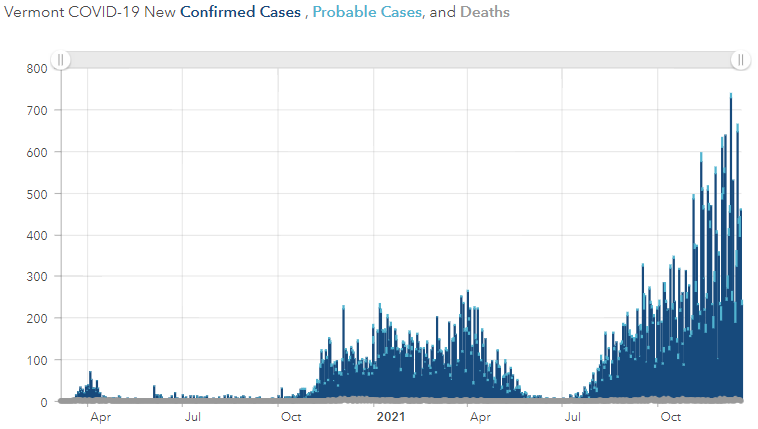
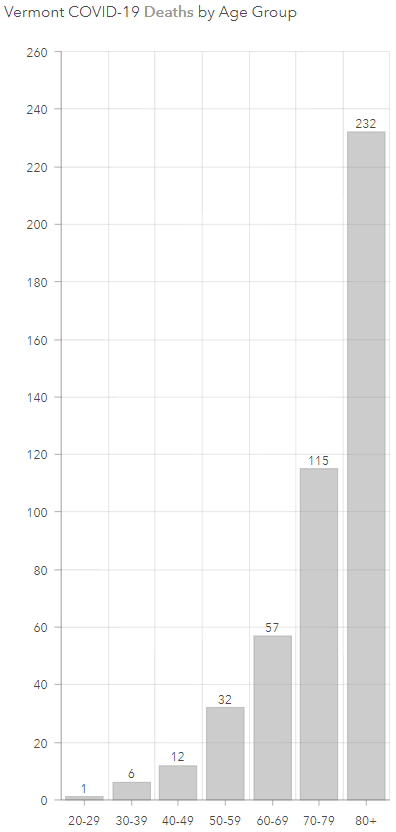
Vermont Business Magazine The Vermont Department of Health on Sunday reported 242 cases of COVID-19, 463 on Sunday and 454 cases Saturday. The VDH reported on Saturday Vermont's first case of the Omicron variant. State health officials have said they were expecting the variant to show up in Vermont soon as it has spread to most states. The VDH also reported today three additional deaths, including one in the 30-39 age band for the first time in several months. COVID deaths now stand at 455 statewide. There have been 23 deaths in the last seven days.
There were 49 COVID-19 related fatalities in Vermont in September 2021, and 47 deaths in October, which were the second- and the third-worst months on record (December 2020, 71). There were 40 fatalities in November and 37 so far in December. Vermont is also close to the pace set last December.
Hospitalizations today were 55 (down four) after breaking its one-day record December 8 with 92 statewide. ICU stays, which also had been elevated, were 19 (up one). The one-day record there was set December 7 (31).
VDH reported Saturday that the Omicron coronavirus variant has been found in a person from Lamoille County, following Friday's announcement that a sample of Burlington wastewater also found evidence of Omicron. Health officials said it was only a matter of time before the fast-moving, but perhaps less dangerous mutation arrived in Vermont. Every surrounding state and Quebec has confirmed Omicron COVID-19 cases.
Genetic sequencing identified the new Omicron variant in a specimen collected on December 8, 2021. The individual is a Lamoille County resident in their 30’s. The individual was fully vaccinated and had been experiencing mild symptoms. The Health Department has partnered with the Broad Institute to perform genetic sequencing of samples collected from lab-confirmed COVID-positive cases.
“We knew it was only a matter of time before we saw Omicron in our state, and made sequencing a priority,” said Dr. Levine. “Vermont is a national leader in the proportion of positive tests on which we perform genomic sequencing. This is key to our ability to quickly identify and respond to cases.”
 Global research is finding that the Omicron variant spreads faster and more efficiently than Delta, which is responsible for the current surge in cases and hospitalizations in Vermont and elsewhere. The new SARS-CoV-2 variant, formally called B.1.1.529, has already been found in more than 40 U.S. states and territories.
Dr. Levine said that the speed at which Omicron is likely to become the dominant strain means it is even more important for people to act quickly to be vaccinated and get their booster shots. “As the effectiveness of the initial vaccines begin to wane, boosters provide the protection you need against bad outcomes, including serious illness, hospitalizations and death, especially for people whose age or health conditions make them vulnerable.”
Scientists are continuing to study how Omicron compares to the already highly transmissible Delta variant, including what impact the new variant may have on the severity of illness and the effectiveness of current vaccines. The CDC expects that anyone with Omicron infection can spread the virus to others, even if they are vaccinated or don’t have symptoms.
“I can’t emphasize this enough: All Vermonters need to be as protected as possible, as soon as possible. So get vaccinated, get children age 5 and older vaccinated, and if you are due to get your booster shot, get it as soon as you can,” said Dr. Levine. “Vaccines are our best line of defense against this virus, and our ability to slow Omicron’s spread and to reduce the chances of new variants from emerging depends on our being fully protected.”
In addition to being vaccinated and boosted, Vermonters should continue taking these common-sense precautions to protect against the spread of the virus in our communities, now and during the holidays,
- Stay home if you feel sick.
- Get tested if you have any symptoms – even if mild, or if you may be a close contact, or have taken part in activities that could put you at risk, such as large gatherings or travel.
- Wear a mask at indoor public settings and around anyone at higher risk of COVID-19.
- Gather with others safely, which means small group sizes and testing before holiday celebrations.
For more information:
- Vaccination and booster locations: healthvermont.gov/MyVaccine
- Protecting yourself: healthvermont.gov/preventCOVID19
- Testing for Covid-19: healthvermont.gov/covid-19/testing
Learn more about the Omicron variant from the CDC: https://www.cdc.gov/coronavirus/2019-ncov/variants/omicron-variant.html
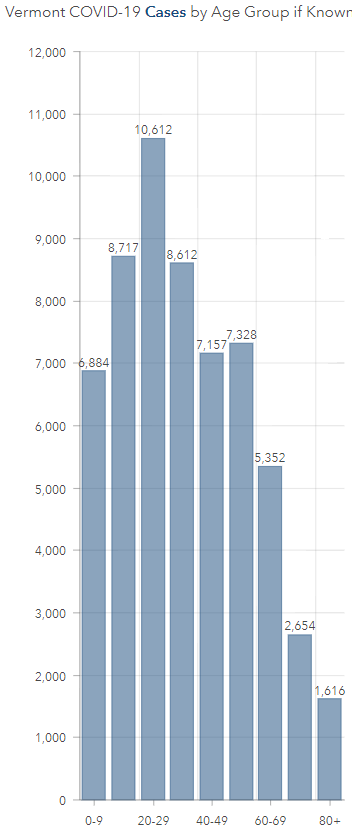 Recent fatalities had all been among Vermonters 50 and older until two weeks ago when there were two deaths in the 40-49 age band and now one in the 30-39 age band. These were the first fatalities for anyone under 50 in more than a month. The oldest age band has had the highest number of deaths since the beginning of the pandemic, despite having by far the fewest number of total cases.
The rate of fatalities by month has slowed even as cases have increased, as nearly all of the most vulnerable Vermonters have been fully vaccinated. (The number of fatalities is sometimes adjusted by the VDH as information is updated).
The most recent data provided by the VDH for time frame 11/28/21 - 12/11/21:
- 7 deaths among fully vaccinated Vermont residents (Rate: 0.16 per 10,000)
- 10 deaths among not fully vaccinated Vermont residents (Rate: 0.54 per 10,000).
Vermont has the lowest COVID fatality rate in the nation (71 per 100,000 residents). Hawaii (75) is second lowest. Mississippi (348) and Alabama (333) have the highest fatality rates. SEE FULL LIST BELOW.
Cases have been especially elevated in southern Vermont, with Bennington County now supplanting Orleans with the most cases per capita, with Essex County third and Rutland County fourth.
Highlights of Governor Scott's press briefing last Tuesday:
- Governor Scott continues to resist the persistent call for a statewide mask mandate. He said why punish the 95% of Vermonters who have done the right thing when 75 percent of the hospital beds and 90 percent of the ICU beds are of the unvaccinated? The unvaccinated are 34 times more likely to die from COVID. The governor added that while he is still urging everyone to get vaccinated and boosted, those who are determined not to get vaccinated will be difficult to convince at this point.
- DFR Commissioner Pieciak said that 930 Vermont lives have been saved with the vaccines since they first came to Vermont on December 15, 2020, according to statistical analysis. This is double the number of total fatalities since the beginning of the pandemic.
- Cases are higher now than a year ago but deaths are trending to less than half.
- COVID cases and hospitalizations in southern Vermont are still high.
- Overall cases are down this week but health officials are expecting cases to increase following Christmas and New Year, as they did last year.
- As for new Omicron variant, it is in every surrounding state and Quebec. Health Commissioner Dr Mark Levine said early data suggests Omicron could transmit faster but milder, meaning it could race through the population and no one would get too sick and then nearly everyone would have some level of immunization.
- While there is still no Omicron, there is also none of the original coronavirus variant that caused COVID-19 in the first place. The current cases are "100 percent" related to the Delta variant.
- Dr Levine said he had been thinking that March could be the end of the pandemic and the beginning of an endemic of COVID, but omicron could hasten that or perhaps extend it if it turned out to be worse than expected. He said we would have to wait and see. The end of March is typically when flu season winds down.
- Cases the last seven days edged lower than the previous seven days..
All of the highest case counts since the beginning of the pandemic have occurred since November 3, 2021. Timing of when tests are taken and when results come back has affected daily totals, but there has been a post-Thanksgiving surge in cases in Vermont.
