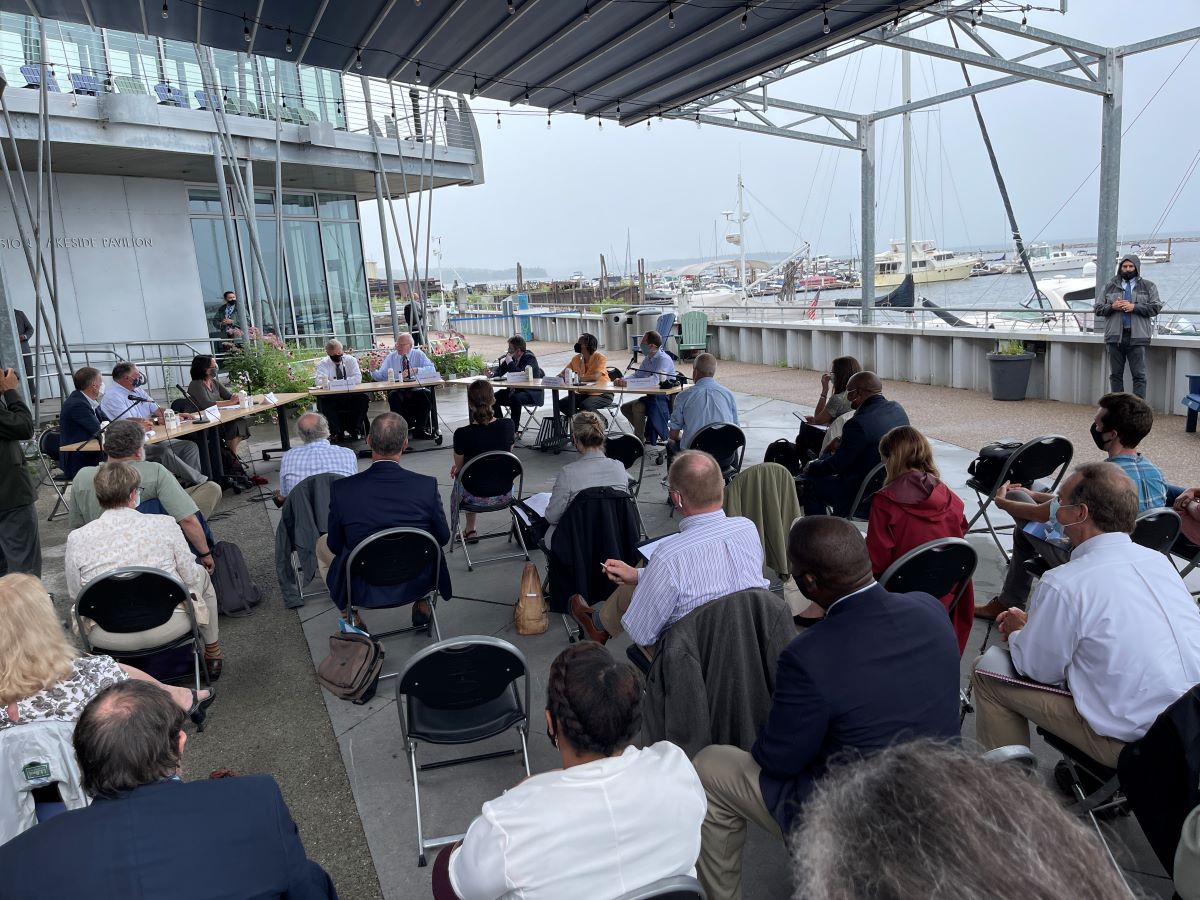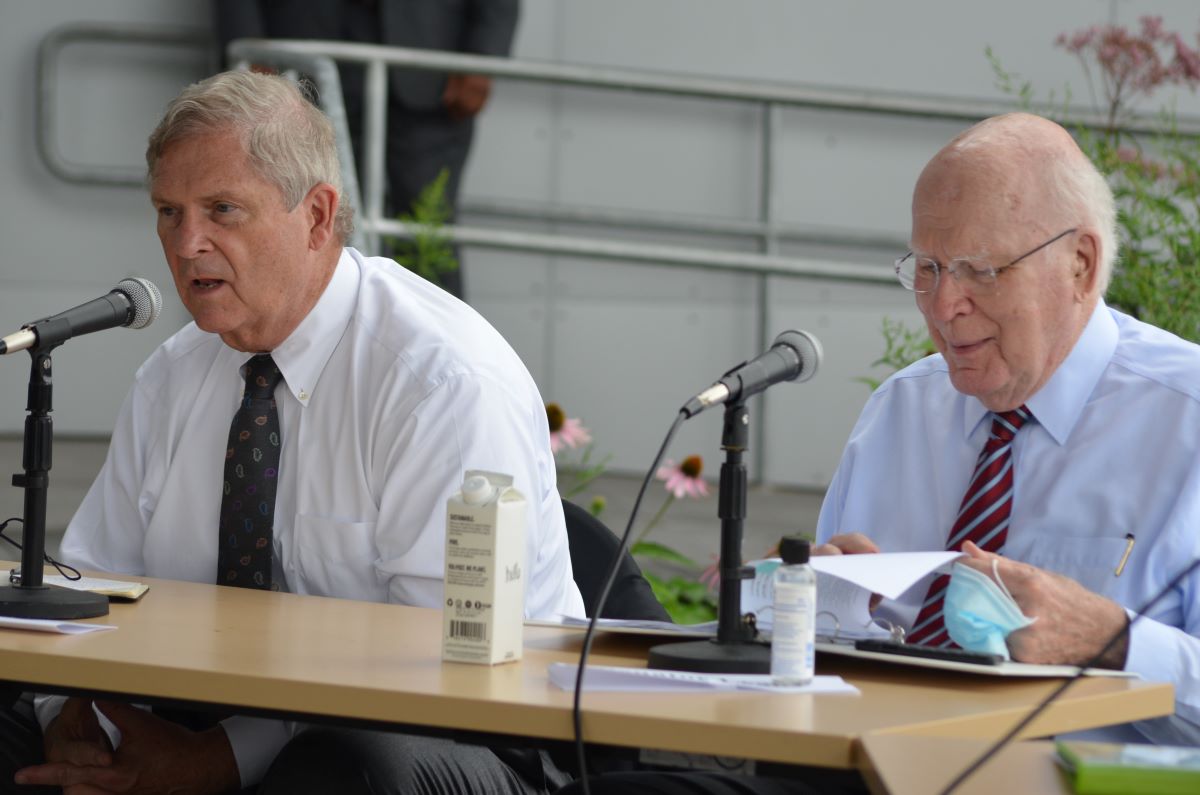
USDA Secretary Tom Vilsack speaks during the roundtable hosted by Vermont Senator Patrick Leahy. VBM photos.
by Timothy McQuiston, Vermont Business Magazine US Agriculture Secretary Tom Vilsack returned to Vermont last Thursday on a drizzly day on Burlington's waterfront. Vilsack was hosted by Senator Patrick Leahy (D-Vermont) at the Leahy Echo Center. They were joined by several Vermont officials in a roundtable discussion. Two of the main themes at the discussion were Vermont's diversification of its agriculture industry and environmental impacts of farming on the state's waterways. Vermont is in the middle of vigorous and expensive mitigation efforts to reduce and restore the land and water.
Lake Champlain, just off the patio from the event, is particularly vulnerable to farm runoff and phosphorus is major concern for many of the states lakes and ponds.
Vilsack is the only Agriculture Secretary to serve in two different administrations. He previously came to Vermont in 2010 during the Obama administration.
Vilsack and Leahy were joined by Echo Center Executive Director Phelan Fretz, Richmond dairy farmer David Conant, ANR Secretary Julie Moore, Agriculture Secretary Anson Tebbetts, State Climatologist Lesley-Ann Dupigny-Giroux, and Vermont Land Trust President Nick Richardson.
This latest roundtable included presentations by Vermont Agency of Natural Resources Julie Moore and Vermont Agriculture Secretary Anson Tebbetts.
The two administration officials, and others at the roundtable, presented much data to support the steps Vermont has made and is continuing to make, on phosphorus and carbon sequestration -- basically letting the land hold these environmental impacts instead of letting them run off into the states waterways or lift into the atmosphere.
Their presentations, in part, are below.
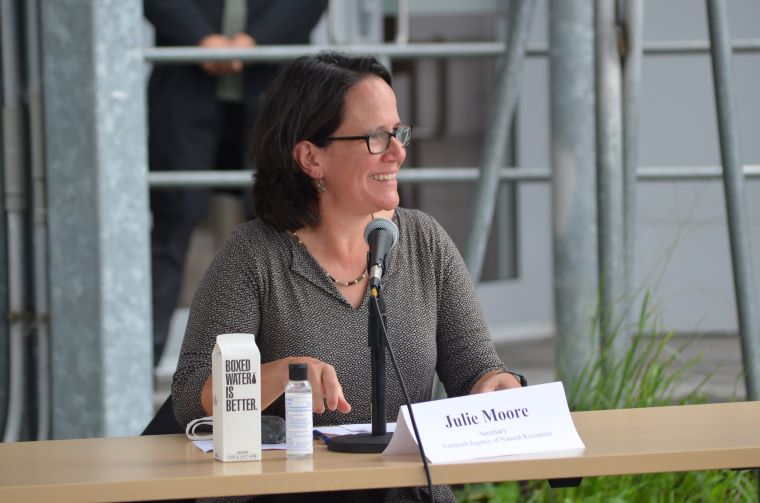
By Secretary Julie Moore
Good afternoon. It is such a pleasure to be here with all of you today. I want to start with some thank yous.
First, to Phelan and the incredible staff here at ECHO for hosting this conversation today.
To Senator Leahy for your steadfast support for Vermont and particular care and attention you consistently bring to the stewardship and restoration of our great lake. The Champlain watershed is a large and complex ecosystem, and the sustained efforts you have championed are essential to our progress toward the clean water goals you, I and so many Vermonters share.
And to Secretary Vilsack for the engagement and expanded commitment of your agency to efforts on the ground here in Vermont. In particular, your team at the Natural Resources Conservation Service has been an incredible partner in this work, which I know Secretary Tebbetts will speak to in more detail during his remarks.
The State of Vermont, and our partners in New York and Quebec, having been working collaboratively to address phosphorus pollution in Lake Champlain for nearly 30 years, and my professional involvement in the stewardship of Lake Champlain spans more than 15 years at this point.
And over the past 15 years implementation efforts have accelerated throughout the watershed, and even more dramatically since 2014 when Vermont received its first award under the Regional Conservation Partnership Program, or RCPP, and began work in earnest on what is now referred to as Vermont’s Clean Water Act.
To me, 2014 is an inflection point – reflecting an increased understanding of the both the enormous value of the lake resource, as well as the investment that is required to properly steward and protect Lake Champlain.
Vermont has taken an “all in” approach – meaning that we are asking everyone – farmers, municipalities, forest landowners and wastewater treatment plant operators and homeowners to do their part, while also pursuing opportunities for nature-based solutions including wetland restoration and riparian buffer improvements.
And in this “all in” approach - agriculture was tasked with the highest reduction goals, and I want to honor how many farmers have demonstrated their commitment to doing everything they can to support this effort.
The collaboration of state, federal and local partners is critical to supporting farmers in meeting these goals. NRCS has been essential in their support of direct implementation of practices and technical assistance, as well as partners like UVM Extension System, the Vermont Land Trust and the Vermont Association of Conservation Districts. These staff people provide the trusted, local contacts essential to ensure that farms with less access to resources are not left behind.
And many agricultural projects draw on a mix of funding – including substantial funding from USDA’s Natural Resources Conservation Services (NRCS) that is then built upon with state and landowner contributions
Each year my agency prepares a comprehensive report assessing our progress in improving water quality. And our most recent report, published this past January, was able to document 28.2 metric tons of phosphorus load reduction (from all sectors) into Lake Champlain which is more than 62,000 pounds.
- And when we are concerned about phosphorus, which is measured in parts per million, the 62,000 pound reduction is all the more impressive!
It is no small task to both measure and model the impact of individual practices in a watershed as large as Lake Champlain.
The team at ANR has worked with USDA/NRCS, AAFM, and EPA to develop and implement methods for tracking and estimating pollutant reductions agricultural conservation practices. The successful collaboration between these agencies in Vermont has resulted in the agricultural sector having the most extensive tracking and accounting methods.
In turn this means that the vast majority of these reductions documented to date – more than 90% - have come from agriculture, including what farmers are installing without state or federal assistance.
This about 13% of the required reduction by 2038 and puts us on track to achieve our long-term water quality goals and meet our commitments to EPA.
And I would like to say just a few words about the important role USDA’s Regional Conservation Partnership Program has played in accelerating the implementation of agricultural practices in the Lake Champlain Basin:
- In 2014, Vermont received $16m the RCPP program that funded additional agricultural, forestry and natural resources work, including direct implementation and technical assistance. This project resulted in:
- More than 450 practices installed on 140 farms
- Conservation plans completed for more than 15,000 acres
- 26 parcels of land were conserved
- 9 parcels of wetlands were restored and conserved
- 87,000 linear feet of forest trails improved
- Taken together, we have estimated this work resulted in 6.6 metric tons of phosphorus load reduction or nearly ¼ of the overall reductions Vermont has achieved to date.
- In 2020, Vermont received an additional $10m to continue and expand this work
- NRCS was again an incredible partner – seeking our input on how to make the RCPP program even more impactful.
- Major changes to the RCPP program now provide funds for more innovative and locally specific approaches to practice implementation such as payments for stacked practices or broader use of funds for cover crop installation.
- RCPP also now covers more technical assistance, planning, monitoring, outreach and education efforts.
I think it is important to reflect on these significant successes knowing that considerable work still lies ahead and we need to maintain this momentum.
In closing, I wanted to offer a few thoughts about the challenges and opportunities that lie ahead as I look toward continued and expanded partnership:
- Ensuring that carbon markets are accessible to and appropriate for Vermont farmers.
We know that USDA is highly focused on carbon sequestration in agriculture and the development of carbon markets. We will need to be intentional to ensure both our small farms here in Vermont, and those Vermont farms that have been “early adopters” of many important soil health practices, will be able to fully benefit from these markets.
- We welcome the opportunity to continue to work with USDA to increase the useability of the Conservation Stewardship Program.
The CSP provides incentives for farmers to go above and beyond but the process has been sluggish and time consuming in the past, resulting in limited farmer participation. We are very encouraged by the changes NRCS is making to address this - including a “transition” program to help farmers go from “fixing the problem” generally thru EQIP to being able to go above and beyond with CSP. And want to emphasize the importance of simplifying the application process and having available additional technical assistance to work with farmers.
- Bringing an equity lens to our work and ensuring that all farmers, regardless of farm size, have access to state and federal resources is a high priority
As you may know, Vermont is in the throes of developing a Climate Action Plan, which will be centered on equity. As an example, this means that when we are designing programs to reduce greenhouse gas emissions from farms we will need to make sure that we don’t focus exclusively on things like helping large farms put covers on their manure pits to recover methane because it has a high cost-benefit but rather seek to engage farms of all size, recognizing the critical role agriculture plays not only in helping reduce greenhouse gas emissions, improve landscape level resiliency, provide food security and sequester carbon.
- Additional funding for agricultural water quality research.
Agriculture is a rapidly evolving science especially with regards to the value of conservation practices. We must be able to continually adapt to new science with funding and make it appropriate to our local environment (and not just rely on metrics and concepts from other regions of the country). I know that it can be hard to “forgo” implementation in order to invest in research, but research is critical to ensuring that our programs and projects are as cost effective and impactful as possible.
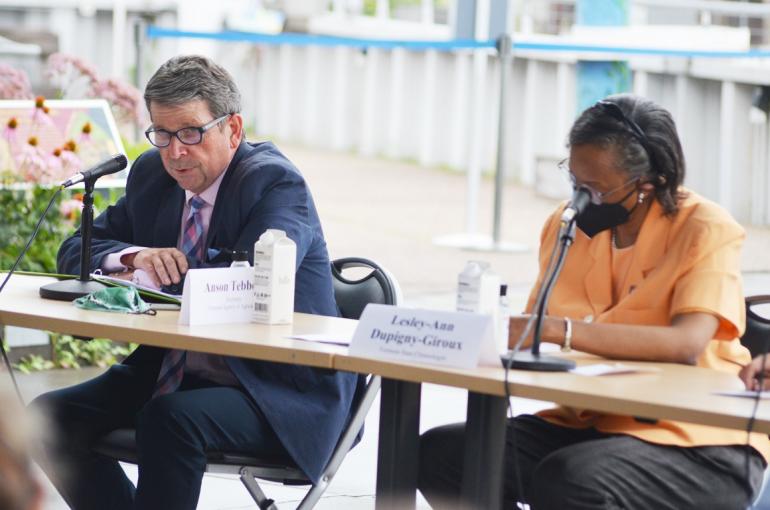
Secretary Tebbetts with Vermont State Climatologist Lesley-Ann Dupigny-Giroux.
Secretary Anson Tebbetts
- Approaching the 7-year anniversary: (August 28, 2014) when Tom Vilsack, Senator Leahy, Rep. Welch, and VT Secretary of Ag meet at Echo to announce $45 Million over 5 years in USDA funding for agricultural water quality efforts.
- This 5-year USDA commitment to Vermont enabled Vermont’s farmers to ‘make hay while the sun was shining’: Major investments in the existing pay-for-practice approach has yielded major water quality dividends for Vermont.
- Vermont farmers have demonstrated their engagement, willingness, and commitment to water quality and since 2016, agriculture has been responsible for between 99% - 96% of all reported phosphorus reductions in Vermont.
- This 99 – 96% annual P reduction from agriculture comes from reporting between State-Federal partnerships which makes available of federal USDA NRCS monies and State of Vermont Clean Water Fund dollars.
- These reductions have come from Pay-for-Practice programs. USDA EQIP, VAAFM FAP (Farm Agronomic Practices) Program.
- These Pay-for-practice programs are the most cost-effective approach Vermont has for phosphorus reductions. Ag is over 100 times more cost effective of an investment for phosphorus reduction than the next sector.
- Mean (Average) Cost per Kilogram of estimated Total Phosphorus Load Reduction annually:
- Agriculture: $97 / kg of P
- Natural resources mean: $1,130 / kg of P
- Road erosion remediation: $3,950 / kg of P
- Urban Stormwater treatment: $4,560 / kg of P
- Mean (Average) Cost per Kilogram of estimated Total Phosphorus Load Reduction annually:
- Reductions have come from farmer participation in Federal and State Pay-For-Practice Programs which has jumped in a significant manner since 2014:
- Cover Crop
- 2014: 5,000 acres of cover crop
- 2020: 36,000 acres of cover crop (over 1/3 of Vermont’s annual cropland is now cover-cropped)
- Conservation Tillage
- 2014: less than 1,000 acres of conservation tillage
- 2020: over 11,000 acres of conservation tillage
- Cover Crop
- Vermont Pay-For-Performance: a new and innovative program will pay farmers on a per pound basis for the P reductions that will are achieved beyond what is minimally required. This pay-for-performance program builds on the existing agricultural water quality clean-up framework and will accelerate the pace of implementation in addition to the existing clean water work engaged in by farmers, partners, and the State.
- Is funded by a USDA NRCS RCPP 5-year grant of $7Million
- $4.9 Million in payments to farmers for performance
- Incentive payments for signing up
- Payments for each pound of P reduced beyond the threshold
- Will accelerate existing phosphorus water quality improvement work being undertaken by farms.
- Does not replace existing Pay-For-Practice; rather provides a new mechanism to incentivize farmers to do more
- Farmers have said they are willing, able, and prepared to participate.
- VT PfP Factsheet
- Vermont Pay-For-Performance: Can it be expanded beyond Phosphorus?
- Yes. There are environmental needs for:
- Clean Water (Phosphorus and Nitrogen)
- Conservation practice implementation forms basis of water cleanup for P in Vt.
- Are Nitrogen improvement needs for CT River
- Climate Change Mitigation
- Co-benefits between WQ and Emissions reduction (for example: No-till does both, reduces P loss and reduces CO2-eq emissions)
- Climate Change Carbon Sequestration
- Co-benefits between WQ and Carbon Sequestration (For example: cover-crop reduces sediment loss from ag fields and sequesters carbon in soils)
- Climate Change Adaptation
- Need for food security and a stable food supply. Current droughts in West give impetus for growing food locally.
- Climate Change Resilience
- Increase in intense episodic precipitation means ag fields with high organic matter soils can help store and reduce down-stream flooding, protecting Vermont’s built infrastructure.
- Clean Water (Phosphorus and Nitrogen)
- The focus of how to get there is: Healthy Soils.
- Yes. There are environmental needs for:
- Healthy Soils provide the framework through which to view and support many of the goals of the State of Vermont; Pay-For-Performance is a mechanism to quantify, value, and compensate the farmer of the benefit the state derives from their good environmental stewardship.
- Improving soils, water, and resilience of the working landscape to combat climate change;
- Increasing sustainable economic development and creating good jobs in Vermont’s food and farm sector; and
- Improving access to healthy local foods for all Vermonters.
- Nexus for work ongoing in: PES Working Group and Vermont Climate Council
- PES Working Group: A farmer-led process focusing on developing a PES Program (Pay-for-performance based) that focuses on increasing soil health to provide:
- Improvements to Water Quality
- Climate Change mitigation and sequestration needs
- Climate change resilience and adaption potential
- Vermont Climate Council: Created by the Global Warming Solutions Act (GWSA)
- Ag & Ecosystems Subcommittee: Has identified the potential for a PES Program to support increased adoption of practices and performance by farmers to meet the Climate goals of the State.
- PES Working Group: A farmer-led process focusing on developing a PES Program (Pay-for-performance based) that focuses on increasing soil health to provide: