

by Timothy McQuiston, Vermont Business Magazine An outside audit of the Vermont Department of Labor’s error in distributing 1099G forms earlier this year has concluded that it was likely caused by human error during manual procedures applied to the creation of print files for some but not all of the more than 70,000 unemployment-related 1099Gs.
Because of the increased volume in the number of 1099Gs associated with the pandemic, VDOL outsourced some of the printing to the Department of Building and General Services in order to meet deadlines.
The manual procedures used in creating the print files for the BGS led to an error being made by someone in the Agency of Digital Services.
The 1099Gs were issued to people who had filed for unemployment claims through several federal programs in 2020. In some cases, the 1099Gs were correct and were addressed to the right person, but in other cases they were sent to other claimants.
The wrongly addressed forms included personal information and Social Security numbers. No breaches of personal information associated with the misaddressed 1099Gs have been reported to date. The audit was conducted by CliftonLarsonAllen LLP from Baltimore under contract to the Vermont State Auditor’s Office.
CliftonLarsonAllen Audit
CliftonLarsonAllen LLP (CLA) was engaged by the Vermont Auditor of Accounts to conduct a Performance Audit of the Vermont Department of Labor (VDOL) 1099G issuance process. The purpose of the report is to provide findings and recommendations if applicable regarding this audit, which included identifying the cause of an error identified in the 1099G issuance process, whereby recipients received 1099Gs with another person’s name, address, or social security number, and determining and evaluating controls placed into operation to mitigate the error.
The audit scope included the 1099Gs issued from January to March 2021. The audit was conducted in accordance with Government Auditing Standards issued by the Comptroller General of the United States. CliftonLarsonAllen performed procedures in March 2021 to verify the accuracy of the assertions made by management, identify the cause of the error, and determine and evaluate controls placed into operation.
Their findings are summarized as follows:
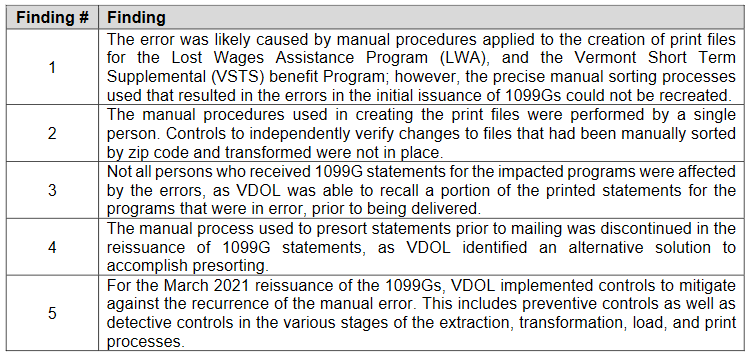
BACKGROUND
In late January 2021, the Vermont Department of Labor mailed thousands of 1099G tax documents in which the name, mailing address, and/or social security number did not match the recipient.
VDOL believes that this 1099G issue was limited to recipients of the following programs:
- Lost Wages Assistance (LWA): This program provided a $300 supplemental weekly benefit payment to eligible unemployment insurance claimants.
- Vermont Short Term Supplemental (VSTS) benefit. This program provided an additional $100 weekly benefit to unemployment claimants.
VDOL and the Agency of Digital Services (ADS) preliminarily attributed this issue to manual intervention (i.e., a spreadsheet sort) in the 1099G printing process. VDOL reissued the 2020 1099Gs in March 2021.
Vermont’s Governor Scott requested that the Auditor of Accounts conduct a performance audit to identify the root cause of the error.
The Auditor of Accounts engaged CliftonLarsonAllen LLP (CLA) to conduct a Performance Audit of the 1099G error at VDOL.
OBJECTIVES, SCOPE AND METHODOLOGY
We conducted this performance audit in accordance with Generally Accepted Government Auditing Standards (GAGAS) established by the U.S. Government Accountability Office (GAO). Those standards require that we plan and perform the audit to obtain sufficient, appropriate evidence to provide a reasonable basis for our findings and conclusions based on our audit objectives. We believe that the evidence obtained provides a reasonable basis for our findings and conclusion based on the audit objectives. Because of the inherent limitations, a performance audit made for the limited purposes of our review would not necessarily disclose all weaknesses related to the Vermont Department of Labor.
The objective of the audit was as follows:
- Identify and determine the cause(s) and extent of errors in processing or system interfaces that led to preparing and issuing incorrect 2020 1099Gs mailed by the Department of Labor. Determine and evaluate the controls Labor has implemented to correct this problem before mailing corrected 2020 1099Gs.
Procedures:
1) Evaluate evidence provided by VDOL and ADS through observation and inspection as to the systems, processes, and procedures - both manual and automated - involved in the printing of 1099Gs. This includes obtaining an understanding of the sources of data and the various policies, procedures and methods involved in the extraction, transformation, loading, printing and mailing processes for the in-scope programs (LWA and VSTS) to help determine how each may have contributed to the error as well as the associated risks.
2) Obtain evidence through observation and inspection related to the Unemployment Insurance Program, and other programs that involve the issuance of 1099Gs, to the extent relevant to the audit objectives, and to confirm our understanding of the differences between how 1099Gs were generated for each.
3) Obtain the actual data files purported to be the “before” and “after” versions of the files involved in the manual error associated with the LWA and VSTS programs, and attempt to reperform and recreate the error using analytical procedures.
4) Identify and evaluate evidence of controls that were relevant to the purported cause of the initial error and related process to correct the error and either prevent, or detect and correct future errors.
FINDINGS, RECOMMENDATIONS AND MANAGEMENT’S RESPONSES
We identified areas related to the objectives. These items are discussed below and include our findings and recommendations, together with the Department’s responses to our findings.
FINDING NO. 1 –
MANUAL PROCEDURES CONTRIBUTED TO THE ERROR
The error was likely caused by manual procedures applied to the creation of print files for the Lost Wages Assistance Program (LWA), and the Vermont Short Term Supplemental (VSTS) benefit Program; however, the precise manual sorting process used that resulted in the errors in the initial issuance of 1099Gs could not be recreated.
Prior to 2020, the print process for 1099Gs for the UI program was conducted in-house using VDOL systems and resources. Similar processes were in place for UI program 1099Gs and they were not impacted by the error.
Due to the additional supplemental programs in place to minimize the impact of the pandemic in 2020 combined with the volume of statements required to print, help was solicited from the Department of Building and General Services (BGS) for print services for the LWA and VSTS, and one-time Treasury payments to enable VDOL to meet print deadlines.
Additionally, the sources of data (master records) of benefit claims differed for each program, as did the processes used to generate the data to print the 1099G statements. These three programs were subjected to manual data extractions from master records to create Excel files, as well as additional manual procedures to pre-sort the data by zip code and prepare the print file to be sent to BGS.
The manual errors occurred during this step of the process for both the LWA and the VSTS programs. Similar errors did not occur in the process of preparing data files for the other programs (e.g., UI and PUA) or one-time Treasury payments.
The actual data files purported to be the “before” and “after” versions associated with the manual error associated with the LWA and VSTS programs, were obtained from VDOL and ADS.
Auditors applied a variety of analytical procedures to attempt to recreate and reperform the error as described. We were able to recreate portions of the error using the files provided, but were not able to reperform conclusively the complete extent of the manual errors made during this stage of the process with the data provided due to anomalies identified in the data.
Nevertheless, we were able to satisfactorily determine that a manual sorting process applied to the print file was the likely cause of the error.
Management’s Response:
The Vermont Department of Labor agrees with this assessment.
FINDING NO. 2 –
PREVENTIVE OR DETECTIVE CONTROLS NOT IN PLACE ON MANUAL PROCEDURES
The manual procedures used in creating the print files causing the error were performed by a single person, absent controls in place to independently verify files that had been manually sorted and transformed.
The process used to generate print files for the LWA, VSTS, and Treasury programs included manual data extractions from master records to create Excel files, as well as additional manual process to sort the data by zip code and prepare the print file to be sent to BGS.
The manual errors occurred during this step in the process for both the LWA and the VSTS programs. The procedures were performed by a single employee in the Agency of Digital Services.
Validation procedures in place by VDOL to verify the accuracy of records during the print process mirrored those in place for UI program, where VDOL controls the entire process, and did not account for additional manual steps necessary for the new programs.
Therefore, while validation procedures did occur, they were applied to print files generated from the master record, and they were not applied to the actual data files used in the printing process, after the manual procedures occurred. Hence, the error was not identified prior to print.
Management’s Response
The Vermont Department of Labor agrees with this assessment.
FINDING NO. 3 –
THE ERROR DID NOT IMPACT ALL 1099G RECIPIENTS FOR THE AFFECTED PROGRAMS
39,125 LWA and 34,042 VSTS 1099Gs were included in the files subjected to manual procedures in the initial January print run. However, not all persons who received 1099G statements for the impacted programs were affected by the errors, as VDOL was able to recall a portion of the printed statements for the programs that were in error, prior to being delivered.
During the process of responding to errors being reported for these programs, officials learned that batches of mailed 1099G statements had not been distributed through the USPS system, and were awaiting distribution in the local office.
As a result, VDOL was able to recover some statements for the affected programs prior to being sent in the mail. Additionally, more statements were returned as undeliverable.
As a result, not everybody notified by the VDOL was actually impacted by this error. VDOL is in possession of the recalled or undeliverable statements, and could provide a full accounting of impacted persons, should the need arise.
Given the litigious environment around data privacy, it is possible that an individual who experiences identity theft or some other form of damages may believe this incident is the root cause.
In the event that such allegations are made and are directed toward this incident, these documents may be able to confirm that their PII was not compromised through this incident.
Management’s Response
The Vermont Department of Labor agrees with this assessment.
FINDING NO. 4 –
ALTERNATIVES TO MANUAL SORT PROCESSES IDENTIFIED
Officials identified alternative processes to meet similar presorting requirements in the process of printing and mailing the 1099G forms, and the manual sort process was discontinued in the 1099G reissuance.
The reason provided by VDOL for the manual sort procedures in the Excel spreadsheets that led to the initial error was driven by the need to presort mail prior to delivery to the post office, to take advantage of cost savings associated with first-class mailings.
Officials identified an alternate solution for reissuing the 1099Gs utilizing services provided by BGS, which included presort tools utilized after printing and stuffing statements. Therefore, the manual presort process in the Excel spreadsheet was discontinued for the reissuance of these statements.
Management’s Response
The Vermont Department of Labor agrees with this assessment.
FINDING NO. 5 –
FOR THE MARCH 2021 REISSUANCE OF THE 1099G FORMS, PREVENTIVE OR DETECTIVE CONTROLS WERE IMPLEMENTED TO AVOID MANUAL ERRORS
VDOL has implemented controls to avoid the recurrence of the manual error. This includes preventive controls as well as detective controls in the various stages of the extraction, transformation, load, and print processes.
VDOL has implemented, and we evaluated the design of, several preventive and detective controls intended to minimize the risk of recurrence of the error in the print process for the reissuance of the 1099s.
These controls are listed below.
- New “core” files used to create print files for the LWA and VSTS programs were generated by an automated job from the mainframe, which simultaneously created a “machine readable” Excel print file and Excel data validation file from the same master record.
- The Excel files were access-protected with a password and were not editable. Any changes to data must be made in the master records, and not on the “core” files. Alerting was also enabled on any changes made to the files.
- Print Batch Control Procedures and other structured, independent verification procedures were implemented during various steps of the process to detect discrepancies. Discrepancy logs were created for any errors identified, with independent persons responsible for confirming that errors were resolved prior to issuance.
o Data contained in the extracted “core” Excel data files were verified on a sample basis back to the original data source or master record. Any discrepancies are resolved.
o Printed statements from BGS printed and scanned and sent back to VDOL, on a sample basis, and verified back to the “core” files. Any discrepancies were resolved. Once this process was completed, the approval was given for BGS to begin stuffing.
o Additional spot check procedures were performed during the stuffing process, to verify information on printed statements back to the master record.
- The sorting of printed mail for VSTS and LWA was performed using the tools available at BGS, as stated in Finding 4, eliminating the need for manual sorting of data in the “core” data files.
VDOL stated that it intends to continue the operation of such controls during future 1099G print operations.
Management’s Response
The Vermont Department of Labor agrees with this assessment.
RECOMMENDATION NO. 1 –
RETAIN RECORDS TO ALLOW FOR A COMPLETE ACCOUNTING OF IMPACTED PERSONS
As stated in Finding No. 3, VDOL was able to recover some statements for the affected programs prior to being sent in the mail. Additionally, more statements were returned as undeliverable. VDOL is still in possession of the recalled or undeliverable statements.
We recommend VDOL retain recalled and undeliverable statements and consider itemizing these documents to provide for a full accounting of impacted persons.
Management’s Response
The Vermont Department of Labor has no additional comment.