

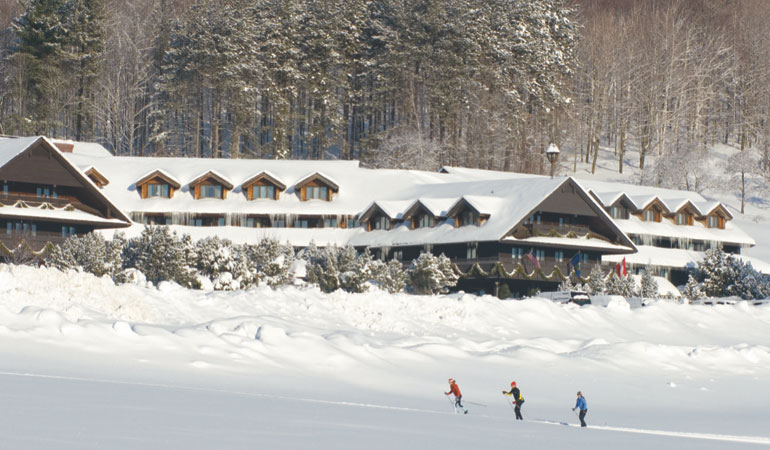
Trapp Family Lodge. Courtesy photo.
by Joyce Marcel, Vermont Business Magazine Thanks to Governor Phil Scott and Commissioner of Health Dr Mark Levine (with an assist from Dr Anthony Fauci), Vermont spent the spring and summer beating down COVID-19.
Because almost everyone wore their masks, washed their hands and kept their distance from one another, we may have a ski season.
When Dr Fauci, head of the National Institute of Allergy and Infectious Diseases, spoke in Vermont (by Zoom) at one of the governor’s COVID-19 news briefings last month, he congratulated Vermont on its 0.2 percent infection rate and said he’d like “to bottle that and take it with me when I go to other parts of the country.”
While more people will be “coming into Vermont from states and regions that have a higher degree of test positivity,” Fauci said, “I don’t think you inevitably are going to have a second wave... It’s going to be challenging as you get into the fall and the winter, but it doesn’t necessarily mean that you’re going to have a problem — if you do the kind of prudent public health measures that you’ve been doing.”
By keeping safe, Vermont took a terrible economic hit, especially in the hard-hit hospitality industry.
Now Vermont is opening up. And even if you've never been on skis in your life, the ski industry is important.
According to a Benchmark Study of Tourism in Vermont done by the Vermont Department of Tourism and Marketing, in 2017 total tourism brought $2.8 billion into Vermont, up from $2.6 billion in 2015.
According to Ski Vermont, $1.6 billion of that is due to the ski and snowboarding industry.
“Winter makes Vermont unique,” says the study. “Vermont sees strong economic activity during the winter that neighbors like New York and New Hampshire do not.”
It's not only lift tickets that bring money to the state, but the sale of equipment, clothing, gasoline, restaurant meals, hotel bookings, gift items, local events, and a host of other economic drivers. Also, it’s mainly tourists who can fill the vacant coffers of the state’s rooms and meals tax.
In terms of jobs, according to Ski Vermont, the ski business alone supports around 12,000 direct jobs and an additional 22,000 indirect positions.
A second wave may still wipe out all the progress made keeping Vermont safe enough to reopen — in a socially distanced way, of course. However ski resorts are optimistic.
Hotels, B&Bs and inns, which got the word in the middle of last month that they could operate at full capacity once again, are moderately so. But every piece of good news seems to be balanced by one that isn’t all that pretty.
The truth is that no-one, optimist or pessimist, knows what’s coming next, how the Fall Foliage season will play out — Dummerston has already cancelled its enormously popular Columbus Day Apple Pie Sale, for example — or what will happen this winter.
At that same mid-September announcement that opened lodging to 100 percent capacity, he said bars and restaurants could seat patrons at the bar counter.
But he demurred in late September on when he might allow for greater indoor occupancy. Right now, indoor capacity remains at 50 percent. He said he does not have a timeline for when he might “turn the spigot” further.
Good news: A survey done in August by SkiDriven.com reports that despite the COVID-19 pandemic putting many normal aspects of life on hold, “there is a strong willingness to travel in the coming months among Americans, with domestic travel preferred and Vermont the number 1 travel destination this winter.”
Bad news: Before some winter tourists come, they may have to quarantine for 14 days.
More bad news: Many Vermonters do not want an influx of people from COVID-19 hotspots flocking to Vermont this winter.
Even more bad news: According to a poll done by the American Hotel and Lodging Association — and the Vermont Chamber of Commerce is the state affiliate for the AHLA — it is only 38 percent of those Americans with “a strong willingness to travel” who are likely to resume travel by the end of the year.
That’s compared to a normal year, say, when 70 percent of Americans took a yearly vacation.
The ski resorts believe, however, people will flock to the slopes because outdoor activities are safer than indoor ones.
“The ski areas still rely on the bulk of their business coming from the nearby population centers of Boston, New York, New Jersey and Connecticut,” said Adam White of Ski Vermont. “For Vermonters, it’s not contingent upon what the pandemic does here. It’s contingent on what the pandemic does in those populations, especially if there’s a virulent second wave. The landscape of the pandemic in those areas is going to impact the degree to which it’s regulated here.”
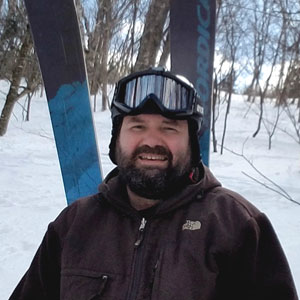 Photo: Adam White of Ski Vermont. Courtesy photo.
Vermont is a skier “drive market” compared to Utah and Colorado, which might require air travel. That gives Vermont a competitive advantage.
“If air travel and the tourism sectors are significantly impacted, it will have a far greater impact on a Western ski area than on New England,” White said. “Being a drive market might be an advantage in this instance, but also a disadvantage due to interstate travel restrictions. The mandatory self-quarantine is going to be a big one. If that’s kept in place or tightened up due to what happens in the schools, that could greatly impact people’s ability to come to Vermont for a ski trip. If you’re required to self-quarantine for two weeks upon arrival, that’s going to be a deal-breaker for a lot of potential visitors.”
For people who don't already own a home in Vermont, travel restrictions are complicated. For example, residents of states who live in counties across the Northeast, including New England, New York, Pennsylvania, Ohio, New Jersey, Delaware, Maryland, Washington, DC, Virginia, and West Virginia that have a similar active COVID-19 caseload to Vermont — defined as less than 400 active cases per million — may enter the state for leisure travel without quarantining if they do so in a personal vehicle.
People who come from other states must quarantine for 14 days. A weekly updated travel map is posted at the Vermont Department of Financial Regulation’s website.
“This is a complicated and ever-boiling issue,” White said.
Will people break the quarantine rule?
“It’s surprisingly enforceable at the lodging level,” White said. “They know when people are arriving and they know where they’re coming from. There is pressure being put on the lodging establishments to be the enforcer.”
Odd news: Apart from leaf-peeping or snowboarding, people with means now want to move to Vermont.
For example, the Deerfield Valley region, home to Haystack Mountain, Mount Snow and Stratton, has seen “quite an influx of property sales,” many of them sold sight-unseen, said Gretchen Havreluk, the economic development consultant for the Town of Wilmington.
“People still want to ski,” Havreluk said. “Last year there were no over-$1 million [house] sales, but this year there have been six. A lot of sales are between $200,000 and $500,000. People want to move to more rural areas, whether they're permanently moving or buying second homes.”
Will they stay in Vermont once a vaccine is created and the danger subsides? No one knows, but Wilmington is hopeful.
“We're putting together a ‘welcome wagon’ to welcome these new residents,” Havreluk said. “We want them to become part of our community by volunteering and opening businesses and having their children go to school here. These are all key pieces to our local economy. Our property taxes in Wilmington and Whitingham are high. The education tax is outrageous. We need to get more students into our schools because it's based on a per-student dollar amount. Anyway, I hear the Old Farmer's Almanac is saying we're going to have a robust winter, and I'm looking forward to that because I love snow.”
Schools are in the process of reopening. How that goes, and what happens in the aftermath in terms of infections or shutting down, will largely affect regulation, especially at the state level. It will also impact customer confidence.
“If so, we're not likely to see a relaxation of regulations such as mandatory self-quarantine,” White said. “So school re-openings are the first openings we have to clear.”
The ski resorts have spent the summer doing everything they can to create safe winter experiences for their guests.
This includes a close study of their summer events to see what worked and what didn’t; studying the just-ended Australia ski season for tips on how to make outdoor recreation safe; making attendance reservation-only; creating safe and warm outdoor areas for food service; investing in new technology; running four-seat chair lifts (called “quad lifts”) for only two people in order to keep social distance; adding a plethora of other safety features; and hoping for the best.
Mount Snow in West Dover and Okemo in Ludlow have already announced plans to open for the 2020-21 season.
But it won’t be business as usual. Access to both resorts will be by reservation only, with prioritized access for skiers and snowboarders with season passes. Masking and social distancing guidelines will also be in effect.
Magic Mountain in Londonderry lowered its season pass prices for early-bird purchasers and has expanded its discounted service pass for military personnel to also include first responders, nurses, emergency room and intensive care doctors.
They have not increased their pass prices, and will provide full credit toward a 2021-22 season pass if the resort has to shut down due to COVID-19 restrictions.
Stratton Mountain Resort is offering a similar guarantee, allowing pass holders to defer the use of their 2020-21 passes and give them credit toward a similar pass for the 2021-22 season.
Finding enough workers might be a problem.
“Work-visa programs are going to be much more difficult now,” White said. “Staffing has long been a challenge for ski areas, and now, with limits on international workers, it adds a different level of challenge.
While protecting the health of the customers is important, protecting the health of the staff is imperative, White said.
“Many of these essential positions at ski areas are such that an infection or outbreak could bring the whole business to a halt,” White said. “If the head of lift safety gets sick, there isn’t another person with the training and certification to just slide into that role. The same thing with the head of your ski patrol. Many essential positions within these businesses can't be refilled in the event of an outbreak. So a handful of infections could easily take down a multi-million dollar operation. Which is why it's so imperative for the customers and employees to do their part.”
Every ski resort is different because of its size, the scale of its business, its layout and its infrastructure. These are all factors that determine how customers flow through and interact with the space. As a result, there’s no such thing as a one-size-fits-all safety plan, White said.
“There will be measures you will see everywhere,” White said. “Mandatory face masks. That won’t be anything new. Rudimentary social distancing and physical distancing – the six foot rule. Again it works well with skiing, because people typically tend to spread out over most of the area. But there are choke points – lift lines, ticket lines, areas where you will need to have regulations. But how much will business be affected? It could translate to a very substantial number.”
Bad news: A recent decision made jointly by the International Ski Federation, National Ski Associations and local organizing committees in Canada and the USA to restrict the Alpine Skiing World Cup tour to Europe until 2021 means that the Women's Ski World Cup, which last year drew 39,000 people to Killington, has been cancelled until the following year.
Unexpected news: Killington, the largest mountain resort in Eastern North America and a POWDR company, shrugs off the cancellation.
“We actually lose money on the World Cup,” said president and general manager Mike Solimano. “It costs us $1.2 million. We have to pay all the athletes. We pay the prize money. We furnish the electricity, the televisions, the grandstand. The costs are endless. We’ve done it because it’s just a great event, but for Killington it’s a substantial net cost. We're doing it for the long term, for the brand. We're trying to support ski racing, and it's a great event.”
The bad news: The Killington resort might not be taking a hit, but what about the restaurants, B&Bs, hotels and small businesses in the area which can make a profit from 39,000 extra visitors?
Cross-country skiing is expecting to see a big bump in popularity this winter. The president of the Vermont Cross Country Ski Association is predicting a 20 percent to 40 percent increase in overall business.
“It’s an easier sport to pick up if you've never skied before,” White said. “It’s the type of sport where you're outside, you’re constantly moving so you’re staying warm, and there isn’t typically as much of an indoor lodge component to it. Cross-country skiers are hardy. That sense of self-sufficiency will come in handy. Apparently retail sales of cross-country ski equipment are reinforcing that idea.”
The important thing is that “We’ll have good snow, and the customers will adapt an attitude that we’re all in this together,” White said. “In New England we’re used to dealing with adversity. This is just a new type of challenge, but it’s not something the ski areas are unprepared to deal with.”
The hospitality industry is less than optimistic about its chances this winter.
“Vermont is certainly positioned well as a location for tourists, due to our public health stance and the positive response we’ve had,” said Amy Spear, the vice president of tourism for the Vermont Chamber of Commerce. “Not only have we done a great job responding to the public health crisis, but we have a lot of space and a lot of outdoor recreation opportunities. There’s mountain biking, hiking and a lot of space for people to spread out. Vermont has done an amazing job, and that makes Vermont a very desirable place to travel. There’s a potential, but the reality is that we’re in the midst of a pandemic. It won’t be a record-breaking year for the hospitality industry.”
Because restaurants, inns, B&Bs and hotels have taken a major hit, the money flowing into the meals and rooms tax has slowed to a trickle.
“Restaurants and lodging businesses are the major drivers of the meals and rooms revenues and have been asked to hibernate in an effort to combat the pandemic,” Spear said. “They have responded to public health needs in stellar fashion to ensure the health of our people, but it has come at a great cost to them.”
Generally, a lodging property needs to carry around 50% occupancy rate in order to break even with expenses and pay down debt, Spear said.
“Vermont lodging properties have been operating at 50% occupancy or less for 6 months now,” she said. “Compounding the impacts of operating at a significantly reduced capacity, there is no reduction in fixed costs, and the industry sells a perishable product. If a room goes unsold, lodging operators will never be able to recoup those lost profits.”
Many Vermont B&Bs, hotels and resorts offer other attractions besides skiing, said Bob Schwartz of the famous Trapp Family Lodge in Stowe. The lodge had a decent summer, he said.
“Right now we are seeing many social groups,” Schwartz said. “We do small weddings of about 15-18 people. We’re not seeing as much corporate business as in past years. Local businesses are coming because they can book at the last minute. Pushing it back, it’s better for us as well as them.”
As of mid-September, advance winter bookings seem soft, Schwartz said.
“November is soft as well, but it usually is,” he said. “October is doing well — people are booking last minute because they're not quite sure what's going to happen. We have a multitude of things to do here. We have 60 kilometers of cross-country ski trails and snowmobile trails. Maybe this is the year everyone will learn how to cross-country ski? We’re trying to get people to book in advance, but closer to their travel dates. We're optimistic. We have enough activities here to have a great winter.”
NSAA data shows that the average US ski area was only open for 99 days this past season, down from 121 days in the 2018/19 season.
Forced closures most greatly impacted the Western regions, as many Midwest and Southeast ski areas were close to or had reached their planned closing days.
However, skier visits were down across all six geographic regions of the country.
The spring break time period generally accounts for 20 percent of a ski area’s visitation and revenue, and is surpassed only by the Christmas holiday period.
Much of the profit margin for Vermont ski resorts comes in the late winter/early spring when they reap the benefits of their hard work earlier in the season. The weather warms up for the skiers and riders. And snowfall is trending toward later in the season.
NSAA estimates that COVID-19 cost the US ski industry at least $2 billion, with estimates reaching as high as $5 billion if the 2020/21 expected downturn is included. This figure was derived from NSAA’s historical revenue and visitation data.
The ski industry faces looming problems above and beyond COVID-19.
Climate change is a big one. According to Adrienne Saia Isaac, the director of marketing and communications of the National Ski Area Association, the entire industry is now focused on trying to reverse climate change.
“One of the most exciting things is how vocal ski industry leaders have been in advocating on climate change at the national levels,” Isaac said. “They’re speaking out and using their influence as business leaders to focus attention and promote the business point of view. Not only is the pandemic devastating, but our senators and congressmen are seeing the economic devastation when there's a shutdown. Climate change is something permanent. It’s so important to be advocating for climate policy now, to ensure that a climate-related shutdown doesn't happen in the future.”
Demographics are another problem. Nationally, the numbers of skiers and snowboarders are diminishing; boomers are aging out and the following generations are not taking up the sports.
“The number of people aging out is slightly greater than the number of young people coming in,” Issacs said “Skiing is definitely an expensive sport. It’s time intensive. Not many people are fortunate to live within 15 or 20 minutes of a ski area, so there's driving involved. Children’s sports are all-year round, so there’s less time for travel. Maybe both parents are working.”
According to the National Ski Areas Association's Kottke End-of-Season and Demographic Report for the 2019-20 season, it is important to get kids into skiing and snowboarding when they are young; the majority of participants who stick with skiing through their lives start before they are 10.
Skiers aged 17 and under made up 28.2% of skier visits, a two point increase over 2018-19. This age group makes up the highest share of visits, and does so year after year.
One of the data sets to watch is the rate of Millennial drop-out.
“When you’re younger, you can go skiing with your parents,” Issacs said. “You don’t have to worry about finances. This is why kids under 18 make up such a significant portion of skiers and riders.
But when skiers hit college age, people start to drop out — due to new job responsibilities, financial constraints, starting families.
NSAA is working with ski areas across the country on best practices for recapturing these ‘lapsed’ skiers, to try to bring them back to skiing — hopefully with their families!”
How big is the drop-out rate?
“When Millennials were the same age as their Gen Z cohorts are now, they made up 41.8 percent of skiers,” Issacs said. “However, Gen Z’ers now only make up 34.4 percent of skiers. So we are also conducting research on Gen Z and why they may not be skiing as much as previous generations did when they were the same age.”
The percentage of women in skiing has remained steady across the past 10 years at approximately 41 percent, Issacs said.
“But there is definitely opportunity to engage more women in skiing and snowboarding,” she said.
In this time of national racial unrest, it is also important to note that skiing is perceived as a sport for white people. The faces of people of color are usually not featured on ski posters.
Well aware of this perception problem, the ski industry is working hard to change its image and attract a more diverse crowd.
“The younger generation wants to do activities where people look like them and where they feel welcome,” Issacs said. “Skiing has a stereotype that's it’s only for whites and affluent people. Women in skiing have only in the last decade made up a decent share of skiers and riders. It’s been predominantly male. The percentage of non-white participants in skiing is behind the percentage of non-white members of the US population. All people deserve to feel welcome in the mountains and should have access to trying skiing or snowboarding. We need to work as an industry to make our sport more inclusive.”
The future will come down to “creativity and perseverance,” said Commissioner Heather Pelham of the Vermont Department of Tourism and Marketing.
“The entire tourism industry and the hospitality industry have been hit by the pandemic,” Pelham said. “Having a strong winter season is one of the keys to our long term recovery. We know there is still a tremendous amount of uncertainty going forward, between travel restrictions and the financial health of our lodging, restaurants and other business attractions. In the winter, we have to deal with the added uncertainty of weather. All that said, folks are getting more comfortable with the new normal when it comes to travel, and they are looking for ways for the family to get outside and enjoy the types of recreational activities they always have enjoyed. So we are hopeful and optimistic that not only Vermonters will take advantage of the outdoor recreational opportunities in the state this winter, but also folks in our closest drive markets will make day trips to the state, as well as longer visits to enjoy all the hospitality that Vermont has to offer.”
Stowe
Mount Snow, Okemo and Stowe are all part of Dale Resorts, which owns and operates 34 resorts in North America. They've all been open this summer.
“All three resorts are open through Indigenous People's Day,” said Jeff Wise, senior communications Manager for Dale Resorts Stowe. “We’re open with a smaller operational footprint than we have had during a typical summer. We did not operate summer attractions that did not allow for physical distancing. The attractions that were open were well attended. I think people were eager to get outside and have an experience on the mountain, whether it was taking a scenic lift ride or hike the ridge line.”
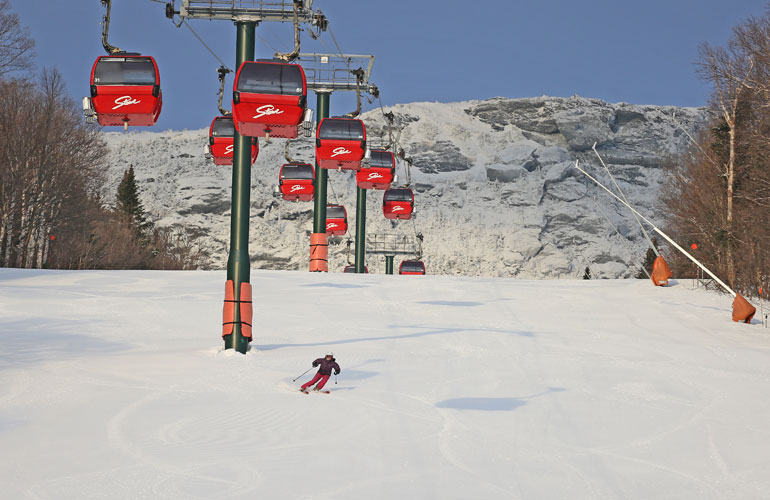 Photo: Skiing at Stowe. Jesse Schloff Photography.
Wise is optimistic about the winter.
“The approach we took to operate during the summer had two main goals,” he said. “One was having our mountains open, and the other was really practicing, learning and understanding how to keep our resorts open this winter: loading chair lifts, selling tickets, having some food and beverage places open. We got good at operating under these new circumstances.”
Because Dale owns ski resorts in Australia, Wise and his staff could closely study how that country ran a ski resort in a pandemic.
“That influenced a lot of decisions for our North American plan this winter,” Wise said. “The main thing, the biggest component of our winter operating plan, is we’re going to use a reservation system. That is going to allow us to manage capacity at all of our ski resorts. We can consistently implement all of the physical distancing protocols. It’s a very effective way of managing capacity at the resorts. Also, we’ve got a vision of how we're going to manage amenities. And while we’re going to have this reservation system, if we discover during the season that it’s something we don’t need, we’re going to be flexible enough to make changes.”
Passes became available on September 17.
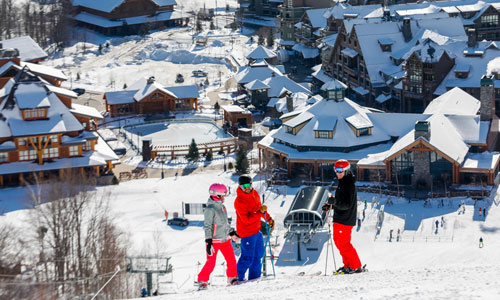 Photo: View of the village at Spruce Peak. Jesse Schloff Photography.
“People who buy our passes are going to have exclusive access to the reservation system for a full month before people without passes can start buying tickets,” Wise said. “We’re really giving top priority to our pass holders. With our three ski mountains in Vermont, we’re encouraging people to get their passes before making lodging reservations. We have a wide variety of pass products that really are tailored for when and how much people want to ski this winter. We’ll have this reservation system that will allow people to ski the vast majority of days they want to ski. With us, the most impulsive you could be is getting that reservation the night before. You could also do that morning of. The key is you can make as many reservation days as you want.”
Magic Mountain
Geoff Hatheway and his partners took over the iconic Magic Mountain in Londonderry in November of 2016 and doubled its business. Now they are facing the pandemic with optimism.
For one thing, it’s been a busy and “challenging” summer, Hatheway said.
“We had the restaurant open,” Hatheway said. “We had the disc golf open. We've been open for business with all the health and safety protocols. It's been very good. We expanded our outdoor dining. The experience of being outdoors in the fresh mountain air has been good and we’ll continue that through the fall. We’ve been working on a bunch of projects. We purchased a new quad lift from Stratton two years ago. We figure that people who are traveling and living together will be able to ride the lift together, but strangers will be able to social distance two-by-two.”
Magic is getting ready to make snow. It has expanded its beginner's area and moved one of its lifts there. Hatheway expects to see more newcomers who want to learn about skiing.
“We're growing the sport,” he said. “We're also expanding our terrain park. It will be lighted after hours on the weekend so people can ski there.”
Magic is ready for winter, Hatheway said.
“What we do is outside,” he said. “And being outside is the best protection against the virus. Like golf this summer, when you’re outside doing skiing, you’re very safe.”
It's socializing in the lodge that becomes problematic.
“We know the guidelines for social distancing,” Hatheway said. “Vermont’s outdoor areas are serving food and beverages. We’ve done this in parts, but it's become the new normal. We know we’ll be doing less with food and beverages because people will be eating outside. They won’t be cold because they will be dressed in winter gear. On our deck, we’ve put portable heating units. Up on the mountain there will be no additional heating. There will be inside dining by reservation only — and six feet apart. We expect to have 50 percent of capacity indoors. People will have a different experience. They’ll spend less time inside the lodge and find different spots to socialize. But in terms of outside, people will be able to ski hundreds of acres of terrain, and that, hopefully will allow us to make more money and make up for the loss inside.”
Magic has been hiring back its local work force all summer.
“The PPP (Payroll Protection Plan) program was very helpful,” Hatheway said. “And our workforce grows exponentially every winter. We’re hoping for a lot of employees to return. And we have job openings.”
All of this leads to optimism for Hatheway.
“We’re going to be open, and so will all the ski areas in Vermont,” he said. “We’re hopeful that as the season progresses, we’ll get a vaccine. If science does their job, we should be in good shape by the end of the year.”
Killington
With the cancellation of the Women’s World Cup, which is broadcast to 60 nations, you’d think Killington would be hurting.
But what really hurt Killington’s bottom line was closing last March because of the pandemic.
“We lost a lot of business when we closed in March,” Solimano said. “We had another six weeks of skiing to go, so we were 20 percent down. And this summer, we were down about 50 percent. About half our revenue areas didn’t open. Things like weddings and conferences, we pretty much had to close all that. Mountain biking continues to grow. We run three lifts for mountain biking, and it’s gotten very popular. People wore masks and we were able to let people recreate and it was a model for winter. We’ve done pretty well with it, but it can’t make up for all the shortfalls.”
Now Killington is focusing all its attention on the outdoors.
“We’re getting back to the basics,” Solimano said. “People want to ski and ride. Food and beverages, ski school and rentals are taking a back seat to skiing.”
Most challenging will be the restaurant businesses.
“There are a lot of capacity constraints in lodges and restaurants,” Solimano said. “We’re trying not to encourage people to come in and hang out in the lodge. We’re making our food offerings much simpler. We’ll have take-out. Over the last seven years, we’ve upscaled our food to make it much better. Like we stopped precooking burgers and wrapping them in tinfoil. We’re going to go back to pre-made food because it’s the only way to move people in and out quickly. People can use the lodge to warm up and use the bathroom, but then we’ll rotate them out and other people in. We need to do social distance, do it safe, so we can keep open for the winter.”
Advance booking for Killington's hotels is “terrible,” Solimano said.
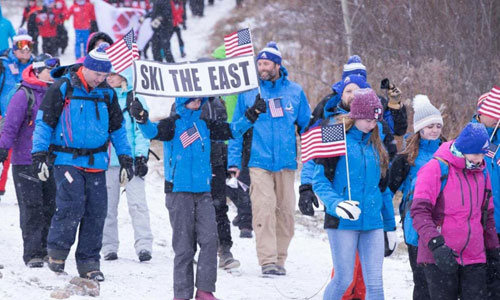 Photo: Spectators of the World Cup at Killington. Courtesy photo.
“Hotel reservations are 20-30 percent full,” he said. “People are waiting to see what’s happening. It’s going to be a tough year, and that's the best case scenario. We’re thinking we'll be off 30- to 40 percent if we’re lucky. The meals and rooms tax will be down everywhere. Then there are restrictions about coming into the state, too. We want to make sure everybody's safe. Our restrictions are stricter than almost every other state. We’ve done really well, and we’re supportive of the governor. We want people to come here. We want to survive as a business. But we want to keep people safe. We feel we’ve shown this summer that we can have people here and recreate in a safe way.”
Looking at it in the long term, “This is just one of those years,” Solimano said philosophically. “It's going to be a tough year no matter what. But the future is bright, and with less people skiing the snow should hold up, so the people who do come will have a great experience.”
Bolton
Looked at one way, the outdoor recreation industry is comparatively lucky in a pandemic said Lindsay DesLauriers of the Bolton Valley Resort in Richmond.
“If people feel good about being outside, there's very little risk of contagion,” DesLauriers said.
Financially it's a different story.
“The impact of those capacity restrictions for all the indoor activities and the travel restrictions is going to take a toll on us and our ability to earn the same kind of revenue that we ordinarily do,” DesLauriers said. “We’re looking at some substantial diminishment. At the same time, at Bolton at least, we’re finding it hard to do much in terms of cutting payroll. In fact, the new regulations force us to increase staffing. Sanitation takes it to a whole new level. There are many added costs with some of the improvements and adjustments we’re making to manage a COVID-19 operation. We need to get rid of lines and crowding. We need to eliminate points of contact between the guests and our staff.”
One thing Bolton, along with many other ski resorts, is doing is increasing its investment in technology.
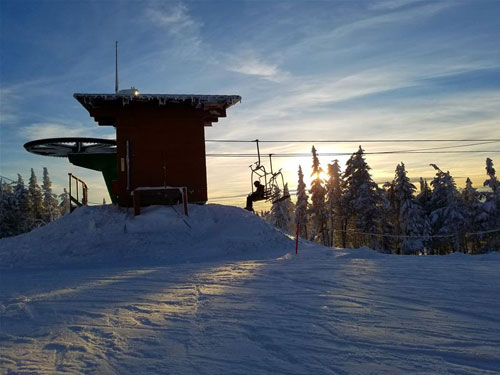 Photo: Sunset at Vista Peak, Bolton Valley Resort in January 2018. Courtesy photo.
“We want people to do pre-purchasing online and do less buying here,” she said. “Even so much as ordering food online and picking it up. Even in our tavern, where we are planning to do table service with capacity restrictions. We used to be slammed with people waiting for tables in the evening. We used to be so busy that even with full capacity, we had people standing in groups. We can’t do any of that. We can’t operate at full capacity. Now we have to lean on our technology to manage wait lists, and all those tweaks come at a cost. And we expect our call volume to go up with a lot more questions, so we'll have to staff more phone operators. It’s a really challenging time.”
Still, season pass sales are good.
“That’s telling us that people are excited to ski,” DesLauriers said. “They feel skiing is going to be safe and we agree. We’re really lucky, but we’re having to make a lot of investments before the season.”
So far, hiring has been successful, she said.
“Early indications are that there are people looking for work,” DesLauriers said. “It’s going good so far. We have a better outlook for staffing than last year, when we had a hard time finding staff. Out operation suffered. Literally, there were times we couldn't run a lift because we couldn’t staff it. It seems that’s improved.”
Staff members' temperatures are already being taken every day. Hand sanitizing stations have been created. Bolton has added two new bathrooms. It does daily cleaning.
“We’re looking at staffing in pods,” DesLauriers said. “We’re trying to staff people in groups, so if there is a case of COVID-19, the contact tracing is limited. We’re doing everything. We want to stay open, we want to stay healthy, we want to create a good guest experience and we want to survive as a business.”
The federal and state COVID-19 relief funding, like the PPP and the Economic Injury Disaster Loans, helped enormously, DesLauriers said.
“Really, all those things combined made a difference,” she said. “They kept us stable through the summer. We ended up making the decision to close our hotel this summer, and we lost all our group business. Not having weddings made a dramatic impact. But those funds kept us stable. As we go into winter, there's just going to be no way we can make the same amount of money with the restrictions that exist. This is our season. It’s challenging. I’m not pessimistic. We’re fortunate because people are going to want to ski. It’s not that there's not a market. But if you can only let half the people into your resort, you can’t make enough money. And we don't have huge piles of cash in the wings. We’re a small business. We have to cover our costs.”
In terms of the operation itself, DesLauriers is optimistic.
“Our plan is really solid and our team up here is incredible,” she said. “We have good solutions to manage crowds and figure out how to do this thing. And long term, a lot of things we're doing now will pay dividends in the future. We’re learning new ways that we never would have done before. It’s kind of exciting for us.”
Bromley
Bromley, located near Manchester in the town of Peru, had a reasonably good summer season, said President Bill Cairns.
“Actually, we delayed opening until the week before the Fourth of July,” Cairns said. “And I have to say that it went very well. The key to this is pre-arrival messaging — what the expectations of our guests will be upon arriving. We’re requiring masks. That gave the employees and customers a sense of safety.”
Bromley did not fully staff and did not open all its attractions.
“We opened the ones we thought would have the safest experience,” Cairns said. “We typically hire 100 employees for the summer. This year, we had between 45 and 50 employees. We had to hunker down. Combined with less travel, that resulted in less revenue. But we also had less cost.”
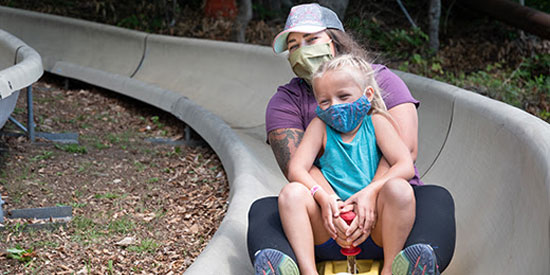 Photo: Triple Tracked Alpine Slide in the Mountain Adventure Park at Bromley. Courtesy photo.
Unfortunately, the resort was unable to provide water cooler stations or free sunscreen throughout the park this summer.
“Each ski resort has to have their own specific plan about how they’re going to monitor their attractions,” Cairns said. “For example, we have an alpine slide. It’s the only one in the state. So we had to write our own guidelines. That will be true in the winter, too.”
Travel restrictions hurt the summer season, Cairns said.
“The summer, as far as revenue?” Cairns asked. “Who’s going to come to Vermont? As you’re well aware, the red and yellow travel map is a real competitive disadvantage. If you have to quarantine for 14 days, New Hampshire didn’t have that requirement. So the spur-of-the-moment travel was down. — ‘Oh, we can’t go to Vermont’ — and it affected our business. We’re hoping to close at about 70 percent of visitors and revenue, and I’m pleased about that for the summer. We understood what the rules were. And actually, Labor Day weekend was our best two back-to-back days.”
Cairns said Bromley was going to take what it learned over the summer and incorporate it into its winter plan, which is submitted to the Agency of Commerce and Community Development.
“We’re redesigning our facilities and experiences to maximize physical distancing to help our guests and employees,” Cairns said. “It includes all the best practices from the Centers for Disease Control. We’ll have social distancing. Masks will be required. The employees will be masked. I think anything that goes on on the hill, outdoors, will see the least amount of impact. Most of the impact will be how do we do lunch, how do we control capacity, how do we manage rentals.”
Bromley is looking to upgrade its technology so it can take credit cards instead of cash.
“A recreation safety grant would allow us to make the necessary physical improvements to our facility under the umbrella of safety,” Cairns said. “What physical improvements may I make to allow people to use our facilities? The lodge can only hold so many people. We want to be careful to be safe, but it’s important to make it fun.”
Bromley won’t have restrictions on its season pass use, Cairns said.
“Skiing is outdoors, and people wear face coverings,” he said. “Skis keep you at least six feet apart from people. With a quad chair, the family arrives together and can sit four to a chair. Or if it’s not a family, people can sit on opposite ends of a quad chair.”
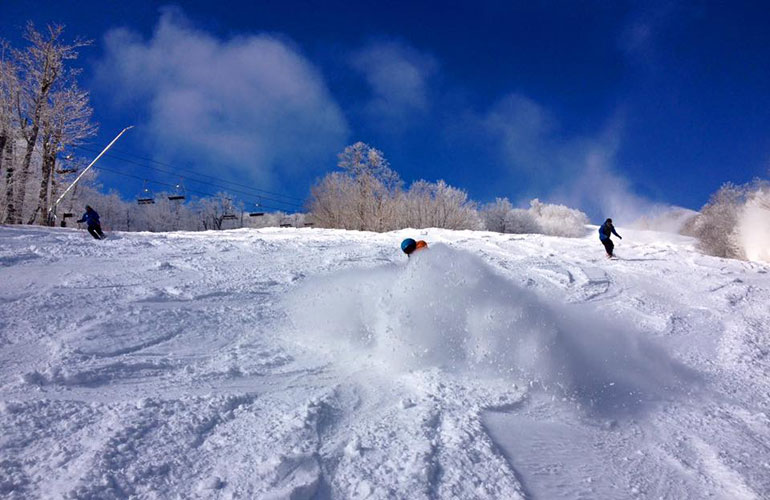 Photo: Skiing at Bromley. Courtesy photo.
One of the most important concepts for the winter is the idea of shared responsibility between ski resorts, communities and guests.
“Don’t be the reason to lose our season,” Cairns said. “We’re all in it together. Wear a mask. Wash your hands. If you don't feel good, stay home. Know what the quarantine rules are. If we have a COVID-19 outbreak, ski season can become history again like it did last March. How we message the season is what’s important. Know what the state travel guidelines are. Practice social distancing and cover your face. We're moving away from calling them masks; we're now calling them face coverings.”
Cairns will take employees' temperatures, but not the guests'.
“I have to assume the guests have met the state guidelines,” he said. “I'm going to trust that you feel good, have a mask, know the quarantine rules, and you’re in Vermont because you’ve been messaged. This summer, one of the most pleasant surprises were the guests willing to arrive here wearing a mask and obeying the rules. I’m impressively surprised and optimistic that the winter will be like that, too. If it snows in early December and gets everybody’s juices going, they’re going to be anxious to ski and we will be ready. They know the rules, so we can form a good partnership and we can have fun. It will be a winter unlike other winters, but the act of skiing is still fun. If the schools go well, and I think they will, I really see the tourism and ski industry up to bat. But will it be different? Will it look different? You bet!”
The Hermitage Club
The most exclusive ski resort in the Vermont mountain-scape is the members-only Hermitage Club on Haystack Mountain in Wilmington. Members have exclusive rights to the Hermitage Lodge — with amenities such as fine dining and a lap pool — as well as to the slopes of Haystack Mountain.
After the collapse of its former developer two years ago, the club was sold at auction in March of this year to a group of former members for $8 million. Along with the resort came a six-person bubble chairlift, a golf course, several inns and some undeveloped land.
Members own their own homes, mostly second homes, in the Wilmington-Whitingham area.
“About 80 percent of our members own either primary homes or secondary homes or have their habitual seasonal rental,” said new executive director and general manager Bill Benneyan. “A number of those homes and townhomes are here on Haystack Mountain. But also quite a few are out in the valley. One of the most important distinctions between today’s club and the former developer’s iteration is we own all of the real estate development rights that were part of the acquisition, but we’re not developers. So, in the interests of growing our membership and answering the needs for additional housing, we will work with outside developers to continue to build out the master plan, albeit likely with some changes that reflect our more modest vision.”
This Hermitage Club is solely member-owned.
“We currently have 195 members and we want to cap it at 230,” Benneyan said. “We expect there will be a waiting list for that number to open up once we get the Haystack Mountain open and operating and can fully assess our safe capacity under state COVID-19 guidelines and regulations.”
The club is being run by a volunteer board and is focused primarily on skiing.
“We have already divested most of our non-core operation assets,” Benneyan said. “We sold the Haystack Golf Course in June to Johnny Cleanthes. He ran the golf course for many years, and he's now living his dream of owning and operating his own golf course. He's doing a fabulous job. The local community is very happy to have a public course back in the valley. And club members have retained user rights.”
The Doveberry Inn and the Snow Goose Inn, both in West Dover, were also sold.
“Both of those new owners are almost complete with their renovations and ready to operate this fall,” Benneyan said.
In addition, the club is in negotiations to sell the historic Hermitage Inn.
“We’re looking forward to a mutually beneficial relationship with the new owners,” Benneyan said.
“Then we have the Horizon Inn on Route 9 that we're selling. We have a number of offers on it.
Our focus is operating the ski area, and let businesspeople who are expert in their field run the inns and restaurants.”
During its two years in receivership, the property was well-cared for by a four-person team.
“Since then we’ve been reinvigorating the infrastructure,” Benneyan said. “We’ve been working on the ski lifts, making sure they’re all in good shape. They were well-maintained during the two years of receivership. So now we’re preparing for the first winter season since 2017-18. We’re ensuring we're ready to open on Thanksgiving weekend. Our priorities have been lifts, snowmaking and the trails themselves. On the trails, that’s pretty much meant mowing. On the snowmaking, it means testing all the equipment, starting the pumps and compressors and making sure they all run well. We’ve done some replacement of snowmaking pipes and pump repairs, and both of those activities are very typical of off-season maintenance tasks. Our infrastructure is in very good shape.”
Things will be different inside the lodge.
“We have all of the amenities of a ski area, like food and beverage service, ski rentals, and the system that supports all of that, like our computer network point-of-sales system,” Benneyan said. “That and the staff program, that's been our focus for the past month or so. We are fortunate to have a very strong and experienced team working for us. And of course, on top of re-launching a ski area that has been closed for two years, and on top of establishing a new business and a new business model from scratch, of course we've had to plan for the additional layer of operating in a COVID-19 environment like every other ski area.”
Benneyan expects Hermitage Club members to become less insular and turn their focus to the wider Deerfield Valley.
“We’re happy to have our members engaged in the community,” he said. “We’re not seeking to capture everyone on the property. We want our members to experience all that southern Vermont has to offer, in terms of hospitality and, most importantly, recreationally.”
Haystack has been working on COVID-19-related practices with Vermont’s other ski resorts all summer.
“It's a very transparent, shoulder-to-shoulder industry in terms of people working together,” Benneyan said. “We’ve learned a lot from ski operators in the Southern Hemisphere. Based on that, all the various trade organizations in our industry have done a really robust job creating guidelines and signage which exceed CDC guidelines. These include use of masks at all times. For spacing on chairlifts, family groups can sit together. Or two strangers can sit at opposite ends of a quad chair. All resorts are looking to move as much activity as possible outside. We understand that it's winter, so we're making it as comfortable as possible. There will be screening to enter the building. Lunches will rely heavily on outdoor barbecues and takeaway lunches that can be eaten in newly designed areas outdoors, protected from the wind, utilizing fire and outdoor heating. In many ways, it’s a bit of a throwback to the earlier, less-developed days of skiing.”
Jay Peak and Burke Mountain
Much of the fraud case has been settled with former owner Ariel Quiros, who soon will start a jail term. There are still ongoing court cases against former President Bill Stenger and two other non-employee defendants. Stenger’s trial is scheduled for next year.
Court-appointed Receiver Michael Goldberg had hoped to sell at least Jay by now, but the pandemic has stalled that effort.
The major ski companies, Alterra/Aspen (Stratton and Sugarbush) and Vail (Mount Snow, Okemo, Stowe), now own most of the larger ski resorts in Vermont. Previous to COVID, Alterra had expressed some interest in Jay
Goldberg, who took over when the resorts were raided by federal authorities in April 2016, originally proposed selling both resorts in a package deal. But because of regulations involving employment levels associated with the EB-5 foreign investor program, the Burke Mountain Hotel likely will have to wait even if Jay is sold.
Goldberg wrote in his eighth interim report in May that: “During the period covered by this report (October 1, 2019 to February 29, 2020), the Receiver, along with his professionals, continued to focus on operating and marketing the Jay Peak Resort for sale. The Jay Peak Resort's operations and sales process have been affected by the COVID-19 pandemic. The Jay Peak shut down in mid-March to protect its customers and employees and the sales process has substantially slowed down. The Receiver and his professionals continue to monitor the situation closely.”
As for actively looking for a buyer, Goldberg wrote: “The Receiver continues to work with Houlihan Lokey (“HL”), the investment bank retained by the Receiver to assist in the sale of the Jay Peak Resort. HL has been actively marketing the Jay Peak Resort to potential buyers. To that end, commencing in the Spring of 2019, HL contacted 142 potential purchasers, including potential strategic and financial buyers, located throughout the United States, Europe and Asia. Of that group, 48 potential buyers executed Non-Disclosure Agreements (“NDAs”). Of that group, 9 potential buyers have submitted initial Indications of Interest. Three additional potential buyers have expressed interest and provided informal initial pricing guidance, but did not formally submit a bid. The Receiver expects that at least one of this group will ultimately submit a bid.”
However, “The sales process has ground to a halt due to the COVID-19 pandemic. The Receiver is hopeful it will begin again once business returns to normal. The Receiver is unsure when a transaction will close. The Receiver wants to assure all investors that he and his professionals are doing their best to obtain the highest possible price for the resort by conducting a vigorous and fully transparent sales process. The proceeds of the sale of the Jay Peak Resort when sold shall be, subject to the Court’s approval, distributed on a pro-rata basis to all investors in the Jay Peak Resort Phase II – Phase VI.”
As for Burke, Goldberg wrote, “The Burke Mountain Hotel was also shut down in mid-March due to the pandemic. Since the Burke Mountain Hotel has not yet generated sufficient jobs for all of the investors in the project, the Receiver has not yet marketed the Burke Mountain hotel because the sales price based on current financial performance would be extremely low. However, the Receiver has sold other land adjacent to the Burke Mountain Hotel that is not necessary for the operation of the hotel and ski area. The Receiver may continue to market those stand-alone parcels prior to the sale of the Burke Mountain Hotel.”
Jay Peak counts on Canadian visitors to bolster revenues, but the government of Canada has extended its border closure through October 21 for non-essential travel. That border closure is expected to be further extended.
Joyce Marcel is a journalist in southern Vermont. In 2017 she was named the best business magazine profile writer in the country by the Alliance of Area Business Publications. She is married to Randy Holhut, the news editor/acting operations manager of The Commons, a weekly newspaper in Brattleboro.