

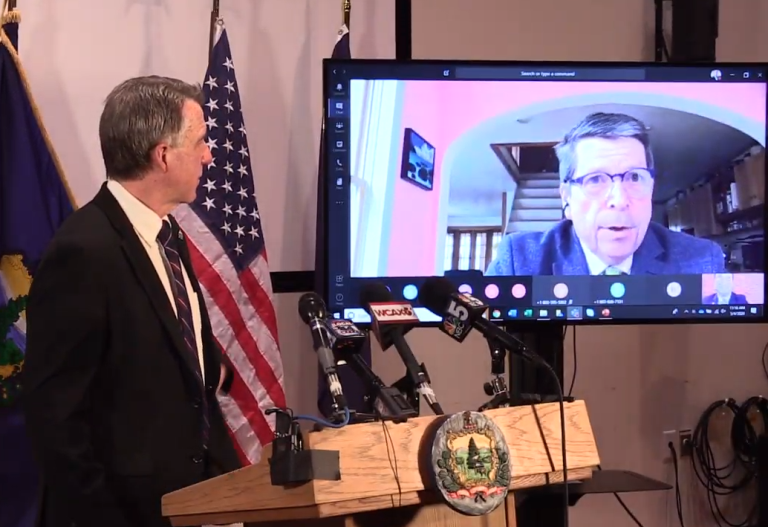
During Monday's press briefing, Governor Scott listens as Agriculture Secretary Anson Tebbetts gives an update via video on the reopening of farmers markets, which happened in a limited fashion last Saturday.
by Timothy McQuiston, Vermont Business Magazine Governor Phil Scott said on Monday that he will announce this week that some social provisions of his "Stay Home" order will be relaxed, but that the overall emergency order he signed March 13 will be extended. He said that announcement will come by May 15, the day it would have expired. The emergency order gives him the authority to enact the mitigation efforts like the "Stay Home" order. The scientific data shows that the spread of COVID-19 has at least plateaued, as the number of cases slows even with more testing. Hospitalizations associated with the novel coronavirus also continue to fall.
Scott said he was still attempting to work out with his staff what those new rules will look like while maintaining the ultimate goal of keeping Vermonters safe and healthy. He also indicated that the "Stay Home" emergency order will be extended.
The "Stay Home, Stay Safe" order (effective March 23) initially was to expire on April 15, but on April 10 the governor extended it until May 15. As early as tomorrow but not later than Friday, he said Vermonters should expect that he will extend it further.
While he did not say for how long, he said that he intended to continue to reopen up the state in a deliberate fashion even as the emergency order is extended.
An announcement on high school graduation also is expected this week. This has been one of the longest delayed decisions. Scott probably has been waiting to see the success of mitigating the effects of COVID-19. In that regard the state has done well, giving some hope to graduates and families that there will be some semblance of a real graduation.
At best this is likely to be an outdoor ceremony with graduates spaced out with only parents and siblings in attendance. It could only be the graduates at the ceremony. Or the governor could mandate that all graduations must be virtual. Families should be prepared to hear, whenever the announcement comes, that grandparents will not be allowed to attend any in-person ceremony.
However, as Scott loosens the social gathering rules, graduation parties might be allowed and be larger than 10 guests by the time graduation rolls around in June.
As for the social reopening, Scott said it will probably follow the incremental approach the state took in closing it down. The first limit on gathering sizes was only down to 250 and eventually to 10. As businesses reopen they are following a similar strategy by taking small steps with larger numbers of people allowed.
For instance, when the "Stay Home" order was enacted and all construction work was shut down, as the economy has reopened, first up to two workers were allowed, then 10 and on May 11 construction and will be fully allowed as long as safety measures are followed. Those measures include wearing masks and hygiene.
If he continues to follow this pattern, larger and larger social groups will be allowed over the coming weeks and months.
Case Information
|
|
Total cases* |
907 |
||
|
Currently hospitalized |
8 |
||
|
Hospitalized under investigation |
25 |
||
|
Deaths+ |
52 |
||
|
Total tests |
17,518 |
||
|
People being monitored |
20 |
||
|
People completed monitoring |
840 |
*Includes testing conducted at the Health Department Laboratory, commercial labs and other public health labs.
+Death occurring in persons known to have COVID-19. Death certificate may be pending.
Hospitalization data is provided by the Vermont Healthcare Emergency Preparedness Coalition and is based on hospitals updating this information.
Find more information on new data dashboard at healthvermont.gov/covid19 by clicking on the map of Vermont.
As of May 5, the Vermont Department of Health is reporting five new cases of COVID-19 and no new deaths, which remain at 52. However, the number of hospitalizations jumped from 15 on Monday to 33 as of Tuesday's report.
However, Health Commissioner Mark Levine, MD, along with the governor, has indicated that any reopening will be led by the health care data. That data suggests that Vermonters have been just about as diligent as any in the nation in following social distancing rules.
But Levine acknowledges that a second wave of the virus is likely to return to some currently unknown extent later this year.
Scott added that it is unlikely that the “new normal” will be “anything but business as usual.” This especially applies to large indoor social gatherings, like sporting events.
The governor has been reluctant to offer advice on when people can expect parades or weddings and other larger gatherings will be allowed.
But this week, Governor Scott did say there will be some relaxing of regulations involving social gatherings. State parks, golf courses and other outdoor recreation venues also are closed as of now.
If Scott follows the pattern he used in closing down the state in reopening it, as he has said, then the number of people allowed to gather will grow in number in incremental steps.
Businesses also would follow that pattern.
That would mean that restaurants and bars (closed March 17) would be among the last businesses to reopen, whenever that might be.
Other states have allowed for outdoor seating first and indoor seating later, with standing at the bar last. Right now, many restaurants have taken advantage of the allowable “curbside” service, which has always been available.
Given that patten, it is likely that nursing homes and other long-term care facilities will be the last to reopen to the public.
Scott acknowledges this has been particularly hard on those living at those facilities and for their friends and families.
Two nursing homes in Burlington have been hit hard by COVID-19, Birchwood Terrace and Burlington Health & Rehabilitation.
Dr Levine said recently that every death in the state attributed to COVID-19 (52 as of Tuesday) has involved either an elderly Vermonter or someone with underlying health issues and often both.
On March 13, Governor Scott restricted visitor access at long-term care facilities.
In Monday’s press briefing, which lasted an 1:40, the governor and members of his administration fielded many questions from reporters across the state.
But before he began the Q&A with reporters, most of whom were on a joint conference call, he mentioned that on his way to work Saturday he observed that vendors and customers at the Capital City farmers market were keeping with the social distancing requirements.
Farmers markets were allowed to reopen for the first time Saturday with not only the social distancing caveats but also without entertainment or non-food vendors.
As of Monday, limited elective procedures may resume. Those procedures had been put on hold as Vermont’s health care system focused on preparing for, and responding to, COVID-19. This does not include elective surgeries that would require a hospital stay, like a hip or knee replacement.
The governor’s decision comes as the state’s modeling continues to show spread of COVID-19 has slowed – thanks to Vermonters’ physical distancing efforts – and the state’s ability to track and trace outbreaks of COVID-19 has become more robust.
Health care providers who recommence these procedures have been provided guidance and must meet specific mitigation criteria to protect patients and clinicians from possible infection.
Elective procedures are important to the financial viability of the health care system. The hospitals have lost much money over the last two months. The University of Vermont Health Network reported last Friday that it was projecting a $152 million loss and was implementing $25 million in cuts.
UVMHN is not laying off any staff, as other hospitals have been forced to do.
The hospitals are getting some federal aid. UVMHN is getting $37.9 million to help offset the losses.
The governor said that dental offices and eyecare offices could be next to reopen.
Q&A
Q: The unemployment insurance issues have not been completely resolved, what is being done and would the state institute another emergency check of $1,200 to those still waiting for benefits.
A: Scott he does not plan on issuing another round of checks, as many of the problems have been resolved, but is not ruling it out. Labor Commissioner Michael Harrington said that between the third party vendors and state staff, that there are 175 people helping resolve cases. He said that will soon ramp up to about 200.
He reminded Vermonters on regular UI or the new PUA that they must refile every week in order to receive benefits every week. He said the Labor Department is chasing down filers. Harrington also said that there are still cases which needed to be adjudicated, as not every filer qualifies for benefits.
He also reminded filers that if they received an offer to return to their job from which they’d been laid off or furloughed that they must do so. Unless they have a pertinent excuse (childcare issue, COVID-19 sick or taking care of a COVID-19 sick family member) they would lose their benefits.
Q: Would the governor sign the “Hazard Worker” bill that would increase pay to those on the frontlines of the fight against COVID-19.
A: Scott said he would wait until the final bill came to his desk. While he considered if a “noble idea” he did not know where the money would come from.
He said it was unclear if the more the billion dollars in COVID-19 relief money that the state received could be used for that purpose. Federal funds often come with strict requirements, like for Medicaid and transportation.
He added that even if it were available there are many needs in state government. Tax revenues alone are expected to fall $60 million in the current fiscal year ending in June and over $400 million in the next fiscal year.
“We need to see the magnitude of the issue” before doling out money, he said. Agriculture has also been hit hard, he said. And it’s not clear if there will be more federal assistance coming.
Q: Testing every inmate at all prisons?
A: All the inmates at the Northwest State Correctional Facility in St Albans Town have been tested and retested following an outbreak there in March. Infected inmates have been moved to the St Johnsbury facility which has been prepared to house infected inmates statewide.
As of now, only the St Albans facility has had any positive cases.
Dr Levine said that as the state has ramped up and is now able to stockpile testing equipment that every facility, whether it’s a prison or long-term care home, will be completed tested if there is a single case.
The state is also expanding its contact tracing capabilities to understand who a person infected with the coronavirus has been.
“If we had the ability, we would test every Vermonter,” Scott said.
Q: Mail-in ballots.
A: The state cannot print ballots and therefore cannot mail them until the candidates are known. The Vermont primaries are scheduled for August.
Q: Why is there not a statewide requirement on wearing masks and is their enforcement for people who should be wearing masks (mostly workers) who are not?
A: There is no enforcement action being taken at the moment. If someone who should be wearing a mask is not, then they are informed that they need to do so.
Scott said Vermonters are largely obeying the requirements. He said unless a problem develops then education and guidance will continue to be the state’s strategy. Vermonters so far have done well following the “Stay Home” and work guidelines.
Q: Will summer camps, which are important for the economy, recreation and childcare, reopen?
A: Scott said he could not say at this point. He would like them to allow them to reopen, but the health data and the behavior of Vermonters will drive that decision, as it does will all the reopening decisions.
He said the sacrifice Vermonters have already made could be undone if a certain sector of the economy was reopened prematurely.
Scott said that sacrifice has saved hundreds of lives and that nearby places like Boston and Connecticut and New York were still hotspots for COVID-19.
He added, however, that Vermonters could expect an update and further guidance on summer camps within the next couple of weeks.
He and Dr Levine both noted that not only is there a health risk involved, but the impact on the economy of opening and then having to close down a sector would be more costly to the economy than waiting for the best time.
Q: Would one region of the state with few cases be allowed to reopen earlier?
A: No. Scott said he wouldn’t want to pit one region against another. Plus, there is too much travel within the state for that to ensure safety for everyone.
Q: The final question was directed to Scott personally. What has been his hardest decision?
A: The last decision is always the hardest.