

by Timothy McQuiston, Vermont Business Magazine As modeling indicates continued progress in slowing the spread of COVID-19, Governor Phil Scott today announced a third incremental, data-driven step forward to put Vermonters back to work. Scott explained at his press briefing today that these next steps focus on construction and manufacturing. He said those two industries were chosen because they are vital to the Vermont economy getting back on track, they already are used to dealing with occupational safety regulations and that they should be able to adhere to the state's new safety measures during the COVID-19 emergency, which include wearing masks and appropriate distancing. The governor also announced that all public transit workers and customers will be required to wear masks.
Scott said that because of the size of these industries, it will allow tens of thousands of Vermonters to get back to work. Once again, he cautioned that everyone must be mindful of the ongoing risk to the coronavirus and some industries will be opened later than sooner in a similar fashion to how they were shut down. This suggests that restaurants and hospitality might be the last to reopen. Restaurants and bars were closed on March 17.
"I want to be clear," Scott said, "and make sure everyone understands, we are not declaring victory."
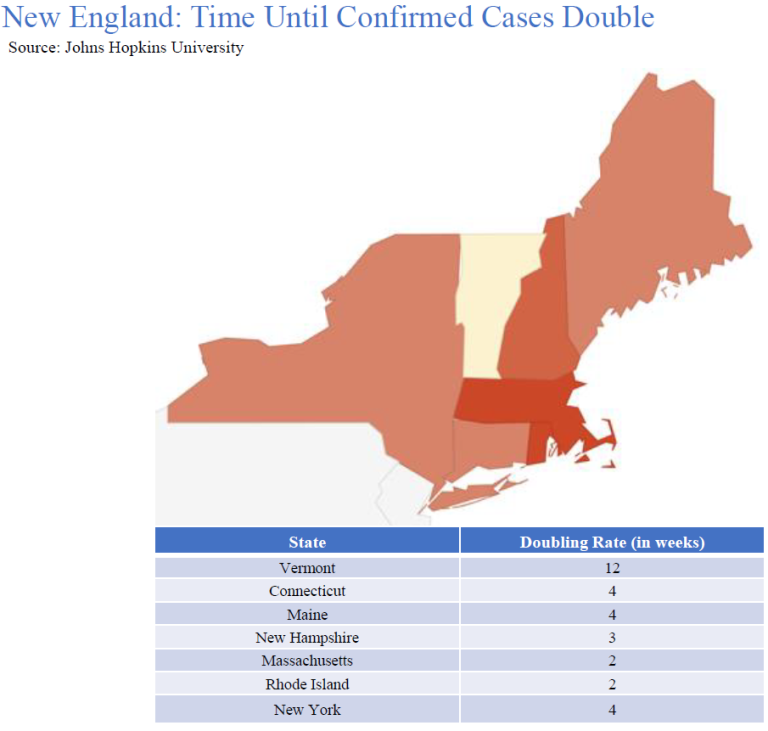
The latest modeling data presented by DFR Commissioner Michael Pieciak indicates that infection rates are down and Vermonters are adhering to social distancing guidelines more than any state in New England and in New York State, by quite a bit.
As he has often said, the infection rates in Massachusetts and New York are still. He noted that Massachusetts could see 1,000 deaths this week and New York 2,000. Given their short and easy access to Vermont, he is still concerned about opening those industries that might encourage visitors from those states coming to Vermont.
As for manufacturing, distribution and construction, if they are able to comply with outlined safety measures, the governor’s latest order expands on Addendum 10 and Addendum 11 allows them to operate under the following conditions:
- Crews of 10 or fewer employees per location/job to perform outdoor work and construction work in unoccupied job sites. (Effective May 4)
- Manufacturing and distribution operations may resume with a maximum of 10 employees in any location if they are low-density and ensure employees are always six feet apart. (Effective May 4)
- Manufacturing, construction and distribution operations may restart with as few employees as necessary to permit full operations if they can meet all health and safety requirements, comply with ACCD guidance and develop enhanced training programs that expand on the Vermont Occupational Safety and Health Agency (VOSHA) training. (Effective May 11)
This latest restart phase includes additional health and safety requirements that build on those in previous addendums, including:
- Required pre-screening before each work shift, including temperature checks and survey to verify each employee has no symptoms of respiratory illness.
- On April 27, VOSHA developed a minimum level of health and safety training to be completed no later than May 4 by all employees and documented by businesses and non-profit and government entities in operation.
- Employers operating with 10 or more employees must now adopt a training program – which can be developed independently, or through industries, trade associations, chambers of commerce or other representative organizations – which must be made available upon request. In most cases, these plans should augment the VOSHA training standards to reflect the unique nature of various workplaces.
- Businesses and non-profit and government entities may require customers or clients to wear masks, and all commuters are required to wear a mask while using mass transit.
Governor Scott continues to highlight the importance of limiting the spread of the virus as the state plans subsequent restart measures: “There is no playbook on what we can expect so we’ve focused on sectors like manufacturing and construction that have controlled environments, open space and built-in mechanisms and expertise in the areas of health and safety training. They’ll be able to set an example for others as we look to do more in other sectors.”
“We also have to recognize that states like Massachusetts, Connecticut, New Jersey and New York – states right on our borders and just a few hours away – are still confronting massive outbreaks and it only takes one spark, or one unhelpful decision, to reignite this fire. We all need to continue to be smart, cautious and disciplined to preserve are hard-earned gains,” he added.
For a full list of health and safety requirements for all businesses and specifications for each newly opened operation, click here to view Addendum 12.
To view ACCD’s memo to business for specific safety guidelines and protocols, as well as additional resources, visit accd.vermont.gov.
As part of his press briefing, the governor noted that this weekend Vermont would have celebrated Green Up Day, with hundreds of Vermonters taking to the highways, byways and streams to pickup trash, rescue recycling and fish tires out of bodies of water.
He said that while the state has canceled the official Green Up Day, that Vermonters on their usual walks could grab a trash bag and still do their part.
As for the modeling, Scott said that health and safety of Vermonters will lead how the state economy reopens.
The state is in the process of undertaking more and more testing. Scott and Health Commissioner Levine underscored that this will very likely mean that the Health Department will report more positive tests for COVID-19, but from less sick people. It will also likely mean that the tested infection rate will go down as the number of tests ramp up and even the positive cases increase.
Governor Scott also announced today that all public transportation workers and those riding public transit will now be required to wear masks. He said the nature of people being inside a vehicle in close quarters with others lent itself to coronavirus transmission. He said this was a reasonable measure to reduce the chance of infection.
Michael Pieciak presented his fourth modeling of the impact of COVID-19 in Vermont and Vermonters response to the "Stay Home" measures first implemented by Scott in mid-March.
As in the previous two presentations, Pieciak revealed data showing that Vermonters were doing a better job in social distancing than anywhere in the region. Vermont also fourth best in the nation in the growth rate of new infections, as measured by how long it takes for the number of cases of COVID-19 to double.
As of this model, Vermont's rate is doubling every 84 days. At the beginning of April it was every 7.5 days. Montana and Hawaii are the slowest, with Alaska about the same as Vermont. The middle part of the country which was hit last has the highest rate, with Nebraska, Minnesota and Iowa at the bottom.
Pieciak presented this as "good news" attributable to the hard work and sacrifice of Vermonters adhering to the "Stay Home, Stay Safe" orders and when out taking precautions, like wearing a mask and social distancing.
And even as Scott has slowly re-opened the economy, the data show that Vermonters are becoming more mobile but there is no evidence that this has caused more infections.
Levine said one person can infect two to three people at a time. As Vermonters go back to work, employers will need to be creative in how they keep their employees safe.
Commerce Secretary Lindsay Kurrle warned that even as the governor "turns the spigot" to re-open the economy, that it won't be "business as usual" even several months from now. But what exactly that looks like is not clear yet.
The governor also introduced by video Bill Shouldice of Vermont Teddy Bear in Shelburne and John Connor of Connor Contracting.
They spoke about the governor's Restart Vermont Task Force. Shouldice talked about the requirements and resources available to manufacturers. Connor, based at their Berlin office, spoke about the construction requirements. See full press briefing at the bottom of this article.
The governor once again was asked when golf courses will be reopened. Vermont is one of only a handful of states in which golf is still not allowed, including New York State, which continues to be much more hard hit by the coronavirus than Vermont.
Scott said he should have further guidance soon on when golf courses will reopen, perhaps as soon as next week.
He added that it is only May 1 and golf courses here typically don't open much earlier than this in any case. He also could have mentioned that this has been an unusually chilly start to spring.
For more information on:
- COVID-19 health information, guidance and case data, visit www.healthvermont.gov/covid19.
- The Governor’s actions, visit governor.vermont.gov/covid19response.
- The state’s modeling, visit https://dfr.vermont.gov/about-us/covid-19/modeling.