


Vermont Business Magazine New data released by the US Energy Information Administration shows renewable energy use exceeded coal for the first time since 1885. Vermont and New England mirror the national trend toward increased reliance on renewable electricity. Across New England, tens of thousands of consumers have been inspired to adopt solar for their homes, farms, schools and town buildings.
Together the more than 180,000 small-scale solar systems in New England pack a mighty punch against climate pollution, according to Montpelier-based Renewable Energy Vermont (REV). These solar sites are concentrated in southern New England and Vermont.
 Just last month, home and community-based solar installations set a new record by generating 3,200 MW of clean power, producing three times as much power as the Seabrook Nuclear Facility.
“As summer solstice approaches, we celebrate the incredible local economic benefits and energy independence that more solar electricity brings to Vermont and our nation,” said Olivia Campbell Andersen, Executive Director of Renewable Energy Vermont. “Every Vermonter should be proud of the progress we’ve made together to raise local renewables and curb polluting fossil fuel electricity in New England. Local solar brings rays of light and hope for the future during these challenging times.”
Consumer demand, price competitiveness, and encouraging state and federal policies enabled renewable energy consumption to expand in the US for the last four years in a row and hit a record-breaking annual output of 11.5 quadrillion Btu. Nationally, electricity from coal continues to decline precipitously, dropping in 2019 to its lowest level in 42 years while total renewable energy consumption continues to grow.
According to REV, in Vermont, two policies have been particularly important in supporting the state’s climate pollution reduction targets while saving Vermonters money on their electric bills—net metering and standard offer. In 1998, the state legislature enacted net-metering making it possible for Vermonters to generate their own renewable electricity and share it with their neighbors. Customers with small-scale solar systems (less than 500 kW) consume power they generate themselves and then buy any additional power they might need from the utility.
Without net-metering, the more than 343 MW of solar powering schools, town halls, homes and farms across Vermont would never have been built and all ratepayers would be paying millions more annually to import electricity.
 For larger community and small utility-scaled projects, the Standard Offer Program requires Vermont utilities to access the lowest price for new local solar generation through a competitive reverse auction. As a direct result Standard Offer, Vermont now generates 136,698 MW of clean power from a wide-range of technologies including farm methane, solar and hydroelectric.
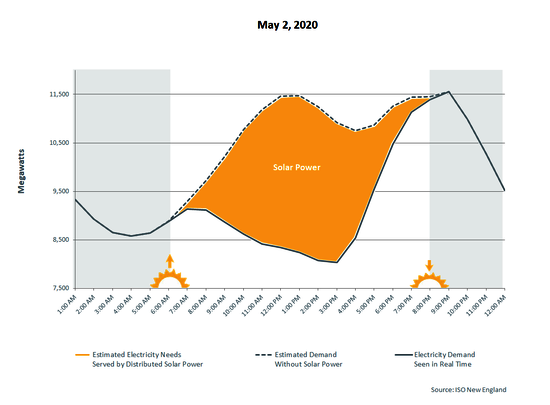
According to grid manager ISONE, New England hit a solar record in May when the region’s over 180,000 behind-the-meter (BTM) solar power installations produced an estimated 3,200 megawatts (MW) of power between noon and 1 p.m. on May 2, 2020.
These BTM systems are connected to local distribution utilities or directly at retail customer sites, meaning the ISO can’t dispatch them. Instead, we see the impact as a reduction in power system demand, ISONE said in a report, and when conditions are right, as they were on May 2, it can be a significant reduction.
Expect this record to be broken again in the months and years to come, ISONE stated, as New England is expected to have nearly 8,000 MW of solar power by the end of the decade. Learn more about Solar Power in New England: Concentration and Impact and How ISO-NE forecasts behind-the-meter solar.
“The new historic record for local solar wouldn’t have been possible without strong state policy – particularly net metering and standard offer,” explained Campbell Andersen. “We need to keep these programs going in Vermont to ensure that everyone can participate and benefit from generating local renewable power.”
REV represents businesses, non-profits, utilities, and individuals committed to eliminating our reliance on fossil fuels by increasing clean renewable energy and energy efficiency. Vermont’s clean energy economy supports at least 18,800 sustainable jobs, representing approximately 6% of Vermont’s workforce. Together, we will achieve 100% total renewable energy (electric, thermal, transportation).
Source: Montpelier, VT – REV 6.18.2020 www.revermont.org. ISO New England, Holyoke, MA