

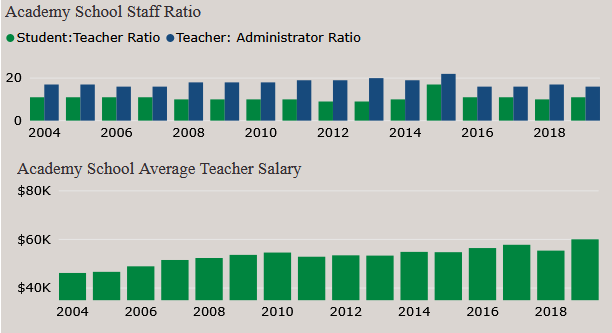
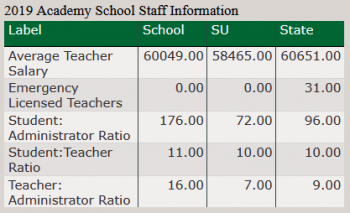
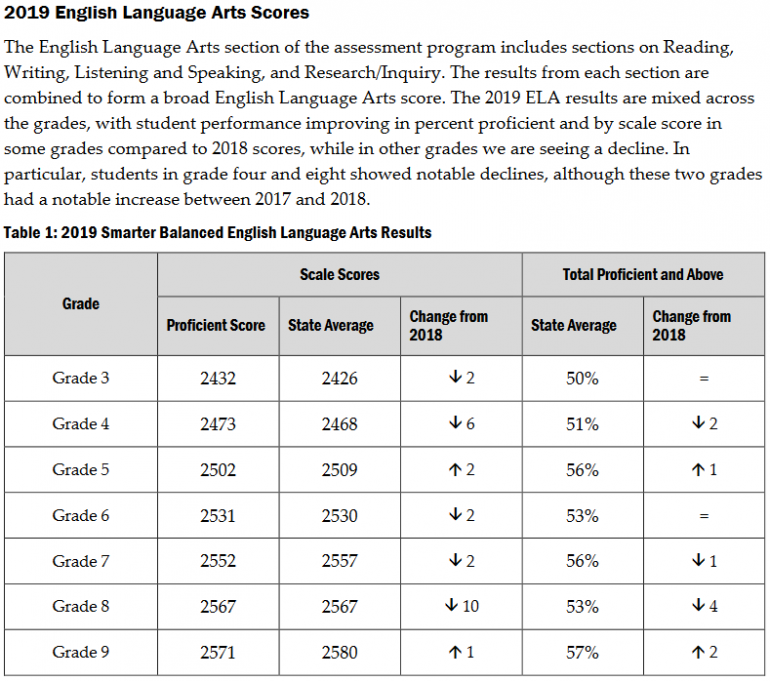
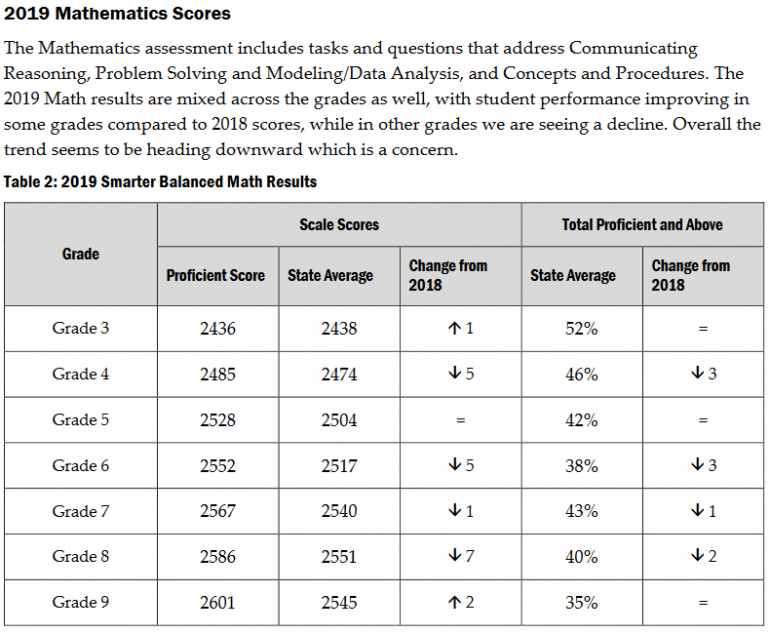
Vermont Business Magazine The Vermont Agency of Education (AOE) has released an updated version of the Annual Snapshot with additional indicators and updated data. This release coincides with the release of the 2019 Smarter Balanced assessment scores. The overall assessments by grade showed a mixed result in English, with some up and others down. The math scores, however, indicate a more downward trend. See tables below.
New in this release of the Snapshot are indicators for College and Career Readiness, School Offerings of Flexible Pathways, Properly Licensed Educators, Physical Education and Per-pupil Spending. This is also the first year of statistically valid results on the Vermont Science Assessment (VTSA) and measure students’ mastery of the Next Generation Science Standards (NGSS).
A summary of Smarter Balanced Scores is available in the 2019 Smarter Balanced Assessment Fact Sheet. Full scores and data are available on the Vermont Education Dashboard. The Annual Snapshot can be found at schoolsnapshot.vermont.gov.
 “This year’s Smarter Balanced scores reinforce trends that we’re already aware of,” said Secretary of Education Dan French. “While Vermont continues to perform well nationally, our performance has plateaued, our growth is stagnant and the percentage of our students achieving proficient scores is too low. It is critically important, especially in the context of the COVID-19 emergency, that we lose no opportunity to support Vermont student learning.”
Vermont administers the Smarter Balanced assessment annually in the spring. Students in grades three through nine take the English Language Arts and Mathematics tests. The Vermont Science Assessment is given to students in grades five, eight and eleven. Both the 2019 English Language Arts and Mathematics results are mixed across the grades, with student performance improving in percent proficient and by scale score in some grades compared to 2018 scores, while declining in other grades.
Because this is the first year of statistically significant results, the 2019 Science results will serve as a benchmark for tracking schools’ progress in helping students demonstrate knowledge of the NGSS. 37% to 41% percent of students meet proficiency on the assessment in 2019 across the grades assessed.
Per-pupil Spending75048 Students
VERMONT
Overall $21,071
Federal $1,211
State & Local $19,860
|
Vermont also reports performance of historically marginalized students compared to students who are not historically marginalized. Vermont reports these data by combining assessment scores of students from racial or ethnic minorities, students with disabilities, English language learners and students in poverty. The combination is necessary because the number of students that meet those criteria school-by-school or district-by-district are often quite small, and the assessment data must be suppressed for student privacy. Vermont has performance gaps between students in historically marginalized groups when compared to their non-historically marginalized peers. This gap is widening in several cases on the Smarter Balanced Math and ELA assessments.
“The disparities on these test results just reinforce that we have more work to do on equity in Vermont,” said Deputy Secretary of Education Heather Bouchey. “Particularly at this time, where we have had to rely on new methods of teaching and remote instruction, it is critical that we are focused on removing the structural barriers to success for Vermonters.”
About the Smarter Balanced Assessment
The Smarter Balanced Assessment Program is administered annually in the spring to students in grades three through nine. These assessments are designed to measure students’ mastery of the Common Core State Standards in English Language Arts and Mathematics.
The English Language Arts section of the assessment program includes sections on Reading, Writing, Listening and Speaking, and Research/Inquiry. The results from each section are combined to form a broad English Language Arts score. The Mathematics assessment includes tasks and questions that address Communicating Reasoning, Problem Solving and Modeling/Data Analysis, and Concepts and Procedures.
Both assessments report scale scores and proficiency percentage scores for all students and scale scores for student groups.
About the Vermont Science Assessment
The 2019 test year was the first operational administration of the Vermont Science Assessment (VTSA). It is designed to measure students’ mastery of the Next Generation Science Standards (NGSS), adopted by Vermont in 2013 as a foundation for science instruction.
Based on the Framework for K-12 Education, the NGSS refocuses K-12 science education to improve readiness for college and STEM careers as well as preparing students to become informed, knowledgeable citizens. The NGSS focus on helping students use scientific inquiry, interdisciplinary thinking and science content to make sense of their natural and designed world. The VTSA is designed to help parents and educators determine if students are on target to achieve proficiency in the NGSS.
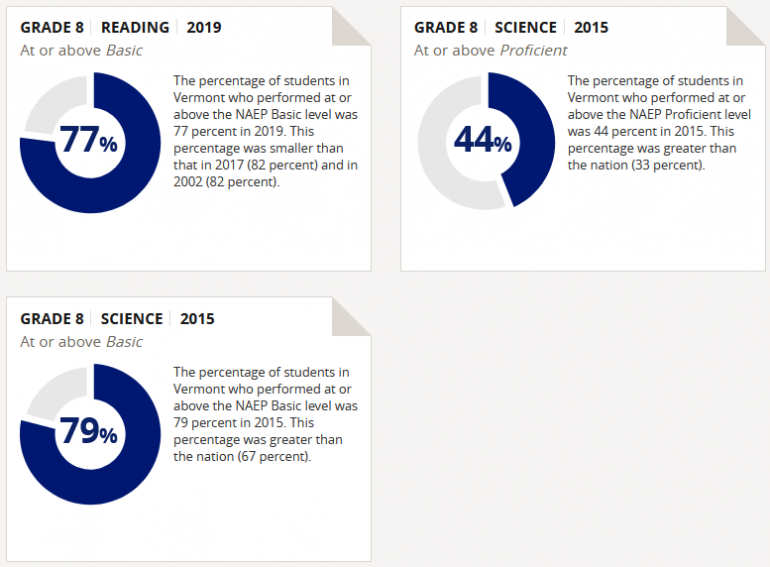
Vermont's Smarter Balanced Scores
Vermont Summary Statements
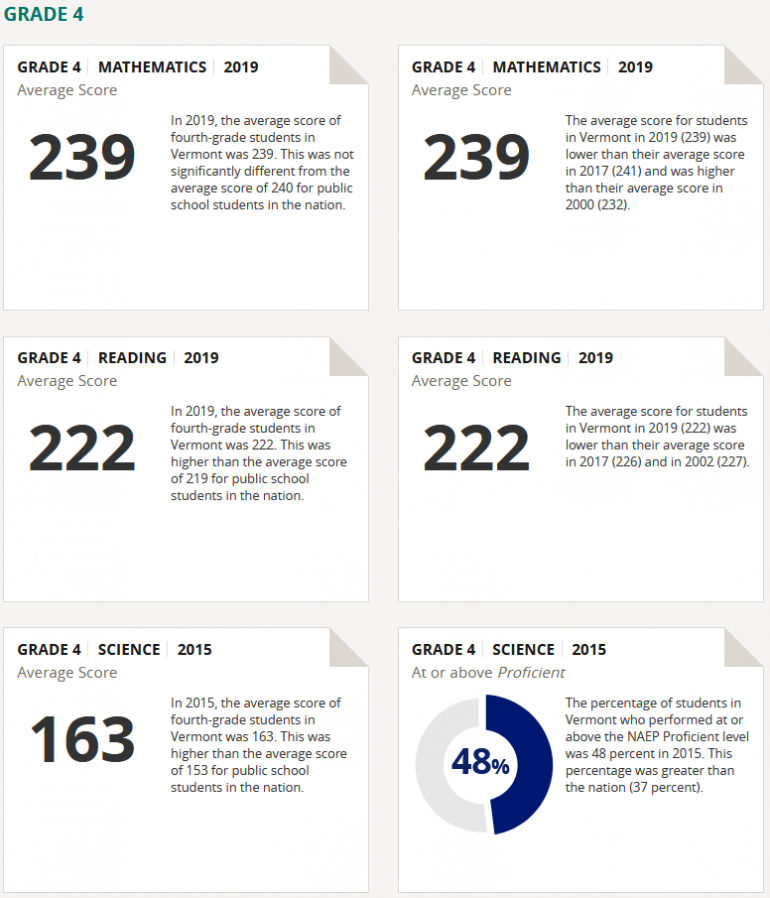
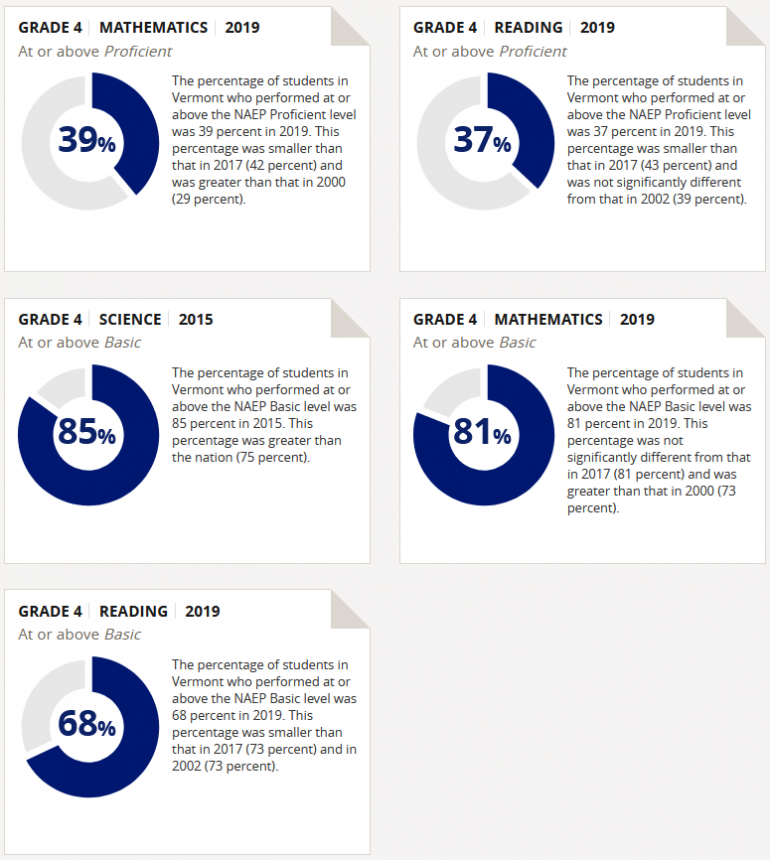
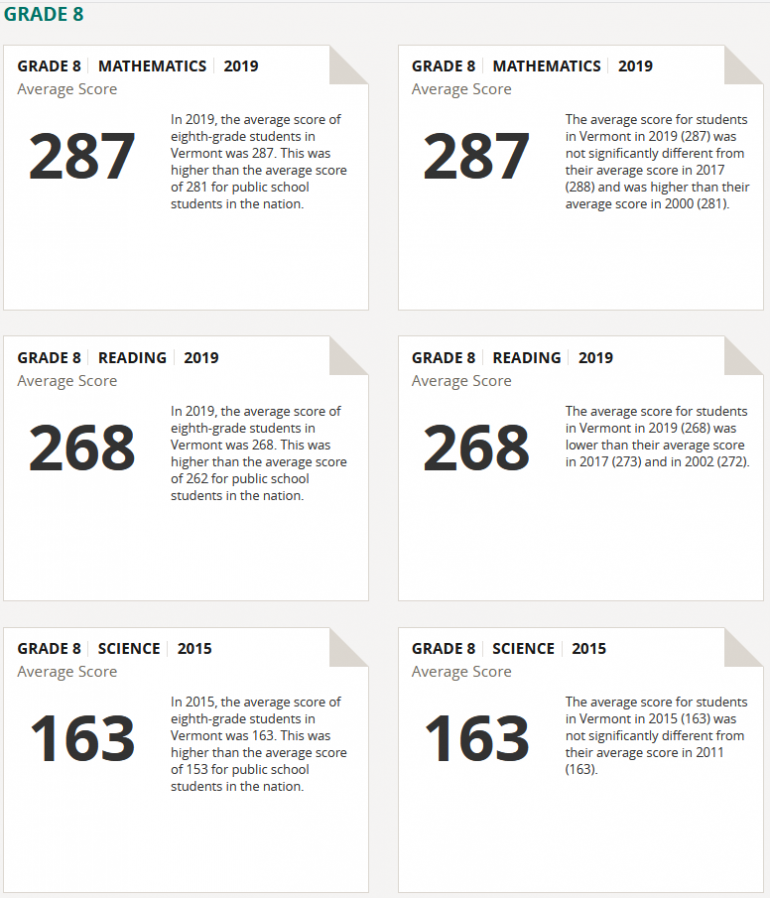
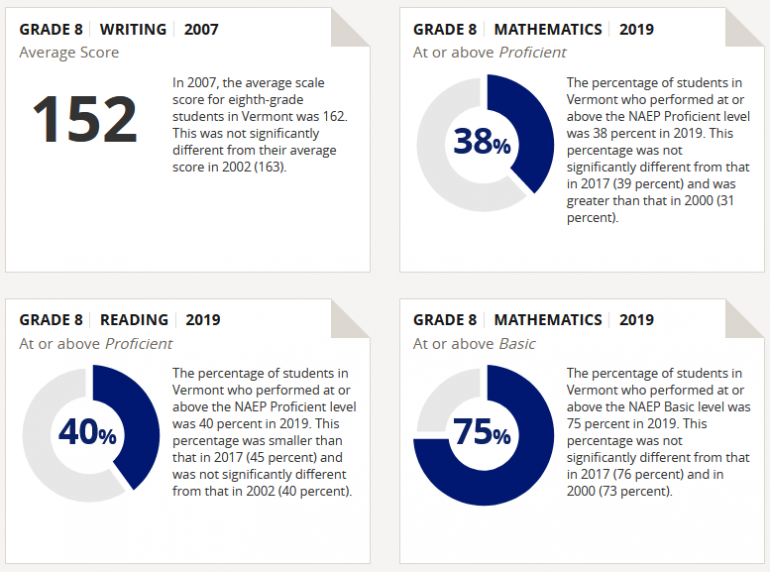
About the Annual Snapshot
The Annual Snapshot shows detail about school, SU/SD, and statewide achievement in meeting Vermont’s Education Quality Standards. These standards are measured across five domains: Academic Proficiency, Personalization, Safe and Healthy Schools, High Quality Staffing and Investment Priorities.
Together with the Integrated Field Reviews, the snapshot help school systems identify successes and areas for improvement for their Continuous Improvement Plans. These plans help SD/SUs meet their goals to ensure high quality schools and equal access to students from Vermont's historically vulnerable communities. The snapshot is part of a more holistic approach to assessing performance, focused on continuous improvement.
Source: MONTPELIER, Vt. – 6.15.2020. Vermont Agency of Education. Connect with the Vermont Agency of Education on Twitter, Facebook and the Web.