

Vermont Business Magazine Today the Vermont Public Utility Commission issued a preliminary report addressing the question of how to deliver energy efficiency for all fuels. The report compares the success of the long-established, statewide efficiency programs for regulated fuels (electricity and natural gas) with the uncoordinated, inadequately funded efficiency approaches for unregulated fuels (fuel oil, propane, diesel, and gasoline).
PUC recommends that Vermont lawmakers begin to identify new program and funding options for those sectors that have not traditionally been subject to energy efficiency programs.
Compared to electricity, the transportation and heating sectors burn more energy, emit the most greenhouse gases, and cost Vermonters more of their energy budget.
Whereas the State has ambitious goals for reducing greenhouse gas emissions and weatherizing its buildings, Vermont’s programs and funding sources do not adequately address the crucial transportation and heating sectors.
As a result, Vermont is falling well short of its greenhouse gas and weatherization goals.
The preliminary report is the first in a two-step process required by Act 62. The final step will be a report from the Commission in January 2021 that will make more substantive recommendations about whether and how to implement a coordinated all-fuels efficiency program and how to fund it.
“If Vermont is going to make significant progress toward its statutory greenhouse-gas reduction goals, and if Vermont is going to stand by its commitment to the emission-reduction targets of the Paris climate accord, Vermont must do much more to reduce its reliance on fossil fuels for transportation and heating,” said Commissioner Margaret Cheney. “This can be achieved by creating robust programs for heating-fuels energy efficiency and for programs that switch consumption from fossil fuels to electricity, which in Vermont is becoming more and more renewable.”
Policy Director Tom Knauer added, “Investments in all-fuels efficiency and fuel switching will not only help fight climate change, but will create in-state jobs, save Vermonters money, increase the comfort of homes, provide substantial health benefits, and make Vermont more affordable.”
Renewable Energy Goals.
With respect to Vermont’s renewable energy goals, most of the progress has been in the electric energy sector, with transportation and thermal lagging. However, the 2025 goal of 25% renewable energy across transportation, thermal, and electric energy sectors is within reach.
Total source energy (“all energy generated and consumed, including energy lost in production and delivery”) is 18.5% renewable. Total site energy (“energy directly consumed in buildings and vehicles”) is 19.4% renewable.
The current snapshot provided in Energy Action Network’s (“EAN”) 2018 Annual Progress Report indicates that there is substantial work to be done in both the transportation and building sectors, but that electric power has nearly met the 2025 goal of 67% renewable pursuant to the CEP.
This is particularly problematic because transportation and thermal combined make up 86% of Vermont’s energy use.
The following chart breaks down energy sources by sector.
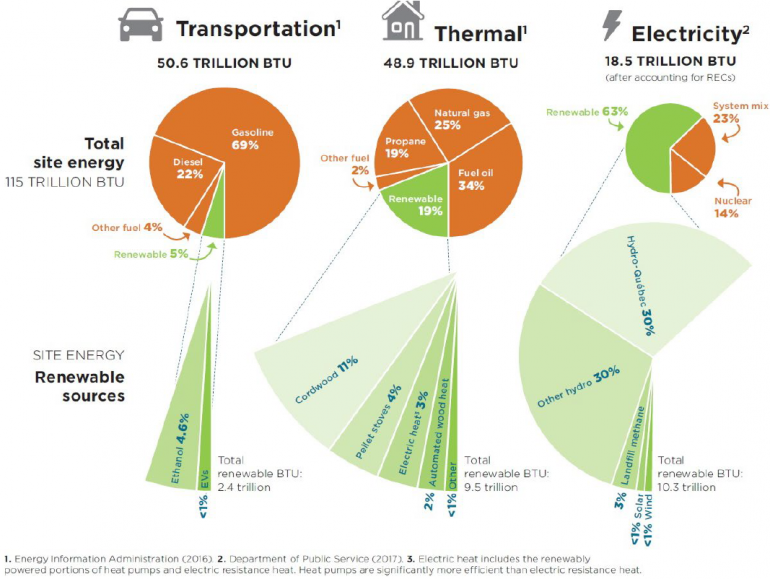
Efficiency Vermont’s Energy Burden Report explains that Vermonters spend an average of $1,150 annually on electricity, which represents 20% of annual household total energy costs. Vermonters spend an average of $2,636 annually on transportation energy, which represents 45% of annual household total energy costs. Vermonters spend an average of $2,050 annually on thermal energy, which represents 35% of annual household total energy costs.
Thus, Vermont’s energy successes have come in the electricity sector, but substantial work is needed to meet the State’s thermal and transportation goals.
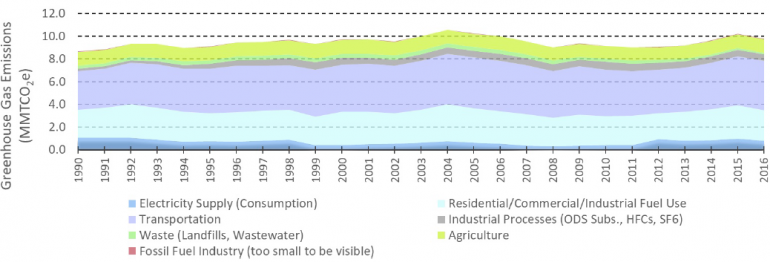
Report
The Commission’s report is the product of a six-month investigation that consisted of a series of written filings and workshops.
Participants included relevant state agencies; Vermont’s electric, natural gas, and energy efficiency utilities; public interest groups; building professionals; consulting groups; industry groups; planning commissions; and citizens.
The Commission opened the investigation and prepared the preliminary report in response to Section 2 of Act 62 of the 2019-2020 Vermont legislative session. The Commission’s investigation is ongoing and will conclude with a final report on January 15, 2021.
The report can be found on the PUC website.
The January 15, 2020, report, as well as all other documents related to the investigation, can be found by searching for Case No. 19-2956-INV on ePUC, the Commission’s online document-management system.
Source: Montpelier, VT, January 15, 2020 –Vermont Public Utility Commission