

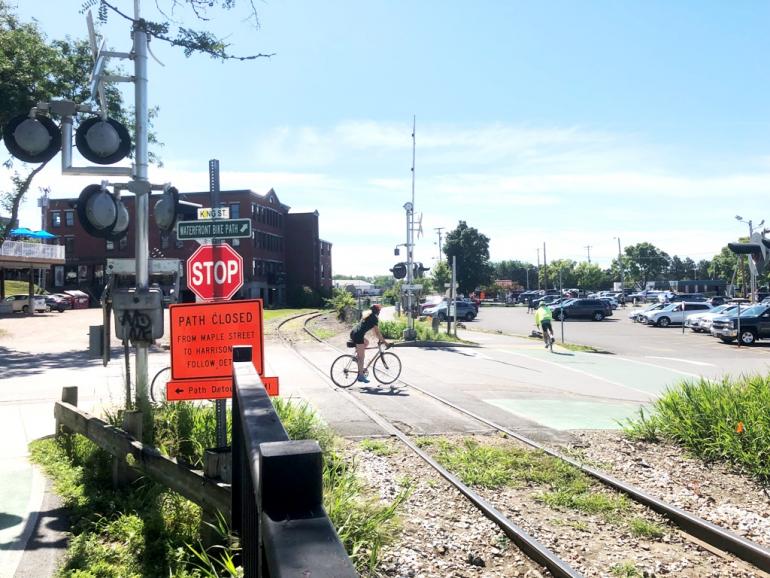
Just south of the Burlington train station and Wing Building, the bike path crosses the train tracks. VRS intends to straighten the line here and slide it East and Burlington intends to move the bike path West, so it won't cross the tracks here at Perkins Pier or up at College Street. VBM file photo
by C.B. Hall, Vermont Business Magazine A decision over where to store an Amtrak train overnight when the passenger rail provider begins serving Burlington remains elusive, as city and state officials and other stakeholders continue to ponder multiple options.
The leading candidates for the purpose, among six that have received public consideration, are a new siding near the McNeil Generating Station just west of Burlington's Intervale Road, and a new siding adjacent to Burlington Union Station, at the foot of Main Street.
But both of those options, while the focus of the public debate, have their opponents, and the outcome of the decision-making process remains anyone's guess.
The train, the Ethan Allen Express, runs between New York City and Rutland, 68 miles shy of Burlington. Plans call for it to begin serving Burlington, as well as Middlebury and Vergennes, by the end of 2021.
The Agency of Transportation (VTrans) sponsors Vermont's Amtrak service. The agency's secretary, Joe Flynn, had anticipated making a decision by the end of 2019 on the overnight storage site.
But in a December 19 email, VTrans spokeswoman Amy Tatko told VBM that the decision would be delayed until February 17, to allow the agency to discuss and assess the relevant questions further.
Then, in a February 10 email, Olivia LaVecchia, spokeswoman for Burlington mayor Miro Weinberger, told VBM that the schedule had been pushed back again.
"The State is giving the City more time to consider all of the options more thoroughly," she wrote. "So, the timeframe will be longer than the 17th and likely at least through March."
She indicated that Weinberger had yet to receive certain information requested from the state to help formulate the city's ultimate position.
The city can do no more than state its preference, however; VTrans can agree with that recommendation or make a contrary decision.
"We will have to make a decision [on the city's recommendation] at one of our March meetings," said city councilor Max Tracy, who chairs the council's Transportation, Energy and Utilities Committee (TEUC).
Asked when his agency would make its decision on the siting, VTrans's Rail and Aviation Bureau director Dan Delabruere said, "No exact date of a decision has been given."
A widely criticized Chittenden County Regional Planning Commission study, ordered by VTrans and completed in June 2019, investigated five possible sites in detail – Union Station, the Vermont Rail System (VRS) railyard just south of the station, a rail spur in Burlington's South End, and two sites in the city's Urban Reserve, north of the station.
But at a public meeting convened by TEUC on November 19, VTrans representatives introduced the McNeil site, which the CCRPC study had not examined, as a sixth possibility. That newer alternative has since excited support from many parties to the controversy.
All six locations remain under consideration, Delabruere told VBM.
Sliding The Mainline East
How the matter will unfold from here remains mostly a matter of speculation.
VRS, which leases the state-owned rail right-of-way between Burlington's College Street and Bennington, will in any event begin "track reconstruction, realignment and signals work" this spring in front of Union Station, according to a December 18, 2019, letter from VRS general counsel Peter Young to Weinberger.
The letter stated that the work – on the existing mainline, rather than any siding - needs to happen "in order to be ready for Amtrak service to Burlington," and that, on March 23, under the terms of the lease agreement in force, VRS will accordingly terminate the city's lease for the alignment of the Burlington Greenway bike path.
The path occupies part of the right-of-way on the east side of the mainline tracks; Burlington plans to move the path eventually to the west of the tracks.
In December Young also reached out to Main Street Landing, which owns the property to the east of the rail right-of-way and has led the charge in opposing construction of a storage siding on that side of the existing tracks.
In particular, MSL has objected to the noise and engine emissions from the train's parked locomotive, which could idle all night long within as little as 14 feet of apartments in the Wing Building, owned by MSL, immediately to the south of the station.
The opening from VRS led to a January 21 meeting between Young, VRS vice president Selden Houghton, MSL CEO Melinda Moulton, and MSL's attorney, Ritchie Berger. Berger described the meeting as "productive."
In an interview for this article, Berger said that, in contrast to earlier VRS statements that it needed a siding, or second track, at Union Station no matter what, Houghton left open the possibility that that would not be necessary, depending on the Amtrak schedule and if the train is overnighted at a location to the north, such as McNeil.
Confirming Berger's account, Houghton said in an interview that "there might be some other things we could look at" if VTrans puts the train somewhere other than the station. That would lead VRS to "reevaluate" the need for the Union Station siding.
"If the overnighting is not at Union Station but somewhere up the track, there is no scenario where the train would obstruct the mainline for more than 10 or 15 minutes," Williston-based passenger rail advocate Carl Fowler pointed out. VRS only needs the area when exchanging cars with the New England Central Railroad (NECR), which connects with the VRS route from the north - and that happens in the middle of the night, he explained.
"Regardless of what happens, we're going to slide the mainline to the east," Houghton said, "to flatten out a significant curve just to the south of Union Station."
That would put the mainline essentially on the alignment of the proposed storage track, erasing the possibility of such a track as Amtrak's overnight lodgings.
The realignment of the mainline "certainly wouldn't bring it any closer to the [Wing] building than what's been contemplated" in siding designs done thus far for VTrans.
But, he emphasized, "Till we know where the train is going to be overnight and what the [Amtrak] schedule looks like, everything is up in the air."
The law allows a railroad to build infrastructure within its right-of-way with few constraints – ultimately opening up the possibility of a siding on the west side of a realigned mainline at Union Station.
Railroads can use all their infrastructure at their discretion, and that's important in that opponents of the Union Station siding currently under discussion have also decried construction of additional trackage there as a mechanism for returning railyard operations to the central waterfront area, whose redevelopment for tourism and recreation pushed out a decrepit railyard decades ago.
Who Foots The Bill?
Among the things up in the air is the question of who will ultimately pay for this track work.
Answers are hard to come by.
Asked who would pay for the mainline realignment – the railroad or the state – Houghton said that matter was "not settled yet." But on the subject of a Union Station siding to park the train, he left no uncertainty.
"If the Amtrak train is going to overnight at the station, the project would need to cover the costs of the necessary second track for freight trains to pass."
That would put the onus on the state.
VTrans's position is not entirely clear on who would foot the bill for a Union Station siding, if it decides that's where to store the train.
“We have created the need for the second track," Michele Boomhower, division director for policy, planning and intermodal development at VTrans, said at the November 19 TEUC meeting.
She referred to the Amtrak presence as an imposition on VRS's business, and said that VTrans therefore has “agreed that we will pay for that track.”
VTrans's Delabruere addressed the same thorny question at a January 16 community meeting on the McNeil site's status and possible impacts, but gave a less certain answer.
"If they [VRS] have criteria to keep their operations working then we need to comply. If their criteria is a second track we need to make it happen and figure out who pays. They know their daily operations and what is necessary," he said, according to the meeting minutes.
The same uncertainty characterized a February 18 email statement by Delabruere.
Responding to VBM's inquiry, he wrote that "the details of funding are still being worked out" as to who would defray the costs for a Union Station siding or the McNeil siding – which would occupy NECR property two miles north of Union Station, and thus become part of the NECR's infrastructure.
Asked to comment on financial and ownership arrangements for a possible McNeil siding, Mike Williams, spokesman for Genesee & Wyoming, which owns NECR, said, "This is not NECR’s issue or responsibility. The responsible parties are Amtrak and VTrans."
Amtrak has for the most part kept itself out of the ongoing debate, not expressing any preference as to where the five-car train and its locomotives might bed down for the night.
In a September 19 email, Amtrak deputy general manager Kevin Chittenden told VBM that "the only real issue where ever we store the train" was to guarantee that its crew receive the amount of overnight rest time required by federal safety regulations.
Precise figures for planning and building the new infrastructure at either the McNeil or Union Station sites remain speculative, but estimates in the $1.5 million-$2 million range have circulated.
No Perfect Solution
Whatever the back-and-forth on the question of who pays, the state has already committed in excess of $431,000 to preliminary work required in view of construction of a siding at Union Station, according to data from VTrans.
The agency approved one of the contracts in question on December 6, 2019. That was three days after the statutory Vermont Rail Advisory Council took a vote on the siting question.
In that poll the Union Station option tied for the worst of the six alternatives. The council voted McNeil as its top choice by a wide margin.
Given the issue of noise and engine emissions next to the Wing Building, and the perception that addition of new track would encourage VRS to restore full-scale railyard operations in the central waterfront, the thumbs-down on Union Station, while merely advisory, came as no surprise.
The McNeil option lacks those disadvantages. It would place the train some 400 feet from the nearest residence, far more than the analogous distance at Union Station, and that 400 feet includes a large swath of woodland.
According to the VTrans presentation at the January 16 meeting, nearby residents would have to cope, at worst, with noise levels just under 60 decibels from an idling locomotive – comparable to a large business office.
That contrasts with levels in the 85 decibel range for Wing Building residents – comparable to a diesel truck passing by at 40 mph 50 feet away.
According to Tracy, some local residents have however expressed concerns about the McNeil alternative.
At the January 16 meeting, specific objections were raised about the possibility of vandalism in the relatively secluded location, the presence of homeless people, noise and lights.
While the McNeil option has enjoyed more popular backing, unanimity is elusive. What location VTrans ultimately approves thus remains anyone's guess.
In addition to the Burlington locations, there remains a dark-horse possibility: taking the train, with or without passengers, up to the NECR railyard in St Albans, 32 miles north of Union Station, and overnighting it there.
That railyard already accommodates Amtrak's Vermonter train every evening, and the idea has received support among those debating the Burlington locations. VTrans has however kept its focus on the alternatives in the Queen City, with the St Albans option a consideration for some time in the future.
Time is short. VTrans aims to launch the Burlington extension by the end of 2021; if that deadline is missed, the agency would have to give back $10 million in federal funding awarded to help underwrite infrastructure improvements for the extension, or ask the feds for more time.
Given the time likely to be consumed in planning and building the storage site, and considering that the service extension has only gotten as far as its present hurry-up-and-wait status after a quarter-century of visions and revisions, the deadline looms large.
Timing is also crucial in that the storage solution may require a substantial public investment that the Legislature has yet to deliberate.
Asked by VBM where all the controversy might wind up, state representative Curt McCormack (D-Burlington), who chairs the House Transportation Committee, left alternatives to the McNeil and Union Station locations open.
"At this point I have not given up on a solution that is neither of those two, but that would make everyone happy."
He declined to give specifics as to what that solution might or might not be.
C.B. Hall is a freelance writer from southern Vermont.