

Vermont Business Magazine Easing trade tensions with China, increased consumer spending and a more stable interest rate environment helped improve US business sentiment in the fourth quarter, according to the Citizens Business Conditions Index from Citizens Bank. Citizens has branches across Vermont. In the latest report released by Citizens Commercial Banking, the index increased from 60.2 to 61 and remained well above 50, showing growing confidence in the US economy.
“Progress toward the first phase of a China trade deal, more clarity around Brexit, improved consumer spending and a stable rate environment took some of the uncertainty off the table for business leaders in the fourth quarter,” said Tony Bedikian, head of Global Markets for Citizens Commercial Banking. “Of course, this quarter the coronavirus is having an impact on certain sectors and markets, but the overall economic trend so far is still positive.”
Confidence went up in the following states:
Connecticut
New Hampshire
Rhode Island
Vermont
And it dipped in Massachusetts, from 52.2 in the third quarter of 2019 to 51.9.
The Index is derived from a number of underlying components, most of which remained strong during the fourth quarter.
- The Manufacturing Purchasing Managers’ Index (PMI) from the Institute of Supply Management (ISM) was down, but the ISM Non-Manufacturing PMI rose.
- Unemployment figures decreased, or remained stable, across most of the country during the fourth quarter and wage growth continued at a slow-to-moderate pace.
- Proprietary measures of business activity among Citizens Commercial Banking’s more than 7,000 clients across the United States remained strong.
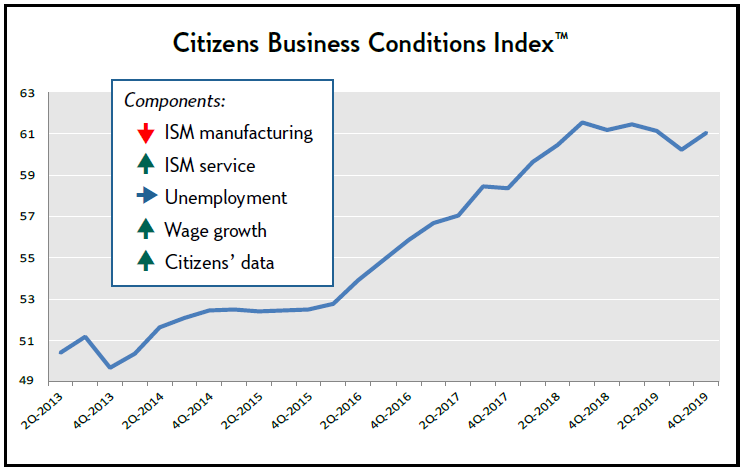
The Index draws from public information and proprietary corporate data to establish a unique view of business conditions across the country. An index greater than 50 indicates an expansionary trend and points to improved business growth for the next quarter.
MANUFACTURING WEAKNESS OFFSET BY OTHER FACTORS
The fourth-quarter Index reading of 61.0 reflected a broadly
positive state for businesses in the U.S. The Index is a function
of five underlying components, most of which indicated strength
in the period.
The weak point was manufacturing activity, which continued to
slow. The Manufacturing Purchasing Manager’s Index (PMI) from
the Institute of Supply Management (ISM) ticked downward again
to 47.2 as the trade war between the U.S. and China enacted its
toll. ISM readings below 50 reflect contracting activity.
Still, manufacturing weakness was offset by strength in the other
four components of the Index. The ISM reading for the service
sector moved higher from its September level of 52.8 to an even
stronger 55.0 in December. Likewise, measures of unemployment,
already healthy in the third quarter, remained unchanged, while
wage growth trended higher.
SERVICE-SECTOR STRENGTH
The outlook brightened for service-sector companies over the
fourth quarter.
The fifth component of the Index is a proprietary measure of
business activity, tracking an assortment of metrics across our
own commercial clients throughout the Northeast, Midwest
and Mid-Atlantic. This measure moved higher from a healthy
third-quarter reading, an additional sign that business conditions
were favorable.
EASING TRADE TENSIONS AND SUPPORTIVE FED
While the manufacturing sector reflected trade-policy headwinds,
policymakers made progress in the fourth quarter toward a
“Phase 1” agreement, which was indeed signed by both countries
early in January. The Federal Reserve’s three interest-rate cuts
over 2019 signaled its supportive stance, reassuring businesses.
STATE INPUTS SUGGEST THE EAST COAST
AND MIDWEST BELOW NATIONAL TREND
The fifth component of the Index, the proprietary measure of
activity among our commercial clients, revealed some regional
trends. Our customers in the Midwest and Northeast posted higher
quarterly activity, while the Mid-Atlantic ticked slightly downward.
All three regions demonstrated slightly weaker conditions than
we saw nationally.
On a state level, four states (out of 11 across our banking
footprint) indicated a decrease in activity from the third quarter,
while seven indicated growth. Customers in Connecticut and
New Hampshire enjoyed the strongest growth, while Michigan
and New Jersey had the weakest trend-lines.
BY INDUSTRY, ENERGY LED GROWTH
Our proprietary client data also displayed disparate trends
by sector. Among commercial clients, we saw the most momentum
among energy companies in the fourth quarter. The energy
sector enjoyed rebounding activity as global growth looked to
be stabilizing, which also pushed oil prices up over the period.
Among laggards, government-sector clients posted the
weakest results.
POSITIVE TRENDS GOING INTO 2020
The Citizens Business Conditions Index™ indicated that the
commercial backdrop brightened slightly in the fourth quarter,
aided by the strong employment market (at 50-year lows) and
upbeat trends in the service sector. Compared to the third quarter,
the Index demonstrated more uniform strength, supported by an
accommodative Federal Reserve, improved consumer spending
and retreating trade tensions. Despite the potential impacts from
the outbreak of coronavirus early in the new year, a strong Index
reading from the fourth quarter bodes well for the business
backdrop as 2020 unfolds.
Citizens is a strategic and financial adviser. For more information, please see the Index here or visit the Citizens Commercial Banking website.
Source: PROVIDENCE, R.I. – Citizens Bank. 2.4.2020