

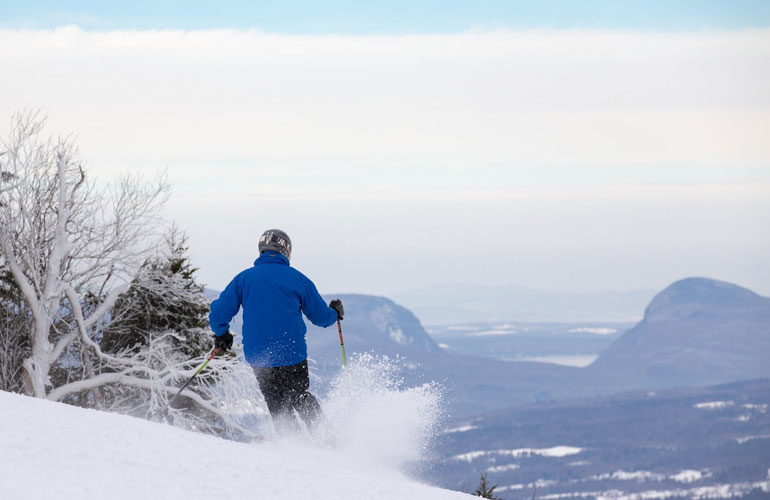
Photo: Burke Mountain and other ski areas are adjusting to the new reality brought on by the Covid-19 pandemic. Burke expects far fewer skiers this season along with fewer staff. Courtesy photo
Manufacturing and real estate are driving ahead as hospitality struggles
Bruce Edwards, Vermont Business Magazine At the Northeastern Vermont Development Association, David Snedeker has spent much of his time this year helping businesses get the financial help they need to survive a year like no other.
Those efforts include hiring someone specifically tasked with helping companies through the COVID-19 pandemic, connecting them with Restart Vermont and its technical assistance program, said Snedeker, NVDA executive director.
The technical assistance program connects businesses and vendors in a number of areas: business operations, financial management, grant writing digital strategies, architecture and physical space design, reconfiguring manufacturing equipment and processes, incorporating safety measures, technology and software consulting, legal, marketing, and other professional services.
“It’s been pretty successful,” Snedeker said. “We ended up in our region connecting about 40 businesses with vendors providing services.”
He said businesses also received financial support for those services from the CARES Act.
Help Is Here
For a small business trying to navigate the perilous financial waters of the current times, the Vermont Small Business Development Center is on the front lines ready to help.
Since March, the VtSBDC has made more than 1,700 new contacts with more than 200 of those contacts in the Northeast Kingdom and Upper Valley, according to Ross Hart, area VtSBDC business advisor in St Johnsbury.
“We’ve been focused on trying to help them respond and react to this in the best possible way,” Hart said. “It could be helping them change a business model, it could be helping them make decisions on how best to handle working capital needs.”
The SBDC is also keeping businesses up to speed on federal and state assistance programs.
He said the bottom line for any business is: does it make sense to continue in business or not, given the individual circumstances.
Hart said he hasn’t run into worst case scenarios a whole lot “because there’s been quite a bit of stimulus money injected and thank God for that, but I fear what’s coming.”
The state is coming to the aid of the hospitality industry with $76 million in financial assistance.
Hart also said there’s still talk about another federal stimulus package but that is not a sure thing.
One of the challenges Hart faces is convincing people to seek help.
He said residents of the Northeast Kingdom “are fiercely independent in many ways and reaching out for help is not something that they do naturally.”
Diversified
The Northeast Kingdom has a diverse economic base from outdoor recreation and hospitality to craft beverages and manufacturing.
There are industrial parks in Saint Johnsbury/Lyndon, Hardwick, and Orleans.
The Saint Johnsbury location is home to NSA Industries, Vermont Aerospace, Lyndon Furniture, UPS and several gas and fuel oil companies.
The Vermont Food Venture Center occupies a 15,000-square-foot facility in the Hardwick Industrial Park. The facility serves as a co-packing space for small food producers.
The Orleans park in Barton is home to The Vermont Beef Jerky Company and Kimtek Corp, a fire safety technology company.
“I think they’re doing OK,” Snedeker said, referring to the manufacturing sector. “They’re still having some workforce challenges, which we had before this whole thing (pandemic) started too.”
To get around the workforce shortage, Snedeker said some companies have invested in new equipment as a way to increase productivity.
He said companies like NSA, the St Johnsbury contract manufacturer, are doing well. “When I don’t hear much, I assume everything is going OK,” Snedeker said.
He said Lyndon Furniture and Ethan Allen also appear to be doing well. He said Lyndon Furniture is one company that has invested in new equipment.
Weidmann, a global electrical component manufacturer, is “super busy,” he said.
NVDA has also supported the fledgling Northeast Kingdom Community Broadband, which formed a communications union district.
“We’ve supported that group by applying for multiple funding opportunities,” Snedeker said. “We had two federal grants and one state grant to kind of get that group off and moving on their planning work.”
NVDA also received several grants to help fund outdoor recreation projects to build trail networks.
“We got $250,000 from the Northern Border Regional Commission which we’ve made ($200,000) available for local community projects,” he said.
NVDA is also continuing its work on obtaining additional funding for brownfields assessments.
The Numbers
The October unemployment rate (not seasonally adjusted) fell sharply in the three counties that comprise the Northeast Kingdom, according to the state Department of Labor. Caledonia posted an unemployment rate of 2.1 percent (Sept. 3.9); Essex, 2.2 percent (3.9); and Orleans 3.1 percent (5.6).
Statewide the October unemployment was 3.2 percent (seasonally adjusted) compared to 4.3 percent in September.
According to the U.S. Census Bureau, median family income in all three counties remained below the statewide median of $60,076 (2018). Caledonia’s median family income was $49,348; Essex, $41,045; and Orleans, $47,915.
The average poverty rate in the three counties remains above the statewide average of 10.2 percent. Both Caledonia and Orleans counties had a poverty rate above 12 percent while Essex stood at 15.5 percent.
The three counties have a combined estimated population of 63,193.
Banker’s View
There’s no doubt that the federal stimulus was a critical lifeline for many businesses during the pandemic, said Jim Kisch, president of Passumpsic Bank, which serves the Northeast Kingdom and New Hampshire.
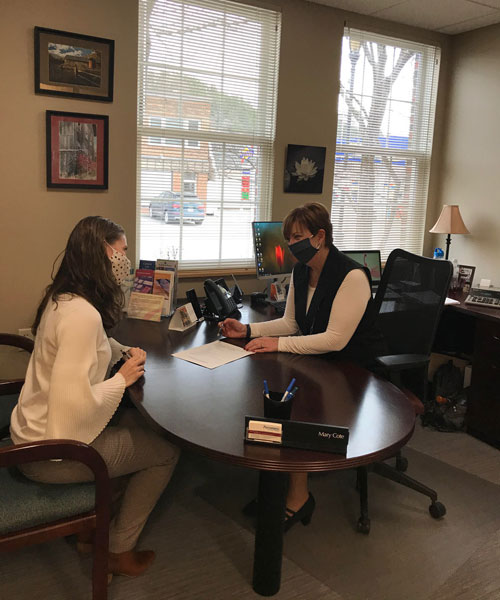 Photo: Passumpsic Bank commercial banker, Mary Cote (right) works with a business customer. The bank made $46 million in PPP business loans and recently has seen a slight uptick in traditional commercial loans. Courtesy photo.
Kisch called the PPP loan program a remarkable success with millions of dollars pouring into the region to “stabilize things.” He also said it created a lot of liquidity, so people are holding more savings.
With the PPP program, the bank made 414 loans totaling $46 million, he said.
Kisch said the real estate market remains healthy with the biggest challenge a lack of inventory.
“Our mortgage company is having the largest year in their 21-year history,” Kisch said. “Incredible volumes everywhere even in the Northeast Kingdom.”
He said not only is the refinancing market strong because of low interest rates but also the purchase market “is very strong.”
Kisch said given the size of the PPP lending there hasn’t been as much demand for traditional commercial loans. He said, however, over the past several weeks the bank has seen an indication that commercial lending is starting to pick up slightly.
Despite the economic hardship brought on by the pandemic, Kisch said loan delinquencies remain low. The question is whether delinquencies will spike once the stimulus money dries up. “We’ll remain responsive and responsible to our customers and our community as we go for the next six to nine months and beyond,” he said.
Island Pond
In the small Essex County town of Brighton, it hasn’t been the best of times, but it hasn’t been the end of the world either.
“We’ve actually had an OK year,” said Mike Strait, who owns The Hearth & Home Country Store in Island Pond.
During the initial shutdown of non-essential businesses, the store’s home decor section on the second floor shut down while the bakery and wine section on the ground floor stayed open.
The store’s bakery has gone “crazy” selling a lot of baked goods, Strait said. “It seemed like people were in a mood to eat and they kind of got in the habit and stuck with it,” he said.
He said he began opening the store at 7 am instead of 10 to serve a light breakfast of coffee, muffins and cinnamon rolls.
During the summer, business at the store was spread out during the week and not focused so much on weekends, he said.
“All in all, the businesses in town seem to do OK through all of it,” said Strait, who also serves on the three-member Brighton Select Board. “I mean nobody reported that their sales completely dropped off the map or anything.”
He said the five restaurants in town are all doing fairly well.
Despite the lack of summer events which were cancelled because of the pandemic, Strait said the area continued to draw hikers and cyclists to town.
Known as the Snowmobile Capital of Vermont, Island Pond is hoping to welcome back snowmobilers this season. But that all depends on whether the coronavirus can be brought under control. For now, the state has mandated that anyone visiting or coming back to Vermont quarantine for 14 days.
Strait said Island Pond is heavily dependent on out-of-state snowmobilers during the winter.
He said the majority of snowmobilers come from Connecticut and Massachusetts. “If they can’t come here, there won’t be a whole lot of snowmobiling.”
Saint Jay
St Johnsbury’s downtown revitalization program is paying dividends with a number of projects either completed, in process or on the drawing board.
“We’ve seen some success both in the hospitality and recreation industry sector, some interest from the manufacturing sector,” said Joe Kasprzak, assistant town manager and economic development specialist.
There has also been quite a bit of success in the commercial sector in and around the downtown.
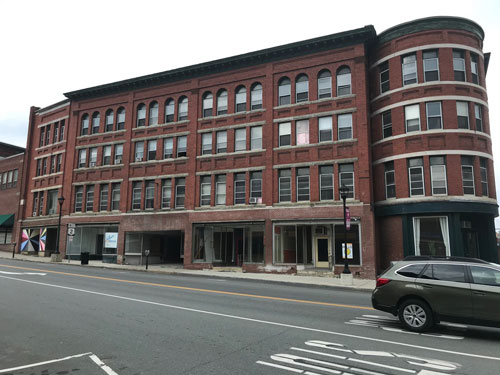 Photo: The $15 million New Avenue project in downtown St. Johnsbury will create 40 affordable apartments and 10,000-square-feet of commercial space on the ground floor. Courtesy photo.
Kasprzak ticked off a long list of projects including New Avenue LLC. Housing Vermont is rehabbing the former Depot Square Apartments, creating 40 affordable units.
“They were able to find a way to acquire that property, they brought partners to the table and successfully funded the project and now they’re in the midst of their complete redevelopment of that property,” Kasprzak said. “That’s a full $15 million gut rehab and they’re well into having that occupied (winter 2021).”
In addition to affordable housing, he said the ground floor, which had been vacant and boarded up, will create 10,000-square-feet of commercial space.
Other projects:
St Johnsbury Animal Hospital will occupy a vacant 12,000-square-foot building on Route 5.
Northern Express Care, a new healthcare clinic, will open soon in the downtown.
Photo: Northern Express Care, a partnership between Northern Counties Health Care and Northeastern Vermont Regional Hospital, is scheduled to open this winter in downtown St. Johnsbury. Courtesy photo.
St Johnsbury Distillery renovated and moved into the former hardware store on Eastern Avenue. The location also includes a tasting room. “It’s an incredible addition to our downtown,” Kasprzak said.
Another recent addition is Whirligig Brewing on Railroad Avenue. It’s located in the same building with the Kingdom Tap Room and the Kingdom Table restaurant. Nearby is the Salt Bistro and the Central Cafe.
“So that whole dining vibe is starting to come alive but of course we believe it to be a bit fragile in the environment we’re in right now, so obviously we’re concerned,” Kasprzak said.
Another significant project on the front burner is the former 26,000-square-foot state office building on Eastern Avenue. The building was vacated several years ago due to potential contamination from what’s believed to be a former dry-cleaning business.
Kasprzak said the property was recently purchased by a party from Morrisville. He said it’s his understanding the owner plans on performing the necessary remediation.
With the help of a $500,000 EPA clean-up grant, the town plans its own remediation at the former St Johnsbury Armory on Main Street, which Kasprzak said is contaminated with PCBs, asbestos and lead paint.
The related project is the public safety building which has outgrown its usefulness.
“We are now embarking on an effort to turn the former armory into a new police station and dispatch center which would include a full remediation of the property,” he said.
There’s also the recent opening of the Three Rivers Trailhead Center. It connects downtown St Johnsbury to the Lamoille Valley Rail Trail. The town expects significant visitors once the trail connects to Swanton.
The town is also looking at ways to redevelop the site of a 2009 fire that destroyed three buildings along Main Street.
Kasprzak said the town has yet to find a suitable project that is financially viable. “We continue to work with the property owners to develop some strategies and theoretical development projects with hopes of being able to attract a developer to that property in the near future,” he said.
Newport
It was a creative way to bring more visitors into the city - allowing ATVs on Newport’s streets.
“The premise behind that was that ATVs bring a lot of new money into the area,” said City Manager Laura Dolgin. She said there are 250 miles of trails around the city, so ATVs were an untapped source to boost local businesses.
Although there was some opposition, Newport voters in January approved the use of ATVs on certain city streets.
The designated streets allowed downtown businesses access to ATV traffic as well as a couple of headworks that would bring ATVs past repair shops, motels and gas stations and the Prouty Beach campground, Dolgin said.
“Over the summer we would have visitors from Rutland and Bennington and we’re not talking one or two ATVs,” Dolgin said. “We’re talking groups of ATVs … camping at Prouty Beach, getting breakfast, filling their vehicles to go riding the trails all day and going to restaurants.”
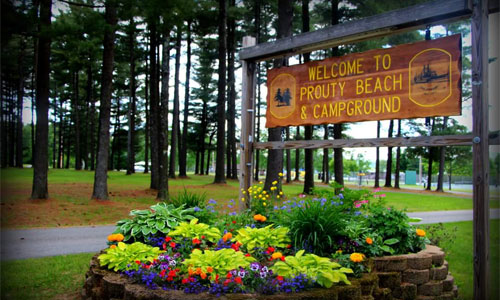 Photo: Newport’s Prouty Beach on Lake Memphremagog is a major attraction for the city. Courtesy photo.
She said a proposal to open up all the streets is on the table and there’s an MOU to increase downtown access for snowmobiles during the winter.
“This all stems from our philosophy to embrace the outdoor recreational economy,” she said.
That philosophy extends to the city’s efforts to improve access to the waterfront.
Situated on Lake Memphremagog, which straddles the Canadian border, Newport has been a favorite destination for visitors on both sides of the border.
Dolgin said a grant will fund construction of a connector path from the downtown trail system to Prouty Beach and on to Bluffside Farm, a public recreation area, owned by the Vermont Land Trust.
A major challenge facing the city is what is to become of a gaping hole in the downtown - a fallout from the EB-5 visa scandal that also engulfed the Jay Peak and Burke Mountain ski resorts.
Dolgin said the state is working on a proposal that could help redevelop the Renaissance Block.
“The Agency of Commerce and Community Development and BGS (Buildings and General Services) are working together and have recently put out an RFP for a 1.5-acre lot as a place to move the two courthouses,” she said.
In an email, BGS Acting Commissioner Jennifer M.V. Fitch said a $1.5 million appropriation has been set aside for “the Newport, Orleans County Courthouse, replacement, site acquisition, planning, and design for a stand-alone courthouse with no retail space.”
Fitch said the state will request additional funding for design and construction with anticipated occupancy in 2025.
According to the RFP, the courthouse must be located in the central business district on a parcel between 1 acre and 1.5 acres. The property must be vacant or any structures on the property must be vacant and easily demolished.
Newport like every other community has seen its businesses struggle this year - some more than others. Retail, lodging and restaurants in particular have had a tough time but there are some exceptions.
Dolgin said state and federal pandemic aid has helped businesses get by but it hasn’t always been easy.
Jay Peak
This ski season promises to be a season like no other. Ski resorts around the state are adjusting their budgets to project a steep drop in business because of the coronavirus and related restrictions on out-of-state travel and other protocols.
At Jay Peak, the ski resort is staring at a 65 to 75 percent drop in business this winter, said Jay Peak spokesman JJ Toland.
With its proximity to the Canadian border, which remains closed, Toland said half of the resort’s business including pass sales relies on Canadian skiers.
In addition, he said any number of visitors will “opt out of winter sports altogether” this season.
Some resorts like Killington are requiring skiers to make parking reservations online before arriving to ski. Jay Peak, however, is not taking that approach.
“We’ll probably make up a bit of those folks with people in the state who want to travel up to Jay Peak because they don’t have to worry about a reservation,” he said.
Season pass sales for the upcoming season have been “very promising.” But Toland said with the border still closed the resort has offered to refund Canadians who purchased passes, or they can opt to use their passes next season.
“We’ve seen a super majority say hold on to them,” he said. “If we don’t get to use it this year, we’ll take it for next year. So that was encouraging just from a loyalty perspective.”
Jay Peak usually logs 300,000 skier visits but this season the resort expects less than half that number to hit the slopes.
That means the resort will need far fewer workers than the normal complement of 1,800 workers.
“I would say anywhere between 500 and 700 employees,” Toland said.
Although the summer and fall business was off by 70 percent, Toland said business was still better than expected given the current situation.
This summer the resort offered a creative deal to drive business called a “relocation vacation package.” Visitors could rent a condo in 30, 60 or 90-day increments. Toland said the resort had hoped to sell 10 packages but instead sold over 100.
Fast forward to this winter and the resort is offering a similar package. “For $15,000 you get your own two-bedroom cottage (condo) from Nov. 27 through May 2 and that includes two adult passes and two dependent passes,” Toland said. “Again, we wanted to sell 10 and we’ve sold north of 70 of those.”
Toland said almost all the rentals have been purchased by Vermonters.
He said the condo rentals have raised more than $1 million in upfront capital for the resort. In addition, he said the long-term rentals save money on housekeeping labor since the condos don’t need to be cleaned every few days.
Jay Peak continues to be run under the auspices of the court-appointed receiver in the EB-5 fraud case with day-to-day operations run by a resort management company.
Burke
“It’s going to be a challenge this winter for sure,” said Burke Mountain spokesman Kevin Mack.
Mack said the before and after ski experience “will be quite different given COVID and the occupancy restrictions and guidance we have from the state.”
Burke is encouraging skiers this winter to boot up in the parking lot.
“The axiom this winter is if you’re coming to a ski resort your car is your new base lodge,” Mack said.
He said the resort is prohibiting bags in base lodges along with time and occupancy limits for people seeking shelter and warmth.
“It will make it easier for our staff managing the indoor spaces and it will make it safer for both our staff if we see a good deal of compliance,” he said.
They’ll be social distancing on the lift lines, but skiers will not be required to ride a lift with someone they don’t know. Mack said it might make lift lines a bit longer on certain days but overall, it shouldn’t be a problem.
“If you’re a group of four and you want to load, great,” he said. “If you’re a group of one or two and that’s how you want to ride, you’re more than welcome and we’re going to accommodate you and allow you to ride the lift in that way.”
Mack said season pass sales are strong which mirrors the demand for outdoor recreation nationwide. However, he added that the question hanging over the ski season is the effect of the state’s travel restrictions which require a 14-day quarantine for anyone visiting the state or returning to the state.
“We’re all wondering in the business from Utah through Vermont what’s that actually going to mean for this winter with COVID and whether people actually use the products that they purchased and how they use it and when they use it,” he said
The resort’s summer business was better than projected given the revised budget. But Mack said summer business was still off more than 50 percent from the previous year.
As far as staffing for the winter, he said Burke expects to hire fewer than half the usual complement of 300 workers.
Kingdom Trails
It may well be considered the recreational jewel of the Northeast Kingdom - 100 miles of trails through four towns that draw hikers, cyclists, snowshoers and cross-country skiers from New England and Canada.
Kingdom Trails is a significant economic driver for the region. In a normal year, Kingdom Trails attracts more than 137,000 visitors (2018), the majority, 84 percent, are from out-of-state and Canada.
According to the Kingdom Trail Association, those visitors have an estimated annual economic impact of $10 million, with each visitor spending $115 a day during an average visit of 2.75 days.
But 2020 has not been an average year.
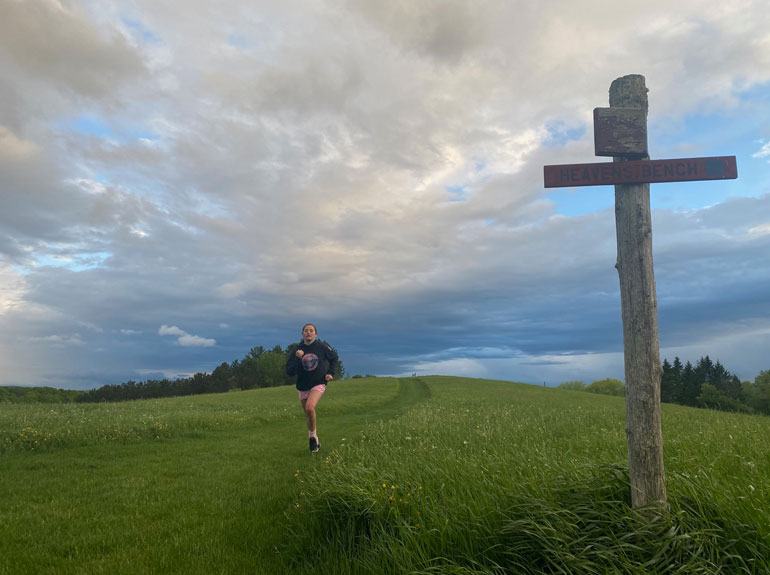
Photo: Kingdom Trails is a significant economic driver attracting more than 137,000 visitors in a normal year. But with the border with Canada closed and other travel restrictions, the number of users is down by 50 percent. Courtesy photo.
Kingdom Trail Association Executive Director Abby Long said the trail network was open to visitors but with safety protocols in place.
The network traverses the properties of 100 landowners and Long said she did hear some concerns from landowners and community members about out-of-state travelers.
“So that wasn’t the case this year,” Long said. “We lost our neighbors to the north.
In addition, she said while there were few out-of-state travelers there was an uptick in Vermont users.
Long estimated that visitations are down 50 percent this year.
Although Kingdom Trails had to make some budget cuts, she said thanks to a PPP loan the board of directors did not have to furlough or lay off any of its employees.
Kingdom Trails has eight, year-round employees, and 30 seasonal workers during the summer.
“We’re proud we were able to keep everybody on,” she said.
The organization was also able to keep up its annual mini-grant program - disbursing $25,000 among local communities along the trail.
The restrictions on travel also had a negative impact on memberships. Kingdom Trails derives most of its revenue from annual and day memberships, $1.24 million.
“We have noticed some dip in numbers compared to 2019 to 2020 and that’s due to the uncertainty of the Canadian border,” Long said.
Long said the board of directors is also looking at creative ways to boost income. Several possibilities include establishing an endowment, applying for grants and recovery loans, or holding a silent auction.
Bruce Edwards is a freelance writer from Southern Vermont.