General Fund, Transportation Fund, and Education Fund revenues continue to come in above targets
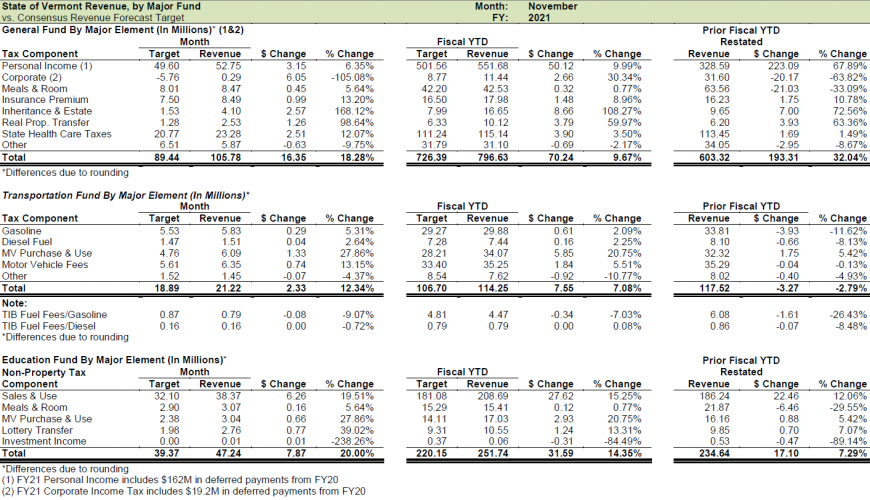
by Timothy McQuiston, Vermont Business Magazine The state’s General Fund, Transportation Fund, and Education Fund receipts for November were a combined $26.55 million, or 18.0 percent above consensus expectations in November.
The vital personal income tax was up as were the consumer taxes – sales and use and rooms and meals – with sales up nearly 20 percent over projections.
Of course, those projections were significantly downgraded by economists last summer.
On August 12, 2020, the consensus revenue expectations were downgraded for fiscal year 2021 by $278 million across the three major funds as a result of the pandemic. The November and fiscal year to date revenues are measured against the August forecast.
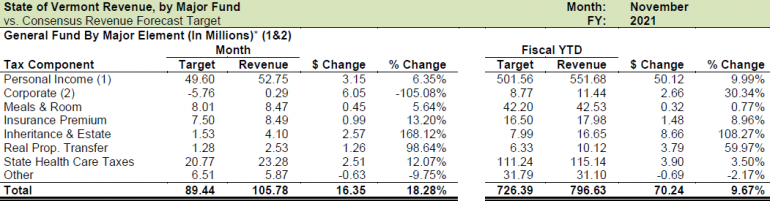
General Fund revenues collected for the month totaled $105.78 million, or $16.35 million above the monthly consensus revenue and for the fiscal year to date, exceeded their consensus target by $70.24 million, or 9.67%.
State officials continue to be worried about the future of another stimulus package from Congress.
Governor Phil Scott said at his daily press conference that he has spoken with Senators Sanders and Leahy about the current negotiations and he remains “cautiously optimistic” that another package will come through.
They also are hopeful that the short-term package included with the budget bill in the next few days could then be followed up with another package after the Biden Administration is installed.
Scott said it appears that the first package, anyway, will be weighted more toward PPP funding for businesses with less aimed at states with discretionary spending.
The $2.1 trillion CARES Act federal funding included $1.25 billion for Vermont. The new federal package appears to be in the range of $900 billion with well less than that targeted for the states.
Under the CARES Act, Vermont was able to use $300 million for economic development grants to help business.
Much of the second half of that funding went to hospitality-related businesses as they continue to struggle under executive order limitations and travel restrictions.
Commerce Secretary Lindsay Kurrle said that the final checks will go out next week and the entire allocation will meet the deadline of the end of December.
She urged Vermonters keep to the health protocols and “buy local.”
Scott was optimistic that this new package will include a direct, $600 check for each person. For Vermont, this would mean about $350 million sent directly to individuals in Vermont.
The governor is also hopeful that the unemployment insurance elements of the new package will include the vital extended benefits and PUA that are expiring next week. He said it’s too early to tell at this point and we’ll have to wait for the final package from Congress.
He said that even though the official unemployment numbers don’t reflect it, there are upwards of 30,000 Vermonters who are unemployed. The unemployment rate for November fell to 3.1 percent, lowest in the nation and the same as the pre-pandemic level, but with many fewer working and thousands less in the labor force.
As for the tax revenues themselves, Administration Secretary Susanne Young said the picture does appear “rosy” at the moment, but the next six months of the fiscal year could look dramatically different than the first six months (the fiscal year ends June 30). Year-to-date revenues are nearly 10 percent ahead of targets in the General Fund, 7 percent ahead in the Transportation Fund and over 14 percent ahead in the Education Fund.
“Though higher than anticipated revenue is good news, the revenue target adopted in August was significantly below pre-pandemic expectations,” Young said in a statement with the release of the revenue figures. “We remain concerned that revenue collections will revert to forecasted levels as federal stimulus payments and economic recovery grants are scheduled to end this month. News of additional stimulus from Congress and the start of the roll-out of a vaccine, however, are encouraging developments.”
The Transportation Fund was $2.33 million, or 12.34%, above consensus expectations for the month, bringing in $21.22 million. Though still above consensus revenue targets, total cash flow in November was lower than September and October’s above-target performances. Year-to-date, the Transportation Fund revenue was above $7.55 million, or 7.08% above the cumulative consensus cash flow target.
The Education Fund was $7.87 million, or 20.0%, above the monthly consensus target, having collected $47.24 million for the month. The largest driver of this additional revenue was the Sales and Use Tax, which came in $6.26 million, or 19.51%, above consensus expectations. Year-to-date, the Education Fund was $31.59 million, or 14.35%, above its cumulative consensus forecast target.
In the first five months of the fiscal year, the three Funds have exceeded cumulative consensus revenue expectations by $109.38 million.
“We are pleased revenue has exceeded our lowered expectations from August, but there is no evidence this situation will continue for the remainder of this fiscal year. Our revenue is still below the pre-COVID forecast, and we can’t predict the upcoming economic effects of the pandemic.” concluded Secretary Young.