

Daily Update on Novel Coronavirus (COVID-19)
December 17, 2020
New or updated information is in red and bold.
This update is available online at healthvermont.gov/covid19
Click the “See the Latest Update” button.
Please visit the Vermont Department of Health’s COVID-19 web and data pages healthvermont.gov/covid19
Stay Safe in Winter Weather
As heavy snow piled up in many parts of southern Vermont today, it’s a good time to remember how to stay safe in winter weather.
- Check on your neighbors, especially if they are older or in need of special assistance. If you can’t do this by phone or text, be sure to wear a mask and maintain a physical distance of at least 6 feet.
- Take breaks while clearing snow. Although it may not seem like a typical workout, shoveling snow can be strenuous. The cold weather combined with the physical exertion of shoveling can stress your heart and cause a heart attack.
- Make sure all outside heating vents are clear of snow. A blocked vent can lead to carbon monoxide (CO) buildup in your home. Symptoms of carbon monoxide poisoning are headaches, dizziness, weakness, upset stomach and vomiting. These symptoms can be confused with the flu. Go outside immediately to get fresh air, then dial 9-1-1 if your CO alarm goes off or you suspect CO poisoning.
- Avoid unnecessary travel. Take a cell phone with you, and if you get stuck in deep snow, do NOT let your engine idle if your exhaust pipe is buried. This can also lead to carbon monoxide building up in your vehicle.
For more tips visit healthvermont.gov/winter-weather.
Questions about the COVID-19 vaccine?
The COVID-19 vaccine is now here in Vermont, and hospitals have begun vaccinations.
If you’re looking for the latest information about who can get the vaccine now, where and when people will be vaccinated, visit healthvermont.gov/covid19-vaccines. Check back often, as we update this web page with new information. And sign up for our Weekly COVID-19 newsletter to stay up to date.
While we wait for vaccine to become more widely available to Vermonters, we must keep up our prevention practices, including physical distancing, mask-wearing and handwashing. This is still the best protection from getting and spreading COVID-19.
New at healthvermont.gov
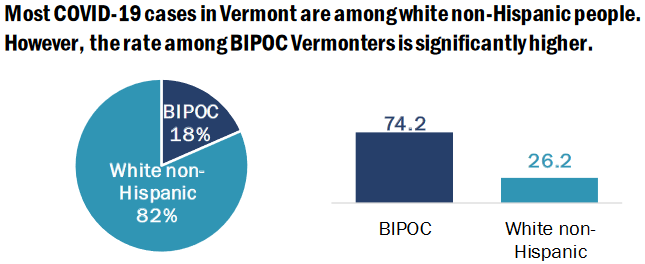
Vermonters who are Black, Indigenous and people of color (BIPOC) represent 6% of the state’s population but 18% of COVID-19 cases.
BIPOC Vermonters with COVID-19 have significantly higher hospitalization and chronic disease rates, relative to white non-Hispanic people with COVID-19.
A new data brief delves deeper into how BIPOC Vermonters have been disproportionately impacted by the pandemic, due to systemic and structural racism affecting the conditions in which people are born, grow, live, and work.
Case Information
Current COVID-19 Activity in Vermont
As of 12 p.m. on December 17, 2020
|
Description |
Number |
||
|
New cases* |
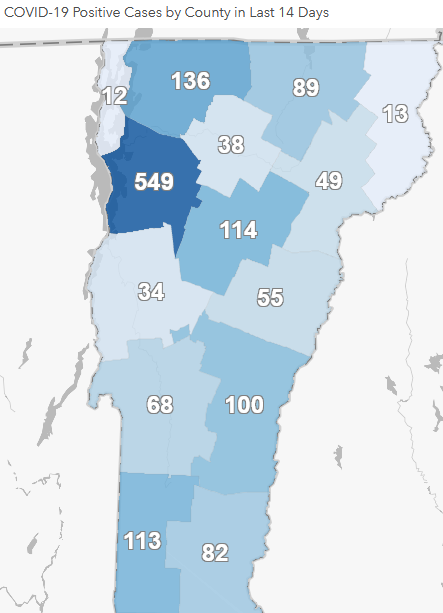
136 (6,149 total) |
||
|
Currently hospitalized |
22 |
||
|
Hospitalized in ICU |
3 |
||
|
Hospitalized under investigation |
4 |
||
|
Percent Positive (7-day average) |
2.1% |
||
|
People tested |
247,304 |
||
|
Total tests |
633,446 |
||
|
Total people recovered |
3,897 |
||
|
Deaths+ |
105 |
||
|
Travelers monitored |
212 |
||
|
Contacts monitored |
199 |
||
|
People completed monitoring |
11,396 |
* Includes testing conducted at the Health Department Laboratory, commercial labs and other public health labs.
+ Death occurring in persons known to have COVID-19. Death certificate may be pending.
Hospitalization data is provided by the Vermont Healthcare Emergency Preparedness Coalition and is based on hospitals updating this information.
 Find more data at: healthvermont.gov/currentactivity.
COVID-19 Testing
Testing is an important tool to help prevent the spread of COVID-19. Learn more about who should get tested and find a site near you at healthvermont.gov/covid-19/testing.
Guidance for Vermonters and Businesses
Health information, guidance and data: healthvermont.gov/covid19
Sector guidance: accd.vermont.gov/covid-19
Modeling: dfr.vermont.gov/about-us/covid-19/modeling
Governor’s actions: governor.vermont.gov/covid19response
Get the information you need at our Frequently Asked Questions.
School & Child Care Guidance
- Strong and Healthy Start: Safety and Health Guidance for Vermont Schools
- Mental Health: A Strong and Healthy Start: Social, Emotional and Mental Health Supports During COVID-19
- Child care: Health Guidance for Child Care and Out of School Care
More resources on the Your Community web page.
Take Care of Your Emotional and Mental Health
If you or someone you know is in crisis or needs emotional support, help is available 24/7:
Call your local mental health crisis line.
Text VT to 741741 to talk with someone at the Crisis Text Line.
Call the National Suicide Prevention Lifeline at 1-800-273-8255.
For more information visit healthvermont.gov/suicide.
Visit our Coping With Stress web page.
Get connected to Alcohol and Drug Support Services at VT Helplink.
Get self-help tips and connect to mental health services at COVID Support VT.
Food resources
If your financial situation has recently changed, you may now qualify for Vermont nutrition and food programs, including WIC program (Women, Infants and Children), 3SquaresVT/SNAP, and more. Newer programs such as Farmers to Families and Everyone Eats are helping to fill the gaps. Contact the Health Department, Hunger Free Vermont, or call 2-1-1 for more information.
Find Opportunities to Support the COVID-19 Response
Vermonters can now step up and help with the COVID-19 response in long-term care facilities and other areas. Visit www.vermont.gov/covid-staffing for more information.
Stay Informed with VT-ALERT
Stay up to date on the latest COVID guidance and information by registering for Vermont Alert (VT-ALERT), the State’s emergency notification system. Visit www.vtalert.gov and select the alerts they would like to receive (COVID information is listed under “Health Alerts”). Current subscribers can also update their notifications. Notifications are available via email, text, phone and the Everbridge mobile app.