

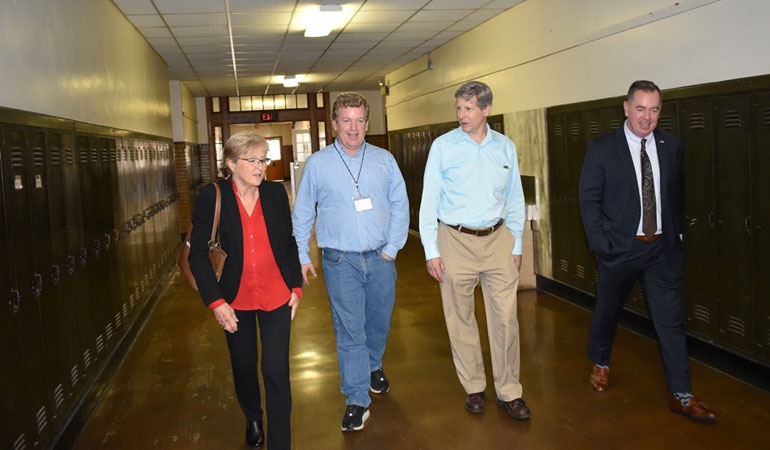
Photo: Bob Flint, second from right, in the BRIC schoolhouse. Courtesy photo.
Windsor County’s economy weathers the COVID-19 pandemic despite the multiple unknowns
by Olga Peters, Vermont Business Magazine This year, Bob Flint’s “normal” workday changed almost overnight. Flint is the executive director of the Springfield Regional Development Corp. The organization serves 10 towns in southern Windsor County.
“All things considered, we’re holding our own,” said Flint. “This force is bigger than anything around or in the state.”
In February, Flint was still undertaking activities such as trips to Montpelier and holding meetings with community partners.
Then the COVID-19 pandemic began.
In recent months, SRDC has devoted most of its time helping businesses navigate the “swamp” of emergency guidelines as well as state and federal emergency funding, such as the federal CARES Act.
The pandemic triggered a nationwide halt to society as governors called on their residents to stay home and practice social distancing in order to reduce the spread of the coronavirus.
Vermont’s Governor Phil Scott declared a state of emergency on March 13. Schools were closed shortly thereafter, followed by most businesses.
While responding to COVID-19 required people to practice social distancing, economies are made of people and the virus essentially stalled the economy as restaurants, hotels, salons, and retail stores all closed their doors for many weeks until restrictions were gradually lifted.
Paul Costello, executive director of the Vermont Council on Rural Development, warns that much of the economy is still in crisis mode.
“Let’s face it, some businesses and some individuals aren’t recovering yet,” he said. “They’re still in crisis.”
See also: A bright economic spot: Real Estate
According to Costello, the post-COVID economic recovery process will start at different times for different industries. Expect this to take years, he said.
Prior to the pandemic, Windsor County had a median household income of $56,828, less than the state average of $60,782. According to data from the US Census Bureau, between 2016 and 2017, the county’s population decreased slightly but also saw an increase in income of 3.77 percent.
According to Flint, most of the businesses in the region his organization serves have survived the initial crisis.
“Knock on wood,” no businesses have closed yet, although recently Whelen Engineering, across the river from Springfield in Charlestown, NH, laid off 148 people, Flint said.
According to multiple news reports, the company also laid off employees at a plant in Connecticut.
“It’s all incredibly fluid,” Flint said.
The Black River Innovation Campus (BRIC) temporarily shut its doors early in the pandemic.
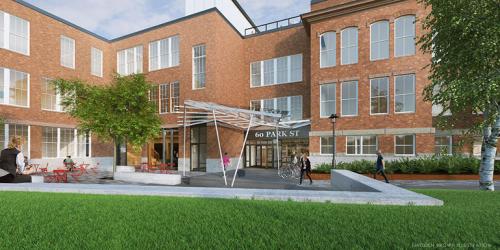 Photo: Rendering of BRIC. Courtesy photo.
The nonprofit organization offers training in digital technologies and web-enabled businesses. It also offers co-working space and resources for entrepreneurs.
It has since reopened and is “now on a roll,” according to Flint.
Other programs are in the pipeline as well, Flint said.
The co-working and remote working facilities BRIC offers make sense for many workers right now, he added.
The pandemic didn’t fix the region’s existing economic vulnerabilities such as its workforce shortage, people working multiple jobs to pay the bills, and a lack of capital for businesses, he said.
One highlight, Flint said is that the “Opportunity Zone has not missed a beat.”
Opportunity zones are an investment program created by the Tax Cuts and Jobs Act of 2017 that allows for a limited type of investment in lower income areas.
Throughout the pandemic, Flint has received calls from private investors seeking to put their money into local projects.
The pandemic slowed a few of Springfield’s big projects but it has not stopped them. Along with BRIC is the Woolson Block, a mixed-use affordable housing project, and the Springfield Co-op’s move downtown, he said.
In Windsor, the Goodyear Property project continues to advance. Lake Hill Preserves has had a good year and shown growth, said Flint.
One elephant-sized unknown, said Flint, is whether the hospitality and businesses that depend on tourism will survive if the pandemic essentially shuts down the foliage and ski seasons.
Calls to business owners were not returned by press time.
The COVID-19 pandemic has reinforced for Flint “that we’re people and at the end of the day, they just want to talk to somebody.”
Lately, his job has emphasized being “friendly, empathetic, and fuzzy” for those who feel overwhelmed by the decisions facing their businesses.
The last big disaster most Vermonters remember is Tropical Storm Irene in 2011.
Yet, Irene’s rains came and went within days. Communities moved quickly from crisis mode into a recovery phase, Flint notes.
In comparison, COVID-19 is like a careless neighbor who leaves their — contaminated — household trash strewn about the neighborhood.
“COVID-19 is a whole other magnitude of disaster,” in that it has lasted longer and carries a deeper level of despair for people, Flint said.
Despite society’s initial reopening over the past several weeks, the recovery phase of this crisis has yet to start, he continued.
In Flint’s opinion, a successful economic recovery requires money and more of it. Many of the unemployment benefits put in place for the crisis have run out, he said. Sole proprietors, despite recent help from the state, still need more financial support, he added. Much remains unknown about the pandemic’s full impact on the tourism industry.
“There is still a need to stabilize this [situation] and provide that cushion,” he said. “We need a New Deal-ish comprehensive multi-agency type of recovery.”
Flint can’t answer how he feels about his region’s economy overall.
“I can’t answer that in a vacuum as good or bad,” he said. “Again, we’re holding our own.”
Institutions: Seeking to maintain connections when a pandemic keeps communities apart
The arts…
Across the country, the COVID-19 pandemic required many large institutions to temporarily close, such as the Vermont Law School in South Royalton. Cultural and arts institutions have almost completely shut down, such as the Weston Playhouse.
Such institutions serve a dual benefit as community centers and economic drivers. Their closings can also mean a double whammy for their host communities.
Susanna Gellert is two years into her tenure as executive artistic director of the Weston Playhouse. She decided in early April to halt the theater’s summer programming.
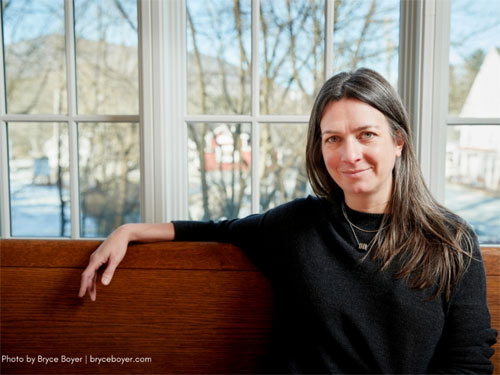 Photo: Susanna Gellert, executive artistic director of the Weston Playhouse. Photo by Bryce Boyer.
The number of people coming to Weston for the summer “would have been a huge vector for the virus,” she said.
“Vermont's creative economy as a whole is a pretty important piece of the state's economic puzzle,” said Gellert. “And so what this has done to the performing arts is pretty huge.”
According to the state website ThinkVermont.com, the creative economy accounts for 3 percent of the state’s total GDP. The site also quotes data from the New England Foundation for the Arts which states the creative sector accounts for 8.6 percent of the Vermont’s employment.
According to Gellert, Weston’s pre-COVID budget was approximately $2.3 million with more than 50 percent of that budget earmarked for direct community spending on things such as car rentals, construction materials, artist housing, and food.
The organization can host two performances at the same time in its two performance spaces: the main playhouse and the new theater at Walker Farm.
In an average summer, Weston sells 20,000 tickets and welcomes 300 to 500 people a night, estimates Gellert.
Usually by July, audiences would be sitting down to a big musical in the Playhouse space or a smaller play or musical in the new theater. While those productions were in performance, the organization would have two more in rehearsal for August. Approximately a combination of 120 theater professionals would be living and working on the Weston’s campus, she said.
While Gellert has yet to crunch numbers on how much audience members spend in the local community, she guesses the amount is significant.
Based on the number of people who eat at MKT: Weston, the playhouse’s 70-seat restaurant, Gellert estimates that “well over 50 percent of audience members are eating in town or the surrounding area.”
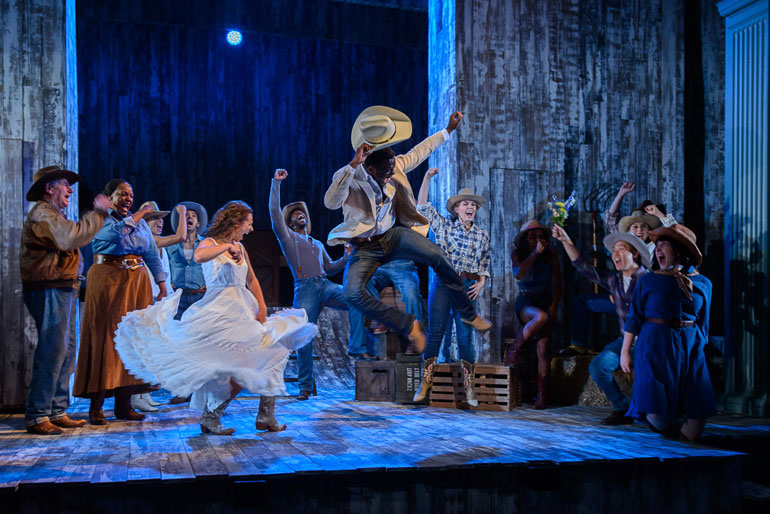 Photo: Production photo from 2019’s OKLAHOMA! Photo by Hubert Schriebl.
In response to closing the theater, Gellert said the organization has cut its budget to under $1 million. Without ticket sales or selling program advertising, the organization has no earned income. She feels fortunate that the playhouse’s board of directors and other supporters have helped fill the financial gaps through donations. Weston also received federal PPP money which has kept the theater’s small staff employed, she said.
“I was on a call not too long ago with Congressman [Peter] Welsh, and one of the things we kept coming back to, is that the arts are almost certainly going to be one of the last sectors of the economy to reopen for exactly the reason it is fundamentally about gathering people together in a space,” she said.
Undaunted by the pandemic’s upheaval, Weston has launched Reimagine the Season. This initiative includes new works by playwrights and musicians.
Gellert said Weston received a grant to commission new creative works that she said “reflect this moment in time.”
“When I decided that we needed to cancel the summer season, I started to think about what I believe is Weston’s fundamental purpose,” she said. “It is a place that connects this community, both the local community and the region at large, to the broader world outside and brings that world to us.”
Reimagine the Season consists of three main projects. The first, One Room, features the work of 14 playwrights who created short, one-person plays. Professional actors and directors then filmed the plays which Weston will release in August.
The second project is called Songs for Today. This project features the work of musical theater writers. In some cases the creators have written a new song. Some have written a new song for musical-in-progress. A few have also revived a previous song. Weston will put these songs online, Gellert said.
Finally, Postcard Plays features postcards with images from Skye Chalmers’s book Sending Milk: The Northeast Farms and Farmers of the Cabot Creamery Cooperative. The book’s photography features Vermont’s dairy farmers. Weston has asked playwrights to write short plays that fit on the back of a postcard.
“I wish I could say that the reimagine season is theater. But, for me, theater is fundamentally, you know, people sharing a space together,” she said.
The pandemic has drilled home for Gellert the community’s love for Weston Playhouse. She can’t go to the grocery store without someone asking about the theater.
“I used to work at a wonderful theater in New York City,” she said. “That was a very special place, but I used to say that if that theater building burned down in New York, would people notice? I'm not quite sure.”
In the meantime, Gellert looks to the playhouse’s future and developing performance models that include social distancing if the pandemic continues beyond the summer.
She views this planning as necessary for the playhouse’s creative and financial health. She also sees the theater’s health as necessary to the surrounding communities.
“Our audience isn’t only the people who buy tickets,” she said. “The theater matters to the people who don’t, just as much as it matters to the people who do, because it is such an important part of the economy.”
Gellert also believes that opportunities exist within the pandemic. Windsor County’s economy was fragile before COVID-19 and not getting better quickly, she said.
“In a way, there's not much to lose right now,” she said. “So, my dream would be that people feel like they can take risks, start businesses. I think if we can get some real infusion of, of activity, it could be a really great thing.”
Education…
Located in South Royalton, the Vermont Law School is the state’s only law school.
For President and Dean Thomas McHenry, the school is as committed to the local economy as it is to its legal, environmental, and restorative justice educational programs.
“Because the more jobs that are created in Vermont, the more jobs there are for lawyers,” he said.
According to McHenry, approximately five years ago, the VLS conducted a study looking at the school’s economic multiplier effect in the region.
“We estimated that the net benefits financially provided by the law school to our community was on the order of $30 million,” he said.
Most of the school’s annual $22 million budget goes to salaries for its 75 staff and 50 faculty. Students also spend money on rent, food, “and too much of their money on craft beer,” McHenry said.
Statewide, the number of students attending Vermont colleges is “extraordinary,” he said.
McHenry chairs the board of directors of the Association of Vermont Independent Colleges. According to AVIC’s 2018 numbers, 23,000 students attended independent colleges. The University of Vermont welcomed an average of 15,629 while the Vermont State Colleges hosted 18,481.
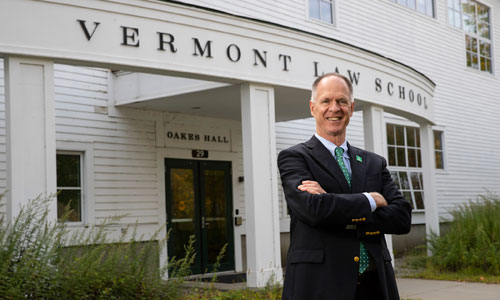 Photo: President and Dean, Tom McHenry of Vermont Law School. Courtesy photo.
It's a huge part of the Vermont economy, not to mention the intellectual brain- power and energy,” he said.
The week of March 16, VLS closed its campus and pivoted to virtual classes. The more than 50 summer programs the college offered also moved online. So far, students’ feedback has remained positive, he said.
“I taught a two-and-a-half day forestry Law and Policy class this past weekend,” McHenry said. “You will have to teach [virtual classes] in a different way — it has to be much snappier, there has to be much more Q&A. And it worked, but it was very demanding.”
VLS has announced that its fall semester will take place virtually as well.
McHenry said he believes the law school has fared better financially during the pandemic compared to other colleges. As a non-residential campus, the school didn’t reimburse dorm fees. The school also received federal PPP funds. As a result, the school hasn’t needed to make any significant budget cuts, he said.
On a side note, McHenry said that of the law school’s 550 students, approximately 187 are, or will be, in South Royalton this fall.
While VLS has offered virtual classes in some form for 10 years, McHenry feels unsure of how students will adapt to the fall’s virtual semester.
In the spring, “our professors rose to the occasion and really applied themselves to teach well, and our students were flexible,” he said.
McHenry added, however, by the spring semester, students had already built connections to each other and their professors.
“They'd already known each other because they've been in person for a number of months,” he said.
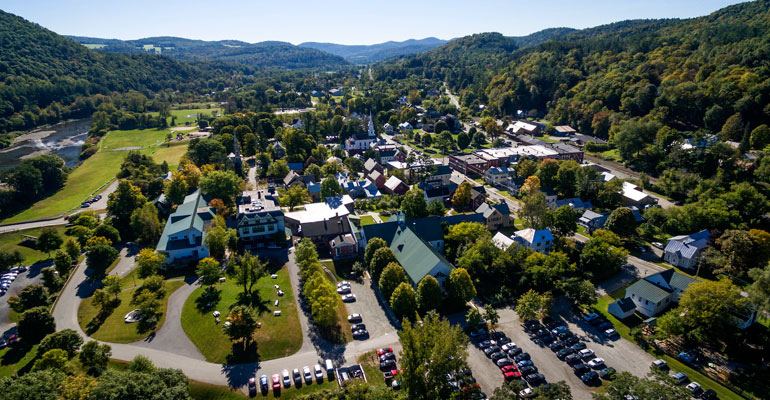 Photo: Aerial of Vermont Law School campus. Courtesy photo.
The fall semester will lack any in-person connections and McHenry wonders what this will mean for the relationships between students and professors.
“And like so many issues, we can't be definitive yet because the virus is changing in its own way, and our responses are changing, but we're very active with the governor's office and making sure we comply with” the state’s health protocols, he said.
McHenry said the school is undergoing a strategic planning process. COVID has taught him that flexibility exists when it comes to providing education virtually.
What is unknown about virtual education, however, is how effective it is, he said.
For McHenry, this is not just an educational question, but a question about community.
“We're a high touch law school, in that our students get to know our staff and faculty really well,” he said. “We don’t know whether COVID should rip that away from us in an irretrievable way.”
Overall, McHenry believes VLS is in better shape than some of the state’s other residential colleges. Still, so much remains unknown as the pandemic unfolds.
“So Meanwhile, I am double and triple crossing my fingers and legs and I'm tapping on the wooden table in front of me,” he said.
Olga Peters is a writer from Windham County and reporter for The Commons, a weekly newspaper based in Brattleboro (commonsnews.org).