

by Timothy McQuiston, Vermont Business Magazine Governor Phil Scott today at his press briefing outlined some additional openings as part of the phased restart of Vermont’s economy, introduced last week. The new order will allow outdoor operations, some construction and manufacturing to operate with five or fewer employees (up from two), while outdoor retail operations like garden centers are allowed have up to 10 total people between staff and customers. Farmers markets with strict social distancing guidelines will reopen May 1. Employees of currently opened or reopening businesses are required to wear face masks; customers are encouraged but not mandated to do so.
The governor’s Stay Home, Stay Safe order remains in effect until May 15, but with modeling continuing to indicate Vermonters are significantly slowing the spread of the virus, the Administration is taking a cautious, incremental and evidence-based approach to putting Vermonters back to work.
Governor Scott has emphasized the need for continued – and even expanded – vigilance as the state implements its restart strategy, saying: “Restarting the economy requires each of us to take a lot of personal responsibility. Each and every one of us has to do our part to help prevent the spread and protect the vulnerable by adhering to all of the social distancing and public health guidance.”
He said, "Now is not the time to declare victory."
Re-opening the economy will be dependent on five factors, Scott said:
1) Keep eyes on health data;
2) Health care systems remains ready to deal with a turn for the worse;
3) Testing ability remains high and aggressive;
4) Businesses that are open or will soon be open must work smarter and safer;
5) We must all play smarter and play safer.
While some say he is moving too fast to reopen the economy and others say he is moving too slowly, Scott said he doesn't care about any political ramifications. The health and safety of Vermonters comes first and their behavior will determine his course of action.
"This is literally in our hands," he said.
The governor’s most recent order, signed Friday, directs any entity currently operating, or soon to be opened, to implement specified physical distancing, health, and sanitation measures, including requiring employees to wear face coverings for nose and mouth.
It also requires all employers to provide – and all employees to complete - training on these health and safety requirements by May 4. VOSHA training is under development and will be released Monday, April 27.
If able to comply with the outlined safety measures, the governor’s order allows the following operations to reopen:
- Expanding on Addendum 10, outdoor businesses, construction operations and recreation maintenance work may operate with a maximum of five total workers per location. (Effective April 27).
- Manufacturing and distribution operations, and interior construction of uninhabited structures, may resume operations with a maximum of five employees in one location, if they are low-density and ensure employees are always six feet apart. (Effective April 27). Corresponding guidance from the Agency of Commerce and Community Development makes clear that, consistent with Addendum 7, workers from out of state must quarantine for 14 days upon arrival; lodging properties remain closed to guests, including to non-essential out-of-state workers, except those previously exempted such as essential workers.
- Outdoor retail space, previously restricted to curbside or delivery service, can allow in-person shopping with a maximum of 10 total people. (Effective April 27).
- Farmers Markets may open May 1 with strict alterations that focus on food distribution and prevent congregating. They must meet the same health and safety requirements of all other operations and are directed to use a pre-order/pick-up model whenever possible. Local municipalities must approve reopening. Additional guidance will be provided by the Agency of Agriculture.
For a full list of health and safety requirements for all businesses and specifications for each newly opened operation, click here to view Addendum 11.
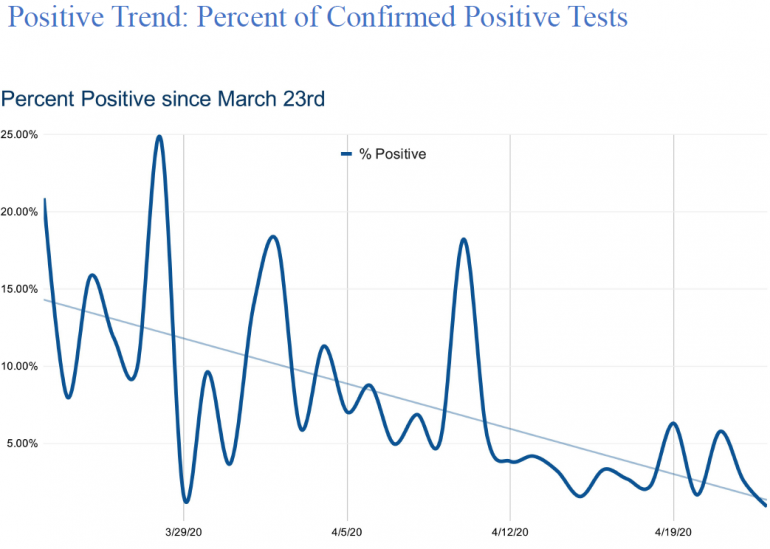
Also at the governor's press briefing, Financial Regulation Commissioner Michael Pieciak and Health Commissioner Mar Levine, MD, presented results of the latest social distancing and health modeling related to COVID-19
As with the governor, they spoke of the success of reducing infections in Vermont and, significantly, the need to stay the course.
"I want to remind everyone," Pieciak said after presenting the demographic and medical data, "that despite this good new, we must remain vigilant."
For his part, Dr Levine focused on the need for everyone to stay healthy beyond COVID-19. He noted that hospital visits nationwide for non-COVID-19 illnesses are significantly down. He said he's concerned that people with any number of health issues, like heart problems, are not seeking treatment for fear of being infected by the coronavirus.
He said the hospitals are prepared for every illness, not just COVID-19. In fact the University of Vermont Medical Center has not had an employee, medical or otherwise, test positive for COVID-19 since April 9.
If sick people do not seek out help, they could be much sicker once they finally do, Dr Levine said.
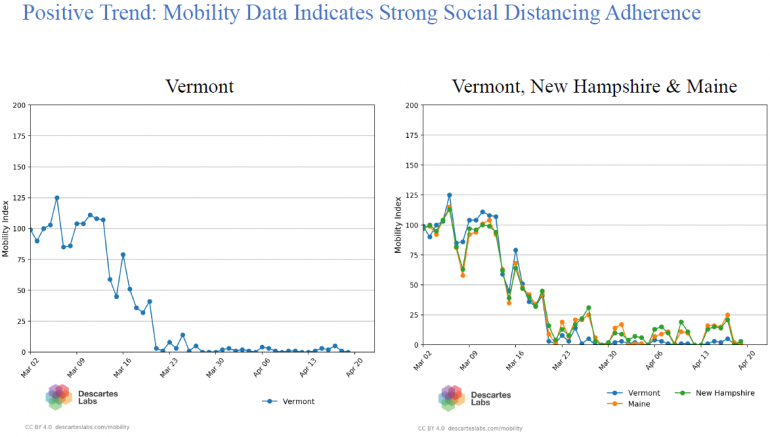
Pieciak presented slides showing how Vermont was a leader in northern New England in social distancing. They said this was the most important component of continued low infection rates. The data supported that assertion.
Scott said the state has one of the most aggressive social distancing and "Stay Home" requirements in the nation and the date supports it. A recent study said Vermont was among the four states most ready from a health standpoint to re-open the economy.
The officials are cautious to do so because of a possible rebound in infections.
Not only would the health of Vermonters suffer, which could lead to more deaths, Scott said the economy would suffer even more. Clearly the 'Stay Home' order and the closing of restaurants and most retail and virtually all hospitality led to a severe economic downturn, the governor acknowledged. But, he added, to open up the economy only to have to shut it down again would do far more harm than a cautious re-start.
"Nobody wants to reopen the economy more than me," Scott said.
Still, the economy is suffering. Tax revenues this current fiscal year (ending June 30) are down an estimated $61 million in the General Fund, which relies on the personal and corporate income taxes, down $40 million in the Transportation Fund (gasoline and fuel taxes, etc) and the non-property tax Education Fund (rooms & meals and sales taxes) is estimated to be about $70 million below expectations.
Economic modeling from the Legislative Joint Fiscal Office will present next Wednesday a "baseline" estimate for the revenue impact on FY21, which begins July 1.
The Legislature and administration will work up a "skinny budget" in May for the first quarter of FY21 and work on a full budget over the summer.
Germane to the state's finances, Congressman Peter Welch attended the governor's briefing by home. He reiterated that while the states are dealing with the health concerns, it's up to the federal government to deal with the serious financial ramifications of the COVID-19 crisis and the "Stay Home" economic impacts.
The latest massive federal aid package just passed Congress and is targeted at small business ($370 billion), the health care system (especially hard hit hospitals, $75 billion), and cornonavirus testing ($25 billion).
So far, Vermont has received the third highest per capita amount of federal assistance, largely because of the prevalence of small businesses here.
Welch said the focus of a fifth federal funding package -- if it indeed happens -- will be targeted to help state and municipal budgets.
To view ACCD’s memo to business for specific safety guidelines and protocols, as well as additional resources, visit accd.vermont.gov.
For more information on:
- COVID-19 health information, guidance and case data, visit www.healthvermont.gov/covid19.
- The Governor’s actions, visit governor.vermont.gov/covid19response.
- The state’s modeling, visit https://dfr.vermont.gov/about-us/covid-19/modeling.
Source: Montpelier, Vt. – Governor. 4.24.2020