

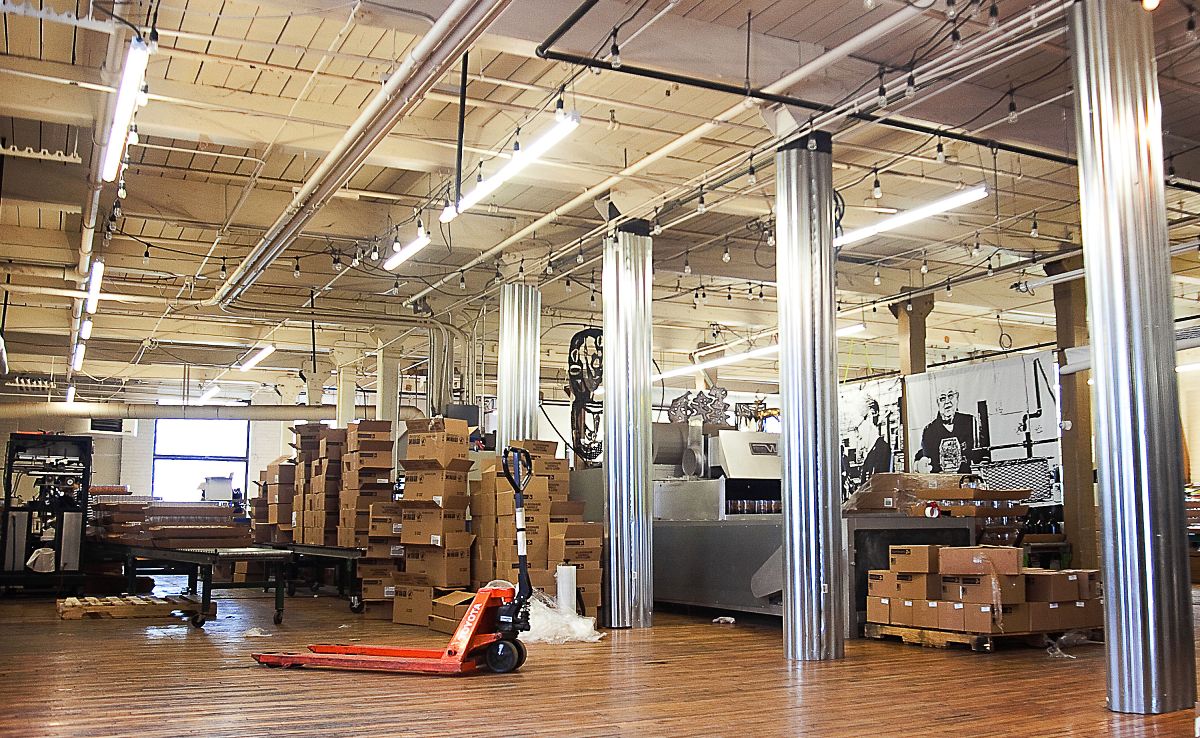
Empty warehouse at Catamount Glass in Bennington. (photo credit: SWVT Chamber / Lauzon Photography)
Vermont Business Magazine The Southwestern Vermont Chamber of Commerce recently surveyed over 400 business and nonprofit chamber members to get a sense of the COVID-19 Crisis’ impact on them. Vermont Governor Phil Scott, in an effort to stop the spread of the COVID-19 virus, issued multiple declarations that have impacted small businesses throughout Vermont starting with an order to close all Vermont prek-12 schools and an order to have all bars and restaurants close or offer take out. This was followed by a “Stay Home Stay Safe” order that had a deep impact on businesses and the Vermont economy.
The Southwestern Vermont Chamber’s Business Impact Survey, distributed on April 7th, had three main goals: to help the chamber better understand the specific impact currently on its business members, to inform the public of the impact on businesses throughout the region, and to advocate for the ongoing support of the business community.
Demographics
Thirty percent of the Chamber’s membership filled out the survey or 125 business and nonprofit members. Of those that filled out the survey, 15% were sole proprietors, 28% had 1-4 full time employees before the crisis, 23% had 5-9 full time employees before the crisis, 23% had 10-29 full time employees before the crisis, 5% had 30-49 full time employees before the crisis, 1% had 50-74 full time employees before the crisis, 5% had 75 or more employees.
Of those that filled out the survey, the following were principal industries that were represented:
1% Agriculture
-
2% Automotive
-
2% Business Support & Logistics
-
4% Construction, Machinery, and Homes
-
3% Education
-
9% Entertainment & Leisure
-
3% Finance & Financial Services
-
18% Food & Beverages
-
7% Healthcare & Pharmaceuticals
-
2% Insurance
-
2% Manufacturing
-
13% Nonprofit
-
23% Retail & Consumer Durables
-
4% Real Estate
-
2% Telecommunications, Technology, Internet & Electronics
-
2% Transportation & Delivery
-
3% Utilities, Energy, and Extraction
 Empty bar at The Tap House at Catamount Glass (photo credit: SWVT Chamber / Lauzon Photography)
SWVT Chamber Business Impact Survey Results:
-
When asked what is the current operating status of their business/organization, participants responded:
-
28% answered “Open - operating at 76-100%”
-
12% answered “Open - operating at 51-75%”
-
6% answered “Open - operating at 26-50%”
-
17% answered “Open - operating at up to 25%”
-
10% answered “Temporarily closed (voluntary closure)”
-
27% answered “Temporarily closed (forced closure)”
-
-
When asked if their organization's/company’s weekly revenue experienced an increase or decrease as a result of COVID-19, participants responded:
-
2% answered “Increased up to 25%”
-
1% answered “Increased 26-50%”
-
0% answered “Increased 51-75%”
-
0% answered “Increased 76-100% or more”
-
11% answered “No change”
-
20% answered “Decreased up to 25%”
-
11% answered “Decreased 26-50%”
-
15% answered “Decreased 51-75%”
-
40% answered “Decreased 76-100%”
-
-
“How has your employee count changed due to COVID-19 specifically? (Checking all that applied),” was asked of the survey participants; here is how they answered:
-
42% answered “No change so far”
-
9% answered “We have implemented a hiring freeze”
-
2% answered “We have hired new staff”
-
15% answered “We have reduced some staff hours”
-
42% answered “We have temporarily laid off some staff”
-
6% answered “We have terminated some staff”
-
-
Participants were asked what percentage of your current workforce is working remotely vs. onsite:
-
33% answered “All current staff is working onsite”
-
6% answered “Up to 25% remote, the rest onsite”
-
2% answered “26-50% remote, the rest onsite”
-
5% answered “51-75% remote, the rest onsite”
-
24% answered “76-100% remote”
-
30% checked a box if “staff could only work onsite, but were unable currently” - meaning they couldn’t work remotely
-
-
When asked if only partially open or temporarily closed, what resources would be required for their company to relaunch or consider a phased restart, participants answered all that applied:
-
40% answered “Rent capital”
-
63% answered “Payroll capital”
-
44% answered “Supplies provisioning capital”
-
10% answered “Worker (re)training”
-
40% indicated “Other” which included:
-
Utilities and credit card payments
-
Advertising and marketing
-
Federal funding like the Paycheck Protection Program (PPP) and the Economic Injury Disaster Loan (EIDL)
-
Other debt obligations
-
Reimbursement of lost revenue
-
Bringing visitors back to Vermont
-
Hosting gatherings more than 50 people
-
Grant funding for nonprofits
-
Volunteerism
-
-
-
When asked if they had applied for any financial relief with the CAREs Act, SBA, PPP, EIDL, etc., participants replied:
-
67% answered “Yes, I have applied”
-
16% answered “No, I have not applied and I am not interested at this time”
-
17% answered “No, I have not applied but I am interested in learning more about the program”
-
-
When asked if they had contacted their bank about a bridge loan or other financing (they could check all that applied), participants replied:
-
24% answered “Yes”
-
44% answered “No”
-
15% answered “Considering it”
-
18% answered “Unnecessary”
-
8% answered “Pending lender response”
-
-
When asked what are their top three concerns looking forward were, participants indicated the following:
-
65% indicated “Decreasing consumer confidence/spending”
-
61% indicated “Financial impact on operations and/or liquidity and capital”
-
58% indicated “Global or US recession”
-
Other areas of concerns included:
-
Employee stress (32%)
-
Supply chain disruptions (19%)
-
Workforce reduction (15%)
-
Lack of information for decision making (15%)
-
Impact on tax and trade issues (9%)
-
Lower productivity (5%)
-
-
When asked on an open-ended question what action(s) from the Southwestern Vermont Chamber of Commerce would be most valuable to the business members as they navigate economic recovery together, the participants responded with a variety of answers including continued communication and education, marketing, advocacy and building a plan to move forward. Here were some of the participants direct answers:
-
“Advertise that we in Vermont weathered the storm well and that urban people should move to Vermont. Many jobs that were never worked from remote offices were successful during this difficult time”
-
“Marketing to locals and tourists to encourage activity for local businesses.”
-
“Keeping us informed of ongoing options for financial assistance and for sharing information about Coronavirus and it’s impact. Ideas for success and moving forward from this difficult time.”
-
“The emphasis upon communication and skill sets expansion - the dynamic proactive approach of the director - the many webinars and press releases and communiques are all enormously valuable. I am glad to be doing business in Vermont, and in Bennington. The advantages far outstrip the well known disadvantages. The public service ethos makes all the difference.”
-
“Disseminating scientifically accurate information, to combat the misinformation and misdirection coming from other places.”
-
“Assisting in bolstering consumer/visitor confidence in partner's programs, events, and fundraising.”
-
“There has been a tremendous amount of negativity directed at out-of-towners during this pandemic and without tourists my business cannot survive. We're going to need a major outreach campaign to welcome people back into the area.”
-
“Finding more definitive answers about resuming business. What steps will be implemented? Will it be gradual? Any target dates? It is difficult to have next to no information.”
-
“Continued support and lobbying for small businesses during this unprecedented period. Help keep us informed about relief options that may present themselves in the days and weeks ahead. This is moving so quickly it is hard to stay abreast of all that transpires.”
The first impact survey was concluded on Friday, April 17th. The chamber has indicated that if they find it necessary they will do more surveys, as well as roundtable discussions like their recent Digital Business Roundtable series, to better understand and assist their business members.
“This is an extremely tough time for our businesses,” reported Matt Harrington, executive director of the Southwestern Vermont Chamber of Commerce. “There are some really heart-breaking stories about our business and nonprofit members and the hard, tough decisions they’ve had to make in the last 30 days. With this survey we wanted to get some facts on the current economic situation in Southwestern Vermont and share those results with our communities. I think it’s important to know the facts of the matter; that helps us build a plan moving forward.”
Harrington added, “However the harshness of these facts, we must continue to have unwavering faith that we, as a region, will survive after the COVID Crisis is over. It might look a bit different, but hard-work, sacrifice, and innovation is in the DNA of all Vermonters, native and transplant. We must be patient; one step at a time, one day at a time. The chamber is here to work with these businesses, along with our other economic partners, to get out of this crisis and forge a path forward.”