

by Timothy McQuiston, Vermont Business Magazine Governor Phil Scott said today that he would rather the Vermont State Colleges close the Williston campus of Vermont Technical College, than close three other residential campuses in rural Vermont.
Last Friday Vermont State Colleges System Chancellor Jeb Spaulding proposed closing three of the VSC campuses in Lyndon, Johnson and Randolph Center. The plan was for trustees to vote today on the plan. They put off that vote for at least a week.
Scott said at his press briefing today that Chittenden County’s economy is doing well, but the other 13 counties in the state are struggling. This was the case before the COVID-19 crisis hit the state in mid-March.
Scott does not blame Spaulding or the trustees necessarily, he said. The governor said they’ve been talking about the need for more funding for the system for years. They consolidated the two colleges in Johnson and Lyndon into the one Northern Vermont University less than two years ago.
It has not made enough difference, everyone agrees.
But Scott wants to take advantage of the re-start the COVID-19 crisis has presented to the state’s public education system. He said the state, because of its small size and flexibility, could create a world-class system.
He has suggested that, working with the Legislature, the state could take the more than $1.8 billion set aside for the K-12 system and re-imagine, perhaps, a K-16 system.
“We need to get creative” he said.
For this he would need buy-in from the Legislature.
Scott said he appreciated the delay in making such a radical decision within just a few days.
Also at the press briefing, the governor and his Acting Labor Commissioner Michael Harrington described the actions over the weekend to resolve nearly all the 34,000 unemployment claims left in limbo by a combination of a shortage of staff, and old mainframe and federal bureaucracy.
The federal red tape is not new. Claims are supposed to be vetted before UI funds can be distributed.
This is usually not a problem.
But the red tape snarled a system in which nearly 80,000 claims were filed in just a few weeks. The 30-year-old mainframe couldn’t keep up and nor could the 15 original employees.
The state quickly brought in staff from other departments and in just the last few days brought in a third part vendor, Maximus.
Now there are about 150 people on the phones and another 200 updating the claims.
This still left about 8,300 claims unfunded by Sunday.
The governor promised that any claims left in the system waiting for money would simply receive $1,200 immediately.
Treasure Beth Pearce and her staff worked a 10-hour Sunday to prepare the checks. Scott brought them personally to the Post Office Monday morning.
The total value of those checks is just over $10 million. They are the equivalent of two weeks’ worth of the federal UI add-on to regular benefits. All claims will be paid in full.
Those 8,300 claims will still be vetted to ensure compliance. Scott said those Vermonters had waited long enough and needed money now.
The federal CARES act, which is putting $2.3 trillion into the economy and which includes those extra UI benefits, also includes a brand new unemployment benefit for the self-employed.
Traditionally these workers could not receive unemployment insurance because they never put money into the system, as typical employees and employers have.
But because they are suffering from the “Stay Home, Stay Safe” work mandates like everyone else, they too will receive benefits.
The COVID-19 economic downturn and “Stay Home” mandates have resulted in an effective unemployment rate of over 20 percent in Vermont.
The self-employed benefit is called the Pandemic Unemployment Assistance program (PUC) is a separate system.
Even those self-employed/contractors/Gig workers who might have worked regular hours as a 1099 or part-time employee somewhere else can apply.
Harrington said they will be rejected by the regular system, but will still be able to apply this week (perhaps as early as Tuesday) on the new system at labor.vermont.gov.
They will able to start filing a claim as early as Friday. They do not have to file a regular claim even if they received some regular wages.
Harrington said he is much less concerned with the PUA system because it is separate from the antiquated regular system. He expects this new system to run more smoothly than the regular system. It took longer to enact because the federal government had to set it up from scratch.
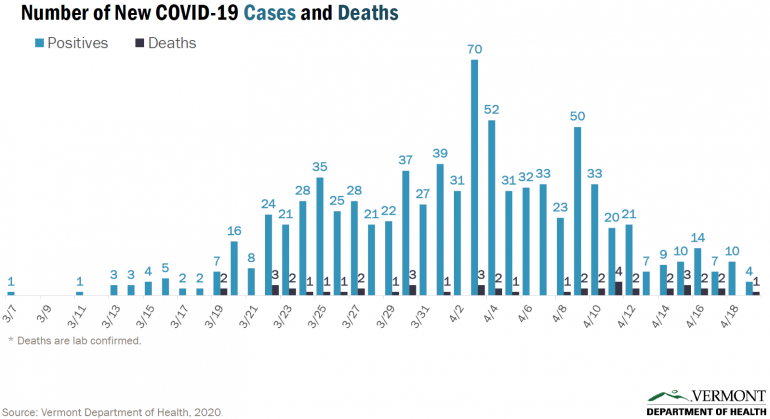
As for the health effects of COVID-19, the news there continues to improve.
Health Commissioner Mark Levine, MD, said hospitalizations continue to subside as have new positive tests.
Meanwhile, they are able to do more and more testing, which indicate a decreasing number of positive cases of COVID-19 as a percentage of total tests.
Levine said the COVID-19 infection rate has clearly plateaued here in Vermont.
He added that while they had sufficient testing capabilities and were able to continue their aggressive testing protocol, that they would continue to add resources in case there is another spike in coronavirus infections.
He and Scott remained cautious about reopening the economy, however, because a flare-up could undo all the good work and sacrifice Vermonters have already done.
Scott said he would not hesitate to reverse course on the modest re-opening of the economy if there was a turn for the worse in the medical data.
Today contractors with no more than two workers could get back to business, as could similarly-sized professional services such as real estate agents and appraisers. On May 1, a very restricted version of farmers markets could reopen.
Scott said if the health data continued to look good this week that he hoped to make another “quarter turn of the spigot” and allow more types of businesses to get back to work.
He acknowledged that this would be a slow process.
“No one wants to re-start the economy more than me,” he said. But, again, the “sacrifices Vermonters are making are saving lives.”