

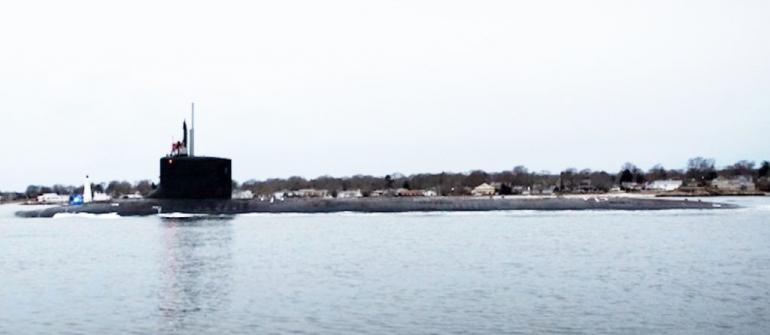
General Dynamics Electric Boat photo of the "Vermont."
Vermont Business Magazine General Dynamics Electric Boat (GDEB) Friday delivered the nuclear-powered attack submarine Vermont (SSN 792) to the US Navy. The Vermont is the first of ten Block IV submarines. The Navy commissioned it as the USS Vermont on Saturday.
Vermont is the 19th submarine of the Virginia-class, which provides the US Navy with the capabilities required to retain undersea dominance well into the 21st century. Vermont is the first of ten Block IV Virginia-class submarines. These ships embody a US Navy and industry commitment to affordably deliver new submarines to the fleet with unmatched stealth and strike capacity.
Virginia-class submarines displace 7,835 tons, with a hull length of 377 feet and a diameter of 34 feet. They are capable of speeds in excess of 25 knots and can dive to a depth greater than 800 feet, while carrying Mark 48 advanced capability torpedoes and Tomahawk cruise missiles.
Vermont Governor Phil Scott said Friday, "This is a proud day for Vermont." He expressed disappointment that he and other state officials could not attend the launch in Connecticut because of the social distancing and travel restrictions associated with the coronavirus.
Vermont is a flexible, multi-mission platform designed to carry out the seven core competencies of the submarine force: anti-submarine warfare; anti-surface warfare; delivery of special operations forces; strike warfare; irregular warfare; intelligence, surveillance and reconnaissance; and mine warfare.
The ship’s construction began in May 2014, and it will provide the U.S. Navy with the capabilities required to maintain the nation’s undersea superiority well into the 21st century.
“The shipbuilders of Electric Boat are proud to deliver Vermont to our Navy, an extraordinarily capable ship," said Kevin Graney, President, General Dynamics Electric Boat. "I am pleased to report that the Vermont has received some of the highest quality ratings in the history of the Virginia program. We wish Vermont and her crew a long and distinguished career in defense of our nation.”
The U.S. Navy commissioned USS Vermont (SSN 792), the 19th Virginia-class attack submarine, April 18.
Although the traditional public commissioning ceremony was canceled due to public health restrictions on large public gatherings, the Navy commissioned USS Vermont administratively and transitioned the boat to normal operations. Meanwhile, the Navy is looking at a future opportunity to commemorate the special event with the ship’s sponsor, crew and commissioning committee.
“This Virginia-class fast-attack submarine will continue the proud naval legacy of the state of Vermont and the ships that have borne her name,” said Acting Secretary of the Navy James E. McPherson. "I am confident the crew of this cutting edge platform will carry on this tradition and confront the challenges of today's complex world with the professionalism and dedication our nation depends on from warriors of the silent service.”
Vice Adm. Daryl Caudle, commander, Submarine Forces, said Vermont’s entry to service marks a new phase of American undersea warfare dominance for a global Submarine Force that is ready to deter, defend and defeat threats to our nation, allies, and rules-based international order.
“This warship carries on a proud Vermont legacy in naval warfare and unyielding determination stretching back to the birth of our nation,” Caudle said.
“To her crew, congratulations on completing the arduous readiness training to enter sea trials and prepare this ship for battle. I am proud to serve with each of you! Stand ready to defend our nation wherever we are threatened – honoring your motto – FREEDOM AND UNITY.
"May God bless our Submarine Force, the people of Vermont, and our families! From the depths, we strike!”
USS Vermont's sponsor, Gloria Valdez, former Deputy Assistant Secretary of the Navy (Ships), offered her gratitude to everyone who played a role in delivering USS Vermont to service. She said she is proud to represent the crew and the first Block IV Virginia-class submarine to enter service.
“I am very proud of the Sailors and families of USS Vermont, who worked so hard to bring her to life, and also feel extremely grateful to everyone who played a role preparing her to defend our nation for generations to come,” Valdez said. “I look forward to commemorating this special occasion together with the crew in the future.”
Vermont's commanding officer, Cmdr. Charles W. Phillips III, highlighted Vermont's accomplishments over the past several weeks getting through initial sea trials. The hard work and dedication of the entire team the past few years was evident in the successful execution of at-sea testing, he said.
Phillips added he is especially thankful to the crew and their families, ship sponsor Valdez, and the USS Vermont Commissioning Committee, led by Debra Martin, for all their hard work and support of the crew.
"We recognize just how important the submarine force is during this era of Great Power Competition," Phillips said. "As part of the nation's maritime asymmetric advantage over our competitors, we are ready to perform whatever duty is most needed.
"The crew is hungry to hone our skills at-sea and become an effective fighting unit, and we will work tirelessly to justify the nation's confidence in us," he added. "Today marks the culmination of six years of dedicated work by the men and women who constructed the nation's newest and most capable warship. We are all honored to be part of this historic moment.
"We are also grateful for the families who have supported our Sailors through the long process of bringing this warship to life and dedicated their time with patriotism and selfless devotion," Phillips said.
USS Vermont is the third U.S. Navy vessel to bear the name of the Green Mountain State. The first Vermont was one of nine 74-gun warships authorized by Congress in 1816. The second Vermont, Battleship No. 20, was commissioned in 1907 and first deployed in December that year as part of the “Great White Fleet.” She was decommissioned June 30, 1920.
Vermont is a flexible, multi-mission platform designed to carry out the seven core competencies of the submarine force: anti-submarine warfare; anti-surface warfare; delivery of special operations forces; strike warfare; irregular warfare; intelligence, surveillance and reconnaissance; and mine warfare.
The submarine is 377 feet long, has a 34-foot beam, and will be able to dive to depths greater than 800 feet and operate at speeds in excess of 25 knots submerged. The boat's construction began in May 2014, and it will provide the Navy the capabilities required to maintain the nation's undersea superiority well into the 21st century.
About Virginia-class Block I II III IV & V SSN
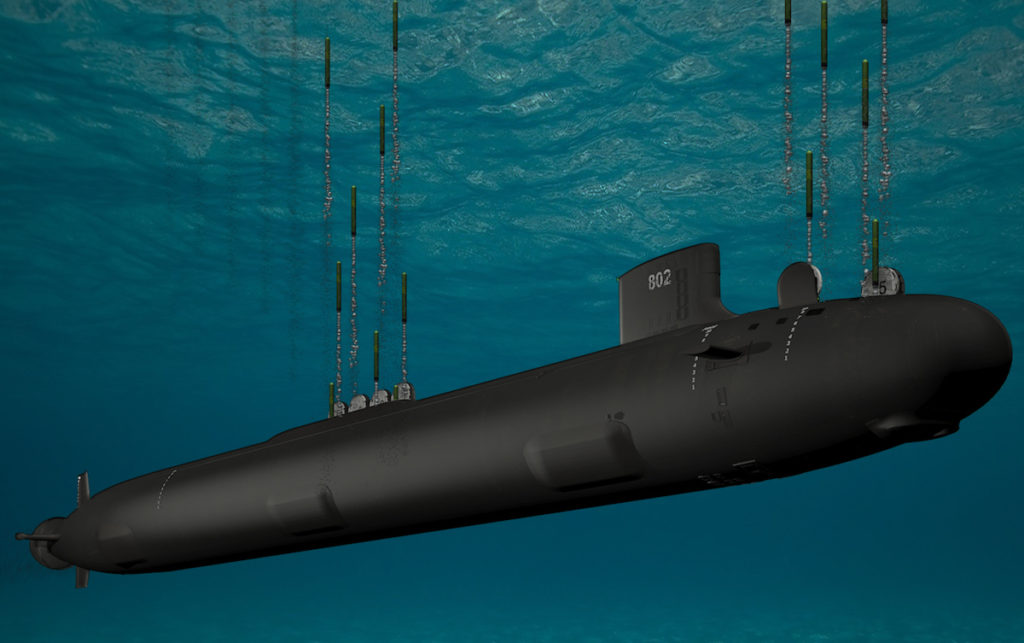
The Block V Virginia-class submarines will to provide expanded capacity and advanced capabilities to the US Navy fleet (Credit : GDEB)
Block IV submarines (SSNs 792 to 801) incorporate design changes focused on reduced total ownership cost (RTOC). By making these smaller-scale design changes to increase the component-level lifecycle of the submarine, the U.S. Navy will increase the periodicity between depot maintenance availabilities and increase the number of deployments.
USS Delaware (SSN 791), the last and final of eight Block III Virginia-class submarines, was commissioned earlier this month. Delaware’s keel was laid April 30, 2016, and was christened during a ceremony Oct. 20, 2018.
The Block III submarines are fitted with the new Virginia Payload Tubes designed to lower costs and increase missile-firing payload possibilities. The first 10 Block I and Block II Virginia-class submarines have 12 individual 21-inch diameter vertical launch tubes able to fire Tomahawk Land Attack Missiles (TLAMS). The Block III submarines are built with two-larger 87-inch diameter tubes able to house six TLAMS each.
Blocks I-III Virginias are planned to undergo four depot maintenance availabilities and conduct 14 deployments. Block IV RTOC efforts are intended to reduce planned availabilities by one to three, and increase deployments to 15. The U.S. Navy refers to this as 3:15.
The Block IV will be followed by the Block V configuration which involves 10 boats and may incorporate the Virginia Payload Module (VPM), which would give guided-missile capability when the SSGNs are retired from service. On 2 December 2019, the U.S. Navy announced an order for nine new Virginia-class submarines – eight Block Vs and one Block IV – for a total contract price of $22 billion with an option for a tenth boat. The Block V subs were confirmed to have an increased length, from 377 ft to 460 ft, and displacement, from 7,800 tons to 10,200 tons.
Next ships in Block IV configuration :
- Oregon (SSN 793) – Keel laid July 8, 2017
- Montana (SSN 794) – Keel laid May 16, 2018
- Hyman G. Rickover (SSN 795) – Keel laid May 11, 2018
- New Jersey (SSN 796) – Construction began March 2016
- Iowa (SSN 797) – Construction began September 2016
- Massachusetts (SSN 798) – Construction began March 2017
- Idaho (SSN 799) – Construction began September 2017
- Arkansas (SSN 800) – Construction began March 2018
- Utah (SSN 801) – Construction began March 2018
Source: https://www.navalnews.com/ 4.17.2020 U.S. Navy www.navy.mil 4.18.2020.