

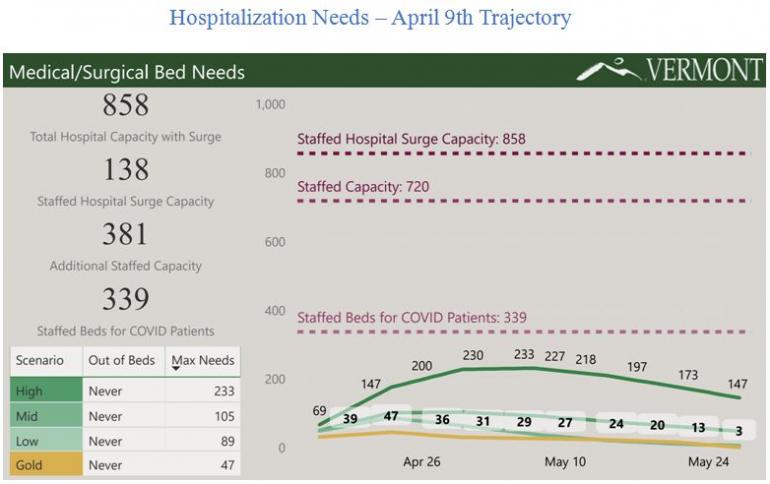
Vermont Business Magazine The Vermont Department of Health reported nine more cases of the novel coronavirus (COVID-19) for a total of 812 statewide. There were no more deaths, which held at 38. The number of hospitalizations -- a key metric in the infection rate -- fell by three patients to 53. There are over 300 beds available for COVID-19 patients statewide and the surge capacity is over 800 beds.
Modeling presented by Governor Scott and administration officials on Friday projected that Vermont is doing better than all the best-case scenarios presented two weeks ago, including for number of deaths, total cases, hospitalizations and ICU needs.
The governor and Health Commissioner Mark Levine, MD, have repeatedly said that the sacrifices that Vermonters are making are paying off and saving lives.
The governor is slowly re-opening the economy. Contractors with no more than two-person crews can get back to work on Monday, as can some other limited professional services workers, such as real estate agents and appraisers. Farmers markets will be allowed to re-open in a very limited manner May 1. CLICK HERE FOR MORE INFORMATION.
COVID-19 is the infectious disease caused by the most recently discovered coronavirus. According to the World Health Organization, “The most common symptoms of COVID-19 are fever, tiredness, and dry cough. Some patients may have aches and pains, nasal congestion, runny nose, sore throat or diarrhea. These symptoms are usually mild and begin gradually. Some people become infected but don’t develop any symptoms and don't feel unwell. Most people (about 80%) recover from the disease without needing special treatment. Around 1 out of every 6 people who gets COVID-19 becomes seriously ill and develops difficulty breathing. Older people, and those with underlying medical problems like high blood pressure, heart problems or diabetes, are more likely to develop serious illness.”
Governor Scott and public health officials have set a strategy to slow the spread in order to protect those at greatest risk, ensure capacity at healthcare facilities and minimize the risk to the public. The state is continually updating community mitigation measures and guidance in close consultation with the Vermont Department of Health and based on new information from the CDC and WHO.
For the most current information on COVID-19 in Vermont, visit healthvermont.gov/covid19.
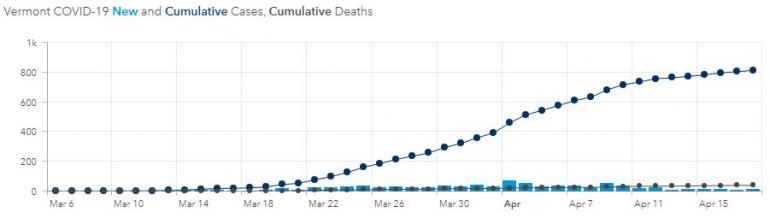
Community Mitigation Measures
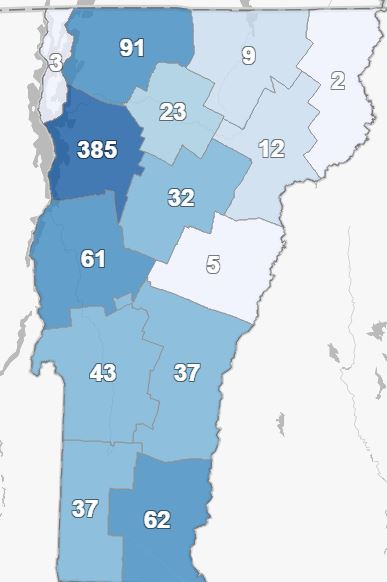
BY COUNTYChittenden County Total Cases: 385 New Cases: 1 Total Deaths: 23 Cases Per 10,000 People: 25 Franklin County Total Cases: 91 New Cases: 1 Total Deaths: 3 Cases Per 10,000 People: 19 Windham County Total Cases: 62 New Cases: 0 Total Deaths: 2 Cases Per 10,000 People: 14 Addison County Total Cases: 61 New Cases: 0 Total Deaths: 2 Cases Per 10,000 People: 17 Rutland County Total Cases: 43 New Cases: 1 Total Deaths: 1 Cases Per 10,000 People: 7 Windsor County Total Cases: 37 New Cases: 3 Total Deaths: 2 Cases Per 10,000 People: 7 Bennington County Total Cases: 37 New Cases: 0 Total Deaths: 1 Cases Per 10,000 People: 10 Washington County Total Cases: 32 New Cases: 1 Total Deaths: 1 Cases Per 10,000 People: 5 Lamoille County Total Cases: 23 New Cases: 0 Total Deaths: 2 Cases Per 10,000 People: 9 Caledonia County Total Cases: 12 New Cases: 2 Total Deaths: 0 Cases Per 10,000 People: 4 Pending Validation Total Cases: 10 New Cases: 0 Total Deaths: 0 Cases Per 10,000 People: 0 Orleans County Total Cases: 9 New Cases: 0 Total Deaths: 0 Cases Per 10,000 People: 3 Orange County Total Cases: 5 New Cases: 0 Total Deaths: 0 Cases Per 10,000 People: 2 Grand Isle County Total Cases: 3 New Cases: 0 Total Deaths: 0 Cases Per 10,000 People: 4 Essex County Total Cases: 2 New Cases: 1 Total Deaths: 0 Cases Per 10,000 People: 3 |
Vermont is now experiencing community spread of COVID-19, which is why Governor Scott issued a Stay Home, Stay Safe order. All Vermonters should stay home whenever possible and practice social distancing (staying about 6 feet apart) and good hygiene with frequent hand washing and cleaning – all strategies to help slow the spread of the virus and protect our vulnerable populations. For more information about how Vermonters can help slow the spread of COVID-19, visit healthvermont.gov/covid19.
Call to Service
Governor Scott Calls on Vermonters to Support COVID-19 Response
Governor Scott is calling all Vermonters into service with the launch of a new website allowing people to sign up for volunteer assistance to support the state’s response to COVID-19: https://vermont.gov/volunteer.
This website directs those with medical and healthcare skills to the Medical Reserve Corp (MRC), and those with other needed skills to a quick registration process to sign up to help.
“I am asking every Vermonter to dig deep and find a way to give more in this incredibly challenging time,” said Governor Scott. “As we prepare for a surge in COVID-19 cases expected in the coming weeks, it will require each and every one of us to do our part to ease the burden on our health care system, the struggles of those less fortunate, and, ultimately, to save the lives of our friends and neighbors.”
Volunteer Form | Press Release
State of Emergency
On March 13, Governor Phil Scott declared a state of emergency to help ensure Vermont has all the necessary resources to respond to this evolving threat. Executive Order | Press Release | Governor's Video Message| Governor's Press Conference
The strategies continue to be updated based on guidance from federal and state public health officials. They currently include:
- On April 17, outlined an approach for the phased restart of Vermont’s economy, emphasizing the state’s modeling indicates initial steps can be taken while the Stay Home/Stay Safe order remains in effect. Addendum 10 | Press Release | Governor's Press Conference
- On April 10, extended Vermont’s State of Emergency through May 15, which also extends the expiration date of all corresponding orders and directives issued in response to the COVID-19 pandemic. Addendum 9| Press Release | Governor's Press Conference
- On April 7, requested federal disaster funds to assist the state of Vermont in its response to the COVID-19 pandemic. The request asks for federal Public Assistance (PA) funds for the state and all towns for costs incurred in the response to and recovery from the COVID-19 pandemic, as well as Individual Assistance, including Disaster Unemployment Assistance and Crisis Counseling Assistance/Regular Services Program for all Vermont counties. Press Release
- On March 30, Governor Scott ordered residents and non-residents coming from outside the state for anything other than an essential purpose to home-quarantine for 14 days and strongly discourages travel to Vermont by those located in COVID-19 “hot spots" designated by the CDC. Addendum 7 | Press Release | Governor's Press Conference
-
On March 26, Governor Scott directed directed schools to remain dismissed for in-person insutrction through the end of the 2019-2020 school year and ordered districts to implement continuity of learning plans for remote learning. Directive 5 | Press Release | Guidance | Governor Scott's Remarks | Governor's Video Message | Governor's Press Conference
-
On March 24, Governor Scott issued a “Stay Home, Stay Safe” order and directed the closure of in-person operations for all non-essential businesses (effective March 25-April 15). Addendum 6 | Press Release | Frequently Asked Questions for Businesses | ACCD Contact form for Businesses |Summary Document | Governor's Video Message | Governor's Press Conference
-
On March 23, Governor Scott ordered telecommuting or work from home procedures for all businesses and not-for-profit entities, to the maximum extent possible (effective March 23-April 15). Addendum 5 | Press Release | Governor's Press Conference
-
On March 21, Governor Scott ordered the closure of close-contact businesses. Addendum 4 | Press Release
-
On March 21, Governor Scott further restricted* non-essential gatherings to 10 or less people. Addendum 4 | Press Release | Governor's Video Message
-
On March 20, Governor Scott ordered suspension of all non-essential adult elective surgery and medical surgical procedures. Addendum 3
-
On March 18, Governor Scott suspended in-person transactions at the Department of Motor Vehicles. Directive 3 | Press Release
-
On March 17, Governor Scott directed childcare centers across the state to close normal operations but encouraged continued operation exclusively where needed to provide childcare services for workers who are essential to Vermont’s ongoing effort in community mitigation of COVID-19. Directive 2 | Guidance | Press Release |Governor's Press Conference
-
Childcare providers will be eligible to receive financial support during the COVID-19 closure period as well as financial incentives for providers serving the children of essential persons.
-
-
On March 16, Governor Scott ordered the closure of all bars and restaurants statewide. Addendum 2 | Press Release
-
On March 15, Governor Scott directed the dismissal of PreK-12 schools and development of a Continuity of Education Plan. Directive 1 | Guidance | Press Release |Governor's Video Message | Governor's Press Conference
-
On March 13, Governor Scott restricted visitor access at long-term care facilities. Guidance
Scott Administration Acting to Help Impacted Individuals, Families and Businesses
“I want every Vermonter to know I understand fully the incredible economic and emotional toll coronavirus is having and will continue to have on each and every one of us. As we continue to work on our first mission to protect the health of Vermonters, we also know financial security is critical for us to recover from this pandemic as well… Let me be clear: my team and I are fully aware these initiatives are not enough. People are hurting and businesses are at risk. Let me assure you: we will pull every lever and turn every dial we can to support folks through this time.” – Governor Phil Scott, March 20, 2020
The Scott Administration has implemented several initiatives – and announced forthcoming action on others – to help provide relief for individuals and businesses impacted by COVID-19 mitigation measures.
(Click here for the Agency of Coimmerce and Community Development Resource Center)
 Unemployment Benefits
** For details on available benefits for individuals, both through state and federal action, please visit accd.vermont.gov/covid-19/individuals **
- Made unemployment available to all Vermonters who can’t work because of coronavirus.
- Waived the work search requirement for those who are laid off or had their hours reduced during this emergency.
- Established an online form for initial unemployment insurance claims to help Vermonters submit claims more quickly.
- Worked with the legislature to allow the extension of unemployment insurance benefits for those who can’t work due to childcare needs during the State of Emergency.
- Worked with the legislature to provide unemployment insurance experience rating relief to employers for temporary layoffs and good cause for quits due to COVID-19.
Healthcare
- Directed insurers to cover any medically necessary COVID-19 testing without charging any out of pocket costs for the patient.
- Directed insurers to make at least a 30-day supply of prescription medication available and encouraged insurers to make a larger supply available when appropriate.
- The Department of Financial Regulation is working with MVP and Blue Cross Blue Shield to encourage the insurers to make sure no one loses their healthcare coverage during this time.
- Urging insurers to expand coverage and reimbursement of telemedicine services, including for office services provided over the phone (audio-only) or by “store-and-forward” means that are currently appropriate for telemedicine, as well as for a broader scope of services, including mental health.
- Announced an emergency regulation requiring commercial insurers to waive cost-sharing requirements, such as co-payments, coinsurance or deductible requirements, for the diagnosis and treatment of COVID-19. The emergency regulation is retroactive to March 13, 2020, the date that Governor Scott declared a State of Emergency.
Utilities and Connectivity
- The Public Service Department has been working with our utilities to ensure that folks are not disconnected during this emergency due to inability to pay. Vermont utilities have overwhelmingly stepped up and their cooperation was acknowledged in the PUC’s recent order to formalize this protection.
- Public Service Department has published an interactive map of free Wi-Fi hotspots to support our students and workers now learning and working remotely as well as a web page detailing new connectivity resourcesto help keep folks in touch and get on-line during the COVID-19 emergency.
- Will work with the legislature to ease barriers to construction of essential communications facilities to ensure systems are not interrupted in this time of critical need.
- Worked with the Legislature to put in place a temporary moratorium on disconnections from public drinking water and wastewater systems
- Announced an innovative collaboration with several partners that will increase internet access by means of public Wi-Fi hotspots for dozens of rural towns in Vermont. Deployment is already underway with installation of devices which begun Saturday, April 11.
Small Business Support
** For details on available resources and funding for businesses, both through state and federal action, please visit accd.vermont.gov/covid-19/business **
- Applied for and secured a statewide disaster declaration from the Small Business Administration, which will small business owners suffering economic injury due the COVID-19 pandemic to apply for SBA’s Economic Injury Disaster Loans (EIDL), offering up to $2 million in assistance per business.
- Provided relief to Vermont businesses who owe Meals and Rooms Tax or Sales and Use Tax until further notice, waiving penalties and interest for late submission of these taxes for taxpayers who are unable to meet the March 25 and April 25 filing deadlines.
- Worked with the legislature to make sure businesses unemployment insurance experience ratings are not negatively affected by the expansion of coverage for workers.
-
Working with the legislature to provide funding to support small business loans through the Vermont Economic Development Authority (VEDA) to provide state fund disaster relief loans.
- Eased liquor laws to allow restaurants—which can currently only offer takeout and delivery—to sell alcoholic beverages as part of takeout service.
- The Department of Health’s Food and Lodging licensing program will grant license extensions to all businesses (which includes restaurants, hotels, B&Bs, caterers, etc.) that are due for renewal March 1,2020 - June 30, 2020.
- ACCD is providing resources to support businesses with technical assistance, regular guidance and more at accd.vermont.gov.
- The Department of Liquor and Lottery’s liquor licensing and permitting program will grant license extensions to all businesses that are due for renewal on April 30, 2020.
Flexibility and Relief
- Extended income tax filing due dates from April 15, 2020 to July 15, 2020, allowing taxpayers to file and pay income taxes on or before July 15, 2020 without any penalty or interest.
- The Department of Financial Regulation is encouraging financial institutions to provide flexibility for customers by waiving fees, delaying loan repayments, and more.
- The Department of Motor Vehicles shifted to online, phone and mail services, and is granting a 90-day extension for all license and registration renewals.
- Working to ease ANR’s procedural requirements to accommodate surge capacity needs at healthcare facilities.
- Working to ease regulatory burdens on healthcare professionals and extend licensing renewals to give our healthcare providers more flexibility on licensing, staffing and referrals.
- Worked with Allstate and its affiliate insurance companies to reduce their auto insurance premiums for Vermont policyholders by approximately 15% due to reduced driving during the COVID-19 pandemic. This plan will amount to over $500,000 in savings for Vermonters.
- Extended April vehicle extensions 60 days.