

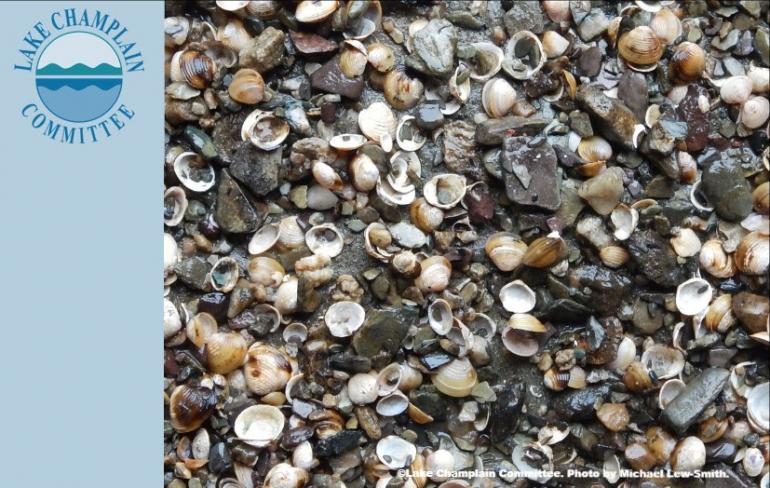
Lake Champlain Committee The Lake Champlain Committee (LCC) has been checking Lake Champlain beaches for Asian clam during the summer and have a fun volunteer opportunity coming up on Tuesday September 24. Join us if you can! We are teaming up with our friends at Arrowwood Environmental and Magic Hat Brewing Company to comb Burlington area beaches for the invasive mollusk. The program includes training, field time, and lunch! It’s a great way to learn more about Asian clams, how to identify them and what we can do to keep them out of Lake Champlain.
You’ll find further details about the 9/24 program below along with background on Asian clam and why they’re a concern. Please RSVP by Monday, September 23 AM so we can be sure to have enough food and materials on hand.
Where and when to meet
- 9:00 AM meet up at the Magic Hat Brewing Company Office Building 1519 Shelburne Road, So. Burlington, VT for training
- 11:00 AM – 3:30 PM carpool to Burlington area beaches to hunt for the invasive mollusk
Lunch will be provided along the way courtesy of Magic Hat Brewing Company
What’s the big deal with Asian clams?
The Asian clam is a hermaphroditic aquatic mollusk first discovered in North America in 1938 in the Columbia River in Washington. Since that time, it has spread across the contiguous United States and is now found in 38 states. Asian clams are an invasive species in North America, which means that not only are they not native to our region, they actively harm the environment, the economy, and/or human health. A single adult Asian clam can produce approximately 35,000 larvae per year, making eradication difficult once they become established. Large infestations can have numerous negative effects on ecosystems including out-competing rare native mussels, altering nutrient cycling, disrupting habitat and increasing the frequency of cyanobacteria blooms. In addition, Asian clams can “biofoul” human-made structures such as water systems, costing an estimated $1 billion per year in the United States.
How close are they to Lake Champlain?
Until relatively recently, the Lake Champlain watershed was not infested with Asian clams. However, in 2007, this species was documented in Lock 8 of the Champlain Canal, only two locks away from the Lake Champlain side of the canal system. In 2010, Asian clams were detected in Lake George. A significant effort has been made to control this infestation, which is estimated to occupy 27 sites and comprise over 100 acres in the lake. In 2016 Asian Clams were found in Lake Bomoseen, Vermont, where they inhabit a portion of the lower lake. Lake George drains into Lake Champlain along the La Chute River in New York. Lake Bomoseen drains into Lake Champlain via the Castleton and Poultney Rivers in Vermont. In 2009, this species was documented downstream of Lake Champlain in Becancour, Quebec in the St. Lawrence River. Lake Champlain appears to be surrounded.
What do Asian clams look like?
Asian clams have a triangular shell, which is roughly the size of a penny (although they can grow to be 5 cm in diameter). The exterior of their shells range in color from greenish-yellow to dark brown and are marked with concentric bands that form ridges you can feel. The interior of the shell is a smooth white or light purple.
How you can help
Despite the eminent threat of infestation from this species, no early detection program for Lake Champlain has been implemented. Because of its prodigious reproductive ability, early detection is essential for controlling the size and extent of potential infestations. That’s where you come in! The Lake Champlain Committee (LCC) and our partner Arrowwood Environmental (AE) have been surveying beach areas of the lake but your involvement will help us cover a larger territory. We have a great group of volunteers from Magic Hat Brewing Company joining us for our 9/24 beach combing effort and welcome additional participants.
9/24 training session & field assessment
Staff from the Lake Champlain Committee and Arrowwood Environmental will provide a training session at the Magic Hat Brewing Company Office Building, 1519 Shelburne Road in South Burlington on Tuesday, September 24 from 9:00 AM to 10:30 AM to help you identify Asian clams, explain the survey approach and give you some practice sieving sand. Then we’ll head into the field from 11:00 AM until about 3:30 PM, combing area beaches to look for the invasive mollusk. Each participant will be provided with a metal sieve to sift through beach sand. We’ll have a delicious lunch to keep you fueled courtesy of Magic Hat Brewing Company.
What to wear & bring for fun in the field
We’ll be spending the day outside so please prepare for the weather. Wear and bring clothing that will keep you warm and dry and that will be okay to get wet and dirty. You’ll be exposed to wind, water and waves as we comb beach areas and wade into shallow water areas. We recommend wearing pants other than jeans or cotton (which does not stay warm when wet). It is also important to bring shoes that you can wade in, such as waders, mud boots or water shoes. For your comfort you may want to bring a towel and a change of clothes and extra socks.
Volunteer packing list for 9/24/19 training and field assessment day:
Bring and wear layers for comfort and warmth
- Hat
- Scarf or neck warmer
- Gloves
- Windbreaker and rain gear
- Jacket
- Thermal undergarments
- Pants other than jeans (if possible – no cotton)
- Clothing that can get dirty
- Rain and wind gear
- Extra non-cotton socks
- A change of clothes
- Towel
- Waders, mud or rain boots or water shoes
- Sunscreen
- Water
- Snacks
Thanks again for your support of LCC’s work and your interest in getting actively involved in protecting lake health. We hope to see you on Tuesday September 24 for a fun field day!
Yours for a healthy lake,
Lori Fisher
Lake Champlain Committee Executive Director