

Vermont Business Magazine A campaign to encourage housing production in Chittenden County is keeping apace of its overall production goals, but the gap between housing costs and wages is growing, housing leaders announced last week. There were 620 homes developed and ready for occupancy in 2018. Over the first three years of the campaign an average of 758 homes were built each year ahead of the pace needed to meet the campaign’s goal of 3,500 homes over five years.
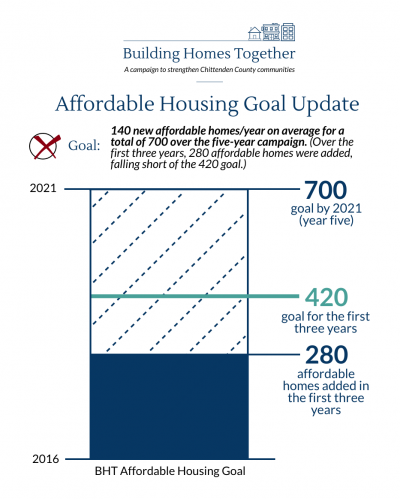
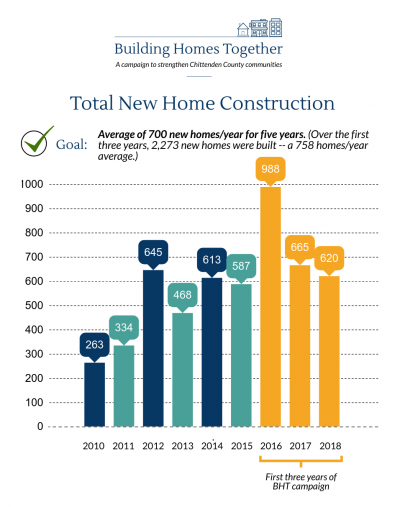 “While overall housing production is strong, we know that we need to build more affordable housing to sustain truly inclusive communities and we’re just not doing that,” said Brenda Torpy of the Champlain Housing Trust. With over 2,200 homes built in the county in the last three years, only 280, or 13%, became permanently affordable. That’s well shy of the campaign’s goal of 20%.
The Building Homes Together campaign was launched in 2016 by Champlain Housing Trust, Chittenden County Regional Planning Commission and Housing Vermont, and is supported by over 100 public officials, business and nonprofit leaders. The organizations combine public education, advocacy and training in efforts to increase the amount of housing stock for people of all incomes in the County.
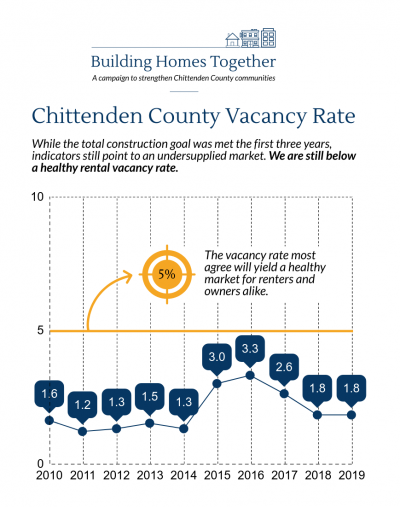 “The campaign has succeeded on one front, and that’s good news,” added Charlie Baker of the Chittenden County Regional Planning Commission, “but we still see anemic vacancy rates which demonstrate a pent-up need and an ongoing need to continue this rate of building.”
The long-term vacancy rate in Chittenden County is 1.8%. Experts consider a vacancy rate between 3 and 5% to better balance the needs of renters and owners.
“We are heartened by the understanding in local communities to address the needs of low wage workers and those priced out of the market,” said Nancy Owens of Housing Vermont. “The State’s Housing Revenue Bond is adding some new affordable homes to our region already, with more on the way. Adding to and sustaining this type of investment over several years is the best way to address workers’ housing needs.”
Since the campaign launched, many initiatives to address affordability have started on the municipal level in Chittenden County communities, including active housing commissions or tasks forces in several towns or cities, adoption of additional planning tools like inclusionary zoning are being used or explored, and housing trust funds have been created or expanded by communities to encourage more affordable housing.
New Investments
The Building Homes Together campaign originally called for a $70 million investment in affordable housing statewide. A $37 million Housing for All Revenue Bond was signed into law in June 2017, helping to fund affordable construction housing in Vermont through 2019. However, in order to meet the needs of Vermonters, the Building Homes Together campaign is still calling for significant, new State investment for affordable housing.
 The BHT campaign also calls for:
- Supporting communities to create and fund local housing trust funds. As of 2018, three municipalities have a local housing trust fund (Burlington, South Burlington and Charlotte) and three other Chittenden County municipalities are considering one.
- Fully funding state sources like the Vermont Housing and Conservation Board. Full funding of VHCB since 2017 would have resulted in $18.5 million of additional funding for critical housing and conservation initiatives.
- Supporting communities that want to address the shortage of housing by offering assistance with zoning changes and other local tools. As of 2018, the majority (14) of Chittenden County municipalities have improved their zoning to accommodate more housing, and most are continually working on this.
Student housing has been an issue for many years in Burlington, as it can displace housing for the permanent population. However, it should be noted that Champlain College added 314 student beds within 105 apartments in Burlington in 2018. UVM added 304 student beds in 2017. Though not included in the total numbers, this is an important component of the overall housing picture.
More information about the campaign, including the data collected over the first three years, is available at www.ecosproject.com/building-homes-together.
Source: Burlington, Vermont – Champlain Housing Trust. 9.9.2019. Graphics courtesy Building Homes Together Campaign.