

This Land: The Changing Story of Rural Vermont
Vermont Public Radio and Vermont PBS, working with Castleton’s Rich Clark recently conducted a comprehensive survey as part of "This Land" series. About two-thirds of Vermonters were optimistic about the future of their community but half said they would tell an 18-year-old to build their life and career elsewhere (!). Those in the most rural areas felt some of the biggest challenges. The survey is online HERE
 Conversations about the survey
VPR and PBS organized a number of radio and TV shows to focus in on particular parts of the conversation, including several Vermont Edition’s on the survey, on leaving and staying in Vermont, on broadband, a special edition of Vermont This Week and a documentary on the future of farming, online HERE

Population Changes
An in-depth analysis of internal population changes by VT Digger found that the more rural areas of the state are losing population the fastest, while Chittenden County and the northwest are gaining.

The story from Vermont’s rural areas
And late last year, Seven Days devoted a whole issue to the challenges facing rural Vermont, including stories on Guildhall, on the state’s $10,000 program to lure non-Vermonters, on general stores and on the role of art in bringing vitality to these towns. The story includes a map showing birth and death rates by town –Vermont’s birth rate has decreased to 9.2 from a high of 24 per 1000 in 1955.
Recent Report on Migration
Peter Nelson of Middlebury College and Mat Barewicz of the state department of labor recently compiled some fascinating information on Vermont workforce participation, demographics & migration that was presented at the Vermont Economic Development Conference. A slide show of that presentation can be found HERE
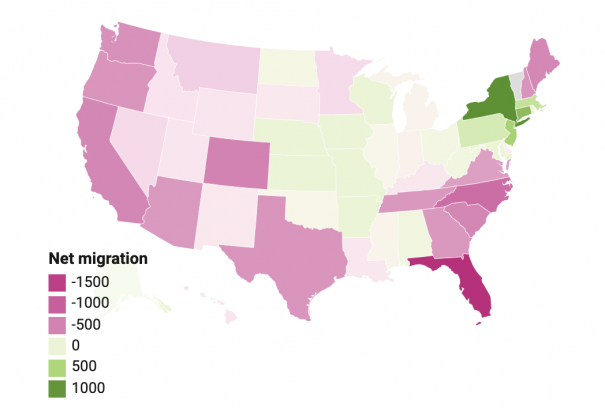
Vermont's losses and gains, 2011-2016
Migration patterns
Researchers Cheryl Morse and Jill Mudgett analyzed thousands of comments through their Roots Migration Project – on why people stay and leave Vermont -- finding that the reasons are nuanced and include (for stayers and returners) the aesthetics of Vermont’s landscapes and sense of community. See VT Digger interview with the researchers.
Vermont Data Center
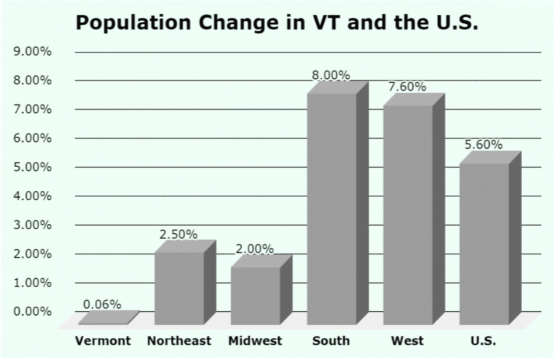
A good source of data on Vermont's demographic changes is the Vermont Data Center which manages Vermont’s census data, and puts together short information “briefs.” Vermont had the fifth smallest population change among the states in the last five-year census release, with an increase of less than 1%; VT Population Brief
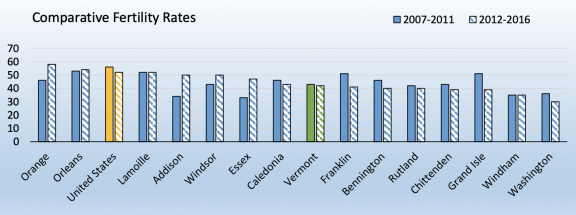
Between the 2006-2010 and 2013-2017 American Community Survey five-year estimate periods, Vermont had one of the lowest fertility (birth) rates in the U.S., and tied with Connecticut for having the lowest fertility rate in the U.S. VT Fertility Brief.
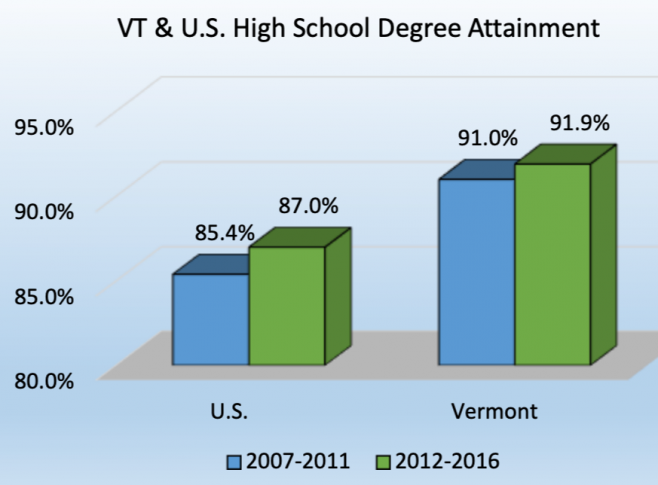 And we are a very educated place, ranking eighth in the U.S. Ninety-two percent of Vermonters 25 years of age and older have a high school degree or higher, a number which increased in the most recent ACS estimates. Additionally, Vermont's percentage of residents with an Associate's degree or higher is well above the national average. Learn more: VT Educational Attainment Brief
Public Assets
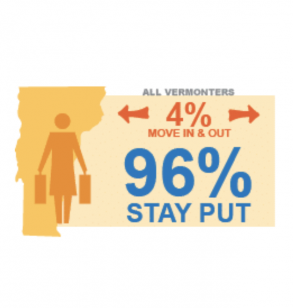
Public Assets Institute has been following Vermont’s migration trends for the last decade. In Migration Update: Most Vermonters Stay Put, they find that young people are leaving Vermont, in about the same numbers as young people moving to Vermont. This report also looks at the migration of various age groups by region, comparing Vermont, New England, and the U.S. and finds that young people everywhere are the most mobile.
 To understand the economic context of the state people are moving to and from, take a look at Public Assets' State of Working Vermont 2018. It’s an annual report that looks at who benefits from Vermont’s economy, who was able to make ends meet (and who wasn’t), and how the overall job market is working. Updated migration information can be found on pages 23-24.
 Statewide conversations - VCRD
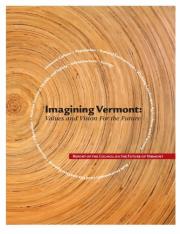
Known for their convening of statewide and community level conversations on key issues facing Vermont, the Vermont Council of Rural Development led a statewide conversation almost ten years ago on the future of Vermont that dived deeply into many of the demographic and economic challenges facing the state. The final report of the Council on the Future of Vermont can be found HERE

Should I Stay or Should I Go?:
A special issue of The Northeastern Geographer in 2016, titled Should I Stay or Should I Go?: Youth and Out-migration from Vermont focused on that question and contains articles by Vermont demographers Vince Bolduc and Herb Kessell and many others (Special Issue: VOLUME 7, 2015 ; Guest Editors ; Wendy I. Geller and Cheryl Morse).

Narratives of departure
In one article in the journal, researchers trace recent "youth flight" narratives to then-Governor James Douglas’s 2006 state of the state address: “For many years, I have expressed a deep concern that Vermont is exporting too many of our youth. High taxes, a shortage of affordable homes, high energy costs, soaring school budgets, and college tuitions, and a challenging economic environment all conspire to drive our young people to seek a more affordable life elsewhere...” (Governor Jim Douglas, 1/5/2006).
Leaving Vermont
And speaking of young people leaving, the 2018 VPR Brave Little State podcast Is Vermont Really Losing Young People? provides an interesting perspective as does their series on choosing Vermont, and a few related articles around that time on studying the rural brain drain why Vermonters stay or go and the film Loser’s Crown. Don’t miss the comments on the VPR coverage.
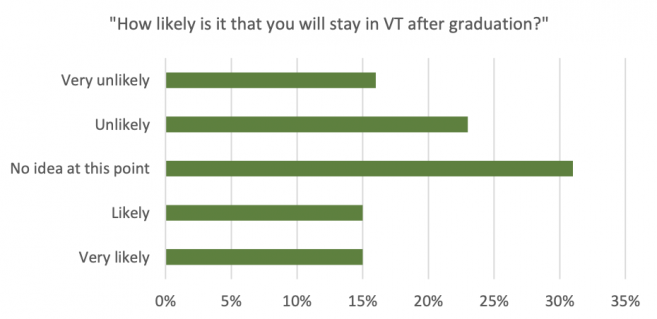
The Vermont Legislative Research Service surveyed the Post-Graduation Intentions of Vermont College Students. With 20,000 college students in the state the possibility of more of them staying post-graduation is of great interest to policy-makers.

Free Conference in Warren Nov. 14
Speaking of education, Vermont and the nation’s postsecondary population is changing. Students on the path to credential attainment are increasingly "post-traditional," a diverse group of adult learners, full-time employees, low-income students, first-generation students, students of color, New Americans, students who commute to school, veterans, those who are incarcerated or recently incarcerated, and working parents, according to Advance Vermont which is hosting an all-day free conference to examine these issues and think about how to better meet student’s needs, register here Today’s Students Summit
Data Collection
The Vermont Community Foundation funded a collaboration between organizations gathering Vermont data that includes many of these sources, and more called the Vermont Data Collaborative, on-line HERE
It’s nothing new
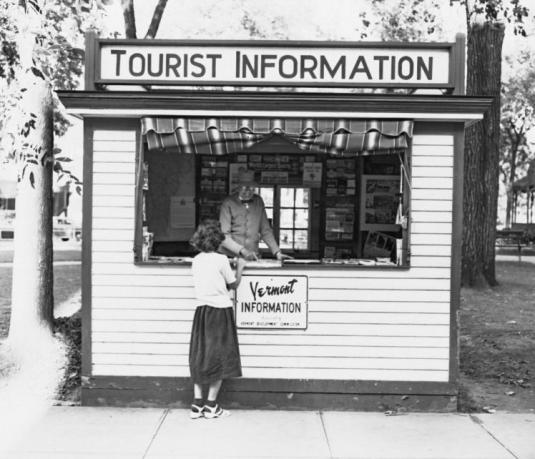
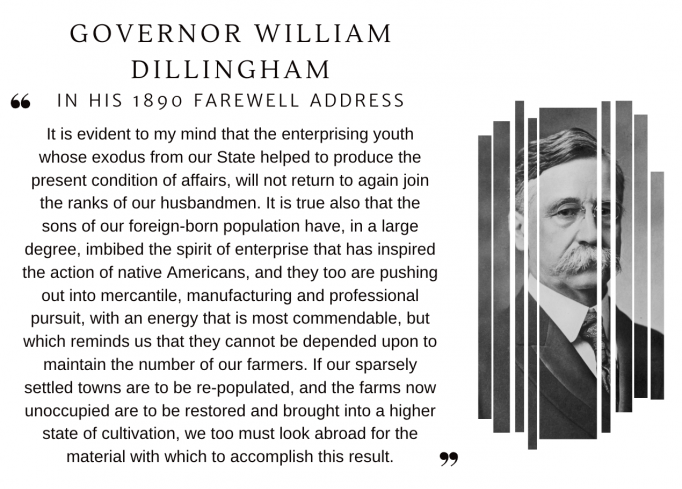
Concerns about Vermont’s aging population and lack of in-migration have haunted the state for more than 150 years, according to Vermont History Editor Michael Sherman and long-time state archivist (now retired) Gregory Sanford. Advocating for more immigrants from outside the U.S. has been one proposed solution.
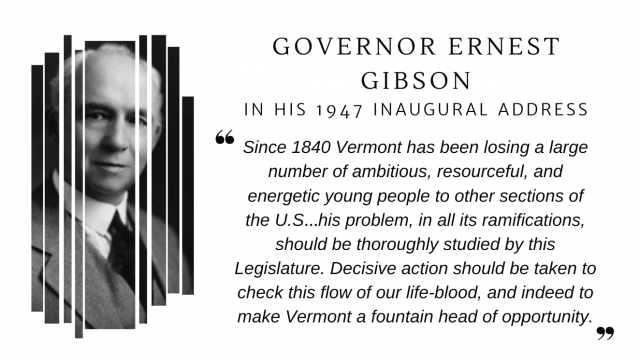
 The Commission on Country Life (1931) touched on the emigration of Vermont's young, noting that (page 28): "One of the most obvious effects of the migration is that it has drained the countryside of its young people. By far the greater number of those remaining are old--older than the average for Vermont, which according to the census has more old people anyway than almost any other state in the union."
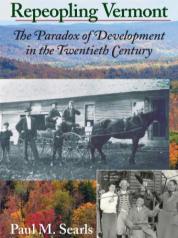
Repeopling Vermont
Paul Searls in Repeopling Vermont: The Paradox of Development in the Twentieth Century (2019) is a recent look at this debate at the beginning of the 20th Century "tracing two distinct but interrelated stories to help illuminate the tension between progress and preservation in the last century, and how these forces continue to shape Vermont today."

The Growth Years
During the 1960s and 1970s, Vermont grew at a rate twice as fast as the rest of the country, In 1970 the Legislature was aware that in the 20 years between 1950 and 1970 the population of Vermont grew more than in the entire century between 1850 and 1950. The idea that the state would have to house 184,000 new residents, caused Gov Deane Davis in his 1970 address to ask: “Where will these people live? How will they support themselves or be supported? Will we be able to continue to freely hunt our woods, fish our streams, roam our winter countryside and enjoy our lakes and mountains? Will we become an extended suburb of Boston, New York, and Montreal? “ – Problems that current state leaders would love to have.
Copyright © 2019 Center for Research on
The Vermont Research News is a bi-monthly curated collection of Vermont research -- focused on research in the Vermont "laboratory" -- research that provides original knowledge to the world and research that adds to an understanding of the state's social, economic, cultural and physical environment. Support from the Office of the Vice-President of Research, University of Vermont.