

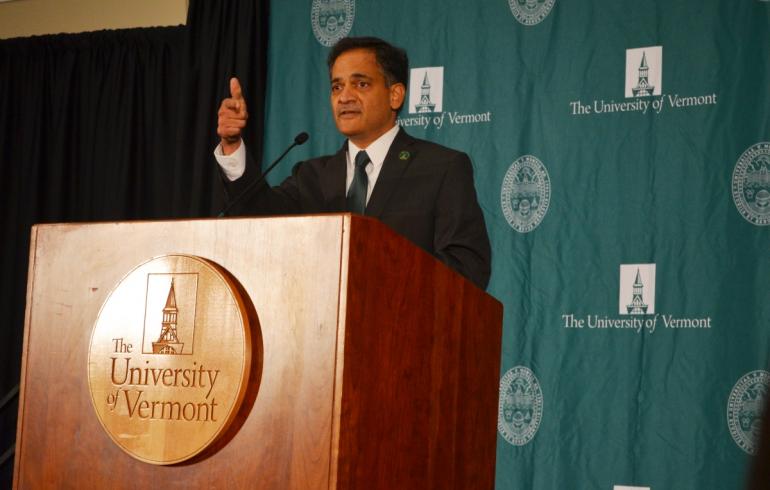
University of Vermont President Suresh Garimella. VBM photo
by Timothy McQuiston, Vermont Business Magazine Kids looking at colleges this fall received welcome news today from the University of Vermont: Tuition at all levels from undergraduate to graduate and for in-state and out-of-state students will not increase next year. As part of his commitment to making UVM more accessible and affordable, President Suresh Garimella announced this morning that tuition for the academic year beginning in fall 2020 would not increase over 2019 levels.
“Student loan debt is the second highest category of consumer debt—second only to mortgage debt and higher than credit card debt. Funding a college education is one of the very largest expenditures families face in the United States,” Garimella said. “Forty-four million borrowers owe $1.6 trillion in student loan debt. Yet, education is increasingly important to future success. It’s critical that we do everything we can to address the pressures that families and individuals face in their effort to achieve their educational goals.”
Garimella said the university has kept tuition increases at modest levels in recent years and commits over $160 million in grants, scholarships and tuition remission every year, enabling 44 percent of Vermonters to attend UVM tuition-free. Some 80 percent of costs are borne by out-of-state students.
"It's critical that we can do everything we can to help students," he said at the gathering of news media, students, administrators and others at the Davis Center announcement.
The UVM president, who has been on the job only since the summer, made it very clear that while "efficiencies" will have to be found across the university landscape, there will be no job cuts.
"We cannot cut our way to success," he said.
The cost of the zero-increase plan will be between $7 million and $8 million. Garimella said he and the trustees will need to take this zero strategy year-to-year. Rates ultimately are set by trustees in the spring. This does not include room and board costs.
Garimella insisted that the university will not simply increase the acceptance rate to bring in more students in order to raise more money.
"Our most sacred obligation is to the success of our students," he said.
Along with the university looking for ways to save money, Garimella will look for revenue enhancements through the generosity of alumni and other donors, government and private research grants, expanding academic opportunities, and taking advantage of money-making opportunities through the use of the school's physical plant.
Garimella, who was a leading educator and administrator at Purdue University in Indiana, noted that Purdue also instituted a zero tuition increase policy for eight years. But Purdue is larger and gets more state support, he said.
UVM has seen a steady rise in its four-year graduation rate, which now ranks in the top 6 percent of public universities nationally. Garimella said the university will work hard to further increase its already enviable graduation rate as another cost-cutting strategy for students and their families. Timely graduation decreases the overall cost of a degree and enables students to join the workforce earlier.
“Despite that solid record,” he said, “we need to do even more.” He emphasized the responsibility UVM has as a Land Grant University.
The zero tuition increase is part of Garimella’s efforts to enhance the value of a UVM education.
Half of the value equation is educational quality, he said, an area the university has devoted thought and resources to in recent years, creating new courses, expanding experiential learning opportunities, investing in student advising and career counseling and continuing to recruit top teacher-scholars, trends that will accelerate during his presidency.
Cost is the other half of the value ratio, an area today’s announcement addresses.
“Relying on annual tuition increases, even modest ones, is not sustainable,” Garimella said. “As we move forward, we will focus intently on all the ways the university can generate additional revenue to relieve the pressure on tuition.”
Specifically, Garimella cited a number of sources where the university could find new revenue, including private philanthropy; improved retention of current students; increased graduate and summer enrollments; expansion of flexible and online course offerings geared to adults and non-traditional learners in Vermont and around the world; enhancing graduate, post-doc and undergraduate research support through grants from the federal government and other sources and through partnerships with private industry; and supporting more students transferring to UVM from other colleges.
“Our recently completed capital campaign, which exceeded its $500 million goal by $80 million, is evidence that we can be successful in finding new non-tuition sources of revenue,” he said.
In addition to benefiting students and families, Garimella said that enhancing UVM’s value will position the university well in the intensely competitive higher education market and act as a talent magnet for both in-state and out-of-state students. Sixty-nine percent of Vermont resident students and thirty-one percent of nonresident students choose to stay in Vermont after graduation, helping address the state’s workforce challenge.
“The relentless rise in tuition over the last several decades has placed an unsustainable burden on students and their families,” said David Daigle, chair of the UVM board. “Our board is fully supportive of this objective as it will immediately reduce this burden and sends an important signal that the university is committed to affordability and accessibility. We look forward to working with the administration on formal board approval next semester.”
“Affordability is a top priority for students,” said Jillian Scannell, president of UVM’s Student Government Association. “We applaud the administration’s effort to contain costs and help keep the university accessible for all.”
“We’re proud of the role faculty play in preparing our students to be informed citizens and to have successful careers after graduation,” said Thomas Chittenden, president of the Faculty Senate. “But these benefits have to come at an affordable cost. I support UVM’s decision to make accessibility and affordability top priorities.”
Garimella also noted that the zero-increase initiative is particularly difficult at UVM because of sparse state funding. UVM receives among the least, if not the least, amount of public support of any state university in the nation. He is sure, he said, that the Legislature is paying attention to this issue, but whether they will act to increase funding Garimella would not hazard a guess. The Vermont State College System has also been pressing the governor and legislators for more support.
Later Thursday, Governor Phil Scott issued the following statement: “We know there is tremendous value for our kids in earning a college degree or pursuing trades training and technical education. These are opportunities that we want all kids to be able to access and afford. That’s why I’m pleased to hear today’s announcement that the University of Vermont will not increase tuition rates for the 2020 school year.
“Having the nation’s best cradle-to-career education system will be the very best economic development tool we could have here in Vermont and probably requires some reimagining of our current systems, which are disconnected between early care and learning, preK-12 and postsecondary.
“However, the affordability of what we currently have, and where we’d like to go, is a huge challenge and balancing act for Vermonters. I believe President Garimella understands this dynamic – I think it’s reflected in today’s announcement – and I appreciate his leadership.”
Vermont has suffered through a rash of small, private college closings just this year and all in the southern part of the state. Just last week Marlboro College in Windham County announced that it will close its campus and merge its programs into Emerson College in Boston. Green Mountain College and St Joseph's College in Rutland County and Southern Vermont College in Bennington County also just shut down.
Garimella, from his first press conference and through today, has emphasized the student experience as the next step in UVM's ascendance. His predecessors laid the ground work for the university's academic standing and fundraising over the last nearly 20 years.
Garimella said, "This is an historic event." UVM hasn't frozen tuition rates for about 40 years.
The effect will be far larger than just for UVM community, he said. Garimella said the state's economy is "inextricably linked" to the success of UVM.
"I really think this is a game-changer for the state of Vermont."
The board of trustees will officially set tuition rates when it meets during spring semester. Once approved, a tuition freeze would apply to new and returning in-state and out-of-state students enrolling at the university in the fall of 2020, which will also apply to graduate students.