


by Olga Peters, Vermont Business Magazine Forty-three thousand, six hundred and nine people call Windham County home. Their average commute time is 24 minutes, pointing to a labor market that lives in one town and drives to another for work. Living locally and acting in a regional economy is a trait the residents and their county share. It is also a trait that points to Windham County’s growth potential, despite its, at times, lackluster economy.
Vermont’s southeastern-most county nestles into a tri-state neighborhood that includes New Hampshire and Massachusetts. The three states also share the Connecticut River with Windham County's Deerfield Valley and Massachusetts also sharing the Deerfield River.
Windham County lags behind its neighbors, and the state, on multiple key metrics. According to census data, Windham County’s median household income is almost $7,000 less than the rest of the state’s. The poverty rate at 14 percent is higher than Vermont’s average poverty rate of 11.9 percent. Windham County’s median household income also lags behind Franklin County in Massachusetts and Cheshire County in New Hampshire. The neighboring counties also have lower poverty rates than Windham County's.
It’s possible that Windham County may have a few more years of recovery ahead before strong change takes root, especially when it comes to wages. The ripple effect of Entergy’s lost wages from closing Vermont Yankee nuclear power plant is just starting to spread.
According to numbers from the Brattleboro Development Credit Corporation, although the plant closed at the end of 2014, the lost wages from 600 jobs with an average annual salary of $100,000, are only just being felt. Adam Grinold, executive director of the BDCC, explained that Energy stepped down its staffing levels over a few years. It also provided employees with substantial severance packages. This buffered the economic impacts, he said.
In 2014, private sector wages across all sectors in Windham County totaled $778,254,000. The next year the wage total peaked at $830,944,00. By 2017, that total dropped to $785,637,000.
Yet, Windham County is also the county that never gives up, never backs down, and never cries Uncle. The county’s secret weapon: its people.
|
RELATED VBM STORIES Self-governance would give towns a bit of freedom from Montpelier |
Given some of the challenges people face in an economy that struggles to pay livable wages across the board and pays, in general, less than it neighbors, no one would be surprised to hear sentiments of “woe is us.” But, no. Instead, people interviewed for this article spoke with optimism for the future, and respect for their fellow Windham County residents.
And there are bright spots in the data to back up the optimism.
According to the BDCC’s 2018 annual report, the number of businesses located in the county is at its highest since the Great Recession. Meanwhile, 44 companies expanded and 14 stayed, opened, or moved to the county. The BDCC helped create 724 new jobs in the county’s manufacturing sector.
Deliberately choosing a neglected piece of downtown
Last year, Mocha Joe’s Roasting Company purchased the former Cultural Intrigue building at 35 Frost Street in Brattleboro. Since moving in, the coffee company has renovated the space to operate as its business offices, storage of green coffee, roasting facility, and soon, an education space. The company also rents to two businesses: Recycle Away and the new Hatch Space, a woodworking studio spearheaded by Tom Bodett and Greg Goodman.
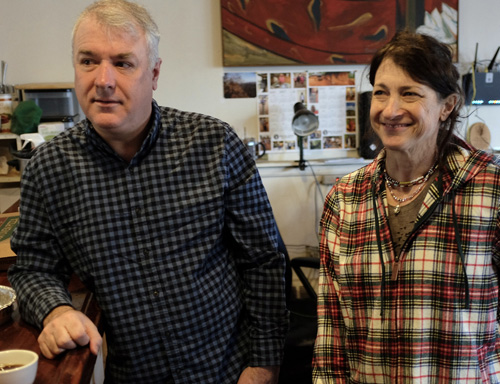
Photo: Pierre and Elayne Copy of Mocha Joes. Photo by Randolph T. Holhut.
Kora Skeele, sales and marketing manager, said that moving to Frost Street was a deliberate decision on owners Pierre and Ellen Capy’s part.
Ellen Capy said that the company, which has owned and operated the Mocha Joe's Cafe at the corner of Main and Elliot Streets for more than 20 years, reinforced the company’s commitment to staying downtown. The commitment has included meeting standards to reduce carbon emissions and the heavy sharp scent of roasting coffee which is not as pleasant as coffee when it is brewing. Capy said that she hopes the new facility — between Mocha Joe's and the other businesses — will attract more people to Frost Street and then send them back to Main Street.
The Flat and Frost Street area of downtown Brattleboro struggled after Tropical Storm Irene flooded the area in 2011, Skeele said. “Anything that bolsters this part of town is important.”
Mocha Joe's, along with its new neighbor, The Whetstone Brewery’s tasting room, hopes to bring more foot traffic to the Frost Street area which is a mix of the arts, peer recovery support, industrial, and residential. Other long-time businesses nearby include the New England Youth Theatre, Cersosimo Lumber Company’s facility, Turning Point of Windham County, and multiple residential buildings.
“When you pull different and important pieces of a town together, and have them work together, it creates a sense of community and reminds us of the different roles we all play in a town,” Skeele said.
Skeele said purchasing the new facility represents the next business chapter for Mocha Joe's. The company expects to expand its wholesale business for starters.
A large number of wholesale clients across New England and New York State “are the bread and butter of our business,” Skeele said.
Mocha Joe's serves customers from small local cafes to larger retail operations such as the Brattleboro Food Co-op and King Arthur Flour in Norwich.
“We span the spectrum very intentionally,” Skeele said. Because the company wants to serve small independent businesses along with its larger wholesale clients.
That said, the local market is mostly saturated by coffee companies including Mocha Joe's, which is one reason Mocha Joe's seeks new markets, Skeele said.
Pierre Capy has told Skeele that one of the reasons he believes the company has lasted is because he never allows the company to become stale. When business starts to feel like…well…work, Pierre Capy inserts a fun shift to create change.
Mocha Joe's will step into the educational arena this summer, Skeele said. The company will feature workshops at the annual Strolling of the Heifers weekend in June. The classes will include a brewing demonstration, a roasting demonstration, and a “cupping” class. Cupping, Skeele explained, is a process for grading coffee.
“We’re looking to spread the love and spread the coffee knowledge,” Skeele said.
Later this summer, Mocha Joe's will also announce a new branch of their business, Skeele said. Stay tuned for more information.
Connecting the dots in a regional economy
The business sector with the most growth over the past decade in Windham County is value-added and specialty food production.
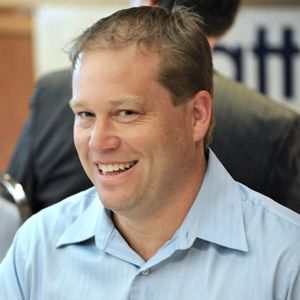
Photo: Adam Grinold of BDCC. Photo by Randolph T. Holhut.
“Value-added food is a bright spot for sure,” said Adam Grinold, executive director of the BDCC. “Over the past 10 years it has seen absolutely, by far the largest growth.”
This sector has also contributed to the most new jobs in the area, he said.
One of the strengths of the value-added food sector is the ability for entrepreneurs to start small, start local, and then gradually grow as they move into new markets, Grinold said.
New markets outside the region are key to brining in new dollars.
Grinold said a local economy is like the water in a community swimming pool. If all summer kids splash water around, jump in and out of the pool, and then the sun evaporates some of the water, eventually the pool will empty. To keep the pool’s water topped up, fresh water must be added throughout the summer. The same is true for a local economy, he continued, new dollars from outside the community must flow in to refresh the supply.
Grinold said the community should not lose sight of the manufacturing sector as a whole which comprises approximately 13 percent of the regional economy.
The organization is still collecting data around wages in the area, but early signs point to them increasing.
“Although not broadly enough or fast enough for some,” Grinold added.
Grinold has also seen an uptick in the region’s “quit rate,” which he takes as a mark of employee confidence in the job market and job mobility. When a region’s economy or job market is stagnant, Grinold said, employees tend to hunker down and not change jobs. When their confidence increases and they feel changing jobs will improve their situation, then the “quit rate” also increases, he said.
Grinold said the region has also completed a number of successful business transfers and expansions that he sees as positive for the economy.
For example, according to Grinold, a subsidiary of Berkshire Hathaway has purchased Sonnax Industries in Rockingham. The new owners of Stratton Mountain Resort continue to make solid capital investment in the mountain.
What Grinold hears from business owners is that they struggle with the high costs of doing business in Vermont. An even bigger challenge, however, is finding employees.
BDCC has responded to the second challenge by creating a series of workforce development programs with many geared towards high school students.
It’s important that students are exposed to different careers in this region and also supported in their education to build the skills necessary to enter those careers, he said.
By aligning education and business, the BDCC can help create a pipeline to jobs so young people can stay here and thrive here, Grinold added.
But it’s one thing to have a job. It’s another to have a community that supports employees in the areas of housing, child care, and access to transportation, he continued. These are all areas that the region also struggles with, enough supply to meet demand.
For example, a healthy vacancy rate for housing is considered to sit around five percent, he said. Brattleboro’s rate on a good day is 1 percent. This keeps demand for housing, and therefore costs for housing, high. Add to this that the town has little buildable land and the cost of creating new housing often is more than what the market will support, Grinold continued.
“It creates a status quo that’s hard to break,” he said.
“No one entity can fix all those issues” which is why partnerships with the state and other organizations are important, Grinold added.
According to studies completed by the BDCC, most people in Windham County live in one community and commute to another for work. This reinforces for him the importance of viewing the economy on a regional scale rather than town by town.
“No one town is strong enough to fight the economic forces that are barreling down like a train” such as an aging workforce, he said.
A healthy economy includes metrics such as wages, business profits, and gross domestic product, Grinold said. A healthy economy also includes a quality of place, strong communities, and activities that support people from childhood into their elder years. By that yardstick, Grinold said, “Vermont is such a great place to be.”
Collaboration to save rural economies
Organizers in Windham and Bennington counties have completed the final draft of the state’s first regional Comprehensive Economic Development Strategy (CEDS), said Rep. Laura Sibilia (I-Dover). The document will next travel to the federal Economic Development Administration (EDA) for approval.
If approved by the EDA, the next step for the region is to establish a federal Economic Development District for southern Vermont. Sibilia said the district will include Bennington and Windham Counties and come with approximately $30,000 a year to help facilitate administrative support for the new district.
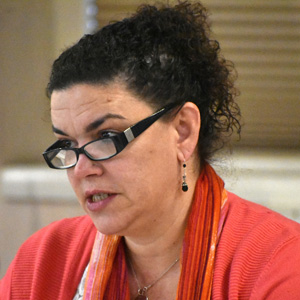 Photo: Rep. Laura Silbila (I-Dover). Photo by Randolph T. Holhut.
Sibilia also works with the BDCC as the director of economic and workforce development.
She is excited about the top economic development projects submitted by different businesses and organizations for inclusion into the regional CEDS. Sibilia said the top projects will be unveiled at the Southern Vermont Economy Summit on May 23.
One of the strengths of a regional CEDS is that it helps connect entities that can then build a common vision and prioritize projects. In turn, these projects build the economy, Sibilia said.
Rural economies across the country are struggling with many of the challenges that plague southern Vermont such as an aging population, a shrinking workforce, and not enough economies of scale, she said. Windham County — and now working with Bennington County — has built the capacity to confront some of these challenges such as organizing complex funding packages to support business expansions (GS Precision in Brattleboro), and building a cadre of otherwise disparate groups (the CEDS process).
“We’re innovating,” she said. “And organizing diverse groups around common goals.”
Moving forward, the region must continue working with the state on programs like Stay-to-Stay designed to recruit people to move to the region, she said. Next, the region needs to “try and understand barriers to People of Color moving here as well as how to be a more welcoming area to immigrants and people from urban areas,” Sibilia said.
“In a rural area like ours, we’re not getting anything done unless we’re working together,” Sibilia added.
Three seasons, working toward four
“Cautiously optimistic.”
People involved in building Wilmington’s business base repeated that phrase when asked how they felt about the local economy.
Sandwiched in the mountains between Bennington and Brattleboro, Wilmington’s economy, along with its sister Dover, has for several decades revolved around the winter ski commerce from resorts such as Mount Snow and Haystack.
In 2011, Tropical Storm Irene’s flood waters swamped Wilmington’s downtown.
The recovery from Irene is complete, according to those interviewed for this piece. Instead, they pointed to the ripple effects of the Hermitage Club’s financial issues as putting the town in “limbo.”
Wilmington’s Economic and Community Development Consultant Gretchen Havreluk said that Hermitage owner Jim Barnes' complex legal and financial situation has left multiple properties in town and the surrounding area, vacant. These empty properties are also tied up in the legal proceedings which means in most cases they're also off the market as new business or residential space, she added.
The Hermitage Club's members-only ski resort attracted high-end clients as well, Havreluk said. The closures have reduced the amount of money coming into the valley overall, she added.
Havreluk compared the revenue from the meals, rooms, alcohol, and one percent option sales taxes, while the Hermitage operated those same revenues after it closed due to bankruptcy. All of those revenues have dropped, she said. For example, in 2016, the area’s revenue from the meals tax jumped from the previous year’s $5.5 million to approximately $8 million. By 2018, however, the revenue dropped to approximately $7.462 million.
Havreluk said on the bright side, her office continues to take calls from entrepreneurs interested in opening businesses. The municipality has a project in the works to expand its water and wastewater infrastructure south towards the junction of Route 100 and Route 9. This project will serve, in part, the health center and a brewery that Jacksonville’s Honora Winery and Vineyard wants to build in a former barn.
“That area is a real Mecca for economic growth,” Havreluk said.
Wilmington and Dover in many cases are bedroom communities for the larger towns to the east and west, Havreluk said. As part of many efforts to expand the economy, the Wilmington and Dover Bi-Town Economic Development Committee has charged a subcommittee with completing a housing assessment this summer. The assessment will look at current inventory, prices, and needs. This assessment would form the foundation of an implementation plan to bring more full-time, affordable housing to the valley.
“I feel that we are a community and that the Deerfield Valley as a whole really comes together and always makes it work,” Havreluk said.
Along with rebuilding its downtown after Irene, Wilmington has also worked to expand its one-season tourist economy into a four-season economy that supports both visitors and residents.
Most residents drive to Bennington or Brattleboro to work and shop, said Meg Staloff of Wilmington Works, Wilmington’s designated downtown organization. They do this because the local job market and stores don’t serve all their needs, she added.
In part, the Wilmington and Dover economies aren’t diverse enough at this point to serve its dual community of residents and visitors.
It would help to attract a few larger anchor employers similar to Brattleboro's GS Precision or Bennington's Southwestern Vermont Health Care & Medical Center, Staloff said.
In the meantime, she feels optimistic about the number of smaller local businesses launching this spring and summer.
The Maple Leaf brewery will open this spring in downtown operated by two brothers who grew up in the area and have returned, she said. A second brewery and tasting room is set to open in historic downtown building. The new owner intends to put residential units on the upper floors. A kitchen store will also open in the downtown, Staloff said.
A bakery called Beurremont Bakery has recently moved into the Old School Community Center and has plans to expand beyond its bread CSA this summer.
The Old School Community Center is a bright spot in the town, Staloff said. The large decommissioned Wilmington High School building “needs a lot of work” but has the potential to support the incubation of multiple small businesses.
Right now, along with Beurremont, the Old School also supports community group fitness classes through 802 Fitness, and provides space to other community groups.
Wilmington has a lot going for it, Staloff said. It has a walkable downtown and a “backbone” of fiber optic internet threading through the downtown. The fiber serves the Old School as well as the rest of downtown. Staloff is working to get more businesses signed onto the service.
“Things are turning a corner,” Staloff said. “The snowball is just cresting the hill.”
But, she added, she also feels “the limbo” created by the Hermitage Club’s closing.
“There’s a lot to be done on all fronts,” she said. It takes effort to balance the seasonal ski economy with a four-season residential economy.
Staloff said the community moves forward piece by piece, small grant by small grant, and new business plan by new business plan.
“You look for the small steps and the small changes,” she said.
Protecting rural communities, expanding transportation
Christopher Campany, executive director of the Windham Regional Commission, defines a healthy economy as an environment where all community members have a sense of income security and businesses do well.
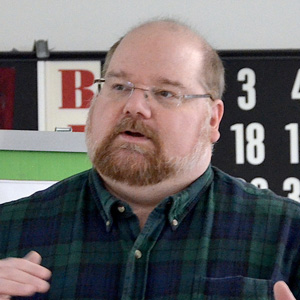 Photo: Chris Campany of Windham Regional Commission. Photo by Randolph T. Holhut.
Many Vermonters, however, “need to piece together jobs” and live paycheck to paycheck.
The WRC is updating its regional plan. In building the current 2014 plan, staff found that that an equal exchange of workers commuted to jobs across the region's tri-state boundaries.
Windham County’s economy and community extends beyond the county’s boundaries, Campany said. In recognition of this, the WRC has developed deep partnerships with its counterparts in Massachusetts and New Hampshire.
One concern Campany has centers on the county’s more rural towns such as Newfane, or Jamaica, or Halifax. Many of these towns lack the public water and sewer infrastructure to expand.
Without this infrastructure, “they really are frozen in time,” he said. Many of these rural centers lack the ability to add new housing or new businesses. As the region grows, as Campany expects it will, these communities will need to expand themselves to take the overflow from the county’s larger towns such as Brattleboro or Bellows Falls.
Campany would like to see towns and the state build a plan to expand water and sewer. Most of the state’s policies around things like clean water, energy, and economic growth hinge on developing compact settlements and walkable communities.
While water infrastructure might pose a challenge to the region, an opportunity is an increase in rail transport. Massachusetts is launching a pilot program to increase rail service from Greenfield, which is about a 20-minute drive south of Brattleboro, this summer that would make train travel to New York City easier.
According to Campany, this will allow people to leave Greenfield early in the morning and return late the same night. Campany speculates that this could lead to commuter rail from Brattleboro to larger metropolitan areas. If this happens, then it could change how people live, work, and commute to and from the Windham region.
One aspect of the region Campany hopes its residents never take for granted is its sense of community and strong community institutions. There are places across the country “trying to recreate what we’ve got,” he said. These “third places” where people congregate, dance, shop, and debate keep cultural organizations vibrant, businesses busy, and isolation — which can lead to health issues like opiate misuse — at bay, he said.
“These third places may not be about the economy, but about the sustainability of our area,” Campany said.
Aligning Vermont values with the digital economy
Campany isn’t the only person with infrastructure on his mind.
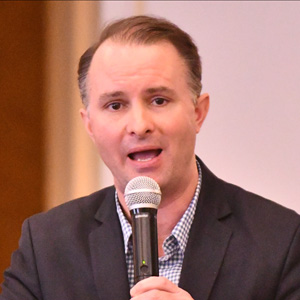 Photo: TJ Donovan speaking in Brattleboro. Photo by Randolph T. Holhut.
In a visit to Brattleboro on April 18, state Attorney General T.J. Donovan spoke about increasing the state’s investment in public infrastructure and aligning Vermont values with the 21st Century digital economy.
“We’re in an interesting spot right now in our history,” Donovan told an audience of Rotarians. “I go around this state and I think there’s a palpable sense that we’ve got a bit of an identity crisis going on right now.”
“We’re not really sure who we are in the 21st Century,” he continued. “Are we the agrarian state of the 19th and 20th Century or are we part of the global digital economy and can we retain our traditions and our values if we’re part of that global digital economy.”
In Donovan’s opinion, the state lacks the public investment needed to move forward. Instead the state is “teetering” and debating affordability.
“And that’s fine, we can have that debate, but we also have to make public investments in our infrastructure: roads, bridges, schools,” he said.
People come to communities because of vibrant downtowns and people who come together, Donovan continued. “We have to create a place in this state where we say ‘business is not a bad thing’.”
Montpelier won’t create a single job, but it can facilitate an environment “that is accessible, transparent, and gives people the answers they need to be successful and then get out of their way,” he said.
“We have to believe in the goodness of our community, we have to believe in the goodness of our people, we have to believe in the potential of our people,” he said.
Donovan said he sees public investments as something that can level the playing field and help Vermonters “get ahead.” Getting ahead includes making sure people have access to clean drinking water, health care, good schools, transportation, and jobs, he said.
“And let’s create an environment and an ecosystem so that people want to flock here and want to stay here,” he said. “It’s not an either-or.”
“We’ve got to acknowledge that this economy that we’re in is changing every single day, it is a global digital economy, broadband matters,” he said. “Let’s also understand that we can retain our traditions and our values and be a participant in that economy.”
Olga Peters is a freelance writer from Windham County.