

The DMU Budd cars owned by AllEarth Rail line up outside Montpelier before making their way into town and eventually up to Barre. VBM photo.
by C.B. Hall, Vermont Business Magazine Montpelier gave the possibility of more passenger rail service in Vermont a small boost on March 26, when House legislators voted to instruct the Agency of Transportation (VTrans) to conduct a technical analysis of a commuter rail system that would serve the Burlington-St Albans and Burlington-Montpelier corridors. The action came during consideration of the pending transportation bill, which would mandate the analysis as well as authorizing VTrans appropriations and providing other guidance to the agency. In a voice vote, the chamber rejected an amendment advanced by Representative Pat Brennan (R-Colchester) that would have deleted the technical analysis provision from the measure.
The language limits the subject of the analysis to one proposition: The use of diesel multiple units, or DMUs, for a commuter rail system. DMUs are self-propelled railroad cars with two diesel engines under each coach. They do not require locomotives and can thus save considerable capital and operating expense.
The mandate to analyze the utility of DMUs grew primarily out of an initiative that debuted in 2017, when alternative-energy entrepreneur David Blittersdorf purchased 12 used DMUs from a Texas transit agency for about $4 million and had them brought to Vermont. Blittersdorf's company, AllEarth Rail, has since made repairs and modifications to the cars, currently being stored at a former Bombardier railcar plant in Barre Town.
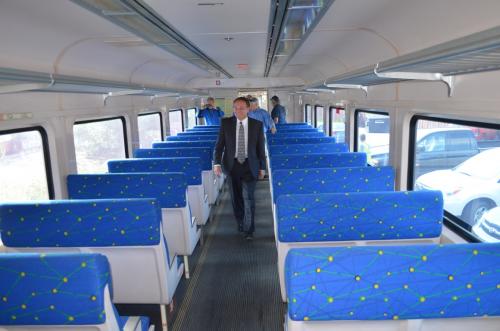 Former Barre Mayor Thom Lauzon makes his way up the aisle of a Budd car in 2017. VBM photo.
The bill's back story also involves a 2017 commuter rail study by a consultancy under contract to VTrans. In its original form, that study erroneously stated that DMUs were not approved for use in US commuter systems. Following objections from passenger rail activists who cited DMU systems operating in Texas and New Jersey, for example, VTrans revised the study.
However, the new version continued to assume that the more expensive locomotive-hauled trains would provide the service, and essentially dismissed DMUs as inappropriate to the purpose. The revision failed to assuage the critics.
It's ultimately a question of money. The 2017 study estimated that the locomotive-hauled trains would cost $162-189 million. In an interview for this article, AllEarth Rail spokesman Nick Charyk said, all told, Blittersdorf has invested “in the neighborhood of $6 million” in his cars,” and that they're ready for service."
The proposal for the new analysis generated a vigorous debate on the House floor, as Representative Curt McCormack (D-Burlington), who chairs the Transportation Committee, pooh-poohed the daunting upfront costs cited by the 2017 study. The assumption that locomotive-hauled trains would be used made the cost estimate of the project "200 million more than it would have been with self-propelled cars,” he told his colleagues.
The Boston-based consultants who did the study envisioned trains furnishing 600 seats, a scale many considered overkill for transit in Vermont.
"Frankly I think they don't know Vermont very well," McCormack said. "They forgot or didn't know about GlobalFoundries." The big Essex employer — which sits beside the tracks — is an ideal stopping point for a commuter stop in the view of passenger rail advocates, but received no mention in the report.
Speaking on behalf of his amendment, Brennan focused on the cost of analyzing the commuter rail idea once more, just two years after submission of the 2017 study.
For the $50,000 estimated cost of the analysis, he said, Vermont could fill in 4,386 potholes a foot square.
“Use the study we have and save some money,” he told the chamber. “It is comprehensive. It discusses the same routes. It's done.”
“It's not about whether commuter rail works in Vermont. Perhaps the results of that study aren't acceptable to some folks, but . . . we do way too many studies in this chamber.”
Michele Boomhower, VTrans's director of policy, planning, and intermodal development, voiced cost objections similar to Brennan's when she testified on the bill before the House Transportation Committee immediately in advance of the floor debate.
“There are probably a few things we're probably going to have to get a consultant for,” she said. The $50,000 cost “will probably have to consist of in-house resources,” she added. “We will have to defer something else, such as deferring a federally required freight plan . . . . So there is a cost.”
Notwithstanding Brennan's satisfaction with it – he was then the House Transportation Committee chairman - the 2017 study went into the archives accompanied by no dearth of criticism. The deluge of big expense estimates doused any legislative enthusiasm for commuter rail.
Senate Transportation Committee chair Dick Mazza (D-Colchester) said at the time that even cutting $150 or $175 million out of the total costs that the study projected "is not going to fly" with legislators. Moreover, that large sum is about what the state might in the most optimistic scenario save in upfront costs by using the privately owned DMUs now parked in Barre.
While he sought to emphasize that he had no animus towards commuter rail in general, Brennan conceded, in an interview for this article, that his skepticism involved more than the cost of the proposed analysis.
“I don't think [commuter rail] would work in Vermont, given our current population. Yeah, I don't see it being viable.”
Referring to McCormack - his successor as Transportation Committee chair - he continued, “I think the committee or maybe the chair is under pressure from the owner of some trains to get a new study going and hopefully get the results that they're looking for this time.”
No one is competing with AllEarth Rail to run commuter trains in Vermont, but the company's idea nevertheless faces multiple obstacles, chief among them being access to the privately owned railroad tracks in question. Their owners have no legal obligation to host a non-Amtrak train.
“I believe you will never see those DMUs on a rail line owned by other folks in Vermont... The positive train control that it would trigger, the scheduling of the routes all around Amtrak and freight service - it would probably collapse under its own weight just from those two things.”
Positive train control, a factor that comes up continually in passenger rail planning, is a pricey, federally mandated safety system that poses a clear challenge for AllEarth Rail and its backers.
But while many skeptics have said that Vermont commuter rail would trigger the PTC requirement, the issue is far too complex to a few factoids offered to a chamber of legislators with plenty of other things on their agenda.
Among other considerations, the federal law in question does allow an exemption from the requirement if the feds approve an alternative risk mitigation plan that does not rely on PTC technology, but ensures a level of safety at least as high as that technology would provide.
The commuter rail proposals must also contend with the deteriorated condition of the eight miles of track between Burlington and Essex Junction. That track would need investment to allow a commuter train to traverse it at reasonable speeds - although that investment would involve much less money than, for example, PTC installation would.
Whatever the obstacles, it was the pro-DMU voices that prevailed in the House debate.
Opposing Brennan's amendment, Representative Kimberly Jessup (D-Middlesex) said, "Perhaps we should take a step towards removing vehicles from our roadways." Representative Sarah Copeland-Hanzas (D-Bradford) chimed in, reminding her colleagues that transportation is the largest source of greenhouse emissions in Vermont and called for possibilities "for more Vermonters to move around without being chained to the pump."
After a half-hour of spirited exchange, Majority Leader Jill Krowinski (D-Burlington), presiding in the absence of Speaker Mitzi Johnson (D-South Hero), put the question to a voice vote, in which those rejecting the Brennan amendment prevailed - if narrowly, to at least some ears.
The bill, with the mandate for the DMU analysis intact, now moves on to the Senate.
“We have an opportunity with these used cars,” McCormack summarized his position to VBM, but he declined to predict whether the Senate would agree with him.
“Definitely not a sure thing,” he said.
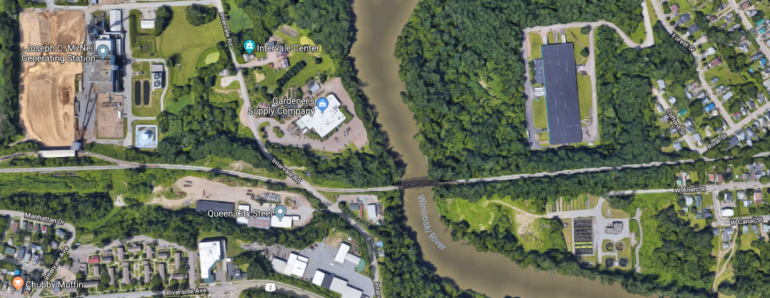
Running past the McNeil generating plant in the Intervale section of Burlington, the railroad tracks cross the Winooski River and eventually make their way into Essex Junction. The poor condition of the tracks would require refurbishing to allow for commuter rail. Google Maps screen grab.