

by Brandon Arcari, Vermont Business Magazine
The University of Vermont Board of Trustees announced February 22 that Dr Suresh Garimella of Purdue University will be the university's next president. Trustees revealed February 4 that Garimella was the sole finalist candidate to replace Tom Sullivan as its next president. Sullivan plans to step down in the Summer of 2019. The Vermont Cynic, UVM’s student-run newspaper, was first to report that trustees had elected Garimella.
Garimella currently serves as Executive Vice President for Research and Partnerships at Purdue University. He is also a PhD in mechanical engineering. Garimella had been the presumptive new president when he met with the media February 14.
In his message to the UVM community confirming the appointment, David Daigle, Chair of the Board of Trustees, said: “It is clear that Dr Garimella possesses the intellect, vision, leadership skills and academic credentials to be a highly successful president at UVM. He is a passionate educator, a highly accomplished researcher, an effective relationship builder and a gifted administrative leader. He has a well demonstrated ability to attract external investment and support, and he has a deep and abiding passion for the land-grant mission. Importantly, Dr Garimella is sharply focused on the quality of the student educational experience as well as student success during and after college.

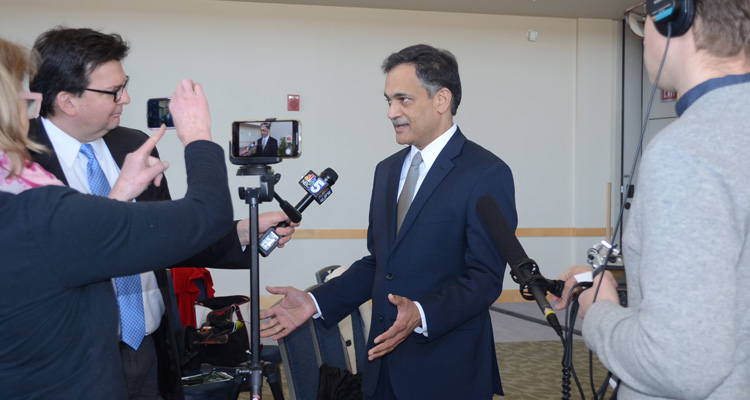
Dr. Suresh Garimella at a recent press conference.
“I also want to pay tribute to President Tom Sullivan, who has led UVM with a passion for students and higher education, with reasoned and thoughtful decision-making, and with unwavering integrity. Our University is unequivocally stronger as a result of his efforts and accomplishments. From the resounding success of our ambitious capital campaign, to the progress achieved on our major academic initiatives, to the positive transformation of our physical campus, we have made tremendous and lasting progress in advancing UVM’s mission under President Sullivan’s leadership.”
Garimella was at UVM February 13-15, for a series of meetings and open-forum interactions with constituency groups across the university.
“Dr Garimella emerged clearly as a compelling candidate whose accomplishments align with our collective vision for the presidential leader who will best serve, and continue to advance, our University in the years to come,” Daigle said.
During his meeting with media, Garimella said that he did not believe that increasing tuition was a sustainable solution for budgetary concerns.
"I don't believe that continually increasing tuition is the answer," he said. "I don't think the sky is falling, you do more with what you've got."
Garimella also repeatedly referenced finding efficiencies for university operations in order to decrease costs without necessarily making cuts, and praised President Tom Sullivan's leadership.
"I'm not coming to fix something that is broken," he said. "There is a lot going for UVM."
Just as Garimella was visiting the campus in February, faculty and students of the Arts & Sciences Department were protesting cuts to programs.
Garimella acknowledged he would need to address that problem and added that cuts in Arts & Sciences was an issue nationwide as enrollment in those programs has fallen in recent years.
In Garimella’s cover letter, published on the University's website, he highlights his “breadth of experience as an active faculty researcher and educator — in senior university administration, in government service, and through service on non-profit and private sector boards,” as a foundation for work at UVM.
“I believe in effective, consistent and timely communication with all internal stakeholders as being vitally important to building trust and morale,” he wrote. “Communications with legislators, alumni, parents, thinktanks, federal agencies and other influencers need different skills and modes, but each constituency is important in its own way.”
A criticism levied at the outgoing President Sullivan by student groups at UVM was a perceived lack of focus on diversity and inclusion, culminating in a list of demands, protests and marches, that had students blocking Main Street and occupying the Waterman building on UVM’s campus.
Garimella addressed diversity and inclusion in his cover letter, writing that “no organization can reach its true potential without nurturing diversity in an inclusive environment.”
He discussed focus on enriching hiring pools and consistently sending the message from the top-down about a commitment to diversity and inclusion on a college campus.
Garimella received his PhD from the University of California at Berkeley, an MS from The Ohio State University, and a bachelor's degree from the Indian Institute of Technology Madras.
Transcript of Press Conference
Suresh Garimella: Well thank you to all of you for coming. My name is Suresh Garimella. I'm the executive vice president for Research and Partnerships at Purdue University. That's my current job. I'm slightly flattered and mildly embarrassed to have TV and all of you here. But it's great to see the excitement in town. And it shows you how important UVM is to the state and to the region. So it adds to my excitement.
Dr. Suresh Garimella at a recent press conference.
You know, what drew me to UVM was that it's a land grant university. It's one of the oldest universities with a great medical school, a long history of a liberal arts programs that everyone is proud of. It's an inclusive place. It's a diverse place or working hard towards it. And so it seems like there's just great faculty and wonderful students. A lovely city, certainly, and setting despite all you've all done to make it colder when I come. But it seems like it's a great place.
And I'm excited about what the next step is for UVM and where we can get from here. Sort of working inclusively towards a strategic plan and vision, ways to enhance our resources from multiple, diversified sources and try to get to the goals that we've laid out for ourselves.
As you know, I work at a different university. I don't know UVM as well yet. I'm here mostly to learn. I've met over 100 faculty members and staff. Each meeting I have is more revealing and I learned a lot of more positive things about UVM. And some of the challenges happen to be, by and large, challenges across higher ed. So, I'm happy to chat with you and answer any questions you might have. So let's get on with that.
Questioners: So fundraising is just about the president's principal job now…
Garimella: If you say so.
Q: I'm going to say so. How do you see yourself as a salesman for the university?
Garimella: Well, you'll have to decide how I do here. But you know we've done quite well in my current role. Certainly on the research side. Again for the last few years we've had record funding in research from very diverse sources, our private giving has been very robust in terms of number of donors and the amount they've contributed.
From my analysis and my understanding of where UVM is, I think you have very happy alumni. My sense is they'd be happy to be engaged with the campus and contribute to campus and I think the important thing is to have a clear vision. I think most folks who want to give back want to support the vision and know we're going somewhere.
President Sullivan has done a great job over the last few years. And I'm certainly going to do my best to continue that trajectory and broaden the number of folks we reach and tell the story of UVM. I need to learn more, but as I do I will be happy to work with friends and alumni and donors and foundations and federal agencies etc. So I think there's a lot to be done but there's great potential for raising those resources.
Q: You mentioned the challenges across higher ed, many colleges across New England are seeing challenges of shrinking demographics. How will you combat those challenges?
Garimella: Yes. So I think that our nationwide challenge in higher ed includes the fact that the number of high school graduates has been dropping, as you probably know. Certainly New England has its own unique set of challenges. I think UVM is very well placed, you already tap into a very rich pool of students from across the region. My sense is that many parents in the region want to send their students to UVM. You've certainly got an important international student population. So I think that the challenges to higher ed are also that you cannot sort of have a business-as-usual approach to the financial challenges.
A model where tuition goes up regularly forever is just not sustainable. Certainly at Purdue we've frozen tuition for seven years in a row. It's cheaper to attend Purdue today than it was in 2012. I don't know that that's exactly the right answer for UVM, but you want to make it as affordable and as accessible as possible. You also want to provide very good reasons why students want to come here. I think you need to be distinctive. There needs to be specific areas of research and teaching and such and programs that attract students.
And I think, again, like the previous question it needs clear communication and messaging. I would be very happy to contribute to that.
Q: Purdue is seen as an innovator in higher education in some ways. What would you try to bring from Purdue to UVM? Is there anything that Purdue has tried which you would not want?
Garimella: It's a great question. You know I would say really at the outset that it's not as if my goal is to transfer a bunch of things we did at Purdue to UVM. The challenges to higher ed are relatively uniform across higher ed. There are some special localized challenges too but the solutions aren't always... You know you cannot sort of cut and paste. They're not cookie cutter solutions. So it's very important for me to state that I don't come with a recipe book that has been tried elsewhere that would just apply here.
That said, I think the approach to these things is to have a very clear North Star. I think it's important for the campus community and the region, the city, the state to articulate a clear vision strategy for where it is trying to go. And once you do that the tactics that you apply can be flexible and you can try different things.
Certainly some of the things we've tried to do, our laser focus on efficiencies and making school affordable and accessible to a diverse community. We did some fairly inorganic things as in not simply more of the same. We started a high school in Indianapolis to add people of color, the underrepresented students because that pool is always challenged. There's Purdue Global now so that we could reach a very different section of the population who probably would never come to West Lafayette and spend four years there.
So I think there are experiences that I have learned from which would certainly enrich the conversation here I'm hoping. But we will need to find solutions here that people with a lot of wisdom will need to come together around the table and contribute. This is staff; this is faculty; this is students.
Q: The last time that UVM searched for a president they named five finalists publicly, this time they've just named one. How do you feel about being the sole finalist for this term?
Garimella: So as you can imagine I did not set the process. I have participated in one other search that was very open, painfully open, but I did not set any rules about how I would participate if there had been multiple finalists that came to campus with an open search. I would not have objected but the process arrived at this way of doing things and I am participating in it.
That said, I would say that there are important reasons why most universities are going this route. You could look across many presidential searches, even this year, that have all gone for either a completely private sort of search, a confidential search, and they announce a president or they do this one finalist approach. So it's not unusual at all. I see why they've done that. But this is not something I asked for.
Q: Can you explain why they're doing this? Why has this trend shifted? What's different now?
Garimella: Yeah. So I will answer the trend rather than why they did it here. So. You want the best candidates possible. And there are candidates who have existing jobs. Say for example that a sitting president somewhere, if they think that UVM, for example or another university, offers them a great vehicle for their next step. And they are one of multiple candidates, then you know it doesn't position them well at their existing campus. And you might say, why should we worry about them? Well, the point is, you want to get the best candidates, the richest pool you can. And I think it's helpful to do your search such that you get the best candidates possible.
Q: Did you know UVM's make making a push to expand its STEM graduates? You're an engineer. Does that make you the right candidate for UVM at this point in time and if you have any new insights after your first meetings on campus?
Garimella: I'm an engineer. You got that right. Thank you. And proud of it. So I can speak for myself. I can also guess that UVM didn't pick me because I'm an engineer. I hope they didn't because I'm not coming here to be an engineering professor. I'm a really good one. But that's not the job. I think it's my administrative experience. It's the strategies we've applied to things at a large university. It's that I have been at public research institutions, and so what I would bring to UVM is those experiences. I have been in my current role very supportive of the humanities and liberal arts. There's a good number of programs we instituted to support them and to bring them more deeply into the rest of the campus fabric.
I'll just give you one example. So, it's a small one but it lets you know. So we received a Mellon grant, I was one of the investigators for it from the Mellon Foundation and the stipulation is that anyone who was to draw funds from that grant, any group, had to be led by a humanities or social science faculty member, a liberal arts person, it had to have a scientist or an engineer in it and it had to have a librarian for the dissemination side of things. Just setting those boundaries, those boundary conditions led to such an interesting set of proposals that came from across campus.
So the humanities and liberal arts and social sciences at Purdue are very much more integrally part of campus. One of the first things I did was to bring about what's called the Purdue Policy Research Institute. It's at the heart of our Discovery Park. Discovery Park is something we're very proud of. It's our interdisciplinary sandbox. About a thousand faculty members interact there, work on big challenges and the Purdue Policy Research Institute, which has communications faculty, political science faculty, English faculty and such, has become the hub, the center of all large efforts.
So there's multiple things we've done along those lines. I would say that I would not recommend you view me as an engineer coming in to somehow advance STEM. Certainly there's a great need for STEM graduates, the medical school has a wonderful record and could grow further. So obviously I would be supportive. But I come here to take UVM, if they will let me, to whatever that next step is that we all collectively arrive at.
Q: How do you balance a budget, when you're dealing with fewer students coming in with tuition and then more demands on what they expect from their college or university?
Garimella: So that's exactly the challenge that higher ed faces. Federal grants in real dollars are pretty much flat. State appropriations are either flat or declining in some cases. I don't think we should look to somehow be able to modify that. Be that as it may I think we need to figure it out. As I said I don't believe that continually increasing tuition is the answer. Student debt as a fraction of household debt has gone from 4 percent to 11 percent in a very short time, in just about a decade.
At Purdue at least one solution is a far more careful plan. And have a fiscal plan that's very focused on efficiencies. Wherever you can find efficiencies you exploit them. And yet we've done it. We have frozen tuition for seven years while still making major investments in strategic research initiatives, having buildings, an Honors College building that went up et cetera. So it is possible to do.
I think one has to take a very careful approach and understand the financial model very well. At Purdue we think of ten thousand dollars as a student tuition unit. The moment you start thinking like that and weigh everything in student tuition units it starts bringing in discipline.
So again you asked what at Purdue would apply here? I'm not suggesting that is the exact thing one could do here but I don't think the sky is falling. I think that you do more with the resources you've got; you increase your efficiency. And like the first question, there are a lot of people who want to support UVM and you raise as much support for things that our friends and donors are passionate about and you increase your federal research presence and grow that. There are many, many levers you can play with. The answer is to recognize them all and adjust them carefully.
Q: The College of Art and Science is seeing decreasing enrollment here. Faculty are upset about some cuts. How do you turn around enrollments there and build that back up?
Garimella: I think what you need is a good understanding of higher ed, of future trends and I think we should all have eyes wide open about the externalities here. And how do you adjust your budgets and your goals to those. I think since I am a candidate at this point I don't really want to put recipes out there, but I would say that anything we do would need to come from the college (of Arts & Sciences) in collaboration with other colleges. You've got a great dean of the College of Arts that I'm sure he can bring together his leadership team and the faculty and have some good conversations.
I think you identify the boundary conditions well and look to the college to suggest how they would like to address the realities that are out there. But every higher ed institution has the same pressures and there are some that have dealt with it well, including at Purdue.
We've done some very nice things where our dean in liberal arts has started a cornerstone program offered to STEM majors. He's written an op ed in The Washington Post about it. He offers out of his college multiple degrees that can be taken in three years, so that obviously is an efficiency there. Greater collaboration between the different colleges – the different silos on campus – is synergistic; it helps both sides.
I would just say that I'm very deeply supportive of an education for students that is rich in the liberal arts, rich in the humanities, it helps everyone if we can find a way to support them.
Enrique Corredera (Executive Director, News & Public Affairs): We've got to transition now to the one-on-ones that many of you requested time for.
Q: I think I have this right, Enrique, that applications are down a little bit and that's because the college rating is higher and it's a little bit more competitive. Do I have that right?
Corredera: One of the claims that is out there is that because we've made efforts to increase the selectivity, you know, that that's having a negative impact on enrollment. But we would not agree with that. The effort to increase our selectivity, it's about increasing quality. The choices that students are making about what fields they're pursuing are sort of independent of those efforts to bring quality up.
Q: It's fair to say though that the university standing has gone up in recent years?
Corredera: Oh, yes.
Q: Was that part of the selling point for you to apply?
Garimella: For sure. I mean UVM is a great school, right? I'm not coming to fix something that's broken. President Sullivan has done a great job over the last few years and it's nice to come to a place like this that has done well and has a great trajectory. So I feel very optimistic. In fact when I met with the search committee every one of them conveyed this optimism. And so it's palpable. I felt the same on campus. I felt that when I met with the students this morning, the staff. So there's a lot going for UVM and I hope that I can in my small part assist that.
Q: This'll be a little bit more than a small part probably as president.
Garimella: Probably.
Q: State appropriations from the state to UVM has been pretty lackluster. They've been pretty flat. Vermont trails the nation in support for higher education. So to Vermont parents out there what can you say? What can you say about the trajectory of in-state tuition going forward given those facts?
Garimella: So you mentioned state appropriations. I would venture to guess, although it's not a concrete statement, that your situation is not that different from most others. Our state appropriations have stayed flat as well. So you know the state has challenges too. I understand where that comes from.
You talk about Vermont parents. I do believe that the high school graduation rate in Vermont is very high and yet not very many of the students are coming to UVM. I can tell you that I will do all I can to engage better with the state, engage more deeply with the state. You know I used to lead the Office of Engagement at Purdue and I really enjoy getting out into the state, getting to meet people. You'll see me do a lot of that. I've worked with three Republican governors and in the state of Indiana I worked with the Obama administration and Secretary Clinton's State Department.
So I feel very comfortable working with government agencies and lead delegations. So to the extent that we can prop up and support their feelings about UVM. Great. But I think it would be unrealistic for us to expect that funding will go up.
As I said, an ever-increasing tuition, whether for in-state or out of state, is not particularly sustainable. You know at some point you may need to make a small adjustment upwards, but that is not the source that you can rely on to balance your books.
I will do all I can to look to other, more diversified sources to raise support so that students from Vermont will have access to this jewel of a university.
Q: Can I ask an engineer a question about sports?
Garimella: You can ask.
Q: What role should varsity sports play for a university the size and with the resources of UVM.
Garimella: So my fundamental thought about athletics and sports is that it is an opportunity for our students to be leaders. At Purdue, despite our being a larger place in terms of athletics, our AD and our entire administration has focused on the student athlete and the student is underlined in the student athlete. I think as long as we view athletics and sports as an opportunity for the students to grow, to seize leadership opportunities, I think it's great.
We want to make sure that there are the right controls in place. There are, you know, some scandals in other places. I'm very encouraged that Vermont's graduation rates and such are extremely good. I would certainly do all I could to continue to support that, but I think athletics has a very important organic and helpful place in a university of your size and any size.
Q: About a year ago here at UVM there were a number of student protests around issues of diversity and representation and one of the student demands in those protests was a greater diversity among tenured faculty. Would you commit to diversifying faculty on campus?
Garimella: Commit to is an interesting story. I would. Interesting way to put it. I would love to. I think we all would like to have a more diverse faculty and more diverse staff and more diverse students, more people of color, underrepresented folks. This is a very challenging area, a very complex area. We've certainly tried specific approaches to enhance our undergraduate people coming into the undergraduate program from underrepresented minorities and we've had some measure of success.
It's hard for a state like Vermont to naturally attract people of color, but from my conversations I think people here are working really hard at it. So of course I commit to it. I would love to see a more diverse and inclusive place. But I think you're doing pretty well in terms of the focus on it and I will do all I can to contribute to that.
Q: How will you work to, how should I put it, woo faculty who might have been felt like they were left out of the hiring process?
Garimella: This hiring?
Q: Yes.
Garimella: So. I think once they meet me they fall in love. So it's easy. Today's meetings were just great. I think that there are process questions and I understand that Chairman Daigle has actually addressed the faculty and has explained the situation. But my sense is that any time faculty, staff, students have questions, the most important thing is to hear them out. You can never please every single person on a campus. And yet what's important is to listen, to explain your decisions in very simple terms and be very transparent.
I had no issues in participating in an open process. I actually look forward to the open forum today. I enjoy being with people and learning about the place.
Q: On a more personal level question. Vermont is a different climate from where Purdue is. Are you ready for that?
Garimella: It’s not so different. It was actually colder in West Lafayette the last time I was here when the polar vortex came through than it was in Burlington. But look, I I've lived in many places in the country. If anything the geography and the place is a great attraction. Burlington is just a beautiful place. When the sole final listing was announced, so many of my colleagues wrote and said they were just jealous. They had either studied here or taught here and everyone said such positive things about this connected community and how beautiful the place is and, heck, they give me this lovely room in the Marriott and it overlooks Lake Champlain. I mean what's to complain?
Q: Have you always wanted to be a college president.
Garimella: Always is a long time. I'm an old man. No I've not always wanted to be anything specific. Things change with time. I was very happy being a faculty member and a researcher and I’ve had a very respected research career.
I really, really enjoy teaching and mentoring graduate students. It's a big part of what I've done. I've also contributed increasingly to the national conversation on science policy, including with my service in the National Science Board.
So, I think these things sort of evolve over time. When I was asked to lead the Office of Engagement at Purdue, I never thought I'd be an administrator, but one thing led to another. But at this point I think that some of the experiences, some of the skills it seems, people think I'm good at it and I enjoy helping others. It is not about me. I'd really like to add value at any institution, if I'm not I shouldn't be in that position, so I would do the same here.
Q: How old are you?
Garimella: You can figure it out. Look at my CV.
Q: Can you tell us a little bit about your own education journey, how you got to where you are?
Garimella: So I got my bachelor's at IIT Madras in India. I went to Ohio State for a Masters. I went to Berkeley for a PhD. And then I taught at the University of Wisconsin for about 10 years. I've been at Purdue for about 20 years, so I've been teaching about 30 years now. The thing about my education is that it's all been through public institutions. I truly, truly believe that higher education is a jewel in the United States and we should do all we can to protect it.
Q: UVM has also tried to increase recruitment of international students. You have an international background. Can you tell us about how you UVM might further that goal?
Garimella: Sure. We have about 10,000 international students at Purdue. So. We've been very selective and focused about what we do internationally now. Beyond simple recruitment we've chosen a couple of countries to go deep with, have a few goals about what we want to accomplish there. If all your international students come from one country then the diversity is lost. And so if UVM chooses to and if it's the right thing for UVM to sort of grow its international presence and student population, then I have done a fair amount of it and I'd be very happy to plot a course for that.
Q: So what do you think is the role of corporate partnerships in higher education that's something you worked on at Purdue.
Garimella: You’ve asked multiple times about how you balance resources and such. So it's a part of the puzzle. Most of these questions have a multifaceted sort of very diversified answer and so you want to do your best to position your faculty and staff and students to go after more and more of the federal funding pie. You want to see what your friends and donors and foundations will give you. Similarly you know corporations increasingly don't have ... what used to be called Bell Labs and things … they don't have very large research labs and efforts of their own anymore.
Therefore I think universities can be in a very good place to engage with companies in areas where the university has strengths. It's not simply a scattershot approach. If you have a cluster of faculty working in an area and they want to sort of engage with a company to do longer-term fundamental research with them and advance an area and have an impact, we've certainly done a lot of it. And I'd be happy to help UVM do that.
Q: To circle back on something and apologies for repeating this but some faculty and students on campus have raised concerns about the role of the humanities and what the administration is doing around the humanities. And there's also been an enrollment drop in that area given that would you cut funding or programs in the humanities or grow it where would you go with that?
Garimella: Today's not the day I can answer that question because I don't know enough about the problem. Across the US this challenge exists, that liberal arts and humanities are facing declining enrollments. You cannot have a continually declining enrollment and the same amount of resources spent there. So something has to give and the answer is not for me to just dictate but for the faculty and the college administration to understand the boundary conditions and arrive at creative solutions that I would be very happy to help with. And a portion of that is to also try to enhance the resources. Perhaps our happy alumni might want to support elements of it. I will say though that Vermont has a long and storied history of being a strong liberal arts school. And I will do all I can to continue to support that.
Q: And once more I apologize for the repetition again. But…
Garimella: Then don't repeat it.
Q: Well, so Vermont has very high in-state tuition. What would you do if you become president to make UVM more accessible to Vermonters?
Garimella: As I said, at Purdue our probably North Star goal is affordability and access. And we've done all we could. We've tweaked everything we could to freeze tuition to make the school more affordable. I see no reason why we shouldn't try something like that in Vermont. I honestly believe that you cannot have a trajectory of tuition that just continues to increase. It's just unsustainable. So I don't know what the right answer for UVM is, but we need to find those answers.
Q: Does Purdue have any variation of the incentive-based budgeting that is in place set in place here at UVM? And what do you think of IBB?
Garimella: So across the US budget models vary all the way from completely centralized to completely decentralized. You can call it different things and I will tell you that from many, many conversations with colleagues who are in both kinds of systems, it's not the budget model that leads to particular outcomes. It's a mechanism to track things. What's really needed is discretion and care and thought and discussion. None of the decisions that are being taken are a direct result of the incentive-based budget model. It's just a way to track the money. So I would say that I don't worry so much about which budget model. The different budget models have different advantages and disadvantages.
Q: We didn't actually get a chance to hear anything personal about you, your interests, family?
Garimella: Just a really fun guy. Come and meet me after I come here. Yes, my kids. My daughter is a sophomore at Purdue and my son's a high school senior. He's just deciding right now which college.
The entire video of this interview can be found at www.vermontbiz.com