

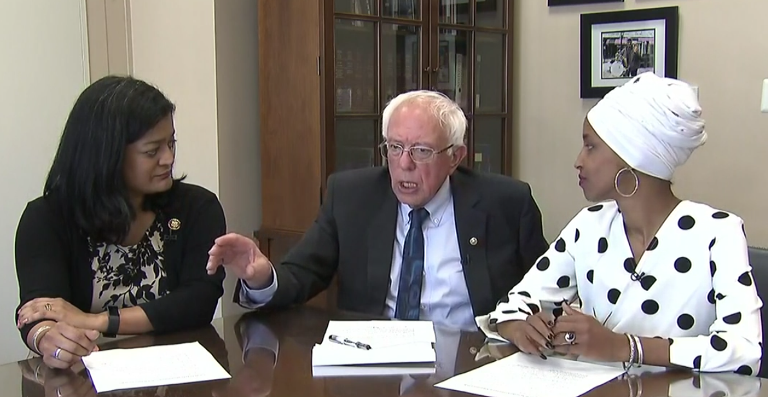
Senator Bernie Sanders (I-Vermont), Representative Pramila Jayapal (D-WA), and Representative Ilhan Omar (D-MN) screen grab during call-in Q&A Monday. Click photo to watch.
Vermont Business Magazine Senator Bernie Sanders (I-Vermont), Representative Pramila Jayapal (D-WA), and Representative Ilhan Omar (D-MN) unveiled landmark legislation today to eliminate tuition and fees at all public four-year colleges and universities, as well as make community colleges, trade schools, and apprenticeship programs tuition- and fee-free for all. The three lawmakers’ proposal also eliminates all $1.6 trillion in student debt for 45 million Americans.
This is truly a revolutionary proposal which accomplishes three major goals,” said Sanders. “First, in a highly competitive global economy, it makes certain that all Americans, regardless of income, can get the college education or job training they need to secure decent paying jobs by making public colleges, universities and trade schools tuition-free and debt-free.”
“Second, in a generation hard hit by the Wall Street crash of 2008,” Sanders said, “it cancels all student debt and ends the absurdity of sentencing an entire generation to a lifetime of debt for the ‘crime’ of getting a college education. Third, it pays for these proposals by implementing a tax on Wall Street speculators. In 2008, the American people bailed out Wall Street. Now, it is Wall Street's turn to help the middle class and working class of this country.”
“There is a crisis in higher education at a time when a postsecondary degree is more important than ever,” said Jayapal. “A college degree should be a right for all, not a privilege for the few. What’s more, our student debt crisis is oppressing borrowers of color, shutting them out from the benefits that American higher education can and should offer. I am so proud to stand with my colleagues and introduce this bold package of legislation to reinvest in our nation’s future. We are committed to restoring freedom to students, workers and families – freedom from the student debt that is holding them back.”
“There are currently 45 million Americans with student debt,” said Omar. “That’s 45 million people who are being held back from purchasing their first home; 45 million people who may feel that they can’t start a family; 45 million people who have dreams of opening a business or going into public service, but are held back.”
“My bill would end this crisis by cancelling all $1.6 trillion in student loan debt,” Omar said. “This would not only allow Americans struggling with debt pursue their dreams, but would unleash billions of dollars in economic growth—stimulating our entire economy. We can fully fund this with a small tax on Wall Street speculation. The American people bailed out Wall Street. It’s time for Wall Street to bail out American people.”
Under the College for All Act, the average student loan borrower would save about $3,000 a year, and the economy would get a boost of approximately $1 trillion over 10 years, which could be used to buy new homes, cars, and open up small businesses. Student debt is also disproportionately impacting African Americans and Latinos. Twelve years after starting college, for example, the median black borrower owed more than he or she had taken out in the first place.
The estimated $2.2 trillion cost of this bill would be paid for entirely by a tax on Wall Street speculation. During the financial crisis, Wall Street received the largest taxpayer bailout in the history of the United States. Now, argue the lawmakers, it’s Wall Street’s turn to help rebuild the disappearing middle class. The members of Congress propose imposing a small Wall Street speculation tax of just 0.5 percent on stock trades (50 cents for every $100 worth of stock), a 0.1 percent fee on bonds, and a 0.005 percent fee on derivatives, which would raise up to $2.4 trillion over the next decade. More than 1,000 economists have endorsed a tax on Wall Street speculation and some 40 countries have already imposed a similar financial transactions tax.
This milestone legislation is endorsed by the American Federation of Teachers, the National Education Association, Freedom to Prosper, Social Security Works, Progress America, Progressive Democrats of America, Student Action, People's Action, Debt Collective, the American Medical Students Association, CREDO Action, and the Council for Opportunity in Education (COE).
FACT SHEETEliminates tuition and fees at public four-year colleges and universities and makes community college tuition- and fee-free for all The College for All Act would provide at least $48 billion per year to states and tribes to eliminate undergraduate tuition and fees at public colleges, universities, and institutions of higher education controlled by tribes. Under this bill, students from any family would be able to attend a public four-year college or university, or four-year tribal college or university, tuition- and fee-free. All students, regardless of income, would also be able to attend community colleges, trade schools, or apprenticeship programs tuition- and fee-free. To qualify for federal funding, states and tribes must meet a number of requirements designed to protect students, ensure quality, and reduce ballooning costs. States and tribes will need to maintain spending on their higher education systems, on academic instruction, and on need-based financial aid. In addition, colleges and universities must reduce their reliance on low-paid adjunct faculty. No funding under this bill may be used to fund administrator salaries, merit-based financial aid, or the construction of non-academic buildings like stadiums and athletic facilities. Cancels $1.6 trillion in student debt for 45 million Americans About 45 million Americans owe nearly $1.6 trillion in student loan debt. As part of the College for All Act, we will cancel student loan debt for all of them. Under this proposal, the average student loan borrower would save about $3,000 a year. The economy would get a boost of approximately $1 trillion over 10 years, which could be used to buy new homes, cars, and open up small businesses. Student loan debt is causing severe economic pain to Millennials. Since its peak in 2004, the homeownership rate among those under the age of 35 has dropped by nearly 19 percent. In 2014, 400,000 more Americans between the ages of 24 and 32 would have owned homes, if not for the increase in student debt over the preceding decade, according to the Federal Reserve. Student debt is also disproportionately impacting African Americans and Latinos. Among graduates of four-year public colleges, 82 percent of black graduates had student debt in 2016, compared to 61 percent of Latinos and 68 percent of whites. However, these differences compound over time. For those who started college in 2003-04, about half of black student loan borrowers had defaulted within 12 years compared to 35 percent of Latino borrowers and 20 percent of white borrowers. Twelve years after starting college, the median black borrower owed more than he or she had taken out in the first place. An increasing number of senior citizens are also being negatively impacted by student debt. The number of people over 60 with student loan debt increased more than five-fold between 2004 and 2017, from 600,000 to 3.2 million. Over that same period, that group’s share of the debt skyrocketed from $6 billion to $85 billion, and many are having student loan payments deducted from their Social Security checks. Ensures students can attend college debt free This bill: • Ensures low-income students getting a Pell Grant can use this aid for books, housing, transportation, and the other costs of colleges. • Requires states and tribes participating in the College for All Act to cover the full cost of college for their poorest students – typically those students from families with incomes less than $25,000 – filling in the cost gap that may remain after the elimination of tuition, fees, and grants. • Caps student loan interest rates at no higher than what the federal government pays for its debt. In other words, this bill would end the absurdity of the government profiting off of student loan programs. • Provides a dollar-for-dollar match for states and tribes that provide extra funding to reduce the cost of college beyond eliminating tuition and fees. States and tribes would also be able to use funding to increase academic opportunities for students, hire new faculty, and provide professional development opportunities for professors. • Triples our current investment in the Work-Study Program, which provides an average award of about $1,760 a year, so that it can reach about 2.1 million students (1.4 million more than today) and focuses funding on schools that enroll high numbers of low-income students. Eliminates or reduces tuition and fees for low-income students at private colleges and universities that serve historically underrepresented minorities This bill provides at least $1.3 billion per year to eliminate or significantly reduce tuition and fees for low-income students at two- and four-year, private nonprofit Historically Black Colleges and Universities (HBCUs) and private nonprofit Minority Serving Institutions (MSIs) that serve a student body that is composed of at least 35 percent low-income students. About 200 schools would be eligible to participate. Provides funding to eliminate equity gaps in higher education attainment This bill doubles funding for the TRIO Programs and increases funding for the GEAR UP Program so more firstgeneration and low-income students can enroll in and graduate college. This means that TRIO Programs would reach 1.5 million students and GEAR UP would reach over 100,000 more students than it currently does. Paid for by a tax on Wall Street speculation The estimated $2.2 trillion cost of this bill would be paid for by a tax on Wall Street speculation. During the financial crisis, Wall Street received the largest taxpayer bailout in the history of the United States. Now, it’s Wall Street’s turn to help rebuild the disappearing middle class. By imposing a small Wall Street speculation tax of just 0.5 percent on stock trades (that’s just 50 cents for every $100 worth of stock), a 0.1 percent fee on bonds, and a 0.005 percent fee on derivatives, we would raise up to $2.4 trillion over the next decade. More than 1,000 economists have endorsed a tax on Wall Street speculation and some 40 countries have already imposed a similar financial transactions tax, including Britain, Germany, France, Switzerland, South Korea, Hong Kong, and Brazil. |
Read the legislative text here.
Read a fact sheet on the Inclusive Prosperity Act to raise revenue for the proposal here.
Source: WASHINGTON, June 24, 2019 — Senator Bernie Sanders