

Experts say focus should be on Northwest corridor
by C.B. Hall, Vermont Business Magazine Williston-based AllEarth Rail, which is hoping to launch the nation's only privately operated commuter rail service, failed this spring in its push for the state to perform a technical analysis of how self-propelled rail cars of the type AllEarth owns could provide such a service. But the company's initiative is not dead.
The Senate-House conference committee that finalized this year's transportation bill dropped the technical analysis, which only the House had supported, and substituted a provision that instructs the Agency of Transportation (VTrans) to estimate some of the costs for a commuter service that, according to at least one expert, has little chance of viability.
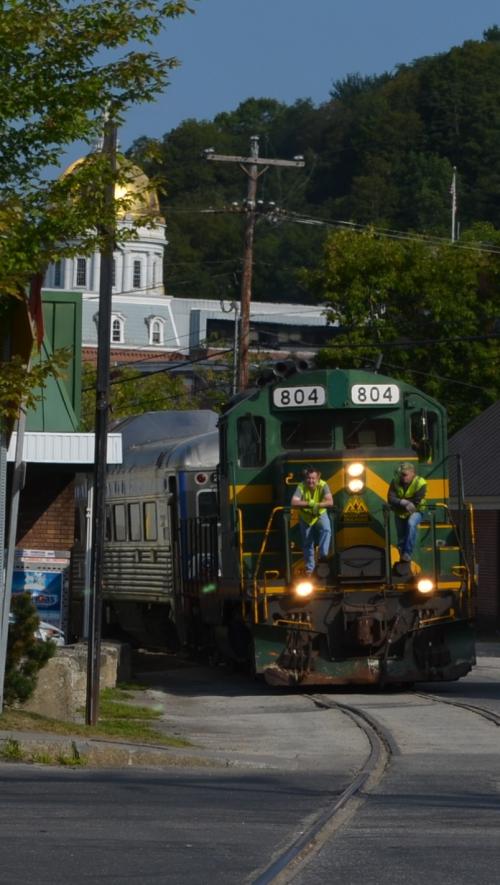 The AllEarth Rail Budd cars pulled into Montpelier in August 2017.
Language in the bill – signed into law by Governor Phil Scott on June 14 – tells VTrans to estimate the cost of upgrading the state-owned railroad tracks between Montpelier and Barre “to commuter rail standards” and to outline a construction schedule in case the Legislature decides to move ahead with the upgrades.
Costs of operating the service fall outside the scope of the study, which is to be completed by December 1.
The line in question, operated as the Washington County Railroad by the Vermont Rail System (VRS), runs 13.1 miles from Graniteville in Barre Town to a junction with the New England Central Railroad (NECR) at the Amtrak station just west of the Montpelier city limits.
There is freight traffic – granite from the Rock of Ages quarry – but the Barre-Montpelier corridor has not seen passenger rail service since the demise of the local trolley in 1927.
Public transit between the two communities currently consists only of a bus running every 30 to 75 minutes six days a week, leading one to ask if commuter rail between two small cities seven miles apart is realistic.
“I personally doubt the population density is there,” said Williston's Carl Fowler, long-time passenger rail advocate and a vice chair of the national Rail Passengers Association.
The smallest US urban area with a public passenger rail system is Little Rock, Arkansas, where a 3.4-mile streetcar system serves that city, population 199,000, and North Little Rock, population 66,000.
Barre, Montpelier and the intervening town of Berlin had a combined population of about 19,000 in 2017 – representing a decrease of more than 3 percent since 2010.
To have a successful passenger rail service, “The biggest thing is having city-pairs the people want to take advantage of,” Anthony Foxx, then the US Secretary of Transportation, opined at a 2016 event in Burlington.
Since travel between Burlington and St Albans, or Burlington and Montpelier, far exceeds what Barre and Montpelier generate, what's going on here?
Fowler wondered specifically why anyone would focus on the Barre-Montpelier tracks rather than the so-called Winooski Branch, which connects Burlington's Union Station with Essex Junction.
Those 7.7 miles of track, which NECR owns, could handle commuter traffic between the Queen City and both Montpelier and St Albans.
The route is the rail counterpart to Interstate 189, which connects the US 7 and I-89 highway corridors in South Burlington.
VTrans's 2015 state rail plan estimated that it would cost about $500,000 per mile to upgrade the Winooski Branch for freight traffic purposes, and about the same sum for the Barre-Montpelier route.
Fowler considered the Winooski Branch crucial.
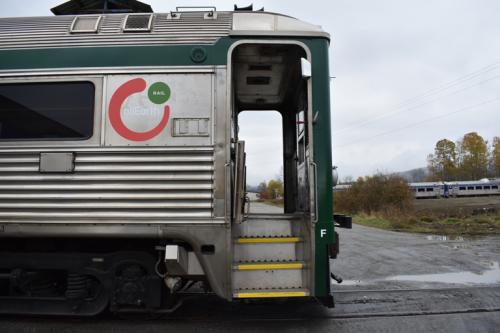 Most of the Budd Cars are parked here, at the former Bombardier plant in Barre. A couple are in St Albans.
“Every idea for commuter rail in Vermont relies on that line. You've got to be able to get to Burlington, and that means fixing that branch line.”
The state rail plan's figures represent analogous improvements to bring the two deteriorated lines up to a state of good repair.
A 2017 state-sponsored of the feasibility of a St Albans-Burlington-Montpelier commuter rail system upped the ante to $2.5 million per mile for track and bridge improvements with that passenger service in mind.
That works out to $19.25 million for the Winooski Branch and about $20 million for the mileage between the Montpelier Amtrak station and downtown Barre.
That study assumed that the commuter trains would run at up to 79 mph – well beyond the needs of a commuter service with frequent stops and thus, in the opinion of critics, one example of the study's absurdly high cost estimates.
In an interview for this article, Dan Delabruere, rail and aviation director at VTrans, noted that the Barre-Montpelier track was currently classed as “excepted.” That's a downgrade from the so-called Class I designation that both it and the Winooski Branch had at the time of the 2015 rail plan.
Per federal regulations, passenger trains must observe a speed limit of 15 mph on Class 1 track, such as the Winooski Branch remains, but cannot run at all on excepted track.
That means that the Essex-Burlington route is now in relatively better condition, and presumably needs less money to bring it up to snuff for commuter service.
So why didn't the Legislature focus on improvements needed for commuter service on a line which by all indications has the better cost-benefit ratio?
“We didn't have any interest,” Senator Dick Mazza (D-Colchester) told VBM. “I don't recall anyone ever coming forward... I don't recall ever hearing from Burlington-to-Essex as something that was requested.”
Asked the same question, Representative Curt McCormack (D-Burlington) told VBM. “I'm not the best person to answer that question.”
Having pushed in the House for the broader technical analysis, he described the cost-estimate mandate for the Barre-Montpelier line as “not my idea.”
“Ultimately we wanted to be running a service in both places,” AllEarth spokesman Nick Charyk recalled the discussions. But he pointed to the level of cooperation from the Barre-Montpelier route's owner and operator – the state and VRS, respectively – as arguing in favor of the Barre-Montpelier initiative.
“We could work out an arrangement with them more easily,” he said. More easily, that is, than with NECR, a subsidiary of Genesee & Wyoming Inc, which owns or leases some 120 railroads on three continents.
In McCormack's words, Genesee & Wyoming “did not appear to be interested” in exploring the use of its tracks by self-propelled passenger cars. He thus gave his support to the Barre-Montpelier alternative.
“I wanted something in this bill that at least shows that interest, however small, to keep the notion of commuter rail service alive.”
On the conference committee, those opposed to the technical analysis expressed reservations about mandating a study that appeared to benefit a specific private company – AllEarth Rail.
“If it was private enterprise, they should put something on the table,” Mazza said. “To fund another study on behalf of the taxpayers – we didn't feel we shouldn't be doing it.”
Legislators thus directed Michele Boomhower, director of policy, planning, and intermodal development at VTrans, to ask Charyk if his company would fund the technical analysis.
She told VBM that a figure in the $50,000 range was the assumption – a sum representing less than 1% of what AllEarth has already invested in its cars.
The answer, coming after Charyk had consulted David Blittersdorf, AllEarth Rail founder and AllEarth Renewables CEO, was no. The Barre-Montpelier alternative emerged as a fallback.
In supporting that alternative, “our goal was not to drive up costs for VTrans but to work with them to provide clarity around the issues that they're best equipped to provide, like track upgrade costs,” Charyk explained in an interview for this article.
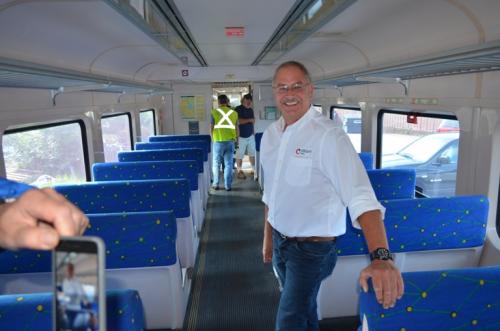 AllEarth Rail founder and AllEarth Renewables CEO David Blittersdorf in a Budd car when they arrived in Montpelier in August 2017. VBM photos.
“It surprised me that they wouldn't spend any money of their own,” Mazza said.
AllEarth's 12 self-propelled cars are being stored at the former Bombardier rail-car assembly plant in Barre Town, and in a St Albans railyard. The cars are so-called diesel multiple units or DMUs, coaches equipped with diesel engines beneath the floorboards for propulsion. That removes the need for locomotives, which cost up to $8 million apiece and consume more fuel. Eight US transit agencies currently use DMUs.
Blittersdorf purchased the cars from Dallas Area Rapid Transit in 2017, for about $4 million, and has since invested another $2 million or so in upgrading them. But prospects for the commuter rail system he envisioned for Vermont are looking dicey in the wake of the Legislature's refusal to order the technical analysis.
And while the cars are ready to go, AllEarth has yet to put on a demonstration run, since federal regulations prohibit operation of passenger cars on the Barre-Montpelier line, and NECR, which owns the mainline track to Burlington, has been uninterested in the project.
“I'm still kind of surprised that someone would go out and spend that kind of money [on the cars] and not have a place to put them,” Mazza said. “Maybe they can relocate them to some other state.”
Fowler noted also that the cars, at least as they stand now, have certain limitations: stiff-backed seats and a lack of toilets. That would foreclose their use anywhere for longer-distance services, he said. He mentioned several short routes around New England as options for relocation.
In Vermont, he said, they could work for a pilot service between Middlebury and Burlington, a route where passenger trains can whisk along at 59 miles an hour, on state-owned track, and several stations already exist or are under development for the extension of Amtrak's Ethan Allen train from Rutland to Burlington.
But the Barre-Montpelier focus left him scratching his head, since it would be “unimaginably expensive” to operate such a short, isolated line.
Asked about reports that agencies elsewhere in the United States and Canada were interested in acquiring the rejuvenated cars, Charyk said, “There is interest elsewhere [but] that's not our plan. We want to get this done in Vermont.”
Defying the skepticism, he remained optimistic that the Barre-Montpelier cost estimate will yield something more than a bunch of numbers.
“It looks like where we're going to is an initial pilot program” on the Washington County route, he said. “We are looking to work with VRS hopefully to begin launching service.”
Senator Andrew Perchlik (D/P-Montpelier), who pressed hard for the Barre-Montpelier option, took a somewhat more cautious view.
“I just thought it would be a good idea to see what the costs are,” he said. “There's just a lot of interest that people showed with what we can do with this corridor. Since we're looking at what we can do with carbon emissions … people wanted to know what we can do with rail.”
“This is a way to move the discussion along,” he continued.
Asked about the possibility that a Barre-Montpelier train, once studied, would prove financially untenable, he said, “That's an outcome possibly, but not a goal.”
C.B. Hall is a freelance writer from southern Vermont