


Photo: Anson Tebbetts, Secretary of the Vermont Agency for Agriculture, Food & Markets at his home feeding his scottish highlander cows. Photo by Vicky Tebbetts, VT Marketing & Communications.
by Joyce Marcel, Vermont Business Magazine If you were going to design the perfect secretary of agriculture for a rural state like Vermont, you might look for someone with deep roots in the state, maybe going back to the 1860s. You might look for a person who has actually milked cows for a living. You would also want someone with good communication skills. You would then look no further than Anson Tebbetts, as two governors have done.
Tebbetts, the former news director for WCAX, has been the secretary of the Vermont Agency for Agriculture, Food and Markets (VAAFM) since Governor Phil Scott appointed him in 2017.
Although he was at WCAX for more than 20 years, he left the news business once before, serving as deputy secretary of agriculture under Governor Jim Douglas from 2007 to 2009.
According to Douglas, Tebbetts is “the quintessential Vermonter.”
“Anson is modest, always respectful of others and hard-working,” Douglas said. “He has a wide range of experiences that have served him well. He grew up on a dairy farm and has managed it, so he has a first-hand understanding of the struggles of those who feed us. His journalism background makes him a great communicator. His time in state government has given him the skills to run an agency, support the staff and ensure that it responds to the needs of the state. Vermont is fortunate to have Anson on the job!”
Tebbetts's current boss credits him with being “creative and a good problem solver.”
“I’ve known Anson for a long time and I’ve always appreciated his passion and commitment to service and his community,” Scott said. “He’s extremely dedicated – which makes him such a valuable member of my Cabinet. Whenever we ever need someone to go the extra mile, I know I can always rely on Anson.”
Tebbetts, 54, grew up on a generational farm in Cabot. He decided to be a broadcaster by milking cows while listening to Red Sox games. Although he no longer farms, he still lives on the family farm today with his wife and two teenage children.
“We're not milking cows now,” he said. “I have had some pets. I have some sheep, and I have a couple of Highlanders. And then we are fortunate to have a farmer in Cabot that does have a cropping. He brings heifers over so it keeps the land productive. We lease it to him.”
Tebbetts first developed his communication skills at radio station WDEV in Waterbury, where the Saturday morning show he co-hosts, “For the Birds,” is still running after more than 25 years, and then at TV station WCAX, where he was a newscaster and then news director.
In 2001, the Vermont Farm Bureau honored him with their Friend of the Farmer award.
Tebbetts said being secretary of agriculture is “a fun job.”
“This job is very much like journalism,” Tebbetts said. “I wake up in the morning and I know I'm going to do a few things, but then something may come up and I do that. One moment I could be dealing with an animal health issue; maybe someone has imported an animal that shouldn't have been imported and it could spread disease. There could be someone with a water quality issue. Or maybe someone is having trouble with a manure pit. So I may have to sign something that gives an exemption under certain parameters. Then I may be testifying at the Legislature on a bill. One day I may be attending a farmers' school event. On Monday I was visiting a hydroponic place and talking about what they're doing and how they're staying in business and what we can do by helping them. I was at a place in Mad River where they're trying to bring more visitors in to see what they're doing there in agriculture with cheese and wine and spirits. I was at a creamery in Berlin with an on-farm operation where they're trying to produce cheese curds. Or it may be the day that they discover that the emerald ash borer is here; somehow I will have a role in that. There's tremendous variety.”
In conversation with reporters, Tebbetts appears restrained and thoughtful. In a suit and tie, he looks like a minor gangster in an old Humphrey Bogart movie. But this is a man who wears his heart on his sleeve for agriculture.
When Tebbetts talked about a farmer who had to sell his cows, for example, he came very close to tears. He had to stop for a moment to pull himself together.
“Probably the biggest thing I struggle with is when I can't help somebody,” he said. “State government comes with the expectation that you should be able to help. And sometimes you can't. Probably the biggest disappointment is that sometimes you'd have to say 'No.' There was a farmer who really wanted to farm, but the finances weren't lining up. Lenders were coming after him. There was nothing I could do to solve that problem. When you sell your cows, it's tough. I know you've got to separate emotion from business, but sometimes it's really tough stuff.”
Tebbetts' enthusiasm for his job is palpable. For example, he works on the third floor of a beautiful old red brick building just across the street from the Statehouse. If the view from his third floor window isn't stunning enough, he eagerly led me to the unused fourth floor. We went past room after room stuffed with storage cartons, an old mannequin and an ancient red brick heating system. We walked up and down little flights of steps that appeared to be in the center of the hallway for no good reason. We finally came to the piece d'resistance, a window with an eye-level view of the golden Statehouse dome glittering in the sunlight, and of the statue on top of one of the Roman goddesses of agriculture, Ceres.
“I am so blessed to have one of the best offices,” Tebbetts said. “It's the most gorgeous view of the State House. We watched when the statue of Ceres was going back up. The fall foliage is amazing. And I go up during snowstorms and get nice pictures.”
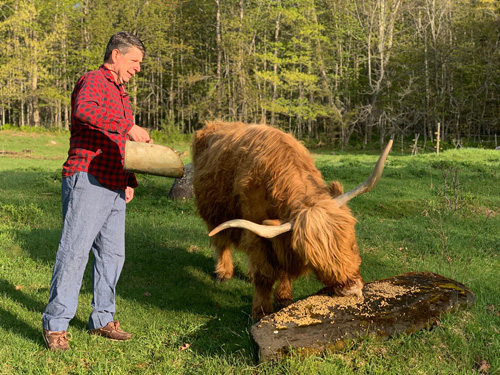 Photo: Anson Tebbetts, Secretary of the Vermont Agency for Agriculture, Food & Markets at his home feeding his scottish highlander cows. Photo by Vicky Tebbetts, VT Marketing & Communications.
On the whole, Tebbetts thinks this is a good time for farming and farmers.
“I think we're in a tremendous place right now,” Tebbetts told me. “Farmers are engaged. They're under heavy regulation now, and if they do get out of line, there's the possibility they can face enforcement. But there's tremendous engagement now in the farm community. I've seen it grow over the last couple of years. They're planning more cover crops to improve the soil health. They're taking care of their buffers. They're managing the manure, which is heavily regulated. They are engaged, in a positive way, trying to make contributions to improve the water of Vermont.”
You wouldn't expect to hear such a positive report. For one thing, over the last 50 years, more than 10,000 dairy farms in New England have disappeared. Fewer than 2,000 are left, about half of them in Vermont. In 2018 alone, Vermont lost another 10 percent of its dairy farms. Yet farming is a crucial part of the state economy.
The agency Tebbetts heads has a FY'20 budget of $26,484,900, which supports 126 people working in one of six departments: administration; food safety and consumer protection; agricultural development; public health and agricultural resource management; the Vermont Agricultural and Environmental Laboratory; and agricultural water quality.
Agriculture has a wide mandate: the agency works with farmers on managing manure; it is working on hemp regulations; it is studying the removal of phosphorus from the land and water; it studies the emerald ash borer and tries to prevent it from killing Vermont ash trees; it inspects meat; it inspects farms.
“We have people making sure that we don't have bugs that spread diseases,” Tebbetts said. “So we've been involved in the tick world, where we go out in the summertime and collect ticks and test them to see if they're carrying Lyme disease or not. And we share that information with the health department. We have also been involved in the emerald ash borer. We're always out looking for pests and trying to make sure that they don't impact human health or the quality of life or the economic health of our forest in this area.”
Farming in Vermont is a sophisticated business. It isn't just about cows anymore. Farmers raise goats, chickens, sheep, bison and llamas. They grow vegetables, either organic or not. They grow plants and capture their seeds for sale. They tap trees and make maple syrup.
Increasingly, Vermont's value-added farm products are both lucrative and prized in the marketplace. The state's butter and cheese have been winning international awards for years. Now the state is producing many popular varieties of craft beer. It produces several popular yogurts. Farmers are taking grain and making gin, rye and vodka. Many companies make artisanal jams and jellies.
And there are always new twists: farmers are already growing hemp and producing CBD oil. And now there are large grow houses ready to provide the market with high-test marijuana just as soon as it becomes legal.
Entrepreneurial farmers are increasingly creative, coming up with breakfast cereals and face creams. Recently Sugar Bob's Finest Kind in Rutland won an international Sofi Award (a food industry honor for excellent and innovative products) from the Specialty Food Association for its smoked maple Sriracha.
Tebbetts' communication skills come in handy for telling the story of Vermont agriculture.
“Farmers have incredible stories to tell, and sometimes they don't have time to tell them,” Tebbetts said. “And the consumer these days really wants to know how a product was made, how it was developed. Was it done sustainably? Was it done ethically? Farmers have to step up and tell what they're doing. And I think I can help them. Part of my mission, over the last couple of years, has been to engage the non-farm community in agriculture.”
For example, you rarely think of farmers and the police working together. But the VAAFM has a brand new program called “Creemee from a Cop,” where cops give out “tickets” for free small creemees from participating vendors.
“You don't think about police and agriculture,” Tebbetts said. “But what better thing to do? Police have challenges. They want good behavior from young people. What can we do to help them? What can they do to help us? Well, we've teamed up with police across the state and we'll be launching this program statewide starting in May. So if you've got good behavior, if you're a good citizen, what better thing to have in a little creemee? Instead of writing them a ticket, we reward good behavior with ice cream.”
Tebbetts has become the public relations face of Vermont farming.
“We'll go anywhere and talk to anyone about agriculture,” he said. “Farmers need to talk with police. Farmers need to talk with environmental groups. Farmers need to talk with anyone who will listen. That's what I've been trying to do — elevate agriculture outside of its normal role. It's important because that's where the consumers are. That's where the conflicts are. If people have conflicts with their farmers, the best way to resolve them is through education and partnerships and relationships, and that's what we've tried to do. We're trying to engage partners that are maybe not in our wheelhouse, instead of farmers just talking with farmers.”
As farmers deal with new realities, they sometimes feel the world is watching.
“I would say it's a learning experience for farmers,” Tebbetts said. “They're under enormous pressure. Their neighbors are watching them. The public's watching. The Agency of Agriculture is watching them. The Legislature is watching them. I think we all should be really proud of them stepping up and saying, 'OK. We're going to do this.' At times it can be really challenging. Every operation is different. It's not like a gas station, where you get four pumps and some pavement and maybe there's a store.”
It's important to let go of the past and be responsive to the present, Tebbetts said. Farming is never a “cookie-cutter” operation.
“We're not engaged in saying one method is better than the other, or whether one size is the right size, or whether you should be conventional or organic, or whether you should be a farm cheesemaker,” Tebbetts said. “We want to give people solid information so they can make choices and decisions about what's best for their operation. The family dynamics are different and even the land, from county to county, is different.”
The public recognizes the important of agriculture, Tebbetts said, and wants farmers to succeed and thrive.
“I know the public is behind agriculture,” Tebbetts said. “It's so much part of our history and economy. Our tourism economy would not be the same if we did not have farmers keeping land open and productive. And that's the key part: productive agriculture. So we need to use the land, and farmers are engaged in making sure that they're doing it in environmentally responsible way.”
Tebbetts' father farmed until he died.
“My dad died suddenly,” he said. “I was working at WCAX at the time. That fall we all made a decision that we couldn't keep it going. My career was kind of going okay, but right up to then I was milking cows pretty much every week.”
Tebbetts, his wife and his two teenage children, a son and a daughter, still live on the farm; his mother passed away this March and his brother is now living in his mother's house.
“So now we're kind of in a transition,” he said.
Early Life
Tebbetts doesn't know where his family came from originally, but they have been working the same farmland in Cabot since about 1860.
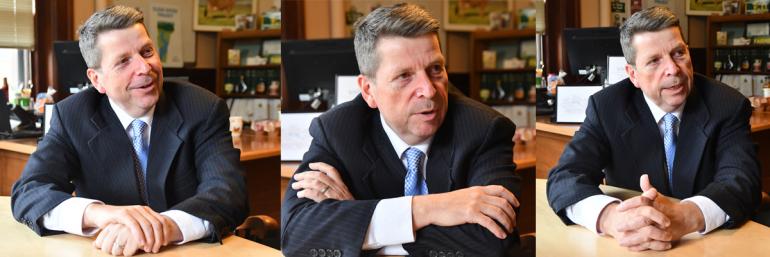 Photo: Anson Tebbetts, Secretary of the Vermont Agency for Agriculture, Food & Markets at his interview for this article. Photos by Randy T. Holbut.
“As far as I know, we've always been in Cabot,” Tebbetts said. “Prior to that, I have not done a really historical background. But my parents, my grandparents and the generation before lived on the farm.”
Tebbetts was one of three boys. When he was born, the newspapers announced that his mother had had a girl.
“I think that was the hint that I was supposed to be in journalism, right?” he joked.
“I wasn't even five days into my career and there was already a mistake.”
While Tebbetts and his siblings were growing up, the farm milked 60 Jersey cows, had about 200 sheep, a team of horses and a sugar bush. Tebbetts grew up milking cows and doing chores.
“It was a great childhood, a great life,” Tebbetts said. “We all worked hard. My mother worked off the farm some, too. She was a teacher. She and my father met at the University of Vermont. My dad was going to the agriculture school there and my mother was in the Classics. She was a trained Latin teacher.”
Tebbetts' mother taught at Cabot High School; she was also a librarian.
In an odd way, it was milking cows as a kid that made Tebbetts a broadcaster.
“To pass the time while milking cows, I listen to the radio,” Tebbetts said. “That's what prompted me to think about Boston and New York. I listened to Red Sox games on the radio and the talk shows — and there were a lot of talk shows at night coming from Boston. One night I was listening to one of them, Larry Glick, on WBZ. He was one of the classic talk show people in Boston, people called him “The Commander.” He went to Emerson, and I think he mentioned it on the air. And I said, 'So I'll go there.' It was the only school I applied to.”
Emerson accepted him.
“I don't know why they let me in,” he said. “I think I was the only dairy farmer that ever went.”
The summer before he graduated high school, he worked as a stringer for radio station WDEV.
“I would go to select board meetings, go to various other events, and cover breaking news,” he said. “They'd give me a tape recorder and send me out. Sometimes I used to file the report from the barn. You got the sound from the select board, with them talking about an issue, and you'd put the phone over the recorder, play that and start talking again.”
One upside of Emerson in the 1980s was that the Red Sox were a terrible team.
“Emerson was very close to Fenway Park,” Tebbetts said. “It was only a five-minute walk. It was not hard to get tickets, and they were pretty cheap. So I saw a lot of Red Sox games. I saw the Sox collapse in 1986 when they were against the Mets. But that's the reason I chose my career. It was because I listened to the radio a lot while milking cows and said, 'I'm going to do that.'”
Last year, Emerson elevated Tebbetts to its Radio Hall of Fame and brought him back for an induction ceremony.
“It was fun,” he said. “I hadn't been back in a long time. And of course, all the friends who were students with me allegedly are adults now, and they have careers. But no one talked about anything political. No one brought their spouse. No one talked about the kids. It was just like everyone was living in 1983 again. For 24 hours, it was 1983. There were no problems in the world. There was no terrorism. There was no 9/11. We were just there again, dancing to Michael Jackson.”
Coming Back Home
Tebbetts had a job waiting at WDEV after he took his degree in communications from Emerson.
“I was one of the lucky people who was able to return to the state where you came from,” Tebbetts said. “A lot of people in broadcasting are not that fortunate with their first job. They don't get to go back to their home state. My first job was writing copy at WDEV. Then I wrote commercials. And then, when someone left from the news department, I took their position. I became a reporter and anchor and worked there for seven years.”
Kenly Dean “Ken” Squier, the longtime owner of WDEV and the man who gave Tebbetts his first broadcasting job, is a Vermont legend. He was the voice of NASCAR on CBS from 1979 to 1997. He was a lap-by-lap commentator for TBS from 1983 to 1999. In 1960, he opened Thunder Road International SpeedBowl in Barre; he sold it only in 2017. He still has an office at WDEV. I asked him about Tebbetts.
“I don't feel the least bit responsible,” Squier said. “Anson was very ambitious in all the right ways. He was a farm guy, and his folks up in Cabot represented as well as anyone could what WDEV was about.”
Tebbetts wasn't going “to upset any apple carts,” Squier said.
“He was going to ask all the right questions,” Squier said. “He's a damn good news guy. He wanted to know what radio was. He had been listening as a youngster and he got it. For us it was magic to have him. He understood that we were a little different from most radio stations. We had grown up out of a weekly newspaper in Waterbury and believed that a weekly newspaper was as vital to Vermont as anything could be. We needed to do radio in the same manner. We went out of our way to make sure we administered the station as if it were a weekly paper. Anson grew up listening to it. He got it. There wasn't any nonsense about it. And he learned. It would never make as much money as some of the other stations, but it would be profitable and still be relevant to what Vermont is.”
Tebbetts was unusual because he represented what makes up Vermont, Squier said.
“That's interest in agriculture, interest in water, interest in what we can create to enhance the value of Vermont,” Squier said. “He was very serious about it. He stuck with us, and sure enough, the only place he could feel more comfortable was in public service. He really understood what public service meant in Vermont. It means accepting its people, not thinking we have to change it. It means not giving much credence to other radio stations. He understood that WDEV stood by itself in the sense of relevancy and real public service and being involved in the communities where we live. He bought it 100 percent. He carried a lot of that forward for us.”
Everyone who worked at WDEV had their “proclivities,” Squier said. For Tebbetts, it was birds.
“He thought it was important, so we sat back to see what he could do,” Squier said. “And 'For the Birds' has been on the air for more than 24 years. It's a real Vermont service. He was right, as he is about so many things.”
Tebbetts' interest in birds came from a 4-H birding club. He joined a group formed by one of his neighbors, who gathered the local kids for 5 a.m. bird walks and weekend Christmas Bird Counts.
“Barbara Carpenter was how I got started,” Anson said. “She's just turned 90. The show began when someone called WDEV and said, 'I just saw this little red bird. What is it?' We opened the phone lines for help. We received dozens of calls. That was back in 1994, and that's how it started. We pitched the show to Ken. We made t-shirts this spring with a bluebird on the front. It says, ‘FOR THE BIRDS. 25 years of giving people the birds.’ It's been tremendous joy for me. Then WCAX had a Monday morning segment called 'Bird of the Week.' We featured a bird each morning.”
Tebbetts displayed “a sly sense of humor” on the show, Squier said.
“He could make us laugh,” he said. “He said WDEV is for the birds, and he seemed to think it's a damned fine idea. Every Saturday he's still doing it, and quite happily. We would love to have him back. Radio should be information, important and relevant information. Anson drank our Kool-Aid and wasn't just a member of the staff. As much as anyone, he represented what we had tried to do. It sort of fit him.”
Squier also praises Tebbetts for creating a golf course on his farm.
“We called it pasture golf,” Squier said. “We would play around whatever the cows left behind and everybody had a good time. We still do the Intergalactic Croquet Tournament. That ran for 35 or 40 years. We had our final one this year, but due to public demand, we'll continue again. Anson helped us get that thing established. We had 12 or 14 teams this year. And he was willing to put his shoulder to the wheel to make it work.”
Television Comes Calling
Tebbetts's first television job was for WCAX in 1994.
“I worked in Rutland for a year,” Tebbetts said. “WCAX used to have a bureau. They had one person, and that person also carried the video camera. They called them 'one-man bands.' So I did that in Rutland for a year.”
Tebbetts still remembers his first mistake on the air.
“My first time on live TV. I was reporting on the leave of the Russian dissident Alexander Solzhenitsyn in Cavendish,” Tebbetts said. “Anchor Marselis Parsons tossed to me. I said a few words and tossed it back to him. What I forgot to do was interview the guest who was sitting inches from me. Marselis said to me 'Anson, why don’t you ask the guy standing next to you questions?’ This was live, remember. I looked stupid and unprepared. I learned from that moment about focus, preparation, knowing your situation and being able to work on the fly. It was a great lesson.”
Tebbetts enjoyed working in Rutland.
“It was great,” he said. “I got a chance to see Windham County and Bennington County. It was a great experience, being down there and seeing the new part of Vermont. I learned how to run a camera, which is not that easy. Then an opening came from WCAX in Montpelier. Being back in Montpelier again, I was able to get close to the farm and milk every day.”
Technology has changed with lightning speed since the days of putting a tape recorder to a telephone headset to transmit a story.
“Equipment's gotten lighter and easier,” Tebbetts said. “But there's nothing better than having a real photographer. CAX was legendary for making sure they had great equipment. They trained the photographers about shot selection and how to be a fly on the wall and all that kind of stuff. So I learned that and that was very valuable. And then when I came to CAX I didn't have to do that. I just focused on the writing and the interviewing and stuff.”
Tebbetts has a long history of mentoring young people. For example, Kristin Carlson is vice president of strategic and regulatory affairs at Green Mountain Power. She met Tebbetts when she got a job at WCAX right out of college.
“One of my favorite stories about Anson was when he covered politics for the station,” Carlson said. “I was still very young, maybe 24. I remember he said, 'Hey! Can we catch up?' I really respected Anson, so when he said, 'What do you think about starting to cover the Statehouse with me?' I was incredibly surprised. I really wanted to do it. I remember the first day, walking over to the Statehouse and feeling nervous. But I was thinking, 'Anson is here. He'll introduce me.' And we get to the Statehouse, he turns to me, says, 'OK. Go mingle and find a story.' And then he walked away. It was one of the best things he could have done. It forced me to forge my own relationships and find my own stories. And that's who Anson is. He's always a supporter and a mentor. He helps people grow to their best potential.”
Carlson worked at WCAX for 14 years and knew Tebbetts very well.
“Anson is a remarkable human being,” she said. “He is a true one-of-a-kind. How much he loves Vermont! How much he loves the people he works with! And how much he wants to do good every day! And he's just as comfortable wearing a suit and talking to the Congress as he is at home wearing hot pink Crocs while he tends to the animals on the farm. He wants to make the state better. He's a real example and a mentor for a lot of people.”
Television journalism suited Tebbetts.
“I liked meeting interesting people and telling stories,” he said. “I got to witness some amazing things. Not all of it was pleasant. Not all of it was fun. But it was fast and it was exciting. And I was blessed to work at two places that were locally owned. At WDEV, the owner lived there and worked there. And with WCAX, there were the Martins. I am just so lucky that I was able to have a chance to be part of something that was a local company doing their thing. I was very blessed to work with two companies like that.”
Public Service
Before politics devolved into a revolving door, it was highly unusual, in Vermont, to move from television news to government. But in 2007, Douglas was looking for a secretary of agriculture and thought of Tebbetts.
“People started saying, 'This guy knows a lot about agriculture. He knows about state government,'” Tebbetts said. “I had been covering state government for probably a dozen years by then. So that gave me experience of how laws are written and how policy is formed. I had exposure and relationships with lawmakers and other secretaries, and someone started putting my name in the hopper. I think the key part of it was that someone put my name on the list and it got published in some paper.”
Eventually, Roger Albee was picked to be secretary of agriculture. Albee, whom Tebbetts considers a mentor, tapped him to be his deputy.
“I picked Anson for two reasons,” Albee told me. “One, he grew up on a small dairy farm in Cabot and helped his father with it. He knew Vermont, and he had great ability to understand the press and public relations. It was very important to have the ability to reach out and have people better understand what agriculture and food systems are all about. He did a wonderful job. He specifically was able to develop ways to get better messages out. He's a very family-oriented person who has a deep interest in the viability of Vermont, not only in agriculture but the state as a whole. He's very committed.”
Tebbetts now has one of the most demanding positions in state government, Albee said.
“The public today has a different understanding of agriculture than they did 15 years ago,” Albee said. “We're going through the worst crisis in the dairy industry in Vermont since the 1960s, when farmers were required to put milk in a bulk tank to store. Whoever is the secretary, they are put in the position of trying to solve things which are beyond the ability of any individual to solve. Milk, for example, is driven by international demand and international events. Vermont's place was always relating to the growing markets in the Northeast, and yet our whole industry today is being driven by international events.”
At the same time, the general public is impatient.
“With water quality, for example, people want immediate cleanup,” Albee said. “A lot of the problems that exist in Lake Champlain — in terms of algae growth — are the result of federal government policies up until 1970. That's when government was paying farmers to put phosphates on their fields. Now much of that pollution is in the bottom of the lake. Anyone who is secretary is in the difficult position trying to resolve ill-conceived policies of the past.”
Back To Broadcasting
When the late WCAX news anchor and news department director Marselis Parsons decided to retire, the Martin family called Tebbetts back to take his place.
 From left, Alex Martin, Anson Tebbetts and Peter Martin at WCAX in September 2014 (Family Men: 60 years of transition at WCAX.) Photo by Timothy McQuiston, Vermont Business Magazine.
“It was a little bit different position than what Marselis had,” Tebbetts said. “Marselis was on camera but also the manager. They wanted to do a little bit different model. They wanted someone to manage the reporters and photographers and the editors and producers and not be sort of tied to the editorial part. So that was a change. I did that from 2009 to two and a half years ago.”
It was a fortuitous move. Tebbetts didn't know it, but Douglas had decided not to seek a fifth term.
“In that position, you can go at any moment,” Tebbetts said. “You serve at the will the governor. So it could have been just a two-year position. And being the news director at WCAX was a tremendous opportunity. I said, 'OK, let's do it.' And so I did. I drove from Cabot to South Burlington for seven years and enjoyed every minute of it.”
Tebbetts has had a front-row seat for vast changes in journalism. He thinks the biggest change may have been the arrival of the digital age, which completely changed how reporters covered the news.
Remember, when Tebbetts started in radio, he would be standing in a barn holding a tape recorder up to a land-line telephone. Now he can put an audio file into his computer and send it anywhere in the world.
The 24-hour news cycle has also helped to change the face of journalism.
“I would say there are more hours and more minutes to fill,” Tebbetts said. “You take TV or radio — radio especially. More minutes to fill means a lot more stories to tell. Sometimes it means repeating more than you want to repeat. But you know, you've got to fill the time. That is a tremendous change.”
Other great changes have come with technology.
“When I started in television, if you wanted to go live somewhere, they had to dispatch a giant satellite truck,” Tebbetts remembered. “At the tail end of my tenure at WCAX. one person could go on air live with a camera and a giant cell pack.”
It's hard to imagine it today, but when Tebbetts started at WCAX, there were only three news shows a day: the 10-minute newscast at noon before “Across The Fence,” the one-hour main newscast at 6 pm, and the 30 minute newscast at 11 pm.
“There were no weekends,” he said. “There were no mornings. But as things grew, and as people's lives changed, there was tremendous growth in the morning news. People who were waking up kind of treated it like radio, believe it or not. The TV morning news is like radio — you got up at 5 am and might be making your breakfast. You got up at 6 am and you might be making your coffee. You may be going from room to room. So you have a different newscast, with people joining at different times. So you get a lot of repetition as new audiences join.”
Technological advancements have their good and their bad sides, Tebbetts pointed out.
“It's a faster pace, so you can never get on the air quickly enough with the information,” he said. “Social media was growing when I first started as news director. We made great strides to engage through Facebook and Twitter and Instagram — they are powerful tools. People are getting a lot of their information now through social media. They aren't always going to the television to get the news.”
Has the quality of the news diminished? I asked him. What about “fake news?”
With his answer, Tebbetts reverted to being a true Vermonter.
“I think it's important to people to make a distinction between the national and the local,” he said. “Vermont has been pretty good. Everyone kind of puts media into one giant bucket. but everyone should treat each organization as its own. One TV station does it a certain way, another TV station does it a certain way, but I wouldn't compare local media versus some of the national stuff you're seeing. I think that Vermont's been pretty good about being respectful. There's not a lot of ambush journalism. There's not a lot of off-the-wall type stuff. People are being respectful of their neighbors because we all kind of know each other. We all kind of live here. Not to say that at times, we don't make mistakes in the media. That's just people. You do your best to correct your mistakes.”
Vermont has lost many of its news gatherers. The state's dailies have been severely diminished, although its many weekly newspapers are strong and well-read, and Vermont Public Radio and VTDigger.com have grown in size and influence.
“I don't know what the answer is,” Tebbetts said. “I mean I don't know how anyone could have stopped what happened to journalism when the Internet came in, because I think the smartphone changed the world. People can get anything they want immediately on the phone and they no longer have to wait for six o'clock or 11 pm or wait for the morning paper to be delivered. But there are opportunities if you stay strong to your content, you're consistent, you're fair and you're accurate. There is a space to be successful.”
The Milk Conundrum
When you think of Vermont you think of Holstein cows. And when you think of cows, you start thinking about milk. Who would have thought something as simple as milk could be so complicated?
You won't be surprised to know that politics — and, especially, trade tariffs — are involved in making life more difficult for dairy farmers.
“Dairy farmers in Vermont are trapped in a regional and national pricing system that they have actually no control over,” laments Tebbetts. “About 15, 16 and sometimes 17 percent of all dairy in the United States is exported. So those markets are very important. If they are not maintained or if we shrink a little bit it can dramatically impact what happens on the ground in Vermont.”
The uncertainty about the tariffs “has created heartburn for dairy farmers,” Tebbetts said.
“Just like anything else in life, predictability is very important,” he said. “Over a long term, these trade things may be beneficial to farmers. We'll wait and see on that. But in the meantime, with all the tariffs, and people retaliating, and so forth, it has created a lot of uncertainty. And that uncertainty has not returned the dollar to the farmer, as it did in the past. It takes sometimes years to establish a market. And if there's a disruption, they lose it. And we've lost it. And it takes a while to get it back. Then you've got to fill a void. So China, Mexico and Canada all have issues with trade, and dairy farmers are right in the middle. And that is because Trump has affected the flow of trade.”
Take the tariff put on glass, he suggested. Glass is needed for packaging.
“So if you're a Vermont producer, and you're buying, the only place you can get that glass is maybe in China,” Tebbetts said. “There's a big tariff on it. That's an extra cost. So there are all those things you don't think about, and sometimes it's not necessarily the product. The container is also part of the issue.”
Tebbetts hopes that the trade wars will settle down in the next few months and some predictability will return to the market.
“So folks can go back to doing what they're doing,” Tebbetts said. “But in the meantime it has had an impact.”
Another thing that influences the market is too much milk; tariffs aren't the only complication.
“Nationally, people are not drinking as much milk as they did in the past,” Tebbetts said. “Part of it is beverages like coconut milk and almond milk. That market share is taken away from dairy farmers. But under the federal pricing system, it's based on supply and demand. There are bright spots in that people are drinking more whole milk than they used too. There are bright spots where people love butter and they love their cheese. But the farmers do not get the best return on their dollar in that federal system. Schools play a huge role in the system, and people are not consuming as much at schools. That's the big market for farmers and it has had an impact.”
Then there's the “grab and go” mentality.
“Take what you do for breakfast,” Tebbetts said. “When I was little, we probably got up in the morning, had a bowl of cereal and put some milk on it. Now you might drive by the convenience store, grab a pre-made sandwich or a breakfast sandwich or a granola bar, and that's your breakfast. So all these things have had an impact on decreased milk sales.”
Northern Tier Dairy
In April, the VAAFM organized a “first-of-its-kind” Northern Tier Dairy Summit at Jay Peak. The goal was to bring famers and stakeholders together to develop action plans “to help the dairy industry, impacted by a fifth year of record low prices, a volatile export market and an oversupply of milk,” according to a press release sent out by the VAAFM after the conference.
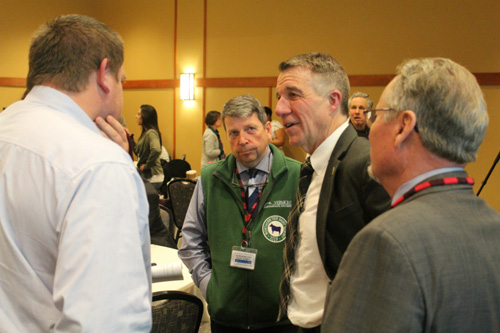 Photo: Secretary Tebbetts and Governor Scott meet with stakeholders at the VAAFM Northern Tier Dairy Summit April 2019. Courtesy photo.
“I think we had about 240 people come,” Tebbetts said. “The most impressive part — and the part that made me so happy — is that we had probably about 150 farmers there from all over New England. And they were there for a day and a half, which is a huge commitment for them, what with everything going on in their farms. It was good for their mental health, and it was good for my mental health. We're trying to take control of some of the things we do have control over.”
The farmers were encouraged to think creatively and work collaboratively “to move dairy into a positive future.”
“We talked about what can we control,” Tebbetts said. “What can we do within our borders? That was the focus of it. We know we're going to continue to work on the federal pricing system. We have something called a growth management plan. We heard a lot from our dairy farmers that they want more help with business planning. They ask, 'How do I transfer my farm to the next generation?'”
Farmers, he learned, want more contact with the general public.
“They want to educate the public more about what they do on their farms,” Tebbetts said. “Could we have more farmers directly work with artisan cheesemakers? Maybe contract directly with them? There was discussions on, 'Hey, does someone want to milk goats instead of dairy?' We talked about growing grains. We talked about diversification. We talked about environmental issues, where farmers are rewarded for their wonderful gold standard work in the environment. So do we set up a payment system in Vermont where, if you are the gold standard in environmental, and you're doing tremendous work on soil health and helping with climate change, you're rewarded for that? So those are some of the things that we talked about.”
Four new initiatives came from the Summit, as well as four additional existing initiatives.
The new initiatives (from the press release):
Create and convene a Secretary's Dairy Advisory Committee to meet quarterly and discuss issues from the farmers' perspectives. The first meeting will be this summer.
Publish a monthly series in Agriview, VAAFM’s newsletter, about current topics in dairy such as market trends, national policy changes that impact Vermont dairy farmers, and updates regarding grant funded work.
Coordinate Legislative farm tours this summer and fall to ensure to all legislators understand what really happens on a farm and hear it directly from the farmers.
Visioning and goal development workshops to meet the needs of farmers who expressed a desire to develop a long term plan for their farm beyond the standard business plan. Workshops will be planned for late 2019 or early 2020.
On-going initiatives:
Growth Management Plan – the Milk Commission will continue to meet, and Agency staff will remain engaged in regional and national level discussions regarding a national growth management plan.
Positive Messaging campaign – VAAFM currently produces a “Fantastic Farmer” series and has engaged additional dollars for a targeted positive dairy focused campaign.
Truth in Labeling – VAAFM is actively engaged at the national level regarding standards of identity for items carrying a dairy product label to ensure they are made from real milk.
Milk in Schools – VAAFM and partners work closely with schools and school nutrition agencies to allow higher fat milk back into schools.
“Furthermore, VAAFM will be applying for the newly released USDA Dairy Business Innovation Initiative funding and the objectives closely match Dairy Summit outcomes and participant visions,” says the agency's report on the summit. “This funding opportunity will span multiple years and allow VAAFM and partners to engage deeply in developing a more competitive value-added dairy marketplace for Vermont producers.”
Clean Water
Cleaning up Vermont's waterways has become a “blooming” issue in the state.
“We have more people working in water quality than any other area,” Tebbetts said. “We have engineers who design manure pits and other structures to make sure they're environmentally correct. We have technical assistance people out there. We have enforcement people to make sure that farmers are complying with the regulations. We have inspectors. So every large farm is inspected at least once a year. Smaller and medium-sized farms are inspected every three years. So every farm knows it's going to be inspected.”
The phosphorous that sits at the bottom of Lake Champlain, as Roger Albee says, is the result of governmental practices gone haywire. Farmers were encouraged to fertilize their fields with phosphorous, which has since run off into the rivers and lakes and caused, among other things, algae blooms.
This has blossomed into a cleanup so costly — estimated to run about a billion dollars — that it has yet to be attempted.
“It's going to take some time,” Tebbetts said. “There's tremendous pressure from all sides to correct it. But I would have to say that the farm community is all engaged in this. They're doing their best to do what they have to do.”
Tebbetts as Ag Secretary has taken a lot of heat over the issue. But the St Albans Messenger in July 2018 described the change in tone in just one year during public meetings about algae pollution in Lake Carmi in Franklin: “Tebbetts spoke at a Carmi meeting, almost a year ago, the audience verbally attacked him, accusing him of cowardice in the face of dairy industry ‘mobsters.’ This time, Tebbetts took the floor to applause.”
Tebbetts, the agency and the farming community have worked hard over the last couple of years to calm the dialogue and institute remediation plans.
One thing Vermont has done is set up a cost-share program for farmers who need to protect the waters by building manure pits — concrete culverts to which manure can be pumped straight from the barn. These pits prevent the manure from running into rivers and streams during rainstorms.
“We've generally gone away from land stacking,” Tebbetts said. “You know, taking the manure out into the field and letting it stay there with nothing over the top of it. It has the potential to run off if there's a big water event, or even minor flooding. Farmers now have regulations about something called 'required agricultural practices.' And so it's a long list of rules, of dos and don'ts, that farmers need to comply with. And those are relatively young. They are only a couple of years old.”
A manure pit is an extensive, not to mention expensive, proposition.
“These structures involve a lot of designing and they can be very expensive,” Tebbetts said. “They can possibly cost hundreds of thousands of dollars. Between the federal government and the state government, there's a cost share. Generally the state and the federal government will pay 90 percent, and the farm share is 10 percent. Still substantial, but manageable.”
Adding Value
Value-added products have always boosted the farm economy, whether they be old-fashioned products like jams and jellies or brand-new ones like the maple-infused Sriracha. Part of the agriculture department's mission is to help expand markets.
“We have been and continue to be leading the nation in quality value-added products,” Tebbetts said. “Just this week at the International Specialty Food Awards, Cabot Creamery won a Sofi Award as the number one new product — a five year old cheese for their centennial. Vermont Creamery had several awards. These are the Oscars of the food world.”
The state is sponsoring entrepreneurial producers at trade shows across the U.S.
“In late June, we will be taking a crew here from the agency and a number of my producers to the big fancy food show at the Jacob Javits Center in New York,” Tebbetts said. “Something like that is eye-opening. You get the real scope of things when you go there. You see what Vermont is up against, trying to get products to market at a bigger scale. We partner with the ski areas. We'll go anywhere. We're going to a trade show in Chicago. We also look to Canada. We've been in Toronto and Vancouver and went to one show out West. We're trying to establish markets.”
Vermont quality is what the VAAFM is pushing.
“One thing we can do in Vermont — our quality is outstanding,” Tebbetts said. “And we are close to the bigger markets. We need to get these people to New York and Boston and Philadelphia and Washington. Our population is small, but we can grow things. We can produce things here. And if we can get them to those bigger markets, that's really important. That's one of our missions.”
Hemp
Right now, hemp is the new big thing in agriculture.
“There's tremendous energy around hemp right now,” Tebbetts said. “The number of farmers we have has probably doubled since last year. Under the rules, people register with us about where they're gonna grow their hemp and how much they're going to grow. A lot of it is going into CBD products. There's a new producer in Brattleboro, for example. “
Unlike other crops, say tomatoes, hemp is under extreme regulation.
“We want to make sure that Vermont hemp has quality, and also that there's safety behind it,” Tebbetts said. “So we're going to set up a program where we can have testing in different grades, much like maple syrup. So we're drafting rules right now.
The goal is that when someone wants hemp or CBD, we want them to think of Vermont hemp. It's like what they think of when they buy cheese. So when they're in Brooklyn and they're buying hemp products, we want them to think Vermont. Much like when they buy our spirits. Or our beer. It's safe and it's high quality. So that's what the program we're trying to set up.”
The program will involve regulation and testing.
“We want to make sure that when you see Vermont hemp, it's the real deal,” Tebbetts said. “So that's where we're heading with it. We're not going to be a giant industrialized hemp producer, because other states are doing this as well. We're competing against New York's hemp, and Kentucky's, Colorado's and Canada's. So we're focused on quality first.”
Future
As someone with deep roots in Vermont, Tebbetts has seen a lot of changes. I asked him what the most important one was, in his opinion.
“I would say the biggest change is we don't slow down enough,” Tebbetts said. “If we need to build relationships, we need to talk with people outside their phones, outside their computers. I think phones have had a big impact.”
Another issue is the demographic of the aging farmer.
“It's an enormous issue,” Tebbetts said. “One of the things that came out of the summit is how do we transition? Some people want to slow down a little bit, or get the farm to the next generation. They may really need some help. There are pockets of people doing that type of work, like the Housing Conservation Board and the Vermont Land Trust. But I think there is more to that dynamic. I think we're on a path where people who have never been in agriculture want to be in agriculture. Somehow, we have to connect those people with people who are working in it now. It might be through mentorships or something like that. I see it in hemp a little bit. I see people coming from other places and coming to work in this field.”
How do farmers retire with enough money to support themselves? This is another question Tebbetts is pondering.
“How do we retire and have enough money to live in retirement, but also how do we hand the farm down to the next generation so they can make a living as well?” he asked. “Those issues, I think, need to be addressed as well. Maybe help would involve creating a group of people who could help farmers with financial arrangements and tax matters. Maybe the agriculture department can play a role in making sure that they get those services.”
Clearly, Vermont agriculture has come a long way from an old Vermont Life cover.
“We need to make sure that we're not a cliché,” Tebbetts said. “We do that by making sure people are able to work the land, be with their animals, be with their families and turn it into a business. too. Some people want this sort of life, and that's great. But you got to pay the bills as well. So you've got to sort it out. You've got to make sure that all those things work together. I would say that probably the biggest challenge now is population, and finding enough people. Everywhere I go, people are struggling to find qualified workers. We want to offer them a support role. It may be technical assistance, it may be through a grant that helps with expenses to get to market, or it could be helping them weave through the different regulations so they don't make a mistake.”
Looking into his own future, Tebbetts said he takes it day by day. He points out that he is still serving only at the pleasure of the governor. But there's no doubt that he'd like to continue serving.
“I like to get to work early and go at it and see and meet as many people as I can,” Tebbetts said. “I'm not a micromanager. I delegate a lot of stuff to people because we have an incredible staff here that's really good. I want to just keep pushing that agriculture has to be part of our economic future. I'm having a grand time, and as long as the governor wants me to be here working for him and the people of Vermont, I'll do it. You know, no one knows what tomorrow will bring. I don't have any grand plan. But like any other Vermonter, I got to pay the bills. I need a job.”
So, no plans to retire?
“I don't think anyone retires in Vermont,” Tebbetts said. “I think we just want to go on to the next journey.”
Joyce Marcel is a journalist in southern Vermont. In 2017 she was named the best business magazine profile writer in the country by the Alliance of Area Business Publications. She is married to Randy Holhut, the photographer who took the photos for this story. He is also the news editor/acting operations manager of The Commons, a weekly newspaper in Brattleboro. The couple have been living in a Windham and Windsor Housing Trust shared equity home for more than 22 years.