

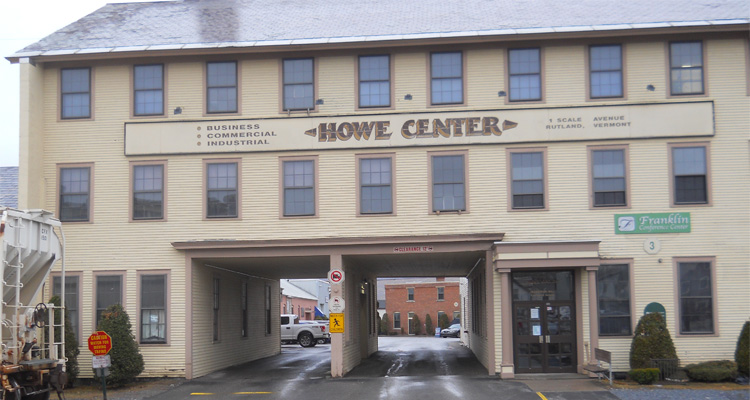
Photo: Howe Center building in Rutland, VT. Photo by C.B. Hall.
by C.B. Hall, Vermont Business Magazine As it nears its 30th anniversary, the Howe Center, in the heart of Rutland, continues to serve as a guidebook to the dos and don'ts of reviving the industrial properties of a bygone era.
The Howe Center boasts an abundance of history as the home of the Howe Scale Company, which opened for business on the site in 1878. Over the ensuing hundred years, the company built scales known worldwide for their ability to weigh everything from a human hair to a box car and even an airliner.
In the 1960s, however, the company entered a slow but irresistible decline, and in 1982 the plant closed. It left behind 21 buildings on 18 acres, complete with a Superfund site.
The city put the property's fair market value at $1.2 million, but that value withered under the onslaughts of time, as the property remained empty, unwanted, and afflicted by everything from vandals to pigeon droppings.
In a 1987 editorial, the Rutland Herald characterized what was left of Howe Scale as “a microcosm of what has happened to a great deal of American smokestack industry.”
That editorial hit the streets in the wake of the announcement by Rutlanders Joe and Barb Giancola that they intended to buy the derelict property.
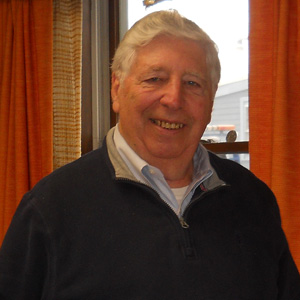 Photo: Joe Giancola. Photo by C.B. Hall.
“Everybody said I was crazy,” Joe Giancola recalled the reaction, in a recent interview.
In Howe to Book, which the Giancola family published in 2008, Joe and Barb's son David described the place, as it stood in 1987, as “a destroyed city” that looked “like Armageddon.”
“Just the square footage of broken glass was overwhelming” was Giancola associate Tom Caggige's reaction, quoted in the same book.
But, in Joe Giancola's view, timing was everything: Rutland was ready for what he envisioned.
So, in 1987, with the property still owned by its last industrial owner, Aerojet General, he and his Giancola Construction Corporation, along with the needed contractors, set to work.
Over the next two years they completed asbestos abatement, removed underground fuel tanks, and disposed of 56 truckloads of contaminated soil.
In time Giancola and his team would also install a centralized propane heating system for the entire property, build a second tunnel to guide traffic under the main building at the street entrance on Strongs Avenue, put utility wires underground, re-point brick facades, and replace thousands of panes of glass.
Giancola's people also dismantled what they conceded to history – such as the rail-car scale – although the salvage sometimes found fresh use.
Suspension rods from that scale today mark parking lot entrances, while other steel from the scale is now part of a bridge on property Giancola owns in West Rutland.
In July 1989, after the two years of remediation and legal preliminaries, the deal went through. The Giancolas paid Aerojet $400,000 for the land and almost 400,000 square feet of decaying structures.
That September, with the property still very much a work in progress, the first tenant moved in. But even with that auspicious start, the way ahead wasn't all downhill.
Asked recently if he made any mistakes with the project, Giancola without hesitation answered affirmatively.
“Act 250. I took it too lightly.”
Rehabbing the property, he explained, entailed a reorganization of vehicular traffic, opening up access from Porter Place, at the south end of the complex. That awakened protests from residents concerned about traffic.
In response, an advisory opinion issued in 1993 by the District 1 Environmental Commission coordinator, Anthony Stout, concluded that a full Act 250 review would be needed.
Giancola appealed that conclusion, asserting that the review would serve no purpose – but he submitted the appeal one day after the deadline.
The review process thus ensued. It brought in multiple interested parties with their objections – the Porter Place residents, another local resident, and the Vermont Railway, whose tracks must be crossed to reach the property's Strongs Avenue entrance.
In 1994 the District 1 Commission issued a permit approving the new traffic configuration. The Porter Place residents and the railway appealed to the State Environmental Board, which ruled in 1995 that the permit would stand.
The two-year process left Giancola with $250,000 in legal and consultants' bills and enough documents to fill two deep file drawers at his office.
Looking back on how he prevailed against his opponents in the Act 250 process, he said, “I don't get mad. I just keep plugging away.”
Speaking with VBM at his office on Rutland's Granger Street, Giancola describes the Howe Center as “a mixed-use facility which is the city of Rutland, condensed – my town, in a smaller version.”
On further thought, he adds, “It's a village in the middle of Rutland. I'm the village manager.”
He rattles off some of the 70 to 75 tenants: state offices, a couple of exercise gyms, auto repair shops, a psychologist's office, consultants' offices, a redemption center, the Salvation Army, two houses of worship, wholesalers, retailers, and Westminster Foods and its subsidiary Lucy's Bakery, which both make biscuits.
“They bring in about a railroad car and a half of flour each week” on the Vermont Railway line that continues to serve the site, he notes with satisfaction.
By his estimate, between 92 and 95 percent of the Howe Center's current 300,000-plus square feet is occupied. And the complex is far from being his only property.
His 56 Howe Street development, formerly the Patch-Wegner Foundry, covers 150,000 square feet in six or eight buildings spread over six acres. The property has 15 tenants, ranging from the state fire marshal's regional office and a homelessness prevention center to a furniture warehouse and a couple of apartments.
“I'm going to put up a new building over there,” he says. “We're going to build five of these incubator spaces [in it]. Twelve hundred or so square feet at five or six hundred a month.”
Giancola also owns the former St Peter School, which, like Patch-Wegner, stands in the southwest Rutland neighborhood that he grew up in.
Indeed, he got his elementary school education at St Peter, which his church owned until it sold it to him some 15 years ago.
“They couldn't afford it,” he explains. Today, the building's 30,000-plus square feet provide a home to a preschool, a large day-care center, offices, and 11 apartments.
Giancola owns three former schools. In addition to St Peter, they include the Dana Center – the former Dana School – on East Center Street, across town from his southwest-side stomping grounds.
The center's approximately 35,000 square feet accommodate two day-cares, a church, nine apartments, and a dance studio.
And then, on Rutland's northwest side, there's the 18,000-square-foot former Kingsley School, which Giancola has retrofitted with 11 apartments.
Aside from all the rental properties and storage lockers, Giancola also owns and operates a car/truck wash, a dog wash, two laundromats, a tool-and-equipment rental store, and, of course, his construction business.
His family also operates the Franklin Conference Center, which seats up to 300, at the Howe Center.
Asked how many properties he and his family own around Rutland County, he says he doesn't know. He puts his total complement of tenants at “five or six hundred.”
The “family of companies,” as he calls them, provide work for 65 to 70 people full-time.
In an era when players from far, far away control more and more of Vermont's economic life, the Giancola family business could not be much more local.
Joe Giancola, now 80 years old, grew up on Rutland's Granger Street and never went further for his education than Castleton State College, which he attended “for a couple of years,” he says.
“Then I ran out of money.”
He went on to work at Pico Peak as a ski instructor, and married one of his students, fellow Rutlander Barbara Allard.
In 1959, shortly before his marriage, Giancola got started in real estate and construction when he bought a house – which he still rents out – across the street from his childhood home.
If one discounts a stint in the army, he says, he has never lived anywhere except Rutland. And he presides over his mini-empire of businesses and commercial and residential rentals from an office – where else? – right down Granger Street from his childhood home.
But the office is far from imperial. Entering, an interviewer notes standard-issue wall paneling and well-worn carpet rather than mahogany and antique rugs. Secretaries plunk away at electric typewriters in the cramped anteroom.
Chatty and sporting a shock of white hair, Giancola leads the interviewer into his office.
He describes himself as “a carpenter who became a businessman – always pounding nails.”
“I've sold insurance, real estate,” he continues, “but I always wound up back building something.”
Asked what the secret of his success has been, he says, “I just look at a building and I can see the whole thing in my head – and I know how to do it. I have a sixth sense of what I can and can't do.”
When the discussion moves on to the prospects for past-their-prime towns and cities around Vermont, he turns more pessimistic.
“We in Vermont, we've got two economies. We've got Chittenden County, which is booming … and the rest of Vermont, where they struggle from day to day to survive.”
Asked what declining communities should do, he says, “I don't know. The market's changing. The retail's no longer downtown – you order it online. There's less people – people leaving Vermont – except for Chittenden County – leaving the state because that's where the jobs are.”
“I don't know,” he repeats himself. “It's a tough thing, to survive. You just have to grind away at it.”
Like many a businessperson, he views government's role skeptically.
“The people making the rules don't realize what they're doing. They're not bad – they're well-intended, [but] it's very difficult to see things from the other perspective.”
He closes with a metaphor. “They're plugging up the dike, but also the natural source of the water.”
But, as he enters his seventh decade in his business, “grinding away” as ever, “they” appear not to have plugged up Joe Giancola.
C.B. Hall is a freelance writer from southern Vermont.