

Vermont legislature must fight to maintain the recent $1 million increase in tobacco control program funding protect public health
Vermont Business Magazine Tobacco use remains the nation’s leading cause of preventable death and disease, taking an estimated 480,000 lives every year. This year’s “State of Tobacco Control” report from the American Lung Association finds Vermont had mixed progress on its efforts to reduce and prevent tobacco use. While the state is leading the way on Smokefree Air with an A grade, the American Lung Association calls on Governor Phil Scott to increase funding for tobacco prevention and control funding and raise the age of sale of tobacco products in order to reduce youth tobacco use and save lives.
By comparison, Vermont overall graded better than New Hampshire, but worse than Maine. Meanwhile, Texas and, not surprisingly, Virginia were among those that got straight F's. California and Alaska did well. No state got straight A's.
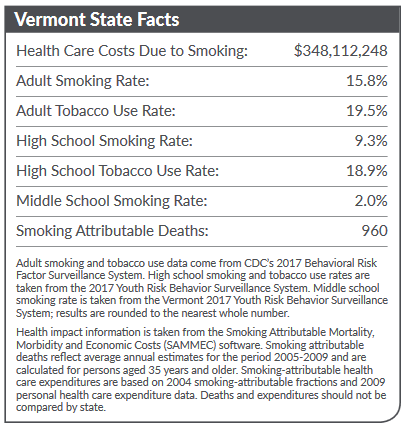
“Vermont recently increased its tobacco control budget for the first time in 10 years, which is a major - but temporary - win. Our high school tobacco use rate remains at 18.9 percent and the rate of people smoking during pregnancy in Vermont is twice the national average,” said Elizabeth Hamlin-Berninger, Director of Advocacy for the American Lung Association in Vermont. “This is unacceptable – and by investing in the proven measures to prevent and reduce tobacco use outlined in ‘State of Tobacco Control’ we can turn the tide on those numbers and save the lives of Vermont residents.”
The 17thannual “State of Tobacco Control” report grades states and the federal government on policies proven to prevent and reduce tobacco use, and finds that Vermont’s elected officials must do more to save lives and ensure all residents benefit from reductions in tobacco use and exposure to secondhand smoke:
- Funding for State Tobacco Prevention Programs – Grade D
- Strength of Smokefree Workplace Laws - Grade A
- Level of State Tobacco Taxes - Grade B
- Coverage and Access to Services to Quit Tobacco - Grade B
- Minimum Age of Sale for Tobacco Products to 21 – Grade F
The American Lung Association encourages Vermont to fully fund tobacco control efforts at levels recommended by the CDC. By doing so they would have a powerful opportunity to help further reduce and prevent tobacco use, including supporting communities that still use tobacco at higher rates and who have been targeted by the tobacco industry. An investment in prevention is especially important given the skyrocketing number of youth who are using e-cigarettes, and the over $348 million in healthcare costs incurred by the state annually, due to smoking. Despite Vermont receiving over $99 million from tobacco settlement payments and tobacco taxes, the state only funds tobacco control efforts at 50 percent of the level recommended by the Centers for Disease Control and Prevention (CDC).
 In addition to funding control and prevention program, the American Lung Association urges Vermont legislators to pass a statewide “Tobacco 21” law - to raise the age of sale from 18 to 21. The need for Vermont to take action to protect youth from tobacco is more urgent than ever, with youth e-cigarette use reaching epidemic levels due to a 78 percent increase in high school e-cigarette use from 2017 to 2018, according to results from the Centers for Disease Control and Prevention (CDC)’s 2018 National Youth Tobacco Survey. This equals one million additional kids beginning to use e-cigarettes, placing their developing bodies and lungs at risk from the chemicals in e-cigarettes as well as a lifetime of addiction to a deadly product. This has caused the U.S. Surgeon General to declare e-cigarette use among young people an epidemic in an Advisory issued in December 2018.
“Virtually all adult smokers had their first cigarette before age 21, and most before the age of 18, but we can change this in Vermont by increasing the age of sale for tobacco products to at least 21 years old. This move would significantly reduce youth tobacco use, slow the e-cigarette epidemic and save thousands of lives,” said Hamlin-Berninger. “In the 2019 ‘State of Tobacco Control’ report, we call for Governor Scott to take action and protect the children of Vermont by raising the minimum sales age for tobacco, including e-cigarettes, to 21.”
Dr. Keith Robinson, a pediatric pulmonologist and an assistant professor at the University of Vermont Medical Center echoed the call to better protect youth from tobacco saying, “According to a 2015 report from the National Academy of Medicine, raising the tobacco age to 21 nationwide would prevent 223,000 deaths among people born between 2000 and 2019, including 50,000 fewer dying from lung cancer, the nation’s leading cancer killer. Failing to enact proven policies like this will continue to place the lung health and lives of Americans and our children at risk.”
Hamlin-Berninger concluded, “State of Tobacco Control” 2019 provides a blueprint that states and the federal government can follow to put in place proven policies that will have the greatest impact on reducing tobacco use and exposure to secondhand smoke in the U.S. The real question is: Will lawmakers in Vermont end their failure to act and take this opportunity to achieve lasting reductions in tobacco-related death and disease?”
Vermont State Highlights

About the American Lung Association
The American Lung Association is the leading organization working to save lives by improving lung health and preventing lung disease, through research, education and advocacy. The work of the American Lung Association is focused on four strategic imperatives: to defeat lung cancer; to improve the air we breathe; to reduce the burden of lung disease on individuals and their families; and to eliminate tobacco use and tobacco-related diseases. For more information about the American Lung Association, a holder of the Better Business Bureau Wise Giving Guide Seal, or to support the work it does, call 1-800-LUNGUSA (1-800-586-4872) or visit: Lung.org.
Source: Williston, VT [January 30, 2019] – American Lung Association