

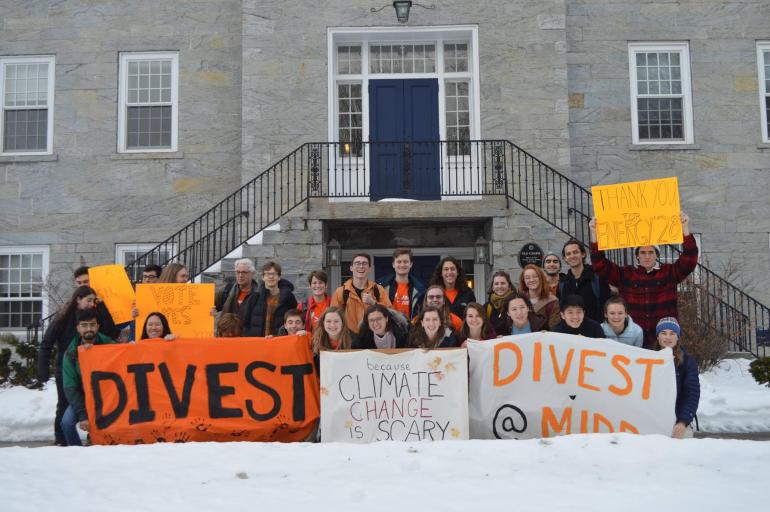
by Brandon Arcari, Vermont Business Magazine Students at Middlebury College are celebrating a win after a seven-year student-led campaign calling on the school to divest from fossil fuels succeeded January 29. Middlebury’s Board of Trustees unanimously voted that Tuesday to fully divest the approximately $55 million of its $1.056 billion dollar endowment invested in the fossil fuel industry, over the next 15 years, as part of its Energy2028 plan.
"This is a huge step forward for Middlebury—today, Midd proved itself to be an institution that recognizes the necessity of divesting from an industry actively feeding climate change and instead working to build a better, more just future,” said Cora Kircher, a student organizer with Divest Middlebury in a press release.
The campaign, run by a student group called the Sunday Night Environmental Group, or SNEG, was founded by students and guided by author Bill McKibben, a professor at Middlebury and one of the founders of 350.org, an environmentalist grassroots movement.
“Middlebury has much to be proud of today. After years of student activism, college leaders have produced a plan that takes into account all the ways it can protect the climate: building renewable sources of energy, a full-fledged commitment to reducing consumption, and above all the leveraging of its big endowment in the fight for a working future. It's precisely what climate leadership looks like,” said McKibben in a press release.
As part of the Energy2028 plan, Middlebury will also shift to 100 percent renewable energy sources, an increase of 50 percent over the next 10 years. It also plans to reduce energy consumption on its central campus by 25%, and says it plans to increase environmental education programs.
The plan also includes a proposed “internal carbon tax” to be examined by the Environmental Council, a committee of students, faculty, and staff which will develop recommendations for an internal carbon charge within the college, which would fund specific projects.
“After much study and discussion, and with the input, encouragement, and even passionate advocacy of many students, faculty, staff, and alumni, the board today has taken a bold step to shape this institution’s future,” said Middlebury President Laurie L Patton in a news release.
“This plan is true to Middlebury’s culture and values. It is bold and aspirational while remaining realistic and highly practical. It acknowledges that we do not have all the solutions at our disposal at this moment to meet these goals, but it commits us to make every effort to do so. I could not be prouder or more inspired by our institution than I am today.”
To help with their shift to renewable energy sources, Middlebury will utilize the renewable natural gas (RNG) digester plant they announced with the Goodrich Family Farm in Salisbury, Vanguard Renewables of Wellesley MA, and Vermont Gas in 2017.
Environmental education programs will be constructed in a manner similar to a program where students intern with the Sustainability Solutions Lab during Middlebury’s January term, according to Sarah Ray, Director of Media Relations, in an email exchange with Vermont Business Magazine.
“The project is aimed at learning what has the greatest and most durable effects for increasing knowledge, attitudes, and behaviors around conservation,” she said. “This initiative will be a collaborative effort between the SSL, Professor Michelle McCauley’s Psychology Lab and classes, and Facilities Services.”