

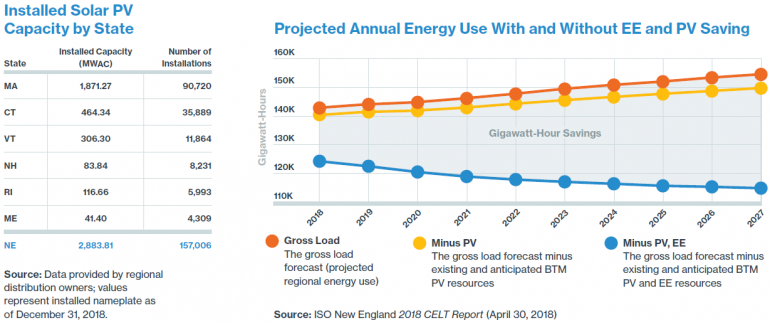
Impact of energy-efficiency measures and behind-the-meter solar photovoltaic. ISONE graphic.
Vermont Business Magazine ISO New England, operator of New England’s power system, expects the region to have the necessary resources this winter to meet consumer demand under both normal and extreme temperatures. Consumer demand is expected to peak at 20,476 megawatts (MW) under normal weather conditions or 21,173 MW at extreme temperatures.
Power resource capacity and fuel delivery constraints
The power plants and demand-side resources with obligations to be available are sufficient to meet the forecasted peak demand under both normal and extreme weather conditions. While New England has adequate capacity resources to meet projected demand, a continuing concern involves the availability of fuel for those power plants to generate electricity when needed during extended periods of extremely cold weather. During these times, natural gas pipeline constraints can limit the availability of fuel for natural-gas-fired power plants. Inclement weather combined with extreme cold can also impact oil and liquefied natural gas (LNG) availability and deliveries to the region.
This year marks the first winter season since the retirement of the Pilgrim Nuclear Power Station on May 31, 2019. The Pilgrim retirement coincided with several new resources coming online, including three dual-fuel plants capable of using either natural gas or oil to produce power, as well as solar and wind resources.
Preparing for and managing through the winter peak
During the fall, ISO New England develops season-long forecasts of consumer demand for the upcoming winter peak season, which runs from December through March. The ISO also coordinates with the region’s power generators and natural gas pipeline companies ahead of the winter months to assess the region’s energy supply.
Throughout the winter, the ISO surveys generators on their fuel supplies, confirms scheduled natural gas deliveries to the region daily, and forecasts the expected energy availability over a 21-day look-ahead period. Beginning last winter, the ISO has enacted a market mechanism to help resource owners manage their fuel so that limited supplies are used when they are more valuable for system reliability. The ISO is also working with stakeholders to develop long-term, market-based mechanisms to address future energy security needs.
Operational procedures to maintain reliability
Power system operations could become challenging if demand is higher than projected, if the region loses a large generator, electricity imports are affected, or during periods of fuel delivery constraints. In those instances, the ISO has procedures in place to maintain reliability, including importing emergency power from neighboring regions, and asking businesses and residents to voluntarily conserve electricity.
Demand
Peak grid demand has remained relatively flat in New England in recent years as a result of increased use of energy-efficiency measures and behind-the-meter solar photovoltaic (PV) systems. Both the normal and extreme peak demand forecasts take into account the 2,594 MW in energy savings from energy-efficiency measures acquired through the region’s Forward Capacity Market. While PV helps reduce energy consumption during sunny winter days, electricity demand peaks in winter after the sun has set. By reducing demand on sunny days, PV can help preserve other fuels for use when demand is peaking. PV generation can also be impacted by snow cover in the region.
2019/2020 winter outlook by the numbers
- Peak demand forecast:
- At normal winter temperatures of about 7 degrees Fahrenheit (°F): 20,476 megawatts (MW)
- If extreme winter weather of 2°F occurs: 21,173 MW
- Resources with a Forward Capacity Market (FCM) capacity supply obligation to be available: 32,747 MW
- Total resources, including both FCM obligations and capability without FCM obligations: 34,775 MW (a generator’s maximum possible output may be greater than its FCM obligation)
- Natural-gas-fired generating capacity at risk of not being able to get fuel when needed: more than 4,500 MW
- Winter 2018/2019 peak demand: 20,773 MW on January 21, 2019, during the hour from 5 to 6 p.m.
- All-time winter peak in New England: 22,818 MW on January 15, 2004
- All-time peak demand: 28,130 MW, on August 2, 2006
|
|
||||
|
Created in 1997, ISO New England is the independent, not-for-profit corporation responsible for the reliable operation of New England's electric power generation and transmission system, overseeing and ensuring the fair administration of the region's wholesale electricity markets, and managing comprehensive regional electric power planning. |
Source: Holyoke, MA—December 4, 2019—ISO New England