

Vermont Business Magazine Acting Commissioner of Taxes Craig Bolio has released the statutorily required education tax rate letter which forecasts the education tax yields for resident homeowners and the nonhomestead tax rate (formerly called “nonresidential”) for the upcoming fiscal year (FY) 2021.
Using statutorily prescribed calculations, the Agency of Education, Department of Taxes, Department of Finance and Management, and Joint Fiscal Office collaborate to establish the yields and rate.
The forecasted FY21 homestead property yield is $10,883 compared to $10,648 for FY20 (the current property tax year). The forecasted FY21 income yield is $13,396 compared to $13,081 for FY20 and impacts credit claims submitted in the spring of 2021.
The increase in the forecasted homestead property yield would result in an average homestead tax rate increase of 5.5 cents. The statewide base nonhomestead tax rate is forecast to be $1.654 in FY21, a six-cent increase from FY20.
Statewide education spending is forecast to grow by $71.5 million while the equalized pupil count is projected to decline by 427, creating a 5.53% increase in average equalized per pupil spending. This rate of growth is nearly double the expected growth in tax year 2020 property values (3%) or income (2.5%), and is the primary cause of the projected rate increase.
Because of the forecasted increases to education spending, coupled with property value appreciation and income growth, the average bill across the state would increase by more than 6%.
Moreover, as in all years, changes in each district’s per pupil spending will result in very different property tax impacts across the state, as locally voted spending amounts are still the primary determinant of a town’s homestead education tax rate.
The forecast this year leads to challenges for affordability.
However, if districts can restrain budget growth to less than 1.4% cumulatively (1.9% per pupil), average rates could stay the same as last year. Additional resources for understanding education tax rates are available on the department’s website at http://tax.vermont.gov/property-owners/understanding-property-taxes/education-tax-rates and from the Vermont school boards association at http://www.vtvsba.org.
In an accompanying letter sent to legislative leaders (See Below), Secretary of Administration Susanne Young said, "The fact that projected education cost increases continue to exceed the rate of growth in education fund revenues - and the rate of growth in household income - remains a cause for significant concern, particularly as the number of students in Vermont's schools continue to decline."
She cited the cost of health care's impact on school costs: "Of the expected $72 million increase in the education payment, about $28 million would cover local school districts' portions of premium increases."
She added, "t's difficult to argue the escalating tax rates do much more than maintain a status quo of rising costs and growing inequity. We need to work together to ensure the investment Vermonters are making is yielding more equitable opportunities and better outcomes for our kids."
See Letter and Cost Breakdown Below.
|
December 2, 2019 Dear Speaker Johnson and President Pro Tempore Ashe: Attached you will find the annual letter from the Commissioner of the Vermont Department of Taxes. As you know, the Commissioner, after consultation with the Agency of Education, the Secretary of Administration and the Joint Fiscal Office, is required by 32 V.S.A. $ 5402b to annually calculate and forecast a property dollar equivalent yield, an income dollar equivalent yield, and a non-homestead tax rate. One of the key performance indicators we use to measure how effectively State government is helping to make Vermont more affordable for families is the percent of household income (HHI) spent on state taxes - and fees. It is our view that if the percent of a household's income captured by government is increasing, government is having a regressive economic impact on households. The fact that projected education cost increases continue to exceed the rate of growth in education fund revenues - and the rate of growth in household income - remains a cause for significant concern, particularly as the number of students in Vermont's schools continue to decline. This is why the Governor devoted much time and attention to this challenge in his first legislative biennium. As you no doubt recall, there was a great deal of conversation around the structural sources of the ongoing tax pressures, including health care costs. One of the bigger pressures on education spending for FY21 is the cost of health care for district employees. Of the expected $72 million increase in the education payment, about $28 million would cover local school districts' portions of premium increases. That figure won't be finally determined until the conclusion of the negotiations of a statewide teachers' health benefit. To be clear, the Governor supports increasing education spending where we can demonstrate that it yields added value, and equity, for students. Given the state of Vermont's declining student population and performance scores, it's difficult to argue the escalating tax rates do much more than maintain a status quo of rising costs and growing inequity. We need to work together to ensure the investment Vermonters are making is yielding more equitable opportunities and better outcomes for our kids. The Governor continues to believe that structural reform is essential to making our education system better for kids, and more affordable for taxpayers. We are very open to working with you to address these challenges and making Vermont's education system the very best in the country. Respectfully, |
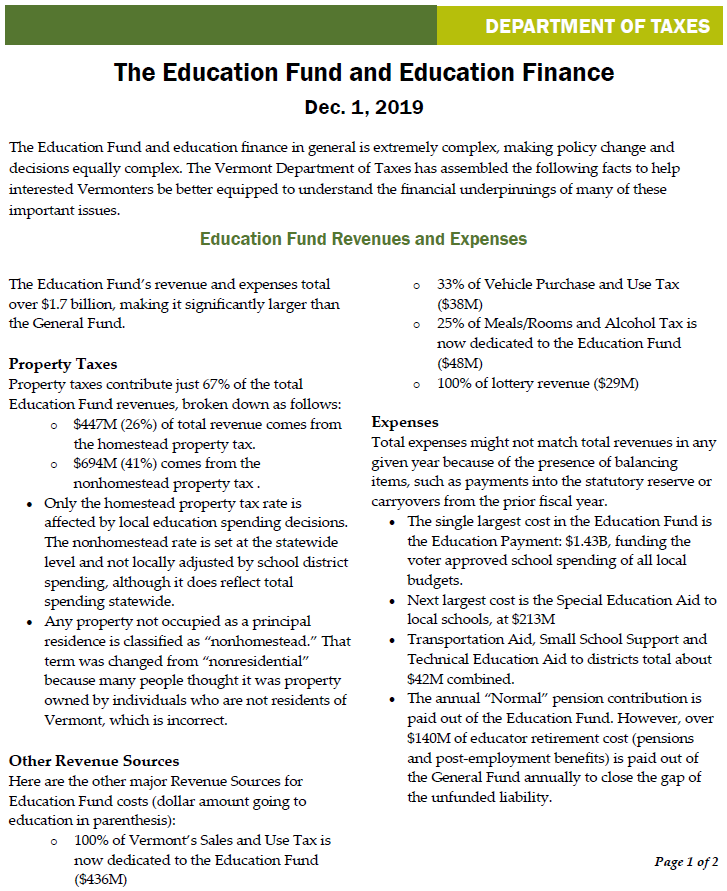
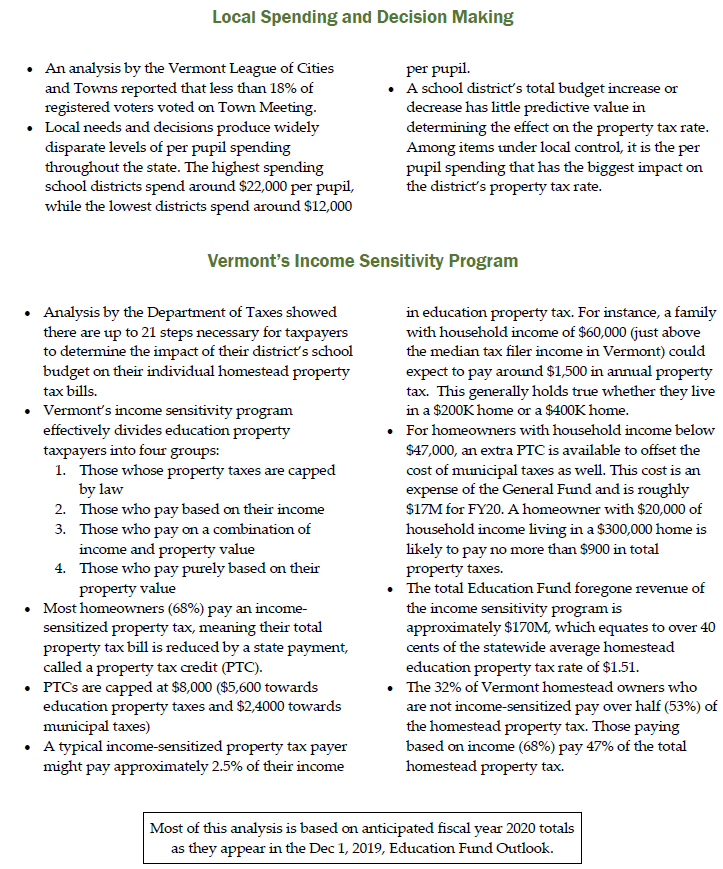
Source: Governor's office Montpelier 12.3.2019