

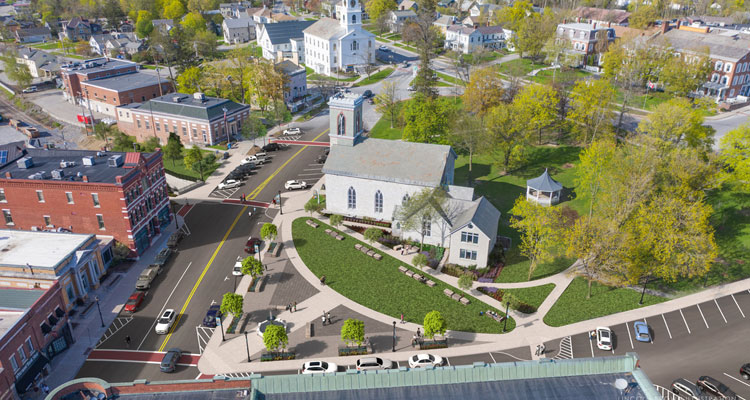
Artist photo rendering of downtown Middlebury after the rail/bridge project is completed in 2021. Next summer Main Street and Merchants Row will be closed to traffic for 10 weeks. Courtesy photo.
by Bruce Edwards, Vermont Business Magazine It’s considered the largest downtown construction project undertaken by the Vermont Agency of Transportation: an estimated $80 million rail and bridge replacement in the heart of Middlebury’s downtown.
For the last two years VTrans and Middlebury have laid the groundwork for the heavy lifting that will take place next summer which will try the fortitude of residents, visitors and most significantly downtown merchants who will bear the brunt of the disruption.
Work started two years ago when the two aging downtown bridges were dismantled and replaced with temporary bridges. Last year a new storm water drainage system was built along the tracks, according to Jim Gish, Middlebury’s project community liaison.
Starting in August additional prep work will be done replacing town water, sewer and storm water lines that cross underneath the rail bed along with excavation along the rail corridor.
“So this has all been leading up to a 10-week closure of Main Street and Merchants Row next year and that’s in order to get this work done in kind of the shortest possible time frame,” Gish said.
He added that during the 10-week period, which is scheduled to begin May 27, Kubricky Construction work crews will be on the job around the clock. He said it was the only way to undertake and complete the work in a timely and cost-efficient way.
Gish said during the 10-week shutdown the rail bed will be lowered, approximately 3,500 feet of track replaced and a 360-foot tunnel will be built to replace the two temporary bridges.
He said during construction next year freight traffic along the Vermont Rail line will be shut down and diverted up the eastern side of the state.
While the construction work this year is right in the center of town, he said it will “have fairly minor impact on vehicular and pedestrian traffic downtown.”
When completed in 2021, Gish said the project will restore the town green to its original size and create a much safer state-of-the-art roadway.
Fred Kenney, executive director of the Addison County Economic Development Corp, also said the new rail configuration will allow Amtrak to extend its service from Rutland with stops in Middlebury, Vergennes and Burlington.
Impact
“Naturally there’s concern about next summer and what the impact will be on the businesses next summer,” Gish said.
He said Neighbors Together and the Better Middlebury Partnership have come up with an extensive marketing program “to drive local business revenue through duration of the project” and mitigate its impact.
He said parking in the vicinity of the downtown will be at premium during the 10-week shutdown.
“We’re already constrained by parking because we’ve lost at least a third, if not more, of the parking in central downtown as the result of the temporary bridges going in,” he said.
During construction next year, he said parking along Main Street and Merchants Row will go away temporarily until work is completed.
As part of a health and wellness program being coordinated with Porter Medical Center, Gish said one alternative is to encourage people to walk to the downtown. He said there are plenty of parking spaces within a 10-minute walk of the business district.
He said another option being explored is shuttle bus service that would transport people from remote parking lots.
Battle plan
Several years ago with the rail/bridge project on the horizon, a group of residents got together to brainstorm how to mitigate what was sure to be a major disruption to the downtown, said Karen Duguay, executive director of the Better Middlebury Partnership.
Between the BMP and Neighbors Together, Duguay said they needed to be advocates for themselves and generate positive momentum in the community before the project took off.
“We have really been collectively working together to find all the ways to turn this into an opportunity for Middlebury and sort of see the opportunity through the challenge,” she said.
The effort to date involves shopping promotions and other events to draw people downtown, she said.
This year BMP and Neighbors Together has ramped up its efforts with its sights set on next year’s massive construction project - what’s believed to the largest downtown construction project undertaken by VTrans.
“I think everyone feels nervous,” Duguay said. “I would hesitate to say it’s doom and gloom but I think there’s an anxiety there because until we really go through next summer we don’t really know what that’s going to be like.”
She said the town is preparing the best it can.
Those marketing efforts include renting a pop-up storefront space in the downtown to hold various events. “So far it’s been really successful,” Duguay said. “We started events in April and the premise was three to five events a month and we are upwards of 10 a month at this point.”
She said the marketing campaign focuses on the Middlebury area’s stellar food and beverage industry, local arts and culture and recreation.
“We felt those were all assets that could draw people regardless of what’s happening in the downtown and yet the downtown will benefit from those visitors,” she said.
Events run the gamut from yoga with kittens and a farmer’s market to artisan and vendor markets.
Duguay said a block party is on the agenda for this summer as well.
Middlebury’s efforts to mitigate the fallout from next year’s construction received a significant boost with a $228,750 state marketing grant.
“The state really recognizes that Middlebury can be used as a model and what we’re doing right now can really be a model,” Duguay said, “because so many of our downtowns are facing infrastructure issues at this point.”
Looking ahead to next summer when the downtown will be shut down for 10 weeks to vehicular traffic, Duguay said more events and promotions are in the works to draw people downtown at a critical time.
“I really feel like a community like Middlebury our biggest asset is the community,” she said.
Adam Lougee, executive director of the Addison County Regional Planning Commission, agreed that next year will be a challenge. The good news is that since it was built several years ago the Cross Street bridge has alleviated most regional traffic concerns. But Lougee added that the Cross Street bridge at Route 7 and the roundabout at the other end will be a “pinch point” during the 10 weeks the downtown is closed to traffic.
Heavy construction equipment will be sharing the roads next year with local traffic.
“A lot of roads in Addison County lead to Middlebury, (Routes) 74, 30, 125, 7 all go through Middlebury,” Lougee said. “So a lot of the big state highways. It’s going to be a real pinch point and we all rely on those roads.”
He said a traffic mitigation plan is being drawn up which would include signage, signal optimization, and the use of the Addison County Transit Resources (ACTR) bus service.
Vergennes
From the perspective of Vergennes City Manager Matthew Chabot a lot has changed in 20 years. At the time, the city was going through a tough economic stretch.
He said at that point the city “drew a line in the sand” and began its revitalization efforts with a focus on the shuttered Opera House.
“It really became the cornerstone for redevelopment and growth within the city,” he said. “We have a very active burgeoning downtown with several great restaurants, art galleries, great events on our city park on our green.”
Chabot said today there is one retail vacancy on Main Street.
Like other communities, he said the city is dependent on the tourism sector.
Vergennes sits on the Otter Creek with access to the Lake Champlain basin.
“It’s one of our premier sites within the community and we get a lot of boaters coming off the lake over the course of the summer docking down in the basin,” Chabot said.
For boaters, the city provides free water, free electrical hookup and free wi-fi. He said the city does ask visitors for a donation to support those free services.
The largest employer in the city and one of the largest in the county is the UTC aerospace plant.
Last November, United Technologies Corp. acquired Rockwell Collins and split UTC into three entities. United Technologies, comprised of Collins Aerospace Systems and Pratt & Whitney, Carrier, and Otis.
The Collins Aerospace plant employs several hundred workers and according to Chabot the company is doing well. As with other employers statewide, he said the company has trouble filling positions.
Truck route
One of the issues facing Vergennes is truck traffic and lots of it.
Chabot said the city is working with the Agency of Transportation to develop what’s being called “the Vergennes economic corridor.”
“Every day the City of Vergennes experiences 9,800 vehicles going through our downtown, 800 of which are tractor trailer truck size,” he said.
The trucks represent one of the largest “saturations” of big trucks in any downtown in the state, he said.
Lougee of the Addison County Regional Planning Commission, said Vergennes has twice as many trucks traversing its Main Street than either Brandon or Woodstock, two communities with truck issues of their own.
The problem, according to Chabot and Lougee, is that most of the trucks that wind up through the downtown come up along I-87 in New York, cross into Vermont along Route 4 in Fair Haven, then north on Route 22A through downtown Vergennes to Route 7 and then north to Burlington.
The plan is to develop a $40 million alternate truck route which would be built on the edge of the downtown within the city limits.
Stantec, the consultant hired by VTrans and the ACRPC, looked at two truck route options. The preferred western option starts on Route 22A on the south end of town and includes a roundabout. Truck traffic would be diverted west of the city for 1.6 miles. There would be another roundabout where the route intersects 22A north of the city and then onto Route 7.
Chabot said the path for the western truck route would be built primarily on ag land that is already owned by the state.
“That by itself moves it up the ladder of feasibility very quickly,” he said. Once built, the land adjacent to the truck route could be rezoned and developed for commercial, industrial and residential purposes which would add to the city’s tax base to an estimated tune of $2.6 million.
Lougee said the Stantec study looked at diverting trucks on Route 22A south of Vergennes, east along Route 17 to Route 7. The costs to upgrade Route 17 is estimated at $20 million, half the cost of building the preferred truck route around Vergennes.
The problem with that, Lougee said, is that none of the neighboring towns liked that idea.
“One of the premises of the study is, yes, Vergennes has an issue but we’re not going to solve the issue by foisting the problem onto neighboring towns,” he said. “We’ve got to come up with a regional solution.”
He also said the Route 17 alternative would add roughly $2 million a year in shipping costs for businesses in Chittenden County.
Chabot said moving truck traffic out of the downtown would enhance the quality of life, preserve historic buildings and make the downtown more welcoming for visitors who frequent the shops and restaurants.
He cited the positive experience of Morrisville which built an alternate route to take trucks out of its downtown.
“What we’re hearing out of VTrans, if we can get regional consensus this could be shovels in the dirt within a 10-year time period,” he said. “It’s a once in a generation opportunity for the city to really get a huge shot in the arm from a revenue perspective.”
In the interim, downtown Vergennes will undergo what’s referred to as “traffic calming” next year that coincides with a major repaving project in the downtown, Lougee said.
Traffic calming includes such items as signal optimization, and crosswalk improvements.
“Again, it doesn’t solve the problem but it should help make things better for people walking, moving around the City of Vergennes,” Lougee said.
He said the proposed western truck route has the added advantage of serving Collins Aerospace and Northland Job Corps.
‘Dry’ success
Addison County is a hub for micro-breweries, wineries and distilleries.
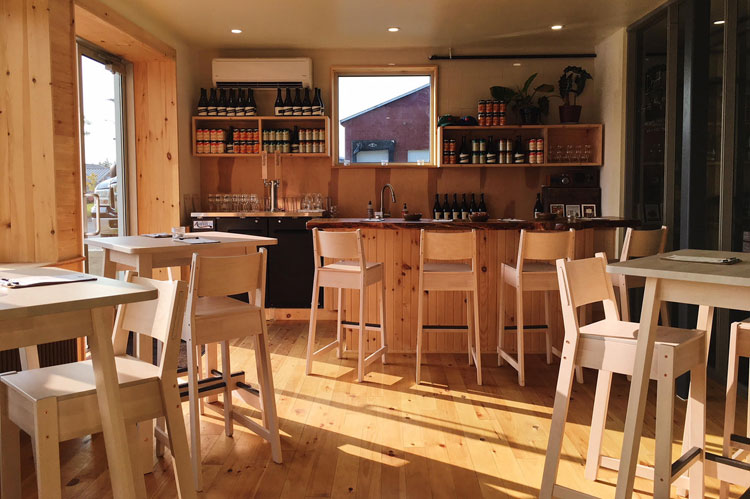 Shacksbury Cider tasting room. Courtesy photo.
In Vergennes, Shacksbury Cider continues to experience rapid growth for its dry cider.
Occupying 7,000 square feet at the former Kennedy Brothers furniture complex, owner Colin Davis said business couldn’t be better with sales doubling twice over the last two years.
“We make dry cider and I think people want something that’s not so sweet and I think we’re relatively innovative,” Davis said.
He said this year Shacksbury expects to produce a minimum of 250,000 gallons.
Sold in cans, bottles and kegs, Shacksbury Cider is distributed in 26 states with Vermont, New York, Texas and California leading the way.
The company, which has 15 employees, produces three core ciders and several specialty ciders.
Davis said renovations to the second floor will provide more manufacturing space. In addition, the winery has off-site warehousing.
No winery, brewery or distillery would be complete without a tasting room and Shacksbury Cider is no exception (open Wednesday through Sunday).
In Burlington, the company jointly operates a winery and tasting room at 266 Pine St., with Zafa Wines, called Co-Cellars.
“As far as we know, Vermont’s first urban winery,” Davis said.
Snapshot
Addison County’s unemployment rate stood at 2.2 percent (not seasonally adjusted) in June. For the same period last year the rate was 2.5 percent, according the state Department of Labor. Statewide the May unemployment rate was 2.2 percent (seasonally adjusted)
The county’s median household income in 2017 was $61,875 compared to the statewide median of $57,808, according to the U.S. Census Bureau.
With an unemployment rate hovering around 2 percent, Kenney of the ACEDC is hard pressed to find fault with the state of the county’s economy.
In Vergennes, Kenney said the county’s largest manufacturer, Collins Aerospace, is busy and hiring more workers.
Other major employers include Middlebury College and Porter Medical Center.
Kenney said the beverage and specialty food sectors have grown into an economic force in recent years.
“They’re all growing and doing exciting and innovating things to get their products on the shelves all over the country and all over the world,” he said.
Those companies include Otter Creek Brewing, Woodchuck Hard Cider, Shacksbury Cider, Appalachian Gap Distillery and Stonecutter Spirits and Vermont Coffee Company. The specialty food sector features Cabot and Champlain Valley Creamery.
If there is an economic cloud, Kenney said it hangs over the state’s dairy farmers.
The number of Vermont dairy farms has declined over the last nine years alone from 1,015 in 2010 to 675 this year, according to the Agency of Agriculture, Food & Markets.
With 101 dairy farms, Addison County is the third largest dairy county in the state behind Franklin and Orleans counties.
Marie Audet, whose family owns Blue Spruce Farms in Bridport, one of the state’s largest dairy farms, weighed in on the dairy industry in a series of published essays.
Audet said dairy farming creates $2.2 billion in economic activity each year in Vermont and approximately $385 million in Addison County.
At the heart of the problem is the federal price support system which Audet called antiquated.
In 2014, farmers were paid an average of $23.63 per hundredweight for their milk, according to the state. For the second quarter this year the price was $16.92.
Audet also said farmers need to do their part as well to sustain the industry.
“Improving and maintaining water quality is our priority,” she said in one of her three essays that appeared in the Addison Independent. “We need to adhere to ever-changing and increasing regulations. We need to adapt to and mitigate the effects of climate change.”
Kenney said agriculture in general is always a challenge. One project the ACEDC hopes will take off is a regional food hub. By creating shared kitchen and freezer space, he said it would allow farmers to diversify into other areas of agriculture.
Kenney said one example of that is Agricola Farm in Panton, which is setting up a pork processing facility on Exchange Street in Middlebury. He said the facility will aggregate pork from several Vermont farms.
For businesses eying an expansion or relocation, Kenney said there is space available. Country Home Products, which moved the bulk of its operations from Vergennes to Wisconsin, is available for lease, he said.
The former Connor Homes building on Route 7 in Middlebury is also available. Kenney said the building’s new owner is willing to work with prospective tenants to split up the building to suit their needs.
“We’re still kind of lacking that 3,000 to 5,000-square-foot space for fast-growing businesses to move into,” he said.
Exchange Street is the industrial hub of Middlebury. Kenney said while there are no existing vacancies there are lots for sale.
South of Middlebury is the Middlebury State Airport.
Kenney said the ACEDC is hoping to leverage recent state legislation that will make it easier for development at the state airports.
He said what’s really encouraging is the number of potential business startups.
“We’re seeing a lot of entrepreneur and small business activity,” he said. “Meeting with a lot of existing small businesses but also people who want to start their own business.”
He said in recent months between his organization and the Small Business Development Center more than 100 new clients have come in seeking advice. He said about 62 percent of those were startups.
Kenney said the challenges the county faces are the same as the rest of the state: labor and housing.
Rob Carter, president of the Addison County Chamber Of Commerce, also said he’s seeing increasing numbers of entrepreneurs.
“We’re seeing that kind of growth,” he said.
Summer recreation activities add to the county’s economy especially with increased interest in hiking and mountain biking, Carter said.
For spectator sports enthusiasts, something new is the Vermont Brew (www.vermontbrewfootball.com/arena), an arena football team.
The Vermont Brew will play their home games starting next season (2020) at the Howard E Brush Arena.
“So that’s going to draw more people to come and stay and eat at the restaurants,” he said.
For downtown merchants, Middlebury College continues to be an economic driver. “Obviously they have a lot of students and faculty,” Carter said. “They’re the ones going to the restaurants so they certainly help to keep the town going.”
He said there are ongoing efforts to strengthen the ties between the town and the college.
Carter said there’s no question that retailers in Middlebury will face a challenge next year with the start of the downtown construction project.
“If you’re just making it, it can be a little scary,” he said.
In Bristol, Lougee said the town is moving forward with a mixed-use development that includes housing and light industry.
Lougee said the housing portion of the project has received an Act 250 permit.
Banker’s view
A good indicator of economic activity is commercial lending.
“We have seen strong demand in commercial (lending) this year,” said Meaghan McLaughlin, vice president and commercial banker with National Bank of Middlebury. “We’ve been very happy with the demand we’ve seen from businesses.”
She said entrepreneurs and small businesses are helping to spur loan demand.
“We’ve seen several businesses of ours looking for more space and we’ve helped finance those expansions,” McLaughlin said.
The bank is also seeing investments in renewable energy, value-added agriculture and the adult beverage industry.
“We certainly have a very strong culture for the adult beverage market,” she said. “On Exchange Street in Middlebury for example we have quite a few distillers and brewers and it’s exciting to see expansions for several of those in that arena as well.”
The craft brewers and distillers also have a ripple effect by attracting visitors to the county, McLaughlin said.
McLaughlin added that public investments in Middlebury’s downtown or the proposed truck route in Vergennes “is an opportunity to enhance the quality of life beyond the project.”
Housing
Like the rest of the state, affordable housing in the county continues to be a challenge.
Elise Shanbacker, executive director of the Addison County Community Trust, said while the overall vacancy rate is 4 percent, job hubs like Vergennes and Middlebury are below 1 percent.
“Statistically median rent is about $1,000 a month but if you look on Craig’s List you would be hard pressed to find anything under $1,200 a month (for a two-bedroom apartment),” Shanbacker said.
She said rents are affected by the county’s proximity to Chittenden County. That’s especially true in the northern part of the county where people commute to Burlington, she said.
Addison County Community Trust has 274 apartments under its auspices, of which 228 it actively manages. In addition, there are nine mobile home parks with 340 homes, along with a shared equity home ownership program with 78 affordable single-family homes.
The trust also has a new affordable housing project underway.
Vergennes Community Housing, a 24-unit apartment building under construction on Armory Lane in Vergennes, will be ready for occupancy next summer.
Shanbacker said rents, including heat, start at $600 for a one-bedroom bedroom and up to $1,200 for a two-bedroom, market rate apartment.
She said income eligibility for the two-bedroom, market rate apartment is up to 120 percent of area median income. For the low-income, one-bedroom unit, income is capped at 50 percent of area median income.
There are 100 households on a waitlist for apartments. But Shanbacker said many of those households need rental assistance which isn’t available in Addison County “for the foreseeable future.”
Bruce Edwards is a freelance writer from southern Vermont.