

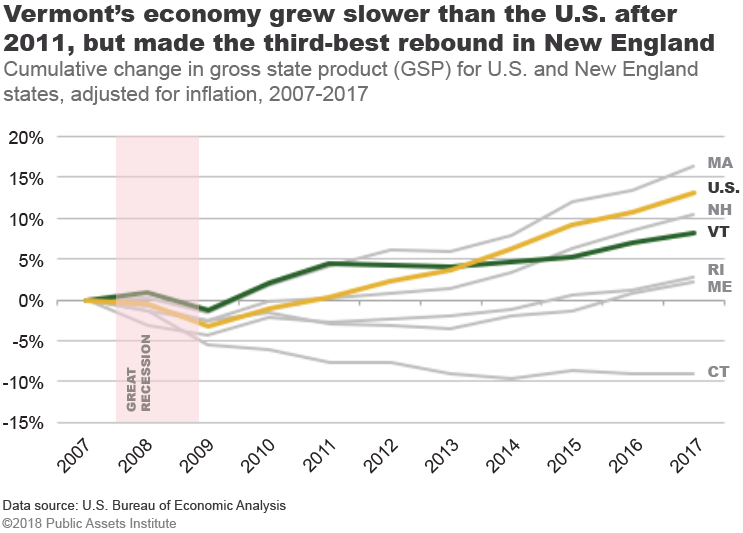
by Stephanie Yu, Public Assets Institute Many Vermonters are not benefiting from the state’s economic growth. That’s the central message of State of Working Vermont 2018, released today by Public Assets Institute. The data are new. But the message was similar in the 2017 report—and the year before that, and the year before that. State of Working Vermont, based on US Census and economic data through 2017, showed that the Vermont economy grew last year—not as much as the rest of the country, but more than three of the other New England states. Even with its overall growth, however, Vermont was one of 10 states where income for the typical household fell in 2017.
 “Vermont is a small state, and its economy largely follows the ups and downs of the national economy,” said Paul Cillo, president and executive director of Public Assets Institute. “But Vermont policymakers can ensure a fair distribution of the state’s economic gains. Tax policy, the state minimum wage, and spending policies can determine whether all Vermonters or only a privileged few will benefit from a growing economy.”
State of Working Vermont 2018 includes indicators to answer three questions:
1. Did the overall Vermont economy grow, and who benefited?
• Vermont’s economy has been growing, but not in every county and not as fast as the rest of the country.
• Economic growth disproportionately benefited those at the top.
• Vermont was one of 10 states where median household income fell in 2017.
• Wages have been stagnant for most Vermont workers.
 2. Were Vermonters able to make ends meet?
• Vermont’s prices were average nationally, but wages were low.
• The cost of essentials grew faster than wages.
• 17 percent of Vermont’s young adults lived in poverty.
• 5,000 fewer Vermonters had health insurance in 2017 than in 2016.
 3. How was the job market for Vermonters, and who was working?
• The number of private sector jobs continued to grow, but not everywhere
in Vermont.
• New jobs were concentrated in service-providing industries.
• Labor force participation was down for all education levels.
Ten years after the start of the Great Recession and more than eight years after it officially ended, there are signs of recovery in Vermont. The economy has continued to grow, if more slowly than the rest of the country. Yet whatever growth or prosperity the state has achieved, many have not benefited from it. Average Vermonters still struggle to make ends meet.
 The economy is improving, but not for most Vermonters: For the past 13 years State of Working Vermont has told the same story. But the narrative can change—policymakers can change it. The economic indicators selected here highlight the areas where Montpelier can focus attention and resources to improve the well-being of all the people of Vermont.
It’s not as though Vermont’s political leaders haven’t seen the indicators or are unaware of the problems the state faces. But administrations of both parties have been reluctant to acknowledge the need for more revenue, and postponing critical investments—for instance, in early care and education, affordable housing, and clean water—has become the norm. Employers have not been asked to share the responsibility to create a fairer economy. Not enough jobs pay wages that can support a family, yet when the Legislature voted this year to increase the minimum wage, the governor vetoed the bill.
 This year again, because the fruits of economic growth have not shown up in the pockets of a lot of Vermonters, the indicators point to mixed results. More Vermonters were working, yet at the end of 2017 their numbers were still below the all-time high of 344,135, reached in 2006. Poverty fell a bit last year, but for young Vermonters, Vermonters of color, and single parents the rates remained high. Fewer families were relying on the Reach Up program for assistance in 2017, but still nearly 70,000 Vermonters lived in poverty, and over 75,000 depended on 3SquaresVT to get enough to eat. In the large majority of families with children, all parents in the household worked, but affordable, high-quality child care was out of reach for many of them.
Newly released data from 2015 show upper-income families continued to make greater gains than everyone else. Vermont’s low, low unemployment rate has not pushed up wages as would be expected in a tight labor market. Low- and middle-wage workers have seen little change in their paychecks in more than a decade. Vermont was among 10 states where median household income decreased in 2017.
 Vermont may be too small to have any influence on the overall national economy. Neither a governor nor the Legislature is going to return the state to the 3 percent real annual economic growth it enjoyed 30 years ago, and waiting for those days to return will not help struggling Vermonters. Still, policymakers can do more now to improve the lives of low- and moderate-income Vermonters who did not benefit from the recent federal tax cuts and are confronted by an economic system that favors the wealthy. Making work pay and raising the incomes of ordinary Vermonters would strengthen the economy and further reduce poverty. And adequately funding social benefits would improve the well-being of Vermonters whose wages are too low to afford the basics.
State of Working Vermont is a companion document to A Framework for Progress, published in 2016 and updated this fall. The data here detail how Vermonters are faring. Framework recommends actions policymakers can take right away to start moving the indicators in a better direction.
Measuring progress
No single statistic or measure tells us whether Vermonters’ lives are improving. We can monitor factors that contribute to the expansion of the middle class: economic growth, job creation, income distribution, public policies, and public investments. But even when those indicators appear to be positive—such as a rising gross state product—it is crucial to look at what is happening to people and how the growth is distributed.
 Measures such as poverty rates, income growth and disparity, housing affordability and homelessness, labor force expansion and job growth, health care coverage, and the availability of social and educational services let us see, at least statistically, who is getting ahead and who is falling behind. Putting these statistics together helps us understand where policy changes could make a difference to working families and start to break down some of the systemic barriers holding back single parents, people of color, and Vermonters without post-secondary educations.
“There is some good news in these indicators,” Cillo said. “Poverty was down somewhat in 2017, and it has trended downward since the recession. Jobs are increasing. But there’s some bad news too,” he continued. “For young Vermonters, Vermonters of color, and single parents, poverty remains high. And wages, after adjusting for inflation, have barely budged for many low- and moderate-wage workers.”
 Public Assets produces the State of Working Vermont annually in conjunction with the Economic Policy Institute in Washington. The report is designed to show how working Vermonters and their families were faring economically at the end of 2017—the latest year for which most data are available—and how conditions have changed, for better or worse, in recent years. Its analyses are based on data released by the U.S. Census, U.S. Bureau of Labor Statistics, and other state and federal agencies in 2018. It is a companion report to A Framework for Progress: Investing in Vermont’s people, infrastructure, and good government.
State of Working Vermont 2018 is published in a readable chart-book format with brief explanatory text. The report can be viewed or downloaded at publicassets.org.
Source: PAI. 12.18.2018. Public Assets Institute is a nonprofit, nonpartisan organization that promotes sound state budget and tax policies that benefit all Vermonters. More information at www.publicassets.org