

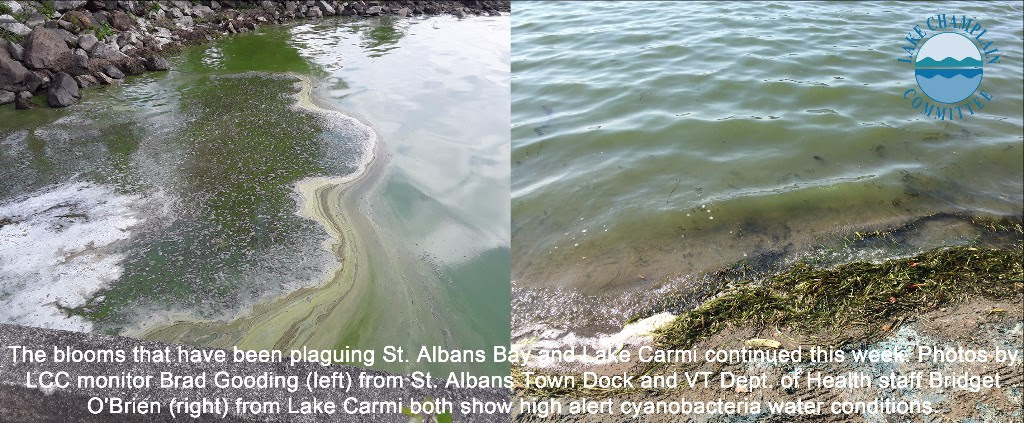
Vermont Business Magazine Today, the Vermont Agency of Natural Resources (ANR) and the Vermont Agency of Agriculture, Food & Markets (AAFM) announced a suite of projects aimed at protecting and restoring the Lake Carmi watershed. The Lake Carmi Implementation Team will lead the coordination of these projects and provide regular updates to the community.
According to the Lake Champlain Committee's Week 13 Cyanobacteria Report from September 15: "Lake Carmi continues to experience an intense bloom. High alert bloom conditions persisted for a third week for most of the lake. Mycrocystin of .34 micrograms per liter was detected at the North Beach Site on September 12 which is below the VT recreational guidance value of 6 micrograms per liter. Microcystin and anatoxin levels were below detection at the State Park Beach based on samples taken on September 12. Everyone should stay away from the water while blooms persist and avoid contact with the water for at least 24 hours after blooms dissipate."
In mid-August, the St Albans Messenger reported that a TMDL meeting between Lake Carmi residents and others with Anson Tebbetts, Vermont’s Secretary of Agriculture, "boiled over" as they expressed their anger over the situation. Tebbetts took the heat for local farmers, whose agricultural runoff is the chief culprit in causing the algae blooms. The state has instituted new runoff regulations for farmers, which went into effect at the end of last year, but Tebbett's admitted at the meeting that he could not predict when the Total Maximum Daily Load of phosphorous goals would be met.
And then, according to a WCAX-TV report, Julie Moore, Vermont’s Secretary of Natural Resources, received a similar reception from residents last Thursday.
“Historically, the Lake Carmi watershed has faced some of the most significant challenges of any area in the state,” Moore said. “As an administration, we are committed to addressing these issues, to ensure a better future for Lake Carmi.”
The Agencies are working closely with farmers and landowners in the area to increase conservation efforts aimed at improving the health of the watershed. They have ramped up technical and financial assistance, education and outreach, and inspections in the watershed, to ensure adherence to Vermont’s Clean Water Act.
“Act 64 of 2015 – Vermont’s Clean Water Act – has accelerated change, statewide, in the effort to achieve clean water,” Moore continued. “Many new resources have been brought to bear thanks to Governor Scott’s and the Legislature’s commitment of significant, additional funding for the Clean Water Fund. This will enable the state to support and invest in numerous clean water projects, including improved stormwater management, lake shore protections to improve habitat and water quality, continued assistance with on-site wastewater treatment, and expanded agricultural stewardship in the Lake Carmi watershed.”
Specifically, ANR has secured permission from key landowners to undertake a wetland restoration project near Marsh Brook that will help reduce the amount of phosphorus reaching the stream. In addition, new projects planned for the coming year by ANR include implementation of best management practices on municipal and private roads which drain to the lake, the design of a pilot aeration project in the northeastern lobe of the lake, and technical assistance to shore land property owners implementing lake-friendly practices. This fall, ANR will also implement enhancements to the wastewater treatment system it owns and operates at Lake Carmi State Park.
“We have to do better. Our entire water quality team from technical assistance to inspectors will be focused on this watershed. Farmers are engaged and have told us they want to help. Important projects are underway and more will happen in the coming months.” said Secretary Tebbetts.
New Required Agricultural Practices (RAPs) became effective in December 2016 and will result in expanded conservation practice implementation throughout Vermont. A combination of AAFM farm inspections and partner education and outreach services will ensure adoption of new requirements included in the rule such as: tighter erosion standards for annual crop fields, required vegetated buffer strips and manure spreading restrictions alongside ditches, and wider buffers on steep cropland fields.
“We are nearing the end of the first growing season under the RAPs, and we are already seeing significant improvements,” said Tebbetts. “Our staff is working closely with farmers to identify solutions, and provide technical assistance. We want to ensure farmers are heard, and their efforts documented. We are here to provide the support and resources they need to go above and beyond the baseline regulations.”
In the Lake Carmi watershed, AAFM has secured significant funding for two major agricultural water quality improvement projects that are on-track to be implemented this fall. Surface water monitoring is being conducted to assess phosphorus reductions from these BMP practices.
The Lake Carmi Implementation Team, a volunteer group that formed in October 2015 to coordinate phosphorus management strategies across the Lake Carmi watershed, is co-sponsored by the Franklin Watershed Committee and ANR, includes representatives from AAFM, Lake Carmi Campers’ Association, Town of Franklin Select Board, Northwest Regional Planning Commission, Farmer’s Watershed Alliance, Friends of Northern Lake Champlain, and Toxics Action Center.
For more information visit: http://dec.vermont.gov/watershed or http://agriculture.vermont.gov/water-quality
Source: ANR, 9.21.2017. LCC, 9.15.2017.