

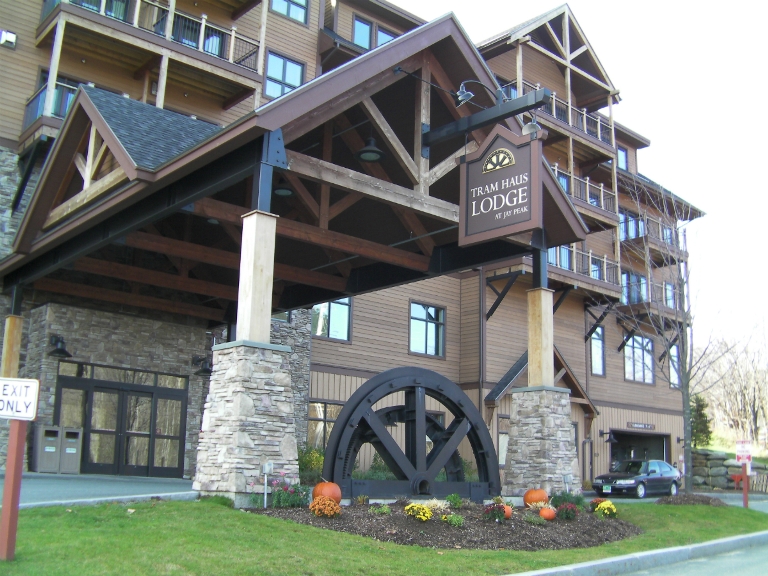
The Tram Haus Lodge was Jay Peak's first EB-5 development. VBM photo.
by Timothy McQuiston Vermont Business Magazine The State of Vermont responded late Friday with a letter that both cajoled and scolded an attempt by the federal government to shutter Vermont’s immigrant investor program, known as EB-5, by immediately closing the Vermont Regional Center. Governor Scott has also desired to close the state-associated program, but favors an orderly and cooperative plan with the US Citizenship and Immigration Services.
The EB-5 program has been plagued by the scandal surrounding the alleged fraud of $200 million related to the Jay Peak and Burke Mountain resort developments. Owner Ariel Quiros and former president Bill Stenger were implicated in a plan that diverted funds from project to project in a “Ponzi-like” scheme. The Securities & Exchange Commission alleges that Quiros even diverted millions of dollars into his own pocket, or as the SEC called it, “looted.”
However, the state argues that a “winding down” of the state’s VRC would be wiser than simply shutting down and has asked USCIS for a meeting to discuss the issue.
The letter, dated September 14, 2017, and signed by the state’s legal representative, Robert Divine of Baker Donelson of Chattanooga, says: “The State and USCIS have a common interest in ultimately closing the VRC. USCIS acknowledges that the State now adequately monitors and oversees current VRC projects, and the State has announced that the VRC is seeking only to continue as a regional center for existing projects (and possibly a new phase at Mount Snow), and not to sponsor any new EB-5 projects.
“As more fully discussed herein, USCIS and the State should work to reach agreement on implementing the VRC Wind-Down in an orderly fashion, thereby protecting existing investors and supporting the economic development associated with the existing projects.”
The state maintains that a wind-down makes commonsense; that the EB-5 projects, even the ones related to the fraud, have created thousands of jobs in the state; that ending the program immediately would harm both ongoing developments at Trapps in Stowe and at Mount Snow; and that such a move could harm investors, which is the very thing USCIS stated it was trying to prevent.
The state also maintains that there very likely is no legal reason for USCIS to end the program, because the VRC did not, in effect, do anything wrong according to the letter of the law.
Going even further to undermine the USCIS’ case, Divine takes issue with some of the evidence presented in the NOIT, including the reliance on news stories:
“Terminating the VRC based on newspaper articles is unreasonable, arbitrary, and capricious.”
The Vermont Department of Financial Regulation has posted on its Web site the response that was filed with the United States Customs and Immigration Services in Washington, DC. The “Notice of Intent to Terminate” and the “Vermont Regional Center’s Response to the USCIS Notice of Intent to Terminate and Exhibits” can be found on the DFR website: www.dfr.vermont.gov/jay-peak-legal-documents
State of Vermont Response Letter
September 14, 2017
U.S. Citizenship and Immigration Services
Immigrant Investor Program Office
131 M Street, NE
Mailstop 2235
Washington, DC 20529
Re: Response to Notice of Intent to Terminate Regional Center
File: ID1031910148/RCW1031910148
Vermont Agency of Commerce and Community Development Regional Center
Dear Officer:
The Vermont Agency of Commerce and Community Development Regional Center (the
“VRC”) received a Notice of Intent to Terminate, dated August 14, 2017 (the “NOIT”), from
U.S. Citizenship and Immigration Services, based upon USCIS’s determination that the VRC no
longer serves the purpose of promoting economic growth. Pursuant to 8 C.F.R. § 2014(m)(6), we
hereby offer the following response in opposition to the NOIT, as well as a suggested solution
for the State of Vermont (the “State”) and USCIS to work together to implement an orderly
wind-down of the VRC over time (the “VRC Wind-Down”). As set forth in the “Review of the
EB-5 Program in Vermont and the Vermont Regional Center,” dated August 18, 2017, prepared
by Department of Financial Regulation (“DFR”) for the Governor of Vermont (the “DFR
Report”), and attached hereto as Exhibit 1, the VRC Wind-Down would provide stability to
existing VRC projects and protect economic growth, investors, and the local contractors those
projects employ.
The NOIT proposes to terminate the VRC based on problems that the NOIT itself
recognizes have been remedied and will not recur due to the 2014 structural changes at the VRC.
Terminating the VRC now, with any oversight issues already in the past, will only cause harm to
the very interests the Immigrant Investor Program (“EB-5” or the “Program”) is designed to
promote. Further, the NOIT bases termination on a set of ex post facto standards that are not set
forth in any statute or regulation, and thus do not provide a permissible basis for adverse
administrative action.
We propose that USCIS work collaboratively with the State to implement the VRC
Wind-Down, thereby meeting USCIS’s goal of ensuring that the Program promotes economic
Page 2 of 10
growth, fostering such growth in Vermont during a transition period, and protecting innocent
investors.
I. USCIS and the State should work collaboratively to implement the VRC Wind-
Down.
Rather than abruptly terminate the VRC, USCIS should work collaboratively with the
State to implement the VRC Wind-Down, which has been approved by the Governor of
Vermont. As detailed in the DFR Report, this plan would wind down the VRC over a period of
time in a manner that protects existing investors and continues to promote economic growth. The
VRC would continue to sponsor and oversee its existing projects (and potentially one new phase
of an existing project, as discussed in the DFR Report) so that existing investors could petition
for their immigration benefits under the Program. However, the VRC would not take on any new
EB-5 projects. DFR would provide ongoing financial oversight for the existing projects; as the
NOIT recognizes, that oversight is “rigorous,” “robust,” and “comprehensive.” NOIT at 20.
As USCIS acknowledges in the NOIT, “not all of the Regional Center’s projects are
associated with the SEC and Vermont complaints – only a subset of them are.” NOIT at 18. The
VRC Wind-Down would protect the innocent investors in the projects where there is no
allegation of fraud or other problems.
Further, USCIS acknowledges in the NOIT that no employees of the VRC or the State
were involved in the alleged fraud at Jay Peak and the State “has taken actions to improve [its]
monitoring and oversight of the [VRC] projects.” NOIT at 20. The NOIT recognizes that DFR
has implemented “a rigorous compliance program for all [VRC] projects,” has “[set] robust
standards that new EB-5 projects must comply with before associating with [the VRC], and
[performs] comprehensive monitoring and oversight activities for current projects… .” NOIT at
20. The DFR Report details the significant monitoring and reporting requirements instituted by
the State for oversight of sponsored projects. See DFR Report at 13-14. The State’s new
compliance efforts have been in effect for almost three years and should give USCIS confidence
that VRC projects are being adequately monitored.
The State believes the USCIS termination process should include the possibility of
discussion with USCIS to resolve the NOIT, particularly in light of USCIS’s acknowledgement
that the State has already instituted a system of oversight and management of existing projects
that rebuts any potential basis USCIS has for terminating the VRC. The State and USCIS have a
common goal in winding down the operations of the VRC. The only difference is in timing and
approach. As USCIS itself acknowledges in its discussion of Public Comments on the Proposed
Rule: Adjustment of the USCIS Fee Schedule, 75 Fed. Reg. 58962, “this regulation currently
provides for a process of notice and rebuttal. The amended regulatory language leaves this
process intact. Regional centers have been and will be provided with ample opportunity to
overcome the reasons for termination of the regional center under this process.” In this case, the
State does not seek to avoid closing the VRC, but to work with the USCIS to do so in an orderly
manner that does not hinder economic growth or harm the interests of innocent projects,
contractors, and investors.
Page 3 of 10
The best way for USCIS to meet its statutory mission in promoting economic growth is to
work collaboratively with the State to implement the VRC Wind-Down.
II. The VRC continues to promote economic growth.
The Appropriations Act of 1993, as amended (the “Act”), authorizing regional centers in
the Program, explicitly enables them “for the promotion of economic growth” through
investment by foreign nationals. In the NOIT, USCIS correctly identifies the Act as the sole
statutory basis for terminating a regional center. A regional center may be terminated under the
Act only when it “no longer serves the purpose of promoting economic growth… .” NOIT at 3.
The VRC has promoted economic growth through its sponsorship of many successful EB-5
projects, and will continue to promote economic growth, regardless of whether it sponsors new
projects in the future. The NOIT recites numerous statistics about the VRC projects completed,
but there is also significant job creation currently underway and additional economic growth will
occur as existing projects are completed, capital is redeployed, and project investors immigrate
to the United States.
In total, EB-5 projects affiliated with the VRC have created at least 3,700 jobs and
deployed hundreds of millions of dollars of foreign investment into the Vermont economy.
Further, economic growth continues to occur through several ongoing VRC projects. Von Trapp
Enterprises LP (“Trapp”) has so far saved or created more than 400 jobs and continues to have a
positive impact on the Vermont economy through operation of an expanded resort and successful
new brewery and beer hall. See letter from Johannes von Trapp, President of Trapp Family
Lodge, attached hereto as Exhibit 2 (the “Trapp Letter”). Carinthia Group 2, LP and Carinthia
Group 2, LP (collectively, “Mt. Snow”) have so far spent $25.48 million of EB-5 proceeds to
finance Mt. Snow projects. Construction continues on Mt. Snow’s new snowmaking reservoir
and lodge, and job creation targets are being met. See letter from Richard K. Deutsch, Vice
President of Business and Real Estate Development, Peak Resorts, Inc., attached hereto as
Exhibit 3 (the Deutsch Letter”). The economic growth supported by the VRC’s sponsorship of
these projects is completely divorced from any alleged lack of monitoring or oversight of the
Quiros/Stenger projects. In fact, prior to receipt of the NOIT, Mt. Snow had begun discussions
with the VRC about affiliating for its next phase, which would produce an estimated nearly
1,400 additional jobs.1 The success of both Trapp and Mt. Snow shows that the VRC is currently
promoting economic growth, and will continue to do so, unless it is terminated by USCIS.
On the other hand, terminating the VRC may either leave Trapp and/or Mt. Snow
investors with no immigration benefits, or obligate Trapp and/or Mt. Snow to undertake efforts
to refund those investors. The latter would be costly and harmful to those businesses, as it would
likely require the businesses to access capital at potentially high costs to accomplish refunds and
result in the loss of jobs in the region. Such an outcome would conflict with the stated goal of the
Program by eliminating jobs and putting unnecessary financial strain on otherwise successful
projects.
1 As discussed in the DFR Report, under the State’s proposal, this phase of the existing Mt. Snow project would
constitute the final project VRC sponsors before winding down.
Page 4 of 10
As the NOIT indicates, permitting the VRC to remain open through completion of the Jay
Peak Hotel Suites Stateside LP project (“Stateside”) with additional capital available from the
April 13, 2017 settlement between Michael Goldberg, the Jay Peak receiver, and Raymond
James & Associates (the “Raymond James Settlement”) would allow for additional job creation,
both during the construction phase and after completion. If the VRC were to be terminated, those
funds may be refunded to investors, mainly in China, instead of invested in the Vermont and
U.S. economies. See letter from Michael Goldberg, Jay Peak receiver, attached hereto as Exhibit
4 (the “Goldberg Letter”).
Many investors in VRC projects may wait several more years for visa numbers before
they are able to immigrate to the U.S. During that time, further economic growth may occur as
job creating entities (“JCEs”) repay investments to the corresponding new commercial entities
(“NCEs”) and, pursuant to recently clarified USCIS policy, the NCEs redeploy that capital into
other at-risk investments. This redeployment of capital may take place at least until the end of
the conditional residence of the investors, and would have significant ripple effects on the
economy.
In addition, some of the Program’s most important economic benefits occur after the
initial investments in EB-5 projects, when investors immigrate to the U.S. as conditional
permanent residents. Investors and their families may buy houses, cars, and other goods and
services, attend universities, start or buy other businesses, and so forth. If the VRC is permitted
to continue sponsoring existing projects, then investors in those projects would continue to have
a meaningful impact on the economy through the aforementioned activities.
III. Terminating the VRC would unnecessarily penalize innocent investors and have
a chilling effect on the Program.
Terminating the VRC would not only have a negative impact on jobs and investment in
the Vermont economy, but also likely cause unnecessary harm to innocent investors in VRCaffiliated
projects. In addition, if USCIS were to follow through with a precipitous termination of
the VRC, and subsequently deny or revoke petitions filed by innocent investors in projects
uninvolved with the alleged wrongdoing, EB-5 participation in Vermont and throughout the
country would likely decrease dramatically. To avoid these unnecessary and unfair
consequences, the VRC should be permitted to remain open through the lifespan of immigration
processing for the hundreds of investors already sponsored.
Terminating the VRC, and consequently denying the Form I-526 petitions of investors in
affiliated projects who are not yet admitted as conditional permanent residents, could have
serious and wide-ranging adverse impacts. 104 innocent investors in Mt. Snow,2 31 innocent
investors in Trapp,3 and approximately 72 innocent investors in Jay Peak projects,4 who have not
2 See Deutsch Letter.
3 See Trapp Letter.
4 See Goldberg Letter. In addition, as set forth in the Goldberg Letter, AnC Bio investors’ funds could potentially be
redeployed into a replacement project, which would preserve the priority dates for approximately 75 investors in that
project.
Page 5 of 10
yet been admitted as conditional permanent residents, would be prevented from immigrating to
the U.S. Those investors would lose their priority dates and, to continue in the Program, be
required to make entirely new investments pursuant to a potentially revised set of regulations.
USCIS’s action would unfairly harm those investors by terminating their immigration benefits
based on the alleged fraud of project managers completely unrelated to their investments.
In addition, if the VRC’s designation were to be terminated, and Stateside not permitted to be
completed with Raymond James Settlement funds, the economic growth fostered by that project
would be unnecessarily diminished.
On a broader scale, prospective EB-5 investors everywhere may be less likely to
participate in the Program if USCIS terminates the VRC for the reasons stated in the NOIT.
Investors in legitimate, well-run NCEs and projects may worry that the sponsoring regional
center could be terminated for reasons unrelated to their NCE or project, leading to the denial or
revocation of their Form I-526 petitions. Thus, terminating the VRC may well have a broad
chilling effect on the market for EB-5 investments, on a national scale, not just in Vermont, and
frustrate the goal of promoting economic growth. See letter from Peter D. Joseph, Executive
Director of IIUSA, attached hereto as Exhibit 5.
IV. Regional center oversight and management obligations are not specified by law
or regulation; such unspecified obligations cannot serve as the basis for
terminating the VRC.
A. No law or regulation sets forth a regional center’s monitoring and
oversight obligations.
A regional center’s responsibilities for the oversight of day-to-day operations of the
separate and unaffiliated sponsored NCEs are not established in any law, regulation, or published
policy, and are not defined anywhere. It would be unreasonable to terminate the VRC for a
perceived failure to comply with requirements that are not sufficiently enunciated or supported in
the law, as due process prohibits arbitrary action by government bodies.
The purpose of Section 610(a) of the Act is for regional centers to promote economic
growth through EB-5 investment in transformational projects. S. Rep. 102-331 at 118 (1992).
The Act does not require that regional centers be independent financial auditors of the enterprises
whose investors it sponsors. In the NOIT, USCIS states that “[a] Regional Center must continue
to demonstrate ongoing active engagement in monitoring, oversight and due diligence of all
investment activities under its sponsorship.” NOIT at 16. However, USCIS cites no law or
regulation that creates such an obligation. The 2010 USCIS regulations, which initiated the
annual regional center reporting (the “2010 Regulations”), simply require each regional center
annually to “demonstrate [it] is continuing to promote economic growth… .” 8 C.F.R. §
204.6(m)(6)(i)(B). The 2010 Regulations focus on the collection of information on activity from
the sponsored enterprises and timely provision of that information to USCIS. Since
implementation of the 2010 Regulations, the VRC collected the required information from
projects — and severed ties with projects that refused to provide it. The VRC also timely
reported required information to USCIS.
Page 6 of 10
The NOIT points to general statements in VRC approval notices from 2007, 2009, and
2010. For example, approval notices stated that “administration, oversight, and management of
your regional center shall be such as to monitor all investment activities under the sponsorship of
your regional center and to maintain records, data and information on a quarterly basis in order
to report to USCIS upon request the following year to date information … .” NOIT at 17. As
noted above, the VRC complied with the annual requirement by requiring projects to report on
their investment activities in a manner sufficient for the VRC to do all required reporting to
USCIS.
Moreover, in more recent approval notices issued since the 2010 Regulations, USCIS’s template
language states only as follows:
As provided in 8 C.F.R. § 204.6(m)(6), to ensure that the regional center
continues to meet the requirements of section 610(a) of the Appropriations Act,
a regional center must provide USCIS with updated information to demonstrate
the regional center is continuing to promote economic growth, improved
regional productivity, job creation, and increased domestic capital investment
in the approved geographic area. Such information must be submitted to
USCIS on an annual basis or as otherwise requested by USCIS. The applicant
must monitor all investment activities under the sponsorship of the regional
center and to maintain records in order to provide the information required on
the Form I-924A, Supplement to Form I-924. Form I-924A, Supplement to
Form I-924 Application is available in the “Forms” section on the USCIS
website at www.uscis.gov.
Regional centers that remain designated for participation in the Immigrant
Investor Program as of September 30th of a calendar year are required to file
Form I-924A Supplement in that year. The Form I-924A Supplement with the
required supporting documentation must be filed on or before December 29th of
the same calendar year.
The failure to timely file a Form I-924A Supplement for each fiscal year in
which the regional center has been designated for participation in the
Immigrant Investor Program will result in the issuance of an intent to terminate
the participation of the regional center in the Immigrant Investor Program.
which may ultimately result in the termination of the designation of the
regional center.
Thus, all USCIS has specifically told regional centers to do is to collect information from
sponsored projects to complete Form I-924A, which requires them only to indicate how much
capital was invested or released from escrow into a particular NCE in a given year, and how
much capital was transferred from a JCE to a NCE. The VRC complied with this reporting
requirement. Moreover, requirements set forth in approval notices issued since the 2010
Regulations are quite far from the sweeping obligations described in the NOIT. Forms I-924 and
I-924A say nothing about regional center monitoring and oversight as part of the annual
reporting to USCIS.
Page 7 of 10
Further, USCIS issued an Advance Notice of Proposed Rulemaking (“ANPR”) on
January 11, 2017 to consider making regulatory changes to the Program based, in part, on the
determination that “program changes are needed to better reflect business realities for regional
centers.” The ANPR includes an entire section dedicated to “Safeguards for Monitoring and
Oversight” aimed at providing “regional centers with the tools to ensure that associated NCEs
and JCEs comply with program requirements.” USCIS proposes that the new regulations may
require from regional centers, “periodic demonstrations that the regional center has active
monitoring and oversight activities.” 82 Fed. Reg. 3211-01. These regulatory changes are needed
because there is currently no clear requirement for regional centers to engage in continuous
active monitoring and oversight. Id. (requirements on regional centers are “subject to varying
interpretations”). The ANPR’s attempt to give clearer direction to regional centers is consistent
with an earlier Office of Inspector General Report on the Program that found federal law and
regulations lacking for enforcement based on fraud or national security concerns. See Dept. of
Homeland Sec. Office of Inspector Gen., United States Citizenship and Immigration Services’
Employment-Based Fifth Preference (EB-5) Regional Center Program. Office of Inspector Gen.
Report (Dec. 2013) at 1, 13.
The “integrity measures” proposed in the ANPR reflect the lack of clarity surrounding
the current regional center obligations and the need to better define their evolving roles.
Legislative proposals for such measures have been proposed.5 Final published guidance from
USCIS on the obligations of regional centers will be welcome but has never yet been available. It
would be inappropriate and unreasonable for USCIS to sanction the VRC for violation of
standards that USCIS never has articulated in the 25 years of the regional center program, and
thereby also punish innocent investors, in the name of promoting economic growth through the
Program.6
The VRC agrees with USCIS that better guidance is needed to define regional centers’
roles and responsibilities. While the VRC supports USCIS’s current efforts to bring clarity to
future standards applied to regional centers, we disagree with USCIS’s essentially ex post facto
attempt through the NOIT to hold the VRC to an undefined standard that was never
communicated to it. The NOIT effectively holds the VRC liable for the alleged secret fraudulent
conduct of others. Only after defining standards may USCIS properly terminate regional centers
for violating them.
5 See S. 2415, 114th Cong. (2015); H.R. 5992, 114th Cong. (2016); S. 4530, 114th Cong. (2016).
6 To our knowledge, USCIS has never before attempted to terminate a regional center based on its alleged failure to
adequately monitor and oversee project principals who were not also principals of the regional center. The nonprecedent
decision of the AAO in Matter of SDRC, Mar. 15, 2017, does not change the analysis or outcome in the
present case. That case involved alleged fraud by the manager/general partner of NCEs who also managed the
regional center. It did not involve, as here, an alleged failure to monitor and oversee managers of independent
projects. Application of the analysis in SDRC would lead to a reversal of the NOIT in this case because USCIS did
not engage in any balancing of the equities, called for by the SDRC decision, to determine if a regional center
continues to promote economic growth. SDRC at 6.
Page 8 of 10
B. The NOIT fails to identify any legal standard for measuring the adequacy
of the VRC’s monitoring and oversight.
The NOIT fails to identify any standard for measuring the adequacy of project
monitoring and oversight. The NOIT does not state what standard of care applies to a regional
center or whether USCIS must show any level of intent (e.g. recklessness, gross negligence, or
mere negligence), associated with a regional center’s alleged conduct, to warrant termination. In
fact, the NOIT seems to apply a strict liability standard – saying that because fraud occurred on
the VRC’s watch, the VRC therefore ipso facto failed to adequately monitor and oversee the
projects and should be terminated. See, e.g., NOIT at 18 (after noting that the fraud was
committed by the project principals and not by the VRC, USCIS finds that, “[n]onetheless, …
the Regional Center… allowed the alleged malfeasance by Quiros and Stenger to occur… .”; id.
at 19 (“[T]he ultimate responsibility for compliance with the relevant statutes and regulations,
remains with the regional center itself.”).
Federal law does not authorize USCIS to impose a strict liability standard on a regional
center for all fraud that may be secretly committed by project principals, or to apply an
unarticulated standard of care as the basis for terminating a regional center. As discussed above,
neither the Act nor the regulations promulgated thereunder articulate any obligation of regional
centers to financially oversee and monitor sponsored projects, let alone set a sufficient standard
for terminating on that basis. The VRC has met its statutory and regulatory obligations. The Jay
Peak project developers perpetrated the alleged fraud on investors, on USCIS, and on the VRC.
The DFR Report and the VRC’s August 25, 2016 RFI Response7 both provide a detailed
history of the VRC and the investigation into the Jay Peak projects. As set forth therein, the State
met any reasonable obligation that the applicable statutes and regulations can be interpreted to
impose.
The State played a vital role, together with the federal government, in investigating and
unraveling the alleged Jay Peak fraud – a fact that the SEC and Receiver Goldberg have
repeatedly stated. USCIS notes in the NOIT that, in his press statement regarding the Raymond
James Settlement, Receiver Goldberg was thankful for the State’s efforts to help “structure the
settlement and protect ‘the defrauded investors and creditors since the very beginning of the
case’.” NOIT at 15, quoting Receiver Goldberg’s Press Release, April 13, 2017, at 1.8 The SEC
expressed its appreciation to the State for its assistance in the SEC civil enforcement action. See
SEC Press Release, April 14, 2016, at 2. USCIS itself recognizes the “rigorous compliance
program” and “robust standards” implemented by DFR. NOIT at 20.
In sum, the only standard to which the VRC should be held is whether it continues to
promote economic growth. The VRC has implemented a robust regulatory scheme that has
7 Attached as Exhibit F to the DFR Report.
8 The State also has had a Common Interest Agreement with Receiver Goldberg for the sharing of confidential
information since just after the filing of the civil enforcement cases and Receiver Goldberg’s appointment by the
federal court in Miami.
Page 9 of 10
protected investors and creditors and continues to promote economic growth. The VRC should
not be terminated to the detriment of innocent project developers and economic growth.
C. The NOIT evidence is insufficient to terminate the VRC.
The NOIT’s cited evidence is insufficient to provide a basis for terminating the VRC.
The NOIT states that the evidence for termination of a regional center must be considered “‘for
relevance, probative value, and credibility.’” NOIT at 16 (quoting Matter of Chawathe, 25 I&N
Dec. 369 (AAO 2010)). In Chawathe, the evidence in question was a Form 10K based on audited
financial statements and reviewed by the SEC; it was deemed to contain highly credible
information that established a fact as “probably true.” Chawathe at 376. In contrast, the NOIT
cites unadjudicated civil complaints and press articles.9
As evidence, the NOIT cites a press article about reported questions raised by a former
business partner and others about possible financial irregularities at the Jay Peak projects in
2012. The NOIT states, “[i]f this article is correct, then [the VRC] fell short in fulfilling its
monitoring and oversight responsibilities.” NOIT at 18. The language of the NOIT makes it clear
that USCIS did not substantiate the context or correctness of the article. Moreover, a press article
– no matter the author – lacks probative value and credibility. See, e.g., Spotts v. U.S., 562 F.
Supp. 2d 46, 54 (D.D.C. 2008) (“[N]ewspaper articles cannot serve as evidence of the truth of
the matter asserted… .”). Terminating the VRC based on newspaper articles is unreasonable,
arbitrary, and capricious. See Chagra v. Comm’r, 1991 Tax Memo 91,366 (U.S. Tax Ct. 1991);
aff’d, 990 F.2d 1250 (2d Cir. 1993), cert. denied, 510 U.S. 990 (1993) (government’s
determination based on a newspaper article without further investigation is unreasonable,
arbitrary, and capricious).
The Vermont, SEC and Investor complaints, also cited in the NOIT, have not been
adjudicated by a court. See NOIT at 17 (“[A]llegations in the SEC, Vermont and Investor
complaints,… indicate serious problems with various [VRC] projects, suggesting inadequate
monitoring, oversight and management by the [VRC]”); id. at 18 (“As seen . . . in the SEC and
Vermont complaints, it appears that for years [the VRC] relied excessively” on third party
project managers for oversight). While the State stands by its complaint, it denies the allegations
in the Investor complaint. The SEC and State complaints do not allege any wrongdoing or lack
of oversight by the VRC or any State actor, and thus do not support termination.
Unproven allegations are suspect as a basis for adverse governmental action. See Int’l
Exports, Inc. v. Mattis, 2017 WL 3025837, at *10 (D.D.C, July 17, 2017) (government’s reliance
on “unproven allegations” to debar a company from government contracting is “arbitrary and
9 The NOIT relies on the press articles for at least two inaccurate factual findings. First, USCIS claims that Stowe
Aviation ended its relationship with the VRC. NOIT at 26. In fact, however, both parties (Stowe Aviation and the
VRC) mutually terminated their MOU because of disagreements and, the State contends, a lack of cooperation by
the project with the VRC’s requests for information. Second, USCIS claims that Peak Resorts, Inc. would not work
with the VRC for the next phase of the Mt. Snow project and that its executive Dick Deutsch “reportedly ‘told
investors that he wanted to divorce Mount Snow’s projects from the State’s EB-5 troubles’.” NOIT at 26. However,
as evidenced by the attached letter from Mr. Deutsch in support of the VRC, prior to receipt of the NOIT, Mt. Snow
had begun conversations with DFR about affiliating with the VRC for a future phase of the project. Exhibit 5.
Page 10 of 10
capricious” – the allegations were “unproven and untested”); N.Y. and Presbyterian Hosp. v. City
of New York, 971 N.Y.S. 2d 72 (N.Y. Sup. Ct. 2013) (arbitrary and unreasonable for City to post
public “Caution Notification” based on allegations against hospital that were settled without
admission of wrongdoing). Thus, the allegations in the cited complaints are insufficient to
terminate the VRC.
V. Conclusion
The State and USCIS have a common interest in ultimately closing the VRC. USCIS
acknowledges that the State now adequately monitors and oversees current VRC projects, and
the State has announced that the VRC is seeking only to continue as a regional center for existing
projects (and possibly a new phase at Mount Snow), and not to sponsor any new EB-5 projects.
As more fully discussed herein, USCIS and the State should work to reach agreement on
implementing the VRC Wind-Down in an orderly fashion, thereby protecting existing investors
and supporting the economic development associated with the existing projects.
To that end, the Secretary of Agency of Commerce and Community Development and the
Commissioner of Department of Financial Regulation request a meeting with USCIS officials to
discuss implementation of the Wind-Down Plan.
Legally, the NOIT does not support termination, as shown above. By statute, USCIS can
terminate the VRC only if it is not continuing to promote economic growth, and not on the basis
of an ex post facto oversight standard not set forth in statute or rule. If USCIS abruptly
terminates the VRC, it will exacerbate the very harms it seeks to prevent. Terminating the VRC
will harm innocent investors in innocent projects and reduce economic growth, contrary to
USCIS’s statutory mission.
Respectfully submitted,
Robert C. Divine