

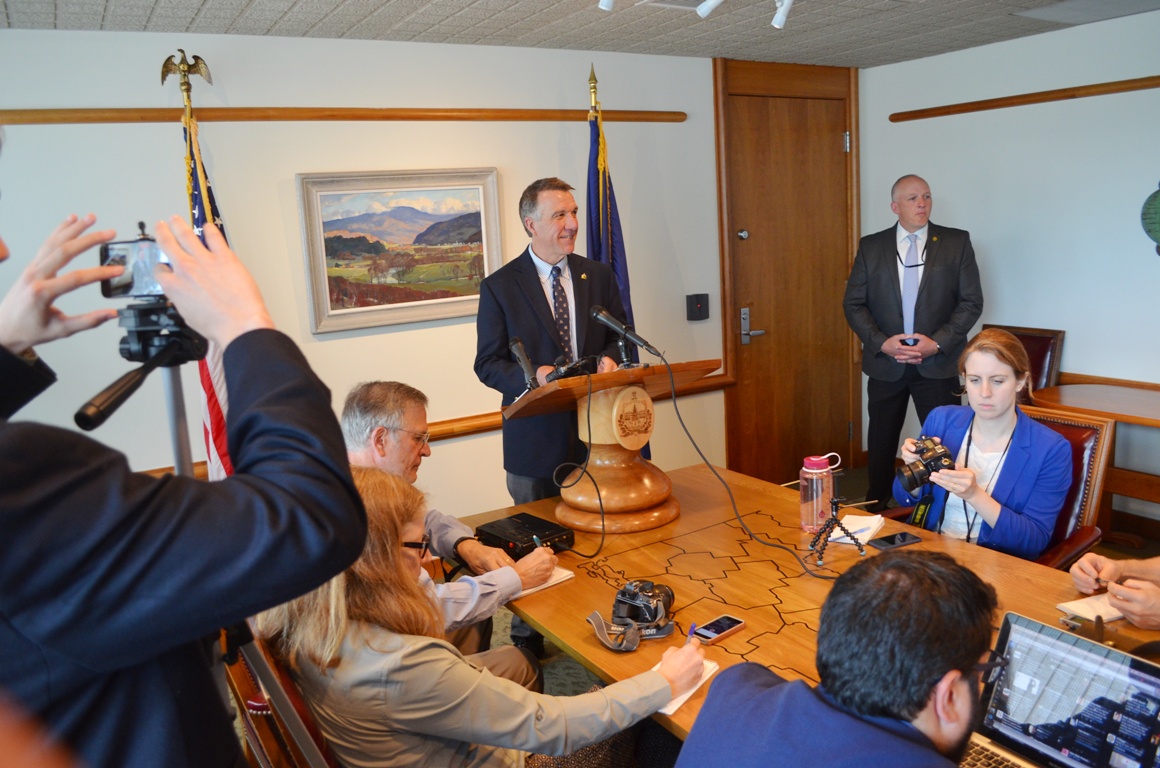
by Timothy McQuiston Vermont Business Magazine At his weekly press conference, Governor Phil Scott announced the he expected to announce a new chair of the Public Service Board this week, as James Volz's term is expiring on the utility regulatory panel. He also said he had signed the racial justice bill (H308) into law. He also added that talks over S22, marijuana legalization, were progressing and while he had already vetoed the bill, he could see a “path forward” to sign a bill during the June 21 veto session.
On the most contentious issue, that of a statewide teacher health insurance plan, he said he would veto both the budget and the property tax bills when they reached his desk. However, despite no new talks, he would not close down the government and would eventually sign both bills.
Scott had urged legislators during the session to roll the many local teacher insurance plans into one plan to save up to $26 million a year. He said the savings of about $75 million in premiums would be offset by $50 million put back into the plans to offset teacher out-of-pocket costs.
His mantra has been that this is “a once in a life-time opportunity” because of health insurance restructuring under the Affordable Care Act (Obamacare).
The governor said that while he would take the $26 million in sustained savings without changing the local collective bargaining process, he just didn’t see how it could get done.
“We don’t have to need government to do this,” he said. But with so many school districts, it was hard to imagine saving $26 million a year without a single, statewide teacher health insurance contract.
Already upwards of nine teacher contracts have been locally bargained. Scott said the employee share of the premiums in those plans is anywhere from zero to 20 percent. His plan would assume a 20 percent employ contribution to reach the savings he’s advocated.
But at the end of the day, ”If we must forego it, so be it.”
As for the budget and property tax stalemate, “We’ll make it right. We’ll get through this.” (See letter to legislative leaders below)
As for the new PSB chair, Scott said that all the candidates seem to share his opinion that opposes large-scale wind farms on Vermont mountains. He said that he did not ask the candidates directly that question and there is not a litmus test on the subject. As a candidate Scott called for a moratorium of such projects.
He supports the new PSB rules issued May 16 on sound levels, which will make it difficult to site new projects. The new rules basically state that the large turbines will have to be nearly a mile from the nearest home and at nightthey would not be able to raise noise levels inside that home.
Regulators said their priority was the health of potential neighbors to the wind farms.
"I think we'll have less industrial wind on our ridgelines (under the new rules)," Scott said.
Meanwhile bill, H308, aims to address racial disparities in the criminal and juvenile justice system.
The newly signed law creates an advisory panel charged with providing recommendations to address racial disparities in statewide criminal and juvenile justice. Further, it drives the development of a strategy to address racial disparities within state systems of education, labor and employment, access to housing and healthcare, and economic development, and requires review of the model Fair and Impartial Policing Policy.
The bill was sponsored by Representatives Martin LaLonde, Thomas Burditt, Charles Conquest, Alice Emmons, Maxine Grad, Kiah Morris, and Janssen Willhoit.
"This bill is historic, crucial and powerful in its comprehensive approach to addressing racial disparities and implicit bias in our justice system,” Representative Morris of Bennington. “The coalition of Governor Scott's administrative team, the Attorney General's Office, Senate and House leadership, law enforcementand nearly three dozen agencies,is a testament to thewillingness to tackle some of our most difficult and damaging social justice challenges. As a bill sponsor, I thank Governor Scott for supporting this bill and responding to the clear voices of Vermonters whoagree thatjustice cannot wait."
Governor Scott signed the bill into law on Wednesday, May 31, 2017. Every state, local, county, and municipal law enforcement agency must adopt each component of new model fair and impartial policing policy by March 1, 2018. The remainder of the bill is effective upon passage.
“I am proud of our legislative leadership, bill sponsors, our administration, and the many community members who engaged in this process, as well as the multiple organizations that formed coalitions around this,” Morris said. “So many people gave voice to making sure that it was well-known that our brave little state has the courage to address these issues head-on. The fight for truth and justice tugs at the heart of all who live in our state, and we are now creating mechanisms to address how those racial disparities affect the life experiences of Vermonters of color for the betterment of all.”
For more information, visit http://legislature.vermont.gov/bill/status/2018/H.308.
Below are Governor Scott's prepared remarks on the teacher health plan:
“I want to reaffirm my commitment to Vermonters, and to continuing to push to ensure the state has the opportunity to realize up to $26 million in education savings a year for taxpayers.
When I learned of this opportunity in February – soon after the Vermont School Boards Association presented it to House and Senate leaders – (see a full timeline here) I felt it was had a lot of merit in light of our financial situation, and would bring lawmakers from all parties together to identify how to capture this once-in-a-lifetime savings opportunity.
But after engaging House members and leadership to look at this opportunity as they worked on the budget, it became clear it was not moving forward. Therefore, as the budget moved to the Senate, my Administration put forward a proposal for a statewide health plan.
Over these last several weeks, politics has unfortunately taken over, and legislative discussions have focused more on process than substance, and all the reasons not to act.
But, I want to remind everyone what we’re working for, why we must stop finding reasons to say “no,” and start getting to yes.
We have a crisis of affordability and I promised Vermonters I would listen to any idea to make Vermont more affordable, and that’s what I’m doing.
The change in school employee health plans presents a once-in-a-lifetime opportunity to make Vermont more affordable with up to $26 million in annual education savings – and we can do it without harming teachers or cutting programs.
But, we must have the tools in place to help school boards achieve these savings for taxpayers, and the legislature has not provided any policy mechanism to do so in the property tax yield bill. In fact, the budget uses rainy day money within the education fund to temporarily buy down residential property tax rates rather than using the savings available through this change in health plans for long-term savings. This is not a fiscally responsible approach to the budget.
Therefore, the budget will overpay school districts by $13 million this fiscal year, and that is why I will veto both the budget and the yield bills when they arrive on my desk. I know we can come to an agreement, and when we do, the budget – and Vermonters – will be better for it.
In my budget address, I shared the story of a woman who works at an area hospital. A full-time worker who, in her fifties, was moving back in with her parents, who, in their seventies, still couldn’t retire. She had to make this move because neither she, nor her parents, could afford their property taxes on their own.
We’ve all heard stories like this. Now that we can do something about it, we cannot let this woman – or thousands like her – down.”


