

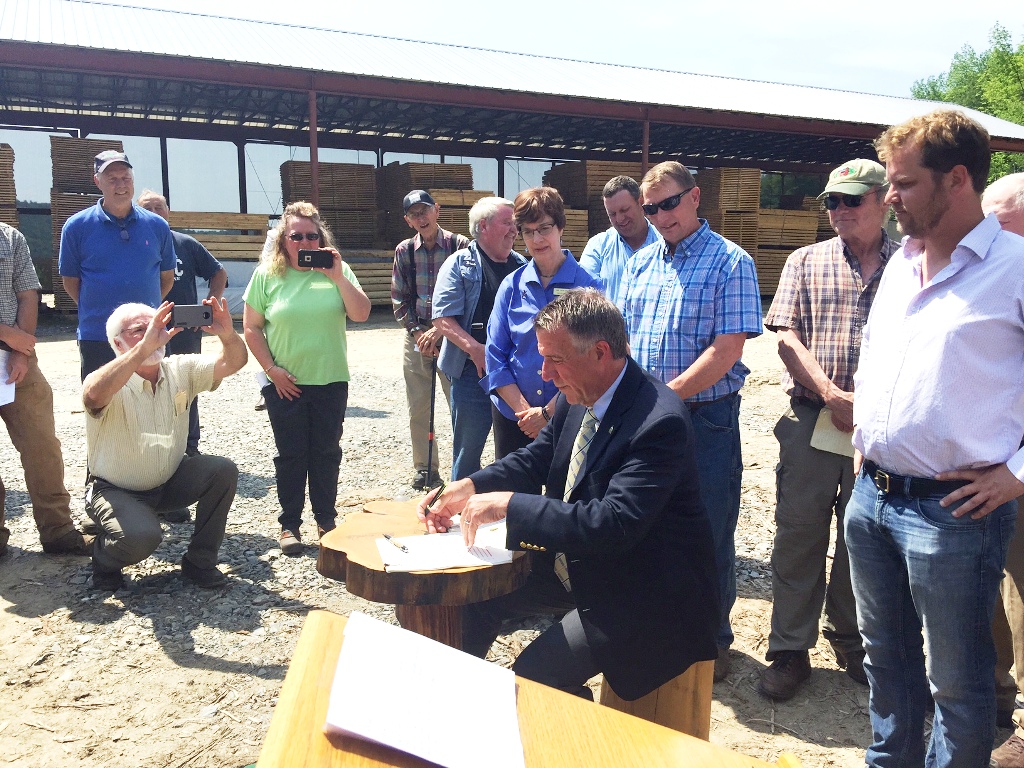
Governor Phil Scott Monday signed S34, an act relating to rural economic development, and H495, an act relating to miscellaneous agriculture and subjects at Goodridge Lumber in Albany June 12. VBM photo.
Vermont Business Magazine Governor Phil Scott on Monday signed S34, an act relating to rural economic development, and H495, an act relating to miscellaneous agriculture and subjects, at Goodridge Lumber in Albany. He said the bills highlight the state’s commitment to our agriculture sector and spurring economic growth for rural communities. These bills create a new exemption from the Vermont sales and use tax for specific types of machinery and equipment used in timber cutting, timber removal, and the processing of timber or other solid wood forest products intended to be sold at retail.
S34 reconvenes the Vermont Milk Commission, charging it with putting forward proposals to the Vermont Congressional delegation for inclusion in the 2018 Federal farm bill to stabilize our diary industry, an examination of how to bring down workers’ compensation rates for high risk industries, and the creation of a Rural Economic Development Initiative.
H495 provides a necessary clarification to existing statute that dyed diesel is not subject to Vermont’s sales and use tax, and creates a Water Quality Assistance program to assist timber harvesters in remaining compliant with water quality requirements.
“Vermont has been the only state in the northeast to charge sales tax on logging and processing equipment and parts – until now,” Scott said. “By reducing the cost of doing business, this change will give entrepreneurs more flexibility, as they carefully prioritize each precious dollar to keep their business and equipment moving, buildings heated, mills supplied with logs and Vermonters employed.”
S34 also attempts to reduce phosphorus water pollution, which manifests most acutely as contributing to blue-green algae blooms on Lake Champlain and other major water bodies.
Language in the bills states that it (a) provides assistance "to contract applicators, nonprofit organizations, and farms to purchase or use innovative equipment that will aid in the reduction of surface runoff of agricultural wastes to State waters, improve water quality of State waters, reduce odors from manure application, separate phosphorus from manure, decrease greenhouse gas emissions, and reduce costs to farmers. (b) The capital equipment assistance program is created in the Agency of Agriculture, Food and Markets to provide farms, nonprofit organizations, and custom applicators in Vermont with State financial assistance for the purchase of new or innovative equipment to improve manure application, separation of phosphorus from manure, or nutrient management plan implementation. (c) Assistance under this section shall in each fiscal year be allocated according to the following priorities and as further defined by the Secretary: (1) First priority shall be given to capital equipment to be used on farm sites that are serviced by custom applicators, phosphorus separation equipment providers, and nonprofit organizations and that are located in descending order within the boundaries of: (A) the Lake Champlain Basin; (B) the Lake Memphremagog Basin; (C) the Connecticut River Basin; and (D) the Hudson River Basin. (2) Next priority shall be given to capital equipment to be used at a farm site which that is located in descending order within the boundaries of: (A) the Lake Champlain Basin; (B) the Lake Memphremagog Basin; (C) the Connecticut River Basin; and (D) the Hudson River Basin. (d) An applicant for a State grant under this section to purchase or implement phosphorus removal technology or equipment shall pay 10 percent of the total eligible project cost. The dollar amount of a State grant to purchase or implement phosphorus removal technology or equipment shall be equal to the total eligible project cost, less 10 percent of the total as paid by the applicant, and shall not exceed $300,000."
Several legislators, loggers, farmers, and industry stakeholders, including the Vermont Forest Products Association and Vermont Traditions Coalition came to show support for the positive impacts these bills will have on the rural economy.
"This is a relatively small, but significant step in supporting a critically important segment of our economy – a step that will help loggers, foresters and landowners maintain healthy working forests and the many benefits they provide," saidForests, Parks, and Recreation Commissioner Michael Snyder. “We appreciate the Governor's leadership and the legislative support for this effort, and hope to build on it as we continue to work toward a sustainable, robust and modern forest economy that works for Vermont."
“We will continue to focus on enhancing the opportunity to operate, grow or invest in forest and farm-based businesses in Vermont,” said Scott. “I want to thank the Senate and House Agriculture Committees, the House Commerce and Economic Development Committee, the House Ways and Means Committee, the Senate Finance Committee, and all legislators who worked on these two bills.”
Click here for more information on the sales and use tax exemption,and to view S34 visit http://legislature.vermont.gov/bill/status/2018/S.34, and http://legislature.vermont.gov/bill/status/2018/H.495 to view H495.
Source: Governor 6.13.2017.