

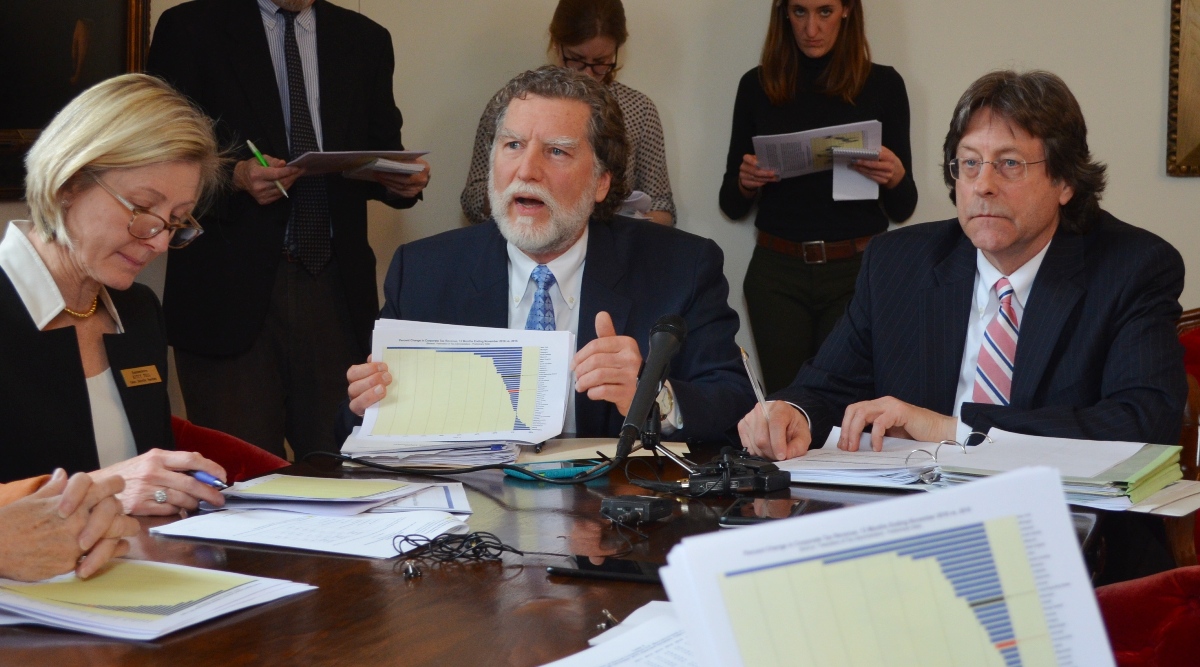
Economists Tom Kavet and Jeff Carr explain to the Emergency Board Thursday how slumping corporate profits have sent tax revenues below projections by $24.6 million in the current fiscal year. VBM photos.
by Timothy McQuiston Vermont Business Magazine State economists downgraded on Thursday Vermont’s current fiscal year tax revenue expectations as well as next year’s (FY 2017 & FY 2018) and largely blamed the suddenly moribund Corporate Income tax. The Corp tax is below its target by over $9 million halfway through FY17. Economists Tom Kavet and Jeff Carr expect the total shortfall for the year to be $24.6 million for the state’s General Fund when all factors are figured in. Governor Phil Scott wondered whether even that was too rosy a projection.
Kavet and Carr made their presentation to the Emergency Board, which hears the revenue review at least twice a year. The current lowering of expectations is based on the revenue numbers the economists presented last July. January adjustments, one way or the other, are typical.
The state will use some one-time funds to get $10 million (Tobacco), an already planned cut of another $10 million and then take about $4 million from the Human Services caseload reserves. There is also an expected surplus in the Medicaid budget, but the administration will not know how much that will be until the end of the fiscal year on June 30.

The Emergency Board, from left, Senator Jane Kitchel, Danville, Appropriations; Representative Janet Ancel, Calais, Ways & Means; Governor Phil Scott; Senator Ann Cummings, Montpelier, Finance; Representative Kitty Toll, Danville, Appropriations. Immediately to the governor’s left is Administration Secretary Susanne Young. VBM photos.
While the Personal Income tax, the state’s most important revenue source, has come around of late and is finally running slightly ahead of projections and ahead of actual revenues from last year.
But the Corporate and the Sales Tax are both behind. The Corp tax is not expected to rebound at this point.
In assessing a slumping of corporate tax returns, Kavet wrote in his report that: “Complex corporate accounting issues and volatile corporate profits have led to both higher refunding activity and lower tax liabilities in FY17. Most of the refunding has yet to be issued, but is expected to be paid in the first three months of 2017, and will result in about 1.7% less (-$24.6 million) FY17 G-Fund revenue than projected in July of 2016. Reduced future liabilities will lower G-Fund revenues in FY18 by about 0.5% (-$7.7 million).
The other major tax funds are also expected to fall short this year (Transportation -$3.2 million and Education -$0.4 million), while next year Transportation is expected to run -$2.3 million lower than the previous target and Education is expected to show a slight gain of $0.7 million.
The governor is skeptical that just corporate profits are the problem, despite economist assertions that if the Corp Tax is taken out of the equation the revenues would be ahead of projections.
“I’m concerned about economic activity,” Scott said.
 Governor Scott listens to a question from VPR’s Bob Kinzel (far right) following the E-Board meeting Thursday morning. Also listening are, from left, WPTZ-TV’s Stewart Ledbetter, Administration Secretary Young and VTDigger’s Anne Galloway. VBM photos.
The Sales Tax is also behind projections. It is the second most important revenue source. It is nearly -$2 million behind current fiscal year projections and is even slightly behind what it took in by this time last year.
Rooms & Meals taxes have continued to perform ahead of FY17 projections and ahead of last year’s revenues.
“The good news is that it appears wages are going up,” the governors said.
But he remains “concerned.”
“We want Vermonters to make more money, but we need to ensure that our businesses can survive and that they prosper as well,” Scott said.
“We have a shrinking workforce, which leads to some of our low unemployment rates. There are less people here, less people working. That artificially restricts the unemployment rate,” Scott said (the Labor Force is the denominator in the unemployment rate equation, so as it drops it lowers the rate itself.)
The economists suggested that the drop in revenues were caused by an increase in wages, which would be typical of the second phase of an economic recovery. The first phase is as corporations recover and show profits, they take a wait-and-see approach to the economy and do not hire right away, which leads to profits. They then start hiring, which reduces profits, but leads to higher wages. This can be surmised from the increase in Personal Income taxes recently also.
Of course, the economists admitted, a lowering of corporate profits is sometimes a precursor to a recession.
Jeff Carr admitted that we are now in the eighth year of economy recovery from the Great Recession. The recovery “is getting a little long in the tooth,” Carr said, meaning that recoveries typically have peaked by this point.
He also noted that this recovery has been both longer and slower, which might indicate that it has not yet peaked.
The economists do not see a recession on the horizon. The financial markets also have been doing well.
The governor said there is still much information to assess before he can make a full determination of the current state of the economy.
“With such a fragile economy and with such small changes in numbers can alter things is a severe way. And I would like to take a look and see whether this is sustainable or not and whether it is growing and trending in the right direction. My feeling still is that Vermonters are still struggling. We’re dealing with this crisis of affordability and we need to grow the economy in order to make it work for everyone. And that includes our businesses. We need them to prosper.”
A downturn by one large company could have a major impact on the state. Already, the largest corporate taxpayers are significantly down from where they were a year ago.
Governor Scott will present his budget message to the Legislature on Tuesday.