

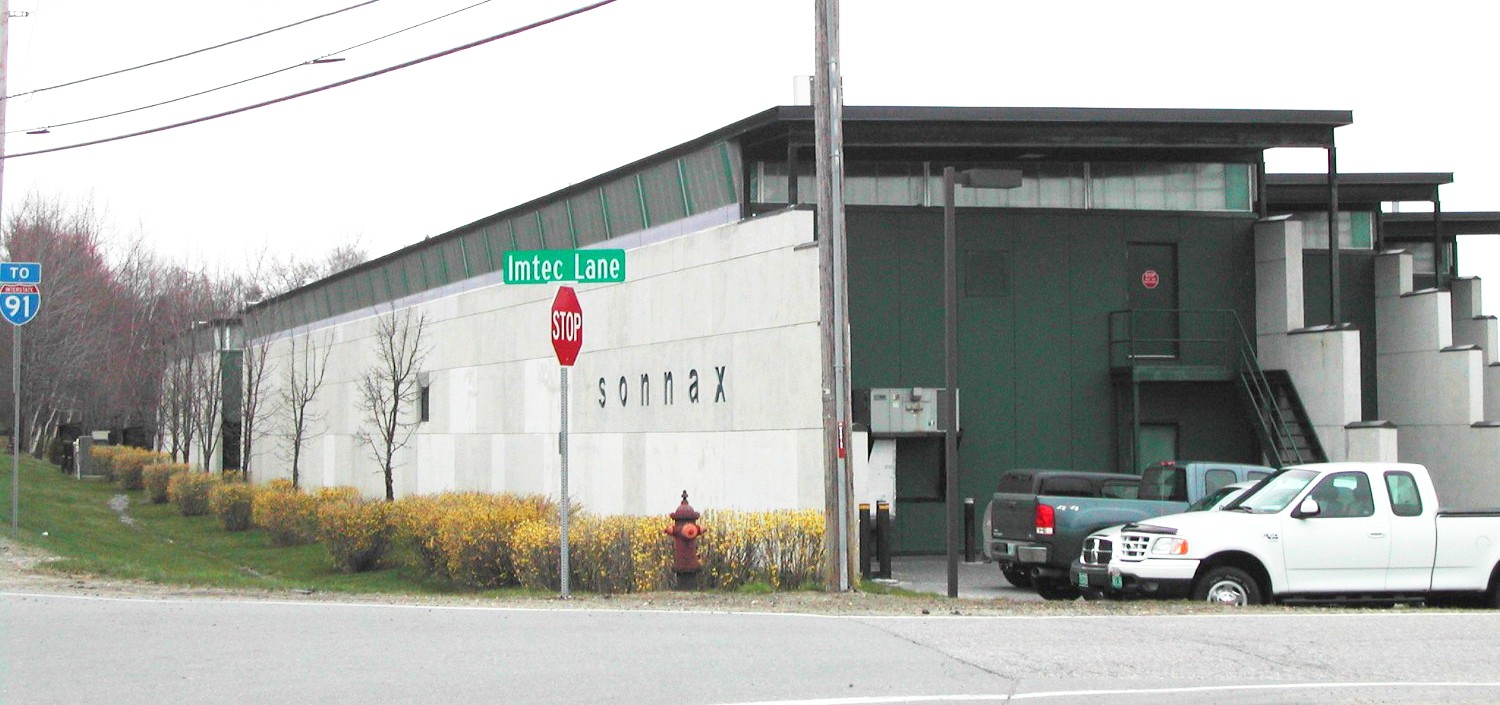
by Timothy McQuiston Vermont Business Magazine The US Department of Labor issued a press release this morning that says it is suing the principals of one of Vermont's fastest-growing companies, Sonnax Industries, Inc, of Bellows Falls. The suit involves the fiduciaries of a Vermont employee stock ownership plan for violations of the Employee Retirement Income Security Act alleging that First Bankers Trust Services, Inc’s 2011 purchase of the company on behalf of the ESOP from its two previous owners caused the plan to suffer sizable financial losses.
Named in the suit (filed with the US District Court District of Vermont December 28, 2016) are Sonnax, a supplier of automotive drivetrain products; Tommy Harmon, its president and chief executive officer; Frederick Fritz, a board member with substantial company control; and First Bankers, headquartered in Quincy, Illinois. Sonnax, Harmon and Fritz hired First Bankers in 2010 as an independent fiduciary to advise the ESOP on whether, and at what price, to purchase shares of Sonnax from Harmon and Fritz. All defendants are fiduciaries of and parties in interest to the ESOP.
The DOL complaint says, in part, "First Bankers caused the ESOP to overpay for Sonnax stock by millions of dollars." And DOL maintains that Sonnax, Harmon and Fritz knew it was too high, "or should have known."
In an email exchange withVermont Business Magazine, Harmon said: "We believe that the claims asserted by the US Dept. of Labor against us are without merit.During the process of selling the company to the ESOP, Sonnax, Rick Fritz and I were represented by experts in ESOP transactions and followed their advice throughout the entire process.We are confident that we properly and fairly executed this transaction and that no losses were incurred by the ESOP. In fact, since the creation of the ESOP six years ago, Sonnax has experienced solid growth and created substantial value for all of our employee owners in the ESOP.
"We will vigorously defend ourselves and Sonnax in this matter. We are confident that the facts will support our position and that we will prevail in this action."
An ESOP is a type of retirement plan that is permitted to invest some or all of its assets in employer stock. Participants’ benefits depend on the ESOP buying and selling stock for fair market value, so the department intends to make certain that:
- The price an ESOP pays for the stock reflects its true market value.
- Those retained to advise an ESOP about the stock purchase fulfill their fiduciary duties under ERISA.
- Those who sell their shares to an ESOP do not receive a windfall.
 Sonnax tooling area. VBM file photos.
On January 3, 2011, the company purchased all of Harmon’s and Fritz’s stock shares for $48.8 million and issued new shares simultaneously which were sold to the ESOP for $10 million. The department’sEmployee Benefits Security Administration investigated and found that First Bankers’ valuation that justified the sales was flawed and its representation of the ESOP during negotiations deficient, resulting in a significant inflation of the purchase price.
According to Vermont Business Magazine, Sonnax had revenue of $45.8 million in 2011 and $65.7 million in 2016, with 179 employees in Vermont and 231 system-wide. Sonnnax was named a Best Places to Work in Vermont in 2012 and 2014.
In its suit, the department alleges that the defendants violated ERISA’s prohibited transaction and fiduciary duty provisions. It further alleges First Bankers:
- Failed to protect the ESOP in connection with the plan’s purchase of Sonnax stock from Harmon and Fritz.
- Relied on a flawed valuation of the stock.
- Did not prudently investigate the transaction’s merits.
- Purchased highly leveraged Sonnax stock for far more than fair market value, with the aid and knowledge of Sonnax, Harmon and Fritz.
Sonnax, Harmon and Fritz knew that First Bankers’ work was flawed yet failed to ensure that First Bankers fulfilled its fiduciary duties, the DOL complaint states. They also failed to prevent the ESOP’s purchase at what they knew or should have known was an inflated price, and participated knowingly in First Bankers’ fiduciary breaches and otherwise failed to comply with their own fiduciary duties.
“The department alleges that the defendants breached their fiduciary responsibilities to act solely in the interest of the plan and its participants with care, skill, prudence and diligence, and solely in accordance with the plan’s documents as required by law. Instead, they placed their own interest above those of the plan’s participants who put their trust in the plan, its trustee and other fiduciaries,” said Susan Hensley, EBSA’s regional director in Boston.
“The alleged actions taken by the defendants improperly disadvantaged the ESOP and its participants. We’ve filed this suit so that the losses are restored to the plan and other corrective action will be taken for the benefit of the participants,” said Michael Felsen, the department’s regional solicitor in New England.
The lawsuit asks the court to:
- Order the defendants to restore to the ESOP all losses incurred as a result of their fiduciary breaches, prohibited transactions and other violations for which they are liable plus appropriate lost earnings.
- Require them to disgorge any and all plan assets obtained by them as well as any and all profits earned by them from those assets.
- Enjoin them from serving as fiduciaries, trustees or service providers for any ERISA-covered plan.
- Enjoin them from future ERISA violations.
- Enjoin First Bankers Trust Services from receiving any benefits from its indemnification agreements with Sonnax that violate ERISA.
The EBSA’s Boston Regional Office investigated the case, and senior trial attorneys Nathan P. Goldstein and Gail E. Glick and trial attorney Niamh E. Doherty in the department’s Regional Office of the Solicitor in Boston are litigating. Workers, retirees and employers may contact EBSA toll free at 866-444-3272 to speak with a benefits advisor, or through https://www.dol.gov/agencies/ebsa/about-ebsa/ask-a-question/ask-ebsa.
In an email exchange with Vermont Business Magazine, DOL spokesman Ted Fitzgerald said:
"The violations alleged in the complaint stem from the transaction: the sale of the stock to the ESOP.
"The complaint alleges that the defendants’ violations resulted in the ESOP overpaying for the company.
"The complaint asks the court to order the Defendants, First Bankers Trust Services, Inc. (the Independent Fiduciary for the transaction), Sonnax Industries, Inc. , Harmon and Fritz to restore the overpayment and all losses incurred as a result of their violations, as well as other corrective actions listed in the news release and complaint.
"I refer you to the complaint for details.
"The defendants are aware of the suit."
Well known Vermont ESOPs include King Arthur Flour (1996) in Norwich and Gardener's Supply (1987) in Burlington.
Paul Millman, founder of Chroma Technology, which also is off Imtec Lane in Bellows Falls and a neighbor with Sonnax, said there "seems to be an overstatement of value."
Millman said, "My understanding is there's a question of collusion with the fiduciary." He added that he had no more information than that presented in the DOL complaint.
Millman said he was disappointed to learn of the DOL suit. He knows many employees there and Harmon, but has not talked to him about the DOL action.
Chroma, which designs and manufactures optical filters, also is an expanding, home-grown company that is employee owned, but not an ESOP.
Millman said his company uses a stock bonus plan, but is considering going to an ESOP. Unlike many employee-owned companies, Millman's started out as employee owned.
Chroma did $30.1 million in sales in 2016. It received approval in December 2016 tobuild a 36,800-square-foot addition to double its space at a cost of up to $20 million.
CHRONOLOGY OF EVENTS (as described in DOL complaint)
"11. In late 2009 or early 2010, Harmon and Fritz decided to explore selling their
combined 100% ownership stake in Sonnax. They initially tried to sell the Company to
strategic buyers or private equity. However, they received little interest, and the few
initial indications of interest they did receive set out prices below the value Harmon and
Fritz believed Sonnax to be worth. Harmon and Fritz eventually decided to explore the
possibility of selling to an ESOP. In or around August 2010, Harmon contacted his
outside counsel who referred him to Steiker, Fischer, Edwards & Greenapple, P.C.
("Steiker"), a law firm specializing in ESOPs. Steiker recommended bringing its
affiliated firm, SES Capital Advisors, Inc., onboard as a financial advisor to Harmon and
Fritz. Harmon and Fritz agreed, and hired SES and Steiker (collectively, "SES") as its
financial and legal advisor.
"12. Harmon and Fritz estimated the equity value of the Company to be in the
range of $48 to $60 million. Privately, SES expressed misgivings about this range. In an
internal email in September 2010, SES stated "there is a lot of risk attached to [Sonnax]
achieving its projections." SES concluded that Sonnax was likely worth about $40
million or $44 million, depending on whether two affiliated real estate LLCs (the
"LLCs") were included in the deal. Based on internal discussions, SES advised Harmon
and Fritz that a $40 to $42 million price range (excluding the LLCs) was "highly likely,"
a $42 to $48 million was "somewhat likely," and anything much above $50 million
would subject Harmon and Fritz to liability as "ERISA fiduciaries."
"13. Harmon, Fritz and SES wanted to finalize the deal by the end of calendar year
2010 and worked quickly to hire a trustee to negotiate on behalf of the ESOP. SES and
First Bankers frequently worked together. On October 4, 2010, SES contacted First
Bankers about becoming the ESOP trustee. SES informed First Bankers that Harmon and
Fritz were seeking a price in the range of $50 to $55 million, and that they intended to
use Stout, Risius, Ross ("SRR") to value the Company on behalf of the trustee. SES
cautioned First Bankers that they were in a "horse race with private equity," so they
would need to work quickly to get a deal done. First Bankers expressed interest and
agreed to use SRR and work quickly. Harmon and Fritz selected First Bankers as
Trustee.
"14. On October 12, 2010, SES made the following offer to First Bankers on
behalf of Harmon and Fritz: the Company would (a) purchase (or "redeem") Harmon's
and Fritz's stock for $55 million (the "Redemption Transaction"), financed by a bank
loan and promissory notes to Harmon and Fritz; and (b) concurrently issue new shares,
100% of which would be sold to the ESOP for $10 million (the "ESOP Purchase")
(collectively, "the 2011 Transaction").
"15. SES followed-up with SRR a few weeks later to inform it that Harmon and
Fritz would need a counteroffer soon. First Bankers quickly arranged a meeting with
SRR, and First Bankers' outside counsel, Katten Muchin Rosenman LLP ("Katten") for
November 2, 2010. In preparation therefor, SRR provided First Bankers a cursory
valuation of the Company (the "Initial Guidance").
"16. Only a small subset of First Bankers' committee designated to approve the
Sonnax deal actually attended the November 2 meeting. At the meeting, SRR observed that Harmon's and Fritz's $55 million asking price was based on financials that did not
account for rent liability to the LLCs, which LLCs the parties had decided not to include
in the deal. First Bankers made a counteroffer of $49 million, which was determined in
part by simply factoring the LLC rent liability into Harmon's and Fritz's asking price.
Harmon and Fritz quickly accepted.
"17. SES had suggested that Harmon and Fritz hold off on formally retaining First
Bankers until after they received a counteroffer from First Bankers and SRR. On
information and belief, Sonnax formally retained First Bankers as Trustee only after the
transaction price was set at $49 million pursuant to an engagement letter signed by
Harmon with an effective date ofNovember 1, 2010. The engagement letter set forth the
duties of First Bankers as Trustee. Among other things, First Bankers "ha[ d] complete
discretionary responsibility with respect to the Transaction ... [and] for the acquisition of
employer securities for the Plan." The engagement letter set First Bankers' compensation
for the 2011 Transaction at a one-time fee of $30,000.
"18. Negotiations over the subsequent few months largely concerned other terms of
the deal, such as Harmon's employment agreement. If First Bankers or its team
questioned anything, SES was prepared to push back. For instance, on November 11,
2010, First Bankers' attorney, Katten, contacted SES to inquire about tax issues on a
separate deal the two were negotiating. SES responded that "[New York City] tax
lawyers [such as Katten] have a unique habit of creating issues where none exist .... [I]f
there is a real[] problem with your tax colleague on any of this, we are really going to
have an issue not only for this deal but for future deals." In subsequent internal emails, SES stated that they would "need to figure out [] whether to pull Katten out of the
Sonnax deal."
"19. On December 22, 2010, SRR provided a draft valuation report (the "Draft
Report") to First Bankers that included new analysis and significantly greater detail than
it had provided in the Initial Guidance. First Bankers left the transaction price
unchanged, except for a $200,000 reduction to $48.8 million based on a recent
distribution to Harmon and Fritz. First Bankers informed SES that it was giving final
approval to the deal.
"20. On December 27, 2010, Sonnax formally adopted the ESOP with an effective
date of October 1, 2010.
"21. On January 3, 2011, SRR provided First Bankers with a fairness opinion
which concluded the $48.8 million Redemption Transaction price and the $10 million
ESOP Purchase price were fair. On that same day, the Company redeemed 100% of its
outstanding shares from Harmon and Fritz for $48.8 million, and sold 100% of newly
issued shares to the ESOP for $1 0 million.
"22. The Company financed the Redemption Transaction through $15 million in
cash provided pursuant to a bank loan, and $33.8 million in subordinated promissory
notes to Harmon and Fritz. As part of the Redemption Transaction, Harmon and Fritz
also obtained stock appreciation rights and warrants (described below). The Plan
financed the ESOP Purchase through a $10 million promissory note financed and backed
by the Company.
"23. On January 10, 2011- a full week after the 2011 Transaction- SRR
completed its final valuation report of the Company (the "Final Report"). The Final Report set forth a new methodology for valuing the Company and different figures than
those in either the Draft Report or Initial Guidance. The $48.8 million Redemption
Transaction and $10 million ESOP Purchase prices, however, remained the same.
"24. For work performed subsequent to the 2011 Transaction, First Bankers
received, among other compensation, an ongoing asset-based fee based on a percentage
of the assets held by the ESOP."
FAILURE TO OBTAIN ADEQUATE
CONSIDERATION FOR THE ESOP'S PURCHASE
"25. The 2011 Transaction was approved on behalf of the ESOP by First Bankers,
who was hired as Trustee solely to represent the interests of the ESOP and its participants
and beneficiaries.
"26. First Bankers had a duty to make certain that its reliance on SRR's advice was
reasonably justified under the circumstances. First Bankers was obligated to read SRR's
valuation reports, understand the reports, and identify, question and test SRR's
underlying assumptions. In addition, First Bankers was obligated to verify the accuracy
of the data SRR relied on, and to ensure that SRR's conclusions were both internally
consistent and consistent with the data provided. First Bankers failed to comply with
these duties under ERISA for, inter alia, the following reasons.
"27. SRR valued the Company using two methodologies standard in the appraisal
industry: the Discounted Cash Flow ("DCF") and the Guideline Company methods. The
DCF method has three primary components: (1) cash flow projections; (2) a discount
rate; and (3) terminal value. Terminal value refers to the cash flow a company is
expected to generate in perpetuity expressed as a present value. A company's terminal
value has an implicit rate of growth. That is, the present value of the company's cash flow in perpetuity factors in a rate at which the company and its cash flow will grow. A
common terminal growth rate is between 2 and 4%.
"28. SRR's implied terminal growth rate was over 8%. It is highly unlikely that a
company could grow in perpetuity at a rate that is so far beyond a common terminal
growth rate, and well beyond even the historic U.S. gross domestic product growth rate.
By contrast, for its valuation, SES used a growth rate of 4%. Accordingly, First Bankers
knew or should have known that the terminal value on which it based its price was
fundamentally flawed. On information and belief, however, First Bankers never
questioned this assumption. In so doing, First Bankers caused the ESOP to overpay for
Sonnax stock by millions of dollars.
"29. First Bankers further erred in relying on SRR's valuation because it adopted
aggressive growth projections that were inconsistent with Sonnax's historical
performance. Like terminal value, growth projections are another key component in the
valuation of a company. SRR obtained five years of growth projections from Sonnax,
Harmon, Fritz and SES (as it did much of the other underlying financial information) and
simply plugged the projections into its valuation model. These projections, however, are
flawed for a number of reasons. The projections forecasted robust and steadily increasing
revenue and margin growth for Sonnax. Sonnax based these projections on five historical
years surveyed. However, each of the five years forecasted was higher than Sonnax's
best historical year, which itself was significantly higher than any of the other four
historical years. And the steadily rising growth assumed in the projections is undermined
by the erratic and often declining growth in the five historical years surveyed. In fact,
SES itself privately noted that "there is a lot of risk attached to [Sonnax] achieving its projections." Like SES, First Bankers knew or should have known that the projections
were overly aggressive and flawed. Instead, it relied on the flawed projection to
determine the transaction price, and thereby caused the ESOP to overpay by, on
information and belief, millions of dollars.
"30. As part ofthe 2011 Transaction, Harmon, Fritz and key management
personnel received a substantial number of warrants (which grant the right to purchase
Sonnax shares in the future at a set price) and stock appreciation rights ("SARs"). When
exercised or earned, warrants and SARs dilute current ownership of a company. This
dilutive effect must be taken into account when determining the fair market value of a
company. SRR never properly accounted for the dilutive effect the warrants and SARs
provided to Harmon, Fritz and other management as part of the 2011 Transaction would
have on the ESOP's ownership of the Company. For instance, SRR's Final Report only
accounts for the impact of the bank loan and promissory notes on Sonnax's fair market
value. It makes no mention, however, of the impact of the warrants and SARs. In so
doing, SRR' s valuation further inflated the value of Sonnax stock and caused additional
damages to the ESOP.
"31. In light of the fundamental valuation flaws and woefully deficient
investigation and negotiation described above, First Bankers' reliance on SRR's
valuation was unreasonable and its representation of the ESOP inadequate. As a result,
First Bankers caused the ESOP to significantly overpay by millions of dollars for highly
leveraged Sonnax stock, thereby failing to loyally and prudently represent the interests of
the ESOP and its participants and beneficiaries.
"32. For their part, Sonnax, Harmon and Fritz were the Plan Administrators who
also had selected and could remove First Bankers as Trustee. In this capacity, Sonnax,
Harmon and Fritz were obligated to monitor the activities of First Bankers, to remove
First Bankers as Trustee ifthey knew, or should have known, that First Bankers was not
acting in compliance with its fiduciary duties under ERISA, and to otherwise comply
with their own ERISA fiduciary duties.
"33. In light of the fundamental valuation flaws and woefully deficient
investigation and negotiation described above, Sonnax, Harmon and Fritz knew or should
have known that the work performed by their co-fiduciary First Bankers was flawed, and
they knowingly participated in such work. For instance, Sonnax, Harmon and Fritz knew
or should have known First Bankers was relying on aggressive and overly optimistic
projections which they had provided and even their own advisors acknowledged were
unrealistic. Sonnax, Harmon and Fritz also knew or should have known about, and
indeed participated in, First Bankers' improper investigation and negotiation which, inter
alia, were done in haste and not in good faith, using the appraiser that SES desired, and
without meaningfully reducing Harmon's and Fritz's inflated asking price, which
Harmon and Fritz knew or should have known was too high. In so doing, Sonnax,
Harmon and Fritz failed to ensure that First Bankers fulfilled its fiduciary duties, failed to
remove First Bankers as Trustee, failed to prevent the ESOP's purchase of shares at a
price they knew, or should have known, was inflated, participated knowingly in First
Bankers' fiduciary breaches, and otherwise failed to comply with their own fiduciary
duties to act prudently and solely in the interests of the ESOP participants and
beneficiaries."
RELATED:
Sonnax owner sells to managers
Bellows Falls-based Sonnax Industries named to SBA 100 for growth
Source: MONTPELIER, Vt. – The US Department of Labor 1.5.2017